Connect with us

Business

As Americans lose faith in higher education, Gen Z turns to skills and blue-collar jobs

Published

on


Gen Z was raised on an American Dream that’s slowly disappearing from view. They followed in the footsteps of their parents, who were once told that excelling in school and landing a spot at a top college will lead to success, a house, and a six-figure career—but broadly speaking, that’s no longer the case. People are pointing fingers at universities to ease costs and skill students to find jobs.

Seven in 10 Americans say the U.S. higher education system is heading in the wrong direction, according to recent data from the Pew Research Center. It’s up from only about 56% of Americans who said the same in 2020, signaling growing discontent over tuition costs and the ability of colleges to set pupils up for gainful employment. 

Simultaneously, the study notes, the Trump administration is cracking down on elite U.S. universities. Earlier this month, nine colleges—including the likes of Brown, Dartmouth, MIT, University of Virginia, and Vanderbilt—were sent a document titled “Compact for Academic Excellence in Higher Education.” It asked schools to pledge allegiance to conservative values and policies, or risk losing their federal funding. The policies instruct colleges to prohibit identities such as gender or race from being considered in admissions decisions, give free tuition to students pursuing “hard sciences,” maintain bipartisan neutrality, and cap international undergraduate enrollment at 15%.

Colleges have since pushed back, with Harvard even taking the issue to court. But others didn’t come out unscathed; a president from the University of Virginia resigned from the pressure, and other schools like Brown and Columbia chose to strike deals with the White House. 

While universities are starting to fess up to their shortcomings, they argue the government’s interference could threaten America’s academic freedom. And as it turns out, disappointment over the state of American colleges transcends party lines. About 77% of Republicans and 65% of Democrats say U.S. higher education is heading in the wrong direction, up from 66% and 49% in 2020, respectively. The real culprits of America’s education problem may be skyrocketing tuition and lack of entry-level opportunities—pushing new Gen Z graduates into blue-collar careers. 

Tuition costs are soaring and entry-level jobs are disappearing

Americans have a bone to pick with colleges, as Gen Z graduates are leaving school with crushing student loans and a lack of job opportunities. 

Around 55% of Americans gave colleges and universities poor ratings when it comes to prepping students for well-paying jobs in the current labor market, according to the Pew data. About 52% also rate the schools poorly in giving financial assistance to students who need it, and 49% say colleges aren’t adequately developing pupils’ critical thinking and problem-solving skills. This is having a real-time impact on Gen Z’s careers.

With tuition costs soaring, many young people are forced to take on debt—or ask their parents to do the same—in order to attend school. The average Gen Zers carries more than $94,000 in personal debt, according to a Newsweek poll, compared to millennials owing roughly $60,000 and Gen Xers needing to pay $53,000. Earlier this month it was reported that Gen Z had the steepest annual drop of any age group since 2020. Their average FICO credit score slipped three points to 676, according to a report—39 points lower than the national average of 715.

Gen Z could pay off their dues by landing high-paying jobs, but those are in short supply, too. AI is increasingly automating roles traditionally reserved for entry-level workers, or those fresh out of college, locking Gen Z out of stepping-stone jobs essential for career success. As of July, 58% of students who graduated college in the past year were still trying to find stable work, compared to 25% of millennials and Gen Xers who faced the same issue. And they’re losing prospects at some of the most sought-after employers; hiring for new graduates among the 15 largest tech companies fell by over 50% since 2019, according to VC firm SignalFire. 

The Gen Z blue-collar wave

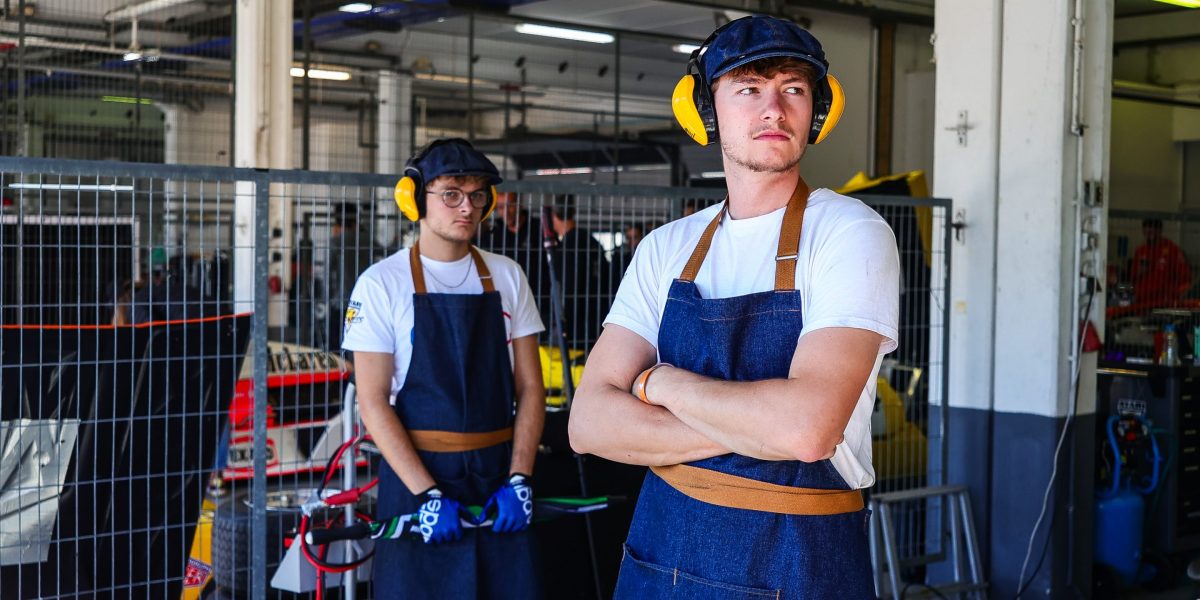
Gen Z is searching for professional refuge as AI continues to sweep corporate workplaces—and many have found shelter in blue-collar work. 

About 78% of Americans have noticed a rising interest in trade jobs among young adults, according to a 2024 Harris Poll survey for Intuit Credit Karma. Many of these roles, from carpenters to electricians, offer the ideal of being your own boss while making good pay. It gives Gen Z workers a chance to skip college and still make six-figures without being burdened by student loans.

Enrollment in vocational-focused community colleges also jumped 16% last year, reaching the highest level since the National Student Clearinghouse began tracking the data in 2018. And certain professions were catching young workers’ eye; there was a 23% surge in Gen Z studying construction trade from 2022 to 2023, and a 7% hike of participation in HVAC and vehicle-repair programs. Even more opportunities are on the horizon, as 3.8 million new manufacturing jobs are expected to open up by 2033, according to research from Deloitte and the Manufacturing Institute.

Even major business leaders are witnessing the trend first-hand. Ford CEO Jim Farley revealed his son didn’t follow in his C-suite footsteps, opting to instead work as a mechanic this past summer. He said his kid questioned why he even needs to go to college when he could take up a blue-collar job and be part of an “essential economy,” according to Farley. 

“Should we be debating this?” Farley recalled discussing with his wife, adding that it’s a conversation stirring in many American households. “It should be a debate.”


Source link

Continue Reading

Business

Macron warns EU may hit China with tariffs over trade surplus

Published

on


French President Emmanuel Macron warned that the European Union may be forced to take “strong measures” against China, including potential tariffs, if Beijing fails to address its widening trade imbalance with the bloc.

“I’m trying to explain to the Chinese that their trade surplus isn’t sustainable because they’re killing their own clients, notably by importing hardly anything from us any more,” Macron told Les Echos newspaper in an interview published on Sunday.

“If they don’t react, in the coming months we Europeans will be obliged to take strong measures and decouple, like the US, like for example tariffs on Chinese products,” he said, adding that he had discussed the matter with European Commission President Ursula von der Leyen.

Macron has just returned from a three-day state visit in China, where he pressed for more investment as Paris seeks to recalibrate its relationship with the world’s second-largest economy. France’s goods trade deficit with China reached around €47 billion ($54.7 billion) last year, according to the French Treasury. Meanwhile, China’s goods trade surplus with the EU swelled to almost $143 billion in the first half of 2025, a record for any six-month period, according to data released by China earlier this year.

Tensions between France and China escalated last year after Paris backed the EU’s decision to impose tariffs on Chinese electric vehicles. Beijing retaliated by imposing minimum price requirements on French cognac, sparking fears among pork and dairy producers that they could be targeted next.

‘Life or Death’

Macron said the US approach to China was “inappropriate” and had worsened Europe’s position by diverting Chinese goods toward the EU market.

“Today, we’re stuck between the two, and it’s a question of life or death for European industry,” Macron said, while noting that Germany — Europe’s biggest economy — doesn’t entirely share France’s stance.

In addition to Europe needing to become more competitive, the European Central Bank too has a role to play in strengthening the EU’s single market, Macron said, arguing that monetary policy should take growth and jobs into account, not just inflation, he said.

He also said the ECB’s decision to continue selling the government bonds it holds risks pushing up long-term interest rates and weighing on economic activity.

“Europe must — and wants to — remain a zone of monetary stability and credible investment,” Macron said.


Source link

Continue Reading

Business

What bubble? Asset managers in risk-on mode stick with stocks

Published

on


There’s a time when investments run their course and the prudent move is to cash out. For global asset managers who’ve ridden double-digit gains in equities for three straight years, that time is not now.

“Our expectation of solid growth and easier monetary and fiscal policies supports a risk-on tilt in our multi-asset portfolios. We remain overweight stocks and credit,” said Sylvia Sheng, global multi-asset strategist at JPMorgan Asset Management.

“We are playing the powerful trends in place and are bullish through the end of next year,” said David Bianco, Americas chief investment officer at DWS. “For now we are not contrarians.”

“Start the year with sufficient exposure, even over-exposure to equities, predominantly in emerging market equities,” said Nannette Hechler-Fayd’herbe, EMEA chief investment officer at Lombard Odier. “We don’t expect a recession in 2026 to unfold.”

Those assessments came from Bloomberg News interviews with 39 investment managers across the US, Asia and Europe, including at BlackRock Inc., Allianz Global Investors, Goldman Sachs Group Inc. and Franklin Templeton.

More than three-quarters of the allocators were positioning portfolios for a risk-on environment through 2026. The thrust of the bet is that resilient global growth, further developments in artificial intelligence, accommodative monetary policy and fiscal stimulus will deliver outsize returns in all fashion of global equity markets. 

The call is not without risks, including simply its pervasiveness among the respondents, along with their overall high degree of assuredness. The view among the institutional investors also aligns with that of sell-side strategists around the globe. 

Should the bullishness play out as expected, it would deliver a stunning fourth straight year of bumper returns for the MSCI All-Country World Index. That would extend a run that’s added $42 trillion in market capitalization since the end of 2022 — the most value created for equity investors in history. 

That’s not to say the optimism is without merit. The artificial intelligence trade has added trillions in market value to dozens of firms plying the industry, but just three years after ChatGPT broke into the public consciousness, AI remains in the early phase of development.

No Tech Panic

The buy-side managers largely rejected the idea that the technology has blown a bubble in equity markets. While many acknowledged some pockets of froth in unprofitable tech names, 85% of managers said valuations among the Magnificent Seven and other AI heavyweights are not overly inflated. Fundamentals back the trade, they said, which marks the beginning of a new industrial cycle. 

“You can’t call it a bubble when you’re seeing tech companies deliver a massive earnings beat. In fact, earnings from the sector have outstripped all other US stocks,” said Anwiti Bahuguna, global co-chief investment officer at Northern Trust Asset Management.

As such, investors expect the US to remain the engine of the rally. 

“American exceptionalism is far from dead,” said Jose Rasco, chief investment officer at HSBC Americas. “As artificial intelligence continues to spread around the globe, the US will be a key participant.” 

Most investors echoed the sentiment expressed by Helen Jewell, international chief investment officer of fundamental equities at BlackRock, who suggested also searching outside the US for meaningful upside.

“The US is where the high-return high-growth companies are, so we have to be realistic about that. But those are already reflected in valuations, and there are probably more interesting opportunities outside the US,” she said.

International Boom

Profits matter above all else for equity investors, and huge bumps in government spending from Europe to Asia have stoked estimates for strong gains in earnings.

“We have begun to see a meaningful broadening of earnings momentum, both across market capitalizations and across regions, including Japan, Taiwan, and South Korea,” said Wellington Management equity strategist Andrew Heiskell. “Looking into 2026, we see clear potential for a revival of earnings growth in Europe and a wider range of emerging markets.”

India is one of the most compelling opportunities for 2026, according to Goldman Sachs Asset Management’s Alexandra Wilson-Elizondo, global co-head and co-chief investment officer of multi-asset solutions.

“We see real potential for India to become the Korea-like re-rating story of 2026, a market that transitions from tactical allocation to strategic core exposure in global portfolios,” she said. 

Nelson Yu, head of equities at AllianceBernstein, said he sees improvements outside of the US that will mandate allocations. He noted governance reform in Japan, capital discipline in Europe and recovering profitability in some emerging markets.

Small Cap Optimism

At the sector level, the investors are looking for AI proxies, notably among clean energy providers that can help meet the technology’s ravenous demand for power. Smaller stocks are also finding favor.

“The earnings outlook has brightened for small-capitalization stocks, industrials and financials,” said Stephen Dover, chief market strategist and head of Franklin Templeton Institute. “Small-cap stocks and industrials, which are typically more highly leveraged than the rest of the market, will see profitability rise as the Federal Reserve trims interest rates and debt servicing costs fall.”

Over at Santander Asset Management, Francisco Simón sees earnings growth of more than 20% for US small caps after years of underperformance. Reflecting the optimism, the Russell 2000 Index of such equities recently hit a record high.

Meanwhile, the combination of low valuations and strong fundamentals makes health care one of the most compelling contrarian opportunities in a bullish cycle, a preponderance of managers said.  

“Health-care related sectors can surprise to the upside in the US markets,” said Jim Caron, chief investment officer of cross-asset solutions at Morgan Stanley Investment Management. “This is a mid-term election year and policy may at the margin support many companies. Valuations are still attractive and have a lot of catch up to do.”

Virtually every allocator struck at least a note of caution about what lies ahead. The top worry among them was a rekindling of inflation in the US. If the Fed is forced by rising prices to abruptly pause or even end its easing cycle, the potential for turbulence is high.

“A scenario — which is not our base case — whereby US inflation rebounds in 2026 would constitute a double whammy for multi-asset funds as it would penalize both stocks and bonds. In this sense it would be much worse than an economic slowdown,” said Amélie Derambure, senior multi-asset portfolio manager at Amundi SA. 

“The way investors are headed for 2026, they need to have the Fed on their side,” she added.

Trade Caution

Another worry is around President Donald Trump’s capriciousness, particularly when it comes to trade. Any flareup in his trade spats that fuels inflation through heightened tariffs would weigh on risk assets. 

Oil and gas producers remain unloved by the group, though that could change if a major geopolitical event upends supply lines. While such an outcome would bolster those sectors, the overall impact would likely be negative for risk assets, they said.

“Any geopolitical situation that can affect the price of oil is what will have the largest impact on the financial markets. Clearly both the Middle East and the Ukraine/Russia situations can impact oil prices,” said Scott Wren, senior global market strategist at Wells Fargo Investment Institute.

Multiple respondents flagged European autos as a “no-go” area for 2026, citing intense competitive pressure from Chinese carmakers, margin compression and structural challenges in the transition to electric vehicles. 

“Personally I don’t believe for a minute that there will be a rebound in the sector,” said Isabelle de Gavoty at Allianz GI. 

Outside of those worries, most asset managers simply believe that there’s little reason to fret about the upward momentum being interrupted — outside, of course, from the contrarian signal such near-uniform bullishness sends.

“Everyone seems to be risk-on at the moment, and that worries me a bit in the sense that the concentration of positions creates less tolerance for adverse surprises,” said Amundi’s Derambure.  


Source link

Continue Reading

Business

Trump says Netflix-Warner Bros. deal ‘could be a problem’

Published

on


President Donald Trump raised potential antitrust concerns for Netflix Inc.’s planned acquisition of Warner Bros. Discovery Inc., noting that the market share of the combined entity may pose problems. 

“Well, that’s got to go through a process, and we’ll see what happens,” Trump said when asked about the deal as he arrived at the Kennedy Center for an event, confirming that he has met Netflix co-CEO Ted Sarandos last week and complimenting the streaming company. “But it is a big market share. It could be a problem.”

The $72 billion deal would combine the world’s No. 1 streaming player with the No. 4 service HBO Max, which has raised red flags from antitrust regulators. 


Source link

Continue Reading

Trending

Copyright © Miami Select.