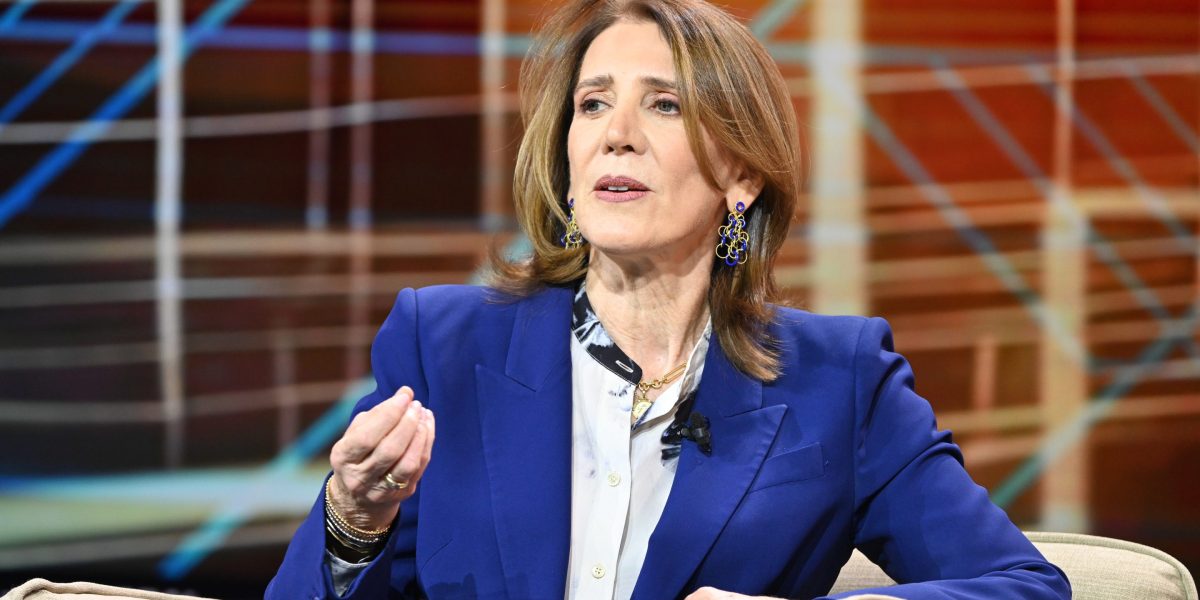
Good morning. Ruth Porat, Alphabet and Google’s president and chief investment officer, is a former longtime CFO who is strategically evaluating what’s needed for AI to drive economic uplift.
“I think we are living in an extraordinary time, and I think of it as a time where there are two speeds,” Porat said during a panel session at the Fortune Global Forum on Sunday in Riyadh, Saudi Arabia.
One speed, she explained, is the pace of change, breakthroughs, and scientific discovery. The other is slower—the pace of adoption.
“That’s the speed of adoption in a truly substantive way, so that each one of us can experience the economic uplift that AI offers,” Porat said. She added, “The upside from AI does require a fundamental rethink of every process.”
Porat noted that while working on chatbots can be useful because it gets organizations thinking about the AI journey, “it shouldn’t stop there.” The big question, she said, is: What does AI mean for my country and for my business?
Porat served as CFO of Alphabet and Google beginning in May 2015 and was promoted to president and chief investment officer in September 2023. She continued as CFO concurrently until her successor, Anat Ashkenazi, was appointed in July 2024. In her current position, Porat regularly engages with policymakers and regulators and plays an influential role in shaping the dialogue around AI’s impact on companies, governments, and the U.S. position in the world.
‘The real promise of AI’
During the panel, Barclays Group CEO C.S. Venkatakrishnan said that realizing the promise of AI requires “fairly large commitments—financially and otherwise—and you need to work with partners you can trust, who will help you through the teething troubles.”
“The real prize is changing business processes end to end using AI,” Venkatakrishnan said. Barclays is already seeing the benefits of AI in customer service and document management, but “we’re still at the tip of the spear—there’s a lot more to be done,” he added.
Venkatakrishnan said leaders’ responsibility is not just to use AI for productivity, but to empower people to take on bigger, more interesting, and more valuable work. “That is the real promise of AI,” he said.
Don’t lose sight of the human element
Saudi Arabia’s minister of investment, Khalid Al-Falih, shared what he’s hearing from companies around the world about how they’re navigating global economic complexities. “I believe people are looking for partners they can trust—partners who are not short-term or transactional,” he said.
Al-Falih added that both governments and companies want to ensure their capital and resources are allocated not only to technology, but also to talent. Despite all the focus on technology, the human element remains essential, he said.
Investing in skills and infrastructure
Porat agreed with Al-Falih that executing AI responsibly is key to ensuring everyone benefits from its upside. “A core part of any strategy must include training, education, and skilling,” she said.
She added that investment in energy, infrastructure, and grid modernization will support AI expansion. “There are 2,500 gigawatts of energy in development in the U.S. waiting to get on the grid,” Porat said.
For example, there’s a shortage of electricians in the U.S., so Google created a training program, she said. Google also announced last week its first carbon capture and storage project, and the company is advancing its work in nuclear energy as well, Porat added.
The challenge of leaders as AI enters its next chapter will not just be harnessing its power, but ensuring its benefits are shared among workers, companies, and economies alike.
***Upcoming Event: Join us for our next Emerging CFO webinar, Optimizing for a Human-Machine Workforce, presented in partnership with Workday, on Nov. 13 from 11 a.m. to 12 p.m. ET.
We’ll explore how leading CFOs are rethinking the future of work in the age of agentic AI—including when to deploy AI agents to accelerate automation, how to balance ROI tradeoffs between human and digital talent, and the upskilling strategies CFOs are applying to optimize their workforces for the future.
Elijio Serrano, SVP and CFO of TETRA Technologies, Inc. (NYSE: TTI), is retiring, effective March 31, 2026. Upon his retirement, Serrano will be retained as an advisor to Brady Murphy, CEO and president. Matt Sanderson was promoted to EVP and CFO, succeeding Serrano. Sanderson is currently EVP and chief commercial officer, having joined TETRA in November 2016.
Mark Spring was appointed CFO of Artelo Biosciences, Inc. (Nasdaq: ARTL), a clinical-stage pharmaceutical company, effective November 1. Spring had been serving as a financial consultant to the company since December 2024. He recently served as interim CFO for LENZ Therapeutics through its reverse merger transaction and was co-founder and CFO of Secura Bio. Spring also served as CFO for Hyperion Therapeutics, Prometheus Laboratories, Veracyte, Sotera Wireless, and Genoptix.
Big Deal
McKinsey’s sixth annual corporate venture building report, released this morning, draws on research from more than 700 business leaders across 66 countries. The timing and level of investment needed to build a value-generating venture vary depending on the type of asset at its core. Nearly one-third of respondents said their new ventures focused on data or intellectual property broke even with investments of less than $1 million. By contrast, far fewer said ventures centered on physical products reached breakeven with investments under $1 million, according to the report.
The report also found that among respondents whose companies built on proven concepts, two-thirds reported above-average organic growth relative to their industries. For incumbents, adopting a successful startup business model can be an effective strategy for scaling new ventures quickly.
Going deeper
“The FOMO-fueled gold bubble may now be turning into a ‘mini-bust,’ analysts say” is a Fortune report by Jason Ma.
Ma writes: “Gold prices continued to decline Monday while stocks galloped to fresh record territory, stirring doubts about the precious metal’s massive rally. Until a few weeks ago, gold looked unstoppable as it blew through record high after record high and at one point was up more than 60% for the year. But since peaking earlier this month, prices are down 9%, hovering around $4,000 per ounce.” Read more here.
Overheard
“I think it’s maybe understatement of the century to say that global trade is facing the greatest disruption in 80 years.”
—Dr. Ngozi Okonjo-Iweala, the director-general of the World Trade Organization, said at the Fortune Global Forum in Riyadh on Monday that the global economy is in its choppiest waters since the 1930s.
Gen Z is sometimes criticized for its proclivity toward slang or its approach to the workforce. But this generation is facing challenges very different from those of their elders. The young adults are slowing down their pursuit of the American Dream of finding “the one,” owning a home, and having kids.
But it’s not because Gen Z doesn’t want to find love, according to a report by Match Group and Harris Poll shared exclusively with Fortune. In fact, their survey results from 2,500 randomly selected U.S. adults shows 80% of Gen Z say they believe they’ll find true love, making them the most optimistic generation about finding love. Yet, only 55% of Gen Z feel like they’re actually ready for partnership.
Therein lies the “readiness paradox,” a phenomenon that paralyzes Gen Z from taking that initial step toward a serious relationship, and subsequently toward marriage and having children. While more than half of Gen Z says they feel lonely despite having online connections, 48% of Gen Z women report feeling additional pressure to enter a relationship for “the right reason,” rather than solely to avoid loneliness. This cycle traps young people in loneliness, which is amplified by social media pressures, like the dread of “hard-launching” a relationship.
“It makes total sense to be stuck in that paralysis of, I want this, I want a relationship, but I don’t feel ready for it, and so I don’t do it,” Chine Mmegwa, head of strategy, corporate development, and business operations at Match Group, told Fortune. “What they’re afraid of is failing. What they’re afraid of is that the other person on the other side isn’t ready.”
Match Group defines this phenomenon as a “self-reinforcing cycle” in which Gen Zers set a high bar for readiness for a relationship, then feel anxious about being alone, then crave new relationships, believe they’re not ready for it and wait longer, experience more loneliness, and then the cycle repeats.
And some of this cycle stems from the fact that Gen Z prioritizes investing in personal growth, therapy, and defining success over other generations. Nearly 60% of Gen Z women say therapy is essential to relationship success, according to the Match Group report, and almost 50% say that setting and respecting healthy boundaries is a prime indication of being ready for a romantic relationship. And as a result, they may be more likely to delay dating.
This report serves as a launchpad for Match Group and other dating app companies to rethink how to best serve Gen Z consumers, some of which had ditched the apps when they did have features they could relate to. But now Tinder has introduced more casual modes for Gen Zers to meet each other, like through its double-date feature and college mode where the generation can meet more people with the same relationship goals in mind.
That’s a step in the right direction for a generation that is reverting back to a desire to meet in real life.
“This is the way Gen Z wants to connect,” Match Group CEO Spencer Rascoff previously said. “They want to vibe their way through meeting people.”
Reprioritizing milestones
Unlike how some other reports about Gen Z love life have portrayed the generation, they’re not rejecting romance. Instead, they’re reshuffling life’s timeline amid economic and social strains.
Match Group’s report shows nearly half of Gen Z say they’re not ready for relationships now, and 75% aren’t rushing into one. But, again, 80% say they believe they’ll find true love.
“They believe that when they work on themselves, their relationships become stronger,” according to the Match Group report. “And they are more likely to wait until they can put their best selves forward to give themselves the highest chance of relationship success.”
Although that may sound like worrisome news for a company trying to appeal to the latest generation, Mmegwa didn’t shy away from the challenge.
Gen Z is “still looking to our products to solve real big issues. And they are still looking to our products and to dating to solve the things that are most important to them” she said. “It’s just a question of when and how they will use our products that [is] very different from prior generations.”
This generation also has a very different view of how happy their own parents’ and grandparents’ relationships are: Only 37% described those relationships as happy, and 34% of Gen Z women also feel working through issues from past relationships indicates readiness, according to the report.
Social media’s vicious cycle
Being highly inundated by and invested in social media has also exacerbated the readiness paradox. While 46% of Gen Z “soft-launch” relationships versus 27% overall, 81% see it as an ironclad agreement, and dread backlash from a public failure.
It’s different from how other generations view making relationships public: “You can also hard launch and then delete the photos the next day, and it’s okay,” Mmegwa said.
But still, for Gen Z, relationship performance pressure creates a cycle: High readiness bars lead to loneliness, which ultimately leads to them pursuing lower-stakes or casual relationships that rarely escalate into something more serious.
Instagram exacerbates the stall. While 46% of Gen Z “soft-launch” relationships versus 27% overall, 81% who hard-launch see it as an ironclad commitment, dreading public failure. Mmegwa highlighted this generational shift: “You can also hard launch and then delete the photos the next day, and it’s okay.” This “performance pressure” creates a cycle: High readiness bars lead to loneliness (over 50% feel it despite online ties), prompting low-stakes connections that rarely escalate.
“For us, the focus is on how we bring people together and encourage them to return to in-person connections,” Hinge CEO Jackie Jantos previously toldFortune. Hinge is part of Match Group, along with Tinder, Match, and OkCupid.
How Match Group plans to address the readiness paradox
Match Group is planning to meet Gen Z where they are: They’ll keep introducing “low-pressure” tools, like Tinder’s Double Dating feature and College Mode.
“The idea here is really around helping our users have the power to control what they’re looking for in a given moment and be able to find that more easily,” Cleo Long, Tinder’s senior director of global product marketing, previously told Fortune.
Using the report as a roadmap for new product plans, future features could include features like readiness signals, Mmegwa said, and more curated matches will be important.
“It’s no longer a speed and volume game,” she said. “It’s [about] truly making our algorithms help you know yourself better, and then help you know the person on the other side of the connection better.”
Good morning. As audit committees confront a rapidly expanding risk landscape, their role in corporate governance is being reshaped. Boards have often turned to current and former CFOs as independent directors, particularly for audit committees, because of their ability to translate complex operational and financial realities into effective oversight.
For example, this month, J. Michael Hansen, former EVP and CFO of Cintas Corporation, was appointed to the audit committee at Paychex. In July, Britt Vitalone, EVP and CFO of McKesson Corporation, was appointed to the audit committee of Align Technology’s board of directors. And in November, Catherine Birkett, CFO of GoCardless, was named chair of the audit and risk committee at Twinkl.
I attended the launch event of the Institute of Internal Auditors’ (IIA) Global Audit Committee Center last week in Washington, D.C., which addressed the challenges and opportunities facing audit committees. The center is designed to be a resource to strengthen the alliance between audit committees of boards and internal audit in a fast-changing risk environment. It offers research, webinars, and events and will ultimately add formal training programs.
“The center has a very strong core belief—well-informed, engaged, and well-supported audit committees are essential to corporate governance,” said Anthony Pugliese, president and CEO of the IIA.
Pugliese emphasized that board audit committees need to turn to internal audit to truly understand what is happening inside an organization. The event drew members from across the U.S. and around the world, including Canada, Europe, Africa, Latin America, and the Middle East, with Abdullah Alshebeili, CEO of the Saudi Authority of Internal Auditors, in attendance.
CFOs, in particular, work with internal audit on risk assessment, internal controls, and audit readiness, and they share information on financial processes and control issues. Finance chiefs also communicate regularly with the board’s audit committee.
AI and analytics reshape how audit committees see risk
During a panel discussion at the event, Ann Cohen, CFO of the IIA, said audit committees are increasingly using AI and advanced technology to connect different types of risk—third-party, financial, operational, cyber, and regulatory. They are using analytics to surface anomalies and emerging risks earlier, support proactive oversight, and run “what if” analyses before risks materialize. “It allows us to be more responsive to risks and provide more robust assurance to stakeholders,” she said.
A major focus is “everyday AI,” said Sarah Francis of the EY Center for Board Effectiveness. “I think audit committees are really also looking at, ‘How do we start to touch, feel, smell, and get used to the products that are out there?’” Directors, many of whom are active executives, are also thinking about how to deploy these tools effectively. “There have to be clear governance frameworks for AI and analytics,” she said, noting that prompts—and the people who craft them—matter. She highlighted the need for experts who can help frame broader questions around ethics within responsible AI frameworks.
Audit committees can and should engage with technology as they work toward a fully defined plan, commented Luke Whorton, executive search and leadership consultant at Spencer Stuart in the firm’s Financial Officer Practice. “How do you create a foundation, but one that’s agile and responsive, because it’s going to continue to change rapidly?” he asked.
“Audit committees need to be curious,” Cohen said. “They need to challenge management on their inputs, on their assumptions and their judgment, and on what they’ve embedded into their AI outputs.”
The committees that challenge assumptions and lean into technology, alongside strong partnerships with internal audit, could be well-positioned to safeguard trust in an uncertain world.
Linda LaGorga will step down as CFO of Entegris, Inc. (NASDAQ: ENTG), an advanced materials science provider, effective Feb. 28. Effective March 1. Mike Sauer, Entegris’ VP, controller and chief accounting officer, will assume the role of interim CFO, in addition to maintaining the responsibilities of his current role. LaGorga will serve as a senior advisor to Entegris through May 15. Entegris has initiated a search process for a permanent CFO with an executive search firm. Sauer has 37 years of experience in finance and accounting roles at Entegris.
Hugo Doetsch was appointed CFO of AuditBoard, a governance, risk, and compliance platform. Doetsch brings over two decades of financial leadership and strategic operating experience to AuditBoard. Most recently, he served as CFO at symplr, an enterprise health care operations software provider. Before that, he was CFO at NetDocuments, a cloud-based content management platform. Doetsch also held senior leadership roles at Ping Identity, where he assisted the company in a 2019 initial public offering.
Big Deal
The 2026 Fortune World’s Most Admired Companies list was released this morning. The annual ranking of corporate reputation is based on a poll of some 3,000 executives, directors, and analysts.
Apple has been No. 1 for 19 consecutive years. Amazon and Microsoft have filled out the top three for seven years in a row. Berkshire Hathaway (No. 6) and Alphabet (No. 8) have each been in the top 10 for well over a decade. Berkshire, the conglomerate nurtured by Warren Buffett, holds the distinction of having been on the All-Star list every single year since it launched in 1998; it shares that honor with Microsoft, Coca-Cola, Toyota Motor, and Johnson & Johnson.
Going deeper
“Who Gets Replaced by AI and Why?” is a report in Wharton’s business journal. New research from Wharton’s Pinar Yildirim explores how AI can impact employee motivation when it is implemented in the wrong part of a team’s workflow. The research addresses topics such as how managers should deploy AI capacity in teams and which positions are most vulnerable to being displaced by AI.
Overheard
“Working closely with David Ellison and this exceptional management team made the decision to resign from the board and jump in fully as CFO an easy one.”
—Dennis K. Cinelli wrote in a LinkedIn post on Tuesday regarding his appointment, effective Jan. 15, as CFO of Paramount, and his resignation from the company’s board. Most recently, Cinelli served as CFO of Scale AI, and he previously held senior finance and operational roles at Uber.
I love watching “Next Man Up” basketball, where the spotlight rotates unpredictably. One night it’s the bench guard dropping 30, the next it’s the role player posting a triple-double.
CapitalG’s Jill Chase—who captained her college basketball team at Williams College—says this logic actually applies to Alphabet’s growth firm. When I ask her what basketball team is most like CapitalG, she lists the WNBA’s Golden State Valkyries.
“Everybody has a different skill set, and everybody is willing to drop anything to help each other win,” said Chase. “It’s a different person every night who wins the game. And I think that’s really consistent with the way CapitalG is building its culture.”
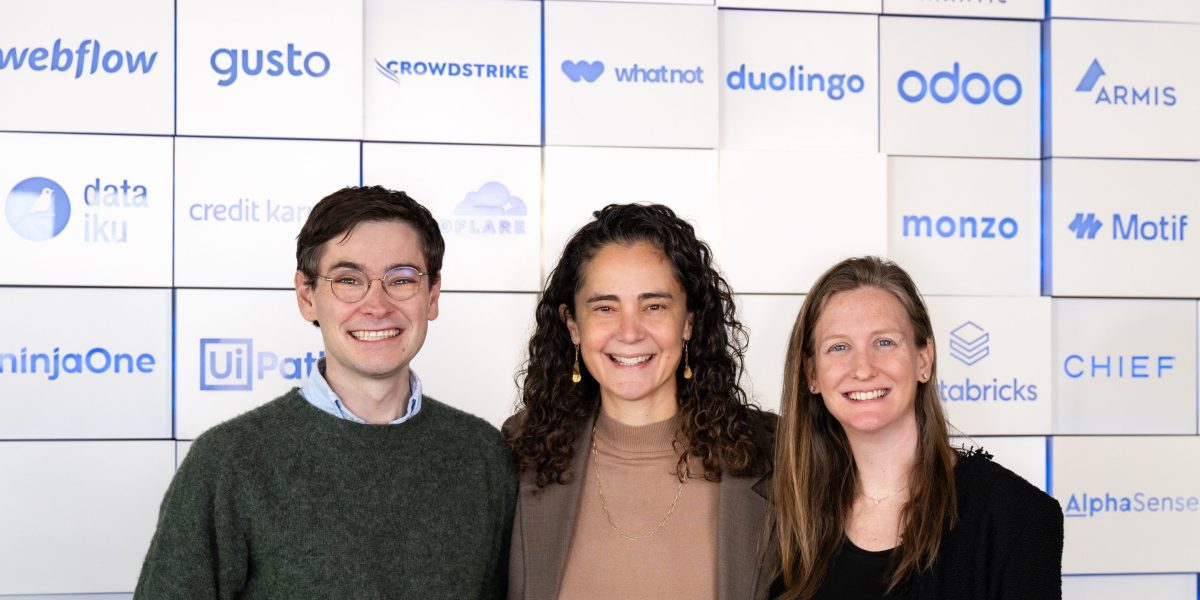
For the first time since the firm was started in 2013, it’s promoting two general partners, Chase and Alex Nichols, Fortune has exclusively learned. Chase, who joined CapitalG in 2020 specifically with a thesis around AI, has backed Abridge, Baseten, Canva, LangChain, Physical Intelligence, and Rippling.
Nichols, meanwhile, joined CapitalG in 2018 as an associate and was promoted to partner just two years ago. He previously worked with managing partner Laela Sturdy on the firm’s investments in Duolingo, Stripe, and Whatnot, and recently led CapitalG’s investment in Zach Dell’s energy startup BasePower. At a moment where there’s mounting angst around data centers and what it will take to power them, Nichols has a surprising take on how AI will affect energy—that both batteries and solar are getting cheaper and better at something like Moore’s Law speed. Those twin cost curves, over time, should actually drive energy prices down.
“I’m actually very optimistic about the future of energy prices,” he said. “You look at the history of energy consumption versus GDP. And cheap energy means more production, more income, and means a higher standard of living.”
At a moment when venture is perhaps more competitive than ever—and there are certainly some solo GPs out there making their mark—there’s an argument that as lines blur between disciplines in an AI-ified world, venture is by necessity a team sport.
Sturdy—who’s been CapitalG’s managing partner since 2023 (and also captained her college basketball team)—and Chase both have clearly taken some learnings from their time on the court. Chase sees venture overall as becoming more team-oriented: “Historically, it used to be like ‘you made general partner, go out and win your deal.’ To me, that’s not the right way to be successful in venture ever.”
Sturdy adds that in basketball, like venture, “We have to look at the scoreboard every once in a while, and you have to get back up when you get crushed… And, of course, coming together is better than playing alone.”
Term Sheet Podcast…This week, I spoke with Exelon CEO Calvin Butler. As resource-hungry data centers continue to sprout across the country, many are questioning whether the nation’s utility network can keep pace with such large-scale demand. Butler says it can. Listen and watch here.
Joey Abrams curated the deals section of today’s newsletter.Subscribe here.
VENTURE CAPITAL
– humans&, a San Francisco-based AI lab, raised $480 million in seed funding. SVAngel and GeorgesHarik led the round and were joined by NVIDIA and others.
– Emergent, a San Francisco-based platform designed for AI software creation, raised $70 million in Series B funding. Khosla Ventures and SoftBank led the round and were joined by Prosus, Lightspeed, Together, and Y Combinator.
– Exciva, a Heidelberg, Germany-based developer of therapeutics designed for neuropsychiatric conditions, raised €51 million ($59 million) in Series B funding. Gimv and EQTLifeSciences led the round and were joined by FountainHealthcarePartners, LifeArcVentures, and others.
– Pomelo, a Buenos Aires, Argentina-based payments infrastructure company, raised $55 million in Series C funding. Kaszek and InsightPartners led the round and were joined by IndexVentures, AdamsStreetPartners, S32, and others.
– Cloover, a Berlin, Germany-based operating system designed for energy independence, raised $22 million in Series A funding. MMCVentures and QEDInvestors led the round and were joined by LowercarbonCapital, BNVTCapital, BoschVentures, and others.
– Statusphere, a Winter Park, Fla.-based influencer marketing technology platform, raised $18 million in Series A funding. VolitionCapital led the round and was joined by HearstLab, 1984Ventures, and HowWomenInvest.
– DominionDynamics, an Ottawa, Canada-based defense technology company, raised $21M CAD ($15.2M USD) in seed funding. Georgian led the round and was joined by BessemerVenturePartners and BritishColumbiaInvestmentManagementCorporation.
– Cosmos, a New York City-based image collection and discovery platform, raised $15 million in Series A funding. ShineCapital led the round and was joined by Matrix and others.
– Mave, a Toronto, Canada-based real estate AI company, raised $5 million in seed funding from StaircaseVentures, RelayVentures, N49P, and AlatePartners.
– Stilla, a Stockholm, Sweden-based developer of an AI designed to accommodate entire teams, raised $5 million in pre-seed funding. GeneralCatalyst led the round and was joined by others.
– AsymmetricSecurity, a London, U.K. and San Francisco-based cyber forensics company, raised $4.2 million in pre-seed funding. SusaVentures led the round and was joined by HalcyonVentures, OverlookVentures, and angel investors.
PRIVATE EQUITY
– ConnectWise, backed by ThomaBravo, acquired zofiQ, a Toronto, Ontario-based agentic AI technology company designed to automate high-service desk operations. Financial terms were not disclosed.
– GrantAvenueCapital acquired 21stCenturyHealthcare, a Tempe, Ariz.-based vitamins, minerals, and supplements company. Financial terms were not disclosed.
– HighlanderPartners acquired Tapatio, a Vernon, Calif.-based hot sauce brand. Financial terms were not disclosed.
– PlatinumEquity acquired CzarnowskiCollective, a Chicago, Ill.-based exhibit and events company. Financial terms were not disclosed.
– UnitedBuildingSolutions, backed by AEIndustrial, acquired DFWMechanicalGroup, a Wylie, Texas-based HVAC solutions company. Financial terms were not disclosed.
IPOS
– PicPay, a Sao Paolo, Brazil-based digital bank, now plans to raise up to $435.1 million in an offering of 22.9 million shares priced between $16 and $19 on the Nasdaq. The company posted $1.7 billion in revenue for the year ended September 30. J&F International and BancoOriginal back the company.
– EthosTechnologies, a San Francisco-based online life insurance provider, plans to raise up to $210 million in an offering of 10.5 million shares priced between $18 and $20. The company posted $344 million in revenue for the year ended Sept. 30. GeneralCatalyst, HeroicVentures, EricLantz, and others back the company.
FUNDS + FUNDS OF FUNDS
– BlueprintEquity, a La Jolla, Calif.-based growth equity firm, raised $333 million for its third fund focused on enterprise software, business-to-business, and tech-enabled services companies.
PEOPLE
– Area 15 Ventures, a Castle Pine, Colo.-based venture capital firm, promoted AdamContos to managing partner.
– BullCityVenturePartners, a Durham, N.C.-based venture capital firm, hired CarlyConnell as a principal.
– HarvestPartners, a New York City-based private equity firm, promoted LucasRodgers to partner, MatthewBruckmann and IanSingleton to principal, and ConnorScro to vice president on the private equity team.
– Wingman Growth Partners, a Greenwich, Conn.-based private equity firm, hired CheriReeve as CFO. She previously served as principal and CFO at AtlasHoldings.







 Politics8 years ago