
Politics
Winner and Loser of the Week in Florida politics — Week of 10.19.25

Not long ago it felt like a reset had arrived for Florida’s college football titans.
In the opening weeks this season, each program flashed signs of life: Florida opened the year with a 55-0 rout of Long Island University, a tidy tune-up that fed optimism in Gainesville. Florida State began the season 3-0 — including a signature 31-17 win over Alabama that had Tallahassee buzzing. Miami, too, looked the part early, riding a run of convincing performances that put the Hurricanes into the Top 3.
Fast forward to the present and the storyline has reversed.
Florida pulled the plug on Billy Napier this week after a 3-4 start and a body of work the program decided wasn’t trending upward. Athletic officials instead installed longtime receivers coach Billy Gonzales as interim while the search begins.
At Florida State, the early spark has gone out — a four-game skid has left Mike Norvell’s future in doubt and school leaders saying a post-season decision is coming.
And Miami, which once was part of the national championship chatter, was stunned at home in a shocking loss to Louisville last weekend that gutted its momentum and knocked the Canes out of the very top tier of contenders. Now, Miami is fearing a repeat of last year, where a trip to the College Football Playoff looked like a lock, then fell apart after late-season stumbles.
Put bluntly: What looked like a three-team rebound after two promising weeks is now a scramble. Coaching changes, simmering buyouts and upset defeats have turned early optimism into urgent questions about whether any of the Big Three can sustain a run at relevancy this year and beyond.
But now, it’s onto our weekly game of winners and losers.
Winners
Honorable mention: Moez Limayem. The University of South Florida this week selected Limayem as its next President, marking a homecoming for the longtime academic leader who previously served as dean of USF’s Muma College of Business before taking the top job at the University of North Florida in 2022.

Florida’s State University System Board of Governors still needs to approve the selection, but that’s largely a formality — largely.
Limayem’s return to USF comes after a national search and at a pivotal time for the Tampa Bay area institution, which has climbed steadily in national rankings and is juggling major capital projects, including the long-awaited on-campus football stadium.
Trustees praised Limayem for his combination of business acumen and academic credibility — traits that helped him win strong support from faculty, donors and state leaders during his time at both universities.
During his tenure at UNF, Limayem expanded partnerships with local organizations and improved student retention and graduation rates. At USF, he was widely credited with helping to grow the business school’s national reputation and boosting connections with the Tampa Bay area business community.
In a state where university Presidents are increasingly expected to deliver both performance and political finesse, Limayem has a proven track record on both counts. His appointment signals continued momentum for USF.
Almost (but not quite) the biggest winner: Rick Scott. Scott broke ranks with Donald Trump this week — and walked away looking stronger for it.
The Florida Senator, one of Trump’s most consistent allies, opposed two of the President’s nominees: Paul Ingrassia for head of the Office of Special Counsel and John Guard for a federal judgeship in the Middle District of Florida.
It’s a rare move in the Trump era, where party loyalty often overrides principle. And this week, both nominations were pulled.
Ingrassia’s nomination imploded after a series of offensive and bigoted remarks surfaced from his past communications. He had referred to having a “Nazi streak,” disparaged the Martin Luther King Jr. holiday, and used racial slurs in text messages — revelations that instantly made him radioactive for a post charged with protecting federal whistleblowers and enforcing civil service law. And that’s all in addition to his lack of experience.
Scott was one of several Republican Senators who were set to oppose Ingrassia’s confirmation.
Guard’s nomination, meanwhile, was caught in the fallout of a criminal probe surrounding the Hope Florida initiative. The investigation, tied to allegations that $10 million from a Medicaid settlement was redirected to a political committee aligned with the Governor’s Office, has placed Guard squarely in the political crossfire.
Scott’s decision to oppose both nominees distances him from Trump’s more controversial picks at a time when the President seems to be testing how far he can push GOP allies in Congress.
Scott has often defended the former President. But his efforts here shows his loyalty has limits if the White House is going to insist on putting forward such substandard nominees.
The biggest winner: Wilton Simpson. Agriculture Commissioner Wilton Simpson notched a major political win this week by earning Trump’s endorsement for his 2026 re-election campaign — a boost that instantly cements his front-runner status and sends a clear signal to potential challengers to think twice.
Simpson, a former Senate President and longtime conservative power broker, has built his brand for many years and connected with Republican voters in the state. But Trump’s blessing carries extra weight in a GOP Primary landscape as he remains the leader of the party.
Laughably, some hard-liners in the conservative movement have tried to criticize Simpson over his pragmatic streak in Tallahassee. Trump’s nod blunts those misguided attacks, giving Simpson support from the MAGA flank and likely smoothing the path to a second term.
Simpson, who has maintained strong ties among legislative leaders and donor networks across the state, now enters the 2026 cycle with plenty of advantages: name recognition, money, and now, the ultimate seal of approval from Mar-a-Lago.
Losers
Dishonorable mention: Rick Lacey. It’s been a rough week for Lacey, the once-powerful Brevard County Republican Chair who is now out of the job after the state party removed him from party leadership.
Lacey, who had long been a fixture in local GOP politics and a vocal supporter of Trump, was ousted after months of mounting controversy and internal friction within the Brevard Republican Executive Committee (REC). His removal follows a series of complaints about alleged mismanagement and conduct unbecoming a party leader — issues that have fractured what was once one of Florida’s most reliably organized local Republican operations.
The Brevard REC has been roiled by factional infighting for much of the past year. Republican Party of Florida officials had grown frustrated with the dysfunction and the mounting grievances, which included allegations that Lacey skirted the rules to support Republican candidates and failed to properly document expenditures.
While the party dominates electorally — holding every statewide office and commanding supermajorities in the Legislature — local-level fractures like this one show that unity isn’t guaranteed. The fight in Brevard reflects the broader tug-of-war between institutional Republicans and grassroots activists vying for control of the party’s direction.
This time, the state party apparatus won out.
Almost (but not quite) the biggest loser: Chad Chronister. Controversy across leadership at the Hillsborough County Sheriff’s Office is dragging Sheriff Chronister down with it.
This week, scrutiny deepened over a widespread academic-cheating scandal among senior staffers, reflecting a failure of leadership, oversight and accountability that falls squarely on Chronister.
The trouble began when the Sheriff’s Office confirmed that newly promoted Chief Deputy Anthony Collins resigned after allegations surfaced that someone else completed his coursework for the FBI National Academy. Among the allegations, Collins reportedly admitted at least half of his assignments were done by someone else, prompting a review and his immediate departure from the agency.
The unraveling didn’t stop there. Six of the agency’s top officials have either resigned or were terminated in connection with the same academic integrity probe.
In his public response, Chronister acknowledged the scandal dealt a “black-eye” to the agency, saying the reputational damage falls on everyone when one leader missteps. But acknowledging the issue isn’t the same as fixing it. The number of senior departures, the high profiles of the victims involved, and the detailed nature of the accusations raise hard questions about how internal controls were allowed to fail.
For a Sheriff who has cultivated a reputation for community outreach, high-profile operations and political prominence (including a nomination for the Drug Enforcement Administration that he later withdrew himself from), the scandals undermine his ability to lead. Chronister’s failure to prevent the cheating debacle raises questions about whether it’s symptomatic of a broader culture flaw under his command.
The biggest loser: Brightline. Brightline this week faced a searing Atlantic feature that branded it the “Death Train.”
According to federal data cited in the report, Brightline has been involved in at least 185 fatalities since 2017 — 148 of them not believed to be suicides. That’s a staggering rate, more than double the next-highest major U.S. railroad, the National Transportation Safety Board found.
The story paints a troubling portrait: a beautiful, efficient train that’s also statistically the deadliest rail line in America. It explores how the company’s route — with 331 grade crossings slicing directly through South Florida’s urban core — creates a uniquely dangerous environment.
Brightline insists it’s not at fault, arguing that all deaths have involved people acting illegally or recklessly. But as the Atlantic piece shows, that explanation falls flat compared to accident rates for other train routes. Brightline countered that those stats don’t account for foot traffic. But the Atlantic piece argued, the fact that Brightline tracks run through neighborhoods and other high-trafficked areas is all the more reason to ensure there are plenty of safety measures in place.
The article also raised questions about Brightline’s finances. It notes that Brightline lost more than $500 million in 2024, has had its bonds repeatedly downgraded, and even deferred interest payments while seeking outside investors. The company’s California expansion, Brightline West, is relying heavily on federal funds, undermining its “no government money” narrative.
For a brand that sells itself as America’s sleek private answer to Amtrak, this was a PR derailment of epic proportions. And it was eerily — and unfortunately — timed, as a Brightline train reportedly struck and killed another pedestrian the same day the piece was published.
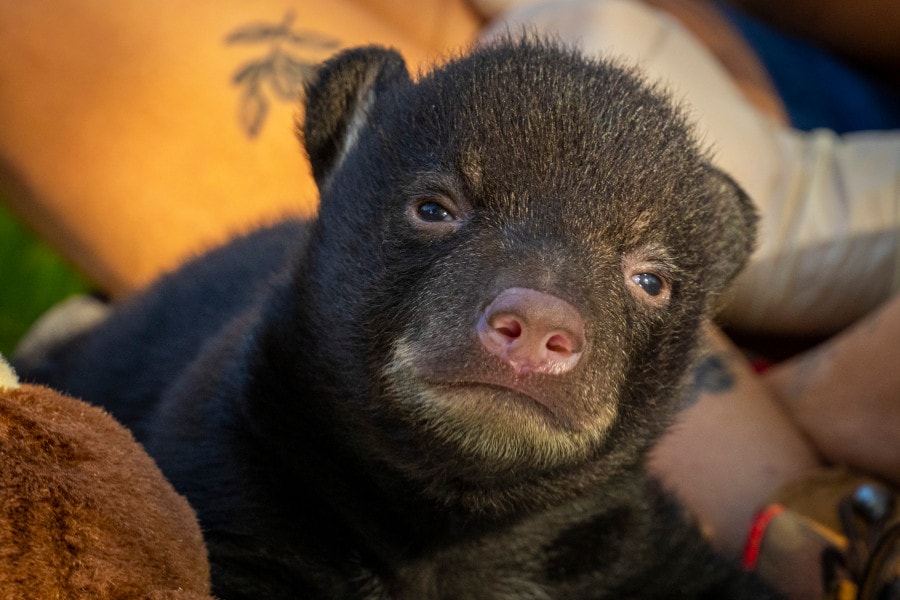
For the first time in a decade, hunters armed with rifles and crossbows are fanning out across Florida’s swamps and flatwoods to legally hunt the Florida black bear, over the vocal opposition of critics.
The state-sanctioned hunt began Saturday, after drawing more than 160,000 applications for a far more limited number of hunting permits, including from opponents who are trying to reduce the number of bears killed in this year’s hunt, the state’s first since 2015.
The Florida Fish and Wildlife Conservation Commission awarded 172 bear hunt permits by random lottery for this year’s season, allowing hunters to kill one bear each in areas where the population is deemed large enough. At least 43 of the permits went to opponents of the hunt who never intend to use them, according to the Florida chapter of the Sierra Club, which encouraged critics to apply in the hopes of saving bears.
The Florida black bear population is considered one of the state’s conservation success stories, having grown from just several hundred bears in the 1970s to an estimated more than 4,000 today.
The 172 people who were awarded a permit through a random lottery will be able to kill one bear each during the 2025 season, which runs from Dec. 6 to Dec. 28. The permits are specific to one of the state’s four designated bear hunting zones, each of which have a hunting quota set by state officials based on the bear population in each region.
In order to participate, hunters must hold a valid hunting license and a bear harvest permit, which costs $100 for residents and $300 for nonresidents, plus fees. Applications for the permits cost $5 each.
The regulated hunt will help incentivize maintaining healthy bear populations, and help fund the work that is needed, according to Mark Barton of the Florida chapter of Backcountry Hunters and Anglers, an advocacy group that supported the hunt.
Having an annual hunt will help guarantee funding to “keep moving conservation for bears forward,” Barton said.
According to state wildlife officials, the bear population has grown enough to support a regulated hunt and warrant population management. The state agency sees hunting as an effective tool that is used to manage wildlife populations around the world, and allows the state to monetize conservation efforts through permit and application fees.
“While we have enough suitable bear habitat to support our current bear population levels, if the four largest subpopulations continue to grow at current rates, we will not have enough habitat at some point in the future,” reads a bear hunting guide published by the state wildlife commission.

___
Republished with permission of the Associated Press.


Tucker Wetmore’s Song ‘Proving Me Right’ is About Model Bryana Ferringer

‘Bachelor’ Winner Cassie Randolph Marries Brighton Reinhardt

Kanye West and Bianca Censori Travel to South Korea Together
-

 Politics8 years ago
Congress rolls out ‘Better Deal,’ new economic agenda
-
Entertainment8 years ago
New Season 8 Walking Dead trailer flashes forward in time
-
Politics8 years ago
Poll: Virginia governor’s race in dead heat
-
Entertainment8 years ago
The final 6 ‘Game of Thrones’ episodes might feel like a full season
-
Entertainment8 years ago
Meet Superman’s grandfather in new trailer for Krypton
-
Politics8 years ago
Illinois’ financial crisis could bring the state to a halt
-
Business8 years ago
6 Stunning new co-working spaces around the globe
-
Tech8 years ago
Hulu hires Google marketing veteran Kelly Campbell as CMO