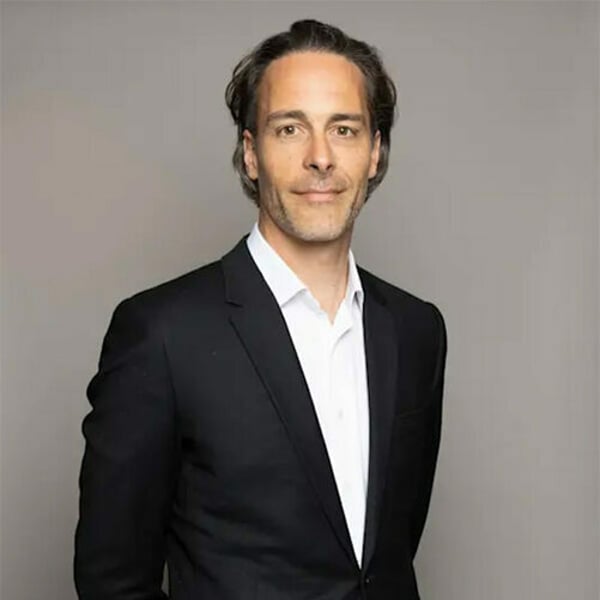
French shopping-centre giant Unibail-Rodamco-Westfield (URW) announced on Thursday the appointment of a new chairman of the management Board, and at the same time thanked Jean-Marie Tritant, who has spent the past five years working to turn the group around.
Vincent Rouget – URW
Vincent Rouget, currently managing director, European operations, will take the reins of the CAC 40-listed company on January 1, 2026.
The 45-year-old joined URW in 2023 as managing director for strategy and investment, and “actively contributed to the development of the company’s 2025-2028 roadmap.”
Before that, he spent more than 15 years at the pan-European real estate private equity firm Aermont Capital, where he served under Léon Bressler, former CEO of Unibail.
This “succession plan” was already in the works, the property company said in a press release, adding that the supervisory board decided on Thursday “to accelerate its implementation”.
“Today’s announcement reflects our proactive approach to succession, the Group’s solid performance and the positive trajectory embarked upon as part of the roadmap” drawn up by Jean-Marie Tritant for 2025 to 2028, said Jacques Richier, Chairman of URW’s Supervisory Board, in the release.
He paid tribute to the outgoing chairman of the management board, appointed “at a critical time” to transform the Group and relaunch its growth “in a particularly difficult external environment.”
Burdened by debt from the Westfield acquisition in 2019, and then by the Covid-19 pandemic, which forced many shopping centres to close, URW found itself in a particularly difficult position at the end of 2020, with its share price at an all-time low.
In open opposition to the strategy at the time, Léon Bressler, the company’s former CEO from 1992 to 2006, and French businessman Xavier Niel led a shareholder revolt to oust the previous management.
This revolt led to the appointment of Léon Bressler as Chairman of the Supervisory Board and of Jean-Marie Tritant as vhairman of the Management Board at the end of 2020. The latter will leave the company at the end of the year, following a transition period.
From storm to profitability
Xavier Niel, a member of the French group’s supervisory board, expressed in a press release “his gratitude and appreciation to Jean-Marie Tritant for his commitment to URW.”
Jean-Marie Tritant – URW
“While managing the group’s activities in the United States, he agreed, at the end of 2020, to return to France to take over the reins of a Group in the midst of a storm”, he said, adding that Jean-Marie Tritant created “the conditions for a solid and lasting turnaround.”
The group has now substantially reduced its debt, sold its U.S. assets deemed less promising, and is forecasting profitability growth of around 6% through to 2028.
“Building on the success of the group’s strategic transformation” during his term of office, Tritant said he is “fully confident in URW’s ability to generate future growth under the leadership of Vincent and the management board.”
Tritant, 58, joined Unibail in 1997 and rose through the ranks of the office division to become managing director, shopping centres and offices, France, in 2012. He was then promoted to chief operating officer in 2013, and appointed president of URW in the United States in 2018.
A disciple of Léon Bressler, he told AFP in the spring that it was the former CEO who “recruited” him, “appointed him to shopping centres”, then “sent him to the US” and “asked him to take over as Chairman of the Management Board”.
At the same time as announcing the change of Chairman, URW, which also owns convention centres and is the developer of the Triangle Tower in Paris, reported on Thursday a 2.4% increase in gross rental income from its shopping centres for the first nine months of the year, compared with the same period in 2024.
Sales by retailers in the group’s centres rose by 3.4% and footfall by 1.8%.
The group also announced the acquisition of a 25% stake in the Saint James Quarter shopping centre in Edinburgh, Scotland, one of the twenty most visited shopping centres in Europe, according to URW.
This article is an automatic translation. Click here to read the original article.
The Comité Colbert has unanimously elected Hélène Poulit-Duquesne to be the new chair of the leading French luxury federation. Poulit-Duquesne, the CEO of Maison Boucheron, succeeds Laurent Boillot. She will take up her new responsibilities in June 2026, working alongside Bénédicte Épinay, general delegate of the Comité Colbert.
Hélène Poulit-Duquesne – Boucheron
Poulit-Duquesne has been a long-term active member of the Comité Colbert. As CEO of Maison Boucheron, she has served on the association’s board of directors since 2018 and became its vice president in May 2022.
“I am proud and happy for the trust placed in me today. My roadmap is to continue supporting the Comité Colbert’s major challenges: promoting our expertise and supporting our industries, collectively promoting our values and our Houses internationally, and placing sustainable development, a future challenge for the planet and our professions, at the heart of our strategies,” said the Boucheron CEO in a release.
The Comité Colbert’s membership includes a wide variety of French luxury labels such as fashion houses like Louis Vuitton, Balenciaga, Dior, Givenchy, Jean Paul Gaultier, and Balmain; fine wines like Château Lafitte Rothschild and Perrier Jouët champagne; perfume brands- Frédéric Malle, Guerlain, and Francis Kurkdjian; jewellers such as Van Cleef & Arpels and Messika; and master chefs and restaurants including Yannick Alléno, Taillevent, and Guy Savoy.
“Each Maison of the Comité Colbert, beyond its individual performance and regardless of its market share and size, has a greater role to play: that of defending values that are universal and cement the foundation of our collective: the values of art, culture, and craftsmanship, the hand of man. Because they have meaning, they give meaning. They enrich the lives of millions of people and inspire them to dream,” insisted Poulit-Duquesne.
A notably experienced executive, Poulit-Duquesne has held senior positions in three of the largest luxury groups in the world- LVMH, Richemont, and Kering.
Hélène Poulit-Duquesne is a graduate of ESSEC Business School in the Paris suburbs, who began her career at LVMH before joining Cartier International, the key brand in the Richemont Group, in 1998. In 2010, she joined its Executive Committee as director of international marketing, before joining the Kering Group at the end of 2015 as CEO of Maison Boucheron.
“I am delighted at the prospect of working with Hélène Poulit-Duquesne to serve, together with our collective, the influence of an industry whose excellence and creativity are one of the major jewels in the crown of the French economy. We are committed to supporting its development, honouring its expertise, and amplifying its international influence,” added Épinay.
Created in 1954 on the initiative of famed perfumer Jean-Jacques Guerlain, the Comité Colbert is a non-profit association recognised as being of public interest, bringing together 98 French luxury houses and 17 cultural institutions. The Comité Colbert’s goal is to work together to promote the French art of living internationally, as well as to preserve and pass on French expertise and creativity.
British photographer Martin Parr, renowned for his colour-saturated pictures and the ironic gaze with which he observed his compatriots’ daily life, passed away on Saturday aged 73. The announcement was made by the Martin Parr Foundation in a press release.
Martin Parr – Afp
“It is with great sadness that we announce that Martin Parr (1952-2025) died on December 6, 2025, at home in Bristol,” stated the foundation. Magnum Photos, the agency for which Parr had worked for a very long time, gave the sad news at the same time.
Parr became famous thanks to his highly recognisable aesthetic featuring close-up shots and a saturated palette, and the amused, sympathetic eye with which he observed his favourite themes, like mass tourism and consumerism, and his subjects, from sunbathers with crimson-baked skin to village fête participants.
Over the last 30 years, Parr’s style won over many fashion labels, and he collaborated with some of the top luxury houses. Last year, the Fashion Faux Parr book traced his links with the fashion world, featuring some 25 images taken over the course of several decades.
Parr’s influence extended beyond the domain of photography aficionados, even if his documentary-style work, sometimes described as kitsch, earned him as many admirers as detractors.
Parr was born in Surrey on May 23, 1952. He was introduced to photography by his grandfather, an enthusiast himself, and began taking pictures in black and white, like the great masters of the 1970s.
He rose to prominence in the mid-1980s, with The Last Resort, a study of working-class people on holiday in New Brighton in Merseyside. It was a foretaste of his future work, notable for the use of flash photography for exteriors shots too.
After a career fraught with challenges, Parr became a full member of Magnum Photos in 1994, despite Henri Cartier-Bresson’s initial opposition. He went on to lead the agency from 2013 to 2017.
Trade unions at the Louvre Museum in Paris on Monday called for a rolling strike next week over working conditions, piling more bad news on the beleaguered institution. The announcement came a day after the world’s most visited museum admitted to a major leak in late November and nearly two months after an embarrassing heist in which French crown jewels were stolen from its permanent collection.
The Louvre at night
In between those two incidents, it had to close a gallery containing ancient Greek ceramics over fears for the safety of a ceiling. Three unions- the CGT, Sud and the CFDT- called for a rolling strike starting Monday December 15 which was voted for at a staff meeting of around 200 employees “with unanimity,” CFDT official Valerie Baud told AFP. If followed widely by the Louvre’s 2,100-strong workforce, it could lead to the closure of the institution in the run-up to the Christmas holidays when Paris is full of festive holidaymakers.
The Louvre was forced to shut temporarily on June 16 this year after gallery attendants, ticket agents, and security personnel organised a spontaneous walk-out over what they see as understaffing and overcrowding. In a joint letter addressed to Culture Minister Rachida Dati on Monday, the unions wrote that parts of the Louvre were being regularly closed because of “insufficient staff numbers as well as technical failures and the building’s ageing condition.”
“The public now has only limited access to the artworks and has trouble moving around. A visit to the Louvre has become a real obstacle course,” they added, according to a copy seen by AFP.
On Sunday, the museum’s deputy administrator, Francis Steinbock, said that an open valve in the heating and ventilation system had caused water damage to 300 to 400 journals, books and documents in the Egyptian department. The damaged items date from the late 19th and early 20th centuries and are “extremely useful” but are “by no means unique,” Steinbock added.
On October 19, a four-person gang raided the museum in broad daylight, stealing jewellery worth an estimated $102 million in just seven minutes before fleeing on scooters. The incident has highlighted major security vulnerabilities and heaped pressure on government-appointed Louvre boss Laurence des Cars. She has called it “an immense wound that has been inflicted upon us.”
Des Cars and unions had warned repeatedly before the break-in about conditions inside the Louvre and the cost of maintaining the vast former royal palace. The home of Leonardo da Vinci’s “Mona Lisa” welcomed 8.7 million people last year.