Connect with us

Business

Salesforce revamps its ‘Agentforce’ offerings to try to pull customers across the gap between AI capabilities and AI adoption

Published

on


Hello and welcome to Eye on AI. In this editionA breakdown of the AI news from Salesforce’s Dreamforce…OpenAI debuts its browser…Google makes a cancer research breakthrough…and backlash against the data-center boom builds.

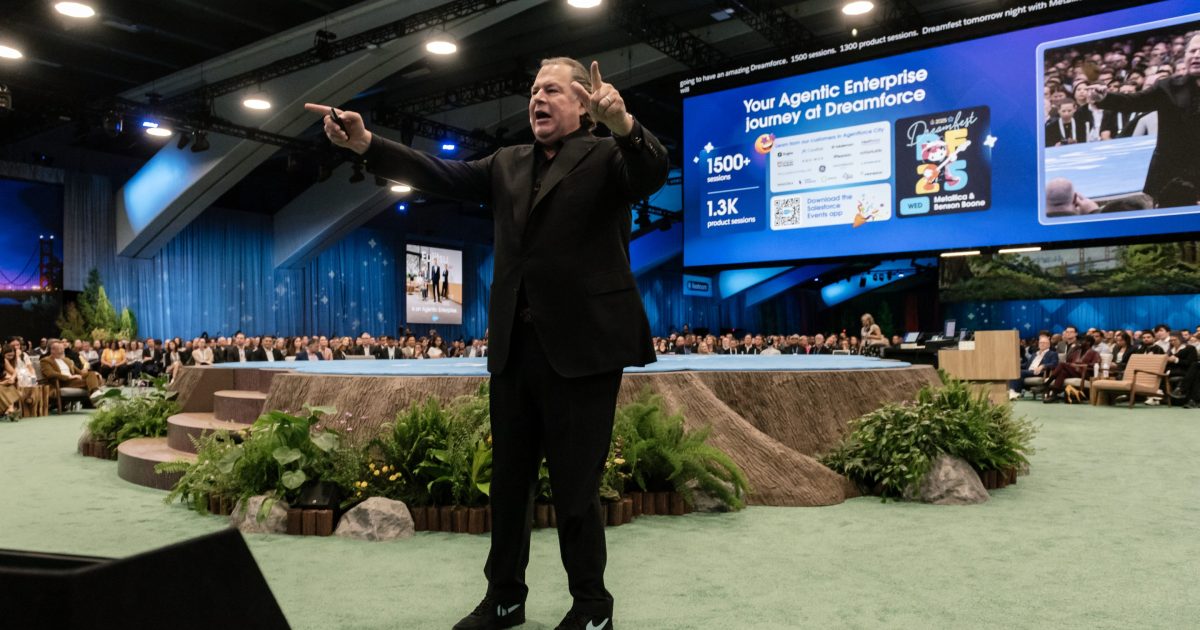
I spent last week on a reporting assignment in San Francisco. While there, I dropped by Salesforce’s huge Dreamforce conference. Salesforce founder and CEO Marc Benioff made lots of headlines—but probably not for the reason he wanted.

En route to the conference, Benioff had given an interview to the New York Times in which he’d been complimentary of President Trump and said he would welcome the National Guard being deployed to San Francisco. By the end of the week, Benioff had apologized for that stance—saying he had spoken out of an abundance of concern about the safety of those attending his conference—after being sharply criticized by famed Silicon Valley investor and advisor Ron Conway, who resigned from the board of Benioff’s charitable foundation in protest, as well as Lauren Powell Jobs, Steve Jobs’ widow and president of the Emerson Collective, who lambasted Benioff’s position in an op-ed in the Wall Street Journal.

All of this was a distraction from what was actually taking place at Dreamforce, where Salesforce announced a slew of new tools to make it easier for its customers to build and deploy AI agents. Few tech company CEOs have staked as much on the promise of “agentic AI” as Benioff. How is that bet going? Well, to judge from Dreamforce, the answer is—like so much that is happening in AI right now—something of a mixed picture.

On the one hand, Salesforce says that its “Agentforce” features have seen the fastest adoption of any product the company has ever released. But, on the other hand, not counting agents in Slack—which I’ll cover further in a moment—the company has only about 12,500 customers (or just over 8% of its customer base) having adopted Agentforce in the past year, and only 6,000 of those are paid engagements. (Salesforce allows customers to experiment with Agentforce for free, up until a certain usage threshold.) Those relatively low numbers—which helped explain Salesforce’s rather tepid recent revenue growth—had been weighing on Salesforce’s stock.

But at the conference, Salesforce also issued improved guidance for its future revenues, saying that, thanks to Agentforce, organic sales growth would accelerate to above 10% year over year in 2026 and continue that way. The company now forecasts $60 billion in annual sales by 2030, ahead of analysts’ consensus view. That projection sent Salesforce’s stock up 5% on the day, and shares have continued to climb over the past week. So what’s really happening here?

Innovation out-stripping adoption

In his keynote at Dreamforce Benioff, acknowledged that there was currently a “bifurcation” between rapid consumer adoption of AI chatbots, such as OpenAI’s ChatGPT, and relatively slower enterprise adoption of AI. And during a press conference afterwards, he went further, saying, “This is the moment where this technology innovation [is] out-stripping customer adoption. Our job is to get those customers into adoption mode. The way to do it is by showing them customers who are front-runners in this, so when you look at these customers, they are making it happen.” Salesforce is also doing this by creating more “forward-deployed engineers” to work directly with its customers, helping them build AI agents. The company seems to have realized in the past year that enterprises will need Salesforce to hold their hand more than was true with its traditional SaaS products.

I toured a section of the convention hall branded “Agentforce City” to look at some of those early adopters and their AI agents. A few, like Williams & Sonoma’s AI agent that offers customers recipe advice—and by the way, also suggests cookware they might need to make that roast or pie—seemed a bit gimmicky. That recipe agent might give the company more touchpoints with a customer, but it wasn’t clear it would directly translate into higher sales. More interesting was PepsiCo’s AI agent that allows it to provide better customer service to the many small Mom-and-Pop shopkeepers and bodega owners who stock Pepsi products but who don’t necessarily get a lot of attention and advice from Pepsi’s sales reps. More promising still is Dell’s use of Salesforce’s AI agents to automate parts of its supply chain, including onboarding new suppliers, which has cut its average onboarding time from months to days.

But Salesforce executives universally acknowledged that it would take time for more companies to follow the lead of Dell or PepsiCo. Adam Evans, Salesforce’s executive vice president and general manager of Salesforce AI, told me that he has spent most of the past year trying to show customers how to move beyond experimentation with AI agents. “What’s hard is to create agents that scale, that do things consistently, that you can work into an enterprise process to create value,” he said.

Slack as the interface to all of Salesforce’s software

To help customers with that, Salesforce unveiled several new Agentforce features at Dreamforce. There’s an Agent Builderthat allows a user to simply describe what it wants an agent to do; the system then automatically sets it up, with much less manual tinkering that was needed previously. There’s a new voice interface for AI agents, powered in part through OpenAI’s voice models, that improves interaction with agents. There’s an Agent Script tool that lets businesses establish rule-based processes for part of a given process and use the less predictable, but potentially powerful, reasoning of a large language model (LLM) for other parts of the process. It also introduced a new vibe-coding tool called Agentforce Vibes, which is aimed at developers already skilled at building Salesforce applications, but allows them to create these apps, including more sophisticated agentic workflows, using natural language.

Perhaps the biggest news is that Salesforce is hoping to position Slack—which Salesforce bought in 2020 for $27.7 billion—as the main “conversational gateway” to all of Salesforce’s software, including its Agentforce offerings. Denise Dresser, Slack’s CEO, told me that the idea is that instead of having to learn to configure and run processes in Salesforce’s Marketing Cloud or its Service Cloud, a Slack user could simply message an AI agent within Slack that will run these processes for them using Salesforce’s software in the background.

Slack has also created “knowledge agents” that can surface information from a particular Slack channel and perform certain actions—helping them onboard a new hire for, instance, or install software on a new laptop, directly from Slack. Dresser also told me that she thinks Slack is the ideal interface because it can incorporate both person-to-person and team interactions on the same channel in which you can have individuals and teams interacting with AI agents, whereas some AI companies are only optimizing their products for human-to-AI collaboration.

Dresser certainly may have a point about chat as the new interface to software. It’s a vision that AI companies like OpenAI and Anthropic are also pursuing. And some of these AI companies are projecting the idea even further, envisioning a future where AI agents use their coding abilities spin up bespoke software on the fly to handle many of the tasks that now require enterprise software, like, um, Salesforce. But whether that vision will come to fruition or whether traditional SaaS products will continue to exist, just with AI front-ends, remains to be seen. One thing that is clear from Salesforce’s experience in the past year since it started rolling out AI agents is that enterprise adoption will probably run behind over-hyped market expectations.

With that, here’s more AI news.

Jeremy Kahn
jeremy.kahn@fortune.com
@jeremyakahn

If you want to learn more about how AI can help your company to succeed and hear from industry leaders on where this technology is heading, I hope you’ll consider joining me at Fortune Brainstorm AI San Francisco on Dec. 8–9. Among those confirmed to appear so far include Google Cloud chief Thomas Kurian, Intuit CEO Sasan Goodarzi, Databricks CEO Ali Ghodsi, Glean CEO Arvind Jain, Amazon’s Panos Panay, and many more. Register now.

FORTUNE ON AI

Marketing leaders say AI is rewriting how brands reach Gen Z and millennials: ‘Forget what you know; learn this’—by Jessica Coacci

Exclusive: Early AI darling LangChain is now a unicorn with a fresh $125 million in funding—by Sharon Goldman

Sam Altman wants to ‘treat adults like adults’—but can OpenAI keep ChatGPT safe after opening the door to erotica?—by Beatrice Nolan

Empathy is the most under-hyped factor of the AI transformation era, American Express exec says—by Sydney Lake

EYE ON AI NEWS

OpenAI launches its long-awaited AI-powered web browser. The company debuted ChatGPT Atlas, a web browser with a built-in conversational assistant designed to act as a “companion” while users navigate the internet. Available globally on macOS (with Windows, iOS, and Android versions coming soon), Atlas includes an agent mode for Plus and Pro subscribers that allows ChatGPT to take real-world actions like booking reservations, editing documents, or managing emails. The release marks OpenAI’s most direct challenge yet to Google and Perplexity, both of which have already released their AI-capable browsers. The shares of Google-parent Alphabet fell sharply on the news. You can read more from Fortunehere.

Walmart partners with OpenAI on commerce. Within the next few months, U.S. ChatGPT users will be able to buy most Walmart products directly in the chatbot using its new Instant Checkout feature, the two companies announced. The move is a sign of what may be a new paradigm of “conversational shopping”—and it means Walmart will share purchase data from ChatGPT transactions with OpenAI, a notable concession given retailers’ usual grip on such data. You can read more from the Wall Street Journalhere.

Study finds AI copilots could save U.K. health service 43 minutes per staffer per day. That’s the result of a study that looked at the deployment of Microsoft’s 365 Copilot across 90 different organizations that are part of Britain’s National Health Service. That could translate to millions of hours per year if rolled out across the entire health service. You can read more from The Telegraphhere.

Anthropic pushes back after criticism from White House ‘AI czar.’ Anthropic CEO Dario Amodei wrote a blog post rebutting social media attacks from David Sacks, the White House’s crypto and AI czar. Sacks accused the company of pursuing a strategy of “regulatory capture”—trying to raise fears of existential risk from AI in order to lobby for AI regulation at the state and federal level that would favor its own products over those of rivals. Amodei argued that Anthropic aligns with the Trump administration on key AI priorities—citing praise for competitiveness-focused executive orders and a July meeting where he spoke with President Trump—while still opposing a proposed 10-year state-level moratorium on new AI laws. He also defended Anthropic’s support for California’s recently enacted AI law, which requires AI companies building powerful AI systems to report the results of their in-house safety-testing and provides additional whistleblower-protection to employees of those companies. Amodei said the company had hired both Republicans and Democrats to policy positions and that its models were less politically-biased than some rivals’. You can read more from my Fortune colleague Beatrice Nolan here.

OpenAI researcher retracts announcement of math breakthrough. OpenAI researchers, including Sebastien Bubeck, claimed that their model GPT‑5 had solved 10 difficult math problems that had been initially proposed by mathematician Paul Erdős (who died in 1996) and had remained unsolved to date, and that it had made significant progress on 11 others. But Thomas Bloom, who maintains the online list of “Erdős problems” quickly debunked this, showing that GPT-5 had merely found obscure published solutions that had not previously been brought to his attention, rather than producing new proofs. The incident sparked sharp industry criticism—Google DeepMind CEO Demis Hassabis called the situation “embarrassing”—and highlighted concerns about whether the mathematical and scientific reasoning capabilities of many AI models is overhyped. You can read more from TechCrunch here.

AI researcher Andrej Karpathy says AGI is still at least a decade away. Andrej Karpathy, a prominent AI researcher who was part of the founding group at OpenAI and headed AI at Tesla for a number of years, appeared on the Dwarkesh Podcast and said that artificial general intelligence (AGI) is likely still about a decade away. His position contradicts claims by a number of AI researchers at companies such as OpenAI and Anthropic that human-level AI is imminent. Karpathy argued that today’s AI agents “just don’t work,” describing them as unreliable, unintelligent, and incapable of handling complex, continuous tasks, and said AGI will emerge gradually rather than through a sudden breakthrough. Karpathy added that progress should be viewed through the lens of steady economic and technological growth rather than hype about machines replacing humans anytime soon. You can listen and watch the podcast episode here

EYE ON AI RESEARCH

Google researchers use AI to help spot genetic drivers of cancer. Researchers at the tech giant created DeepSomatic, a new open-source AI model that helps scientists analyze cancer genomes more quickly and accurately. The tool—which is based on a convolutional neural network, an older form of AI architecture that is particularly good at analyzing visual data—is able to distinguish between genetic mutations a person is born with and those that develop in cancer cells. In early tests, it outperformed existing methods of detecting these cancer-related genetic changes, making it especially useful for studying hard-to-analyze cancers like childhood leukemia and brain tumors. Google is open-sourcing both the AI model and the training data set it used to create it. You can read Google’s blog post on the research here.

AI CALENDAR

Oct. 21-22: TedAI San Francisco

Nov. 10-13: Web Summit, Lisbon 

Nov. 26-27: World AI Congress, London

Dec. 2-7: NeurIPS, San Diego

Dec. 8-9: Fortune Brainstorm AI San Francisco. Apply to attend here.

BRAIN FOOD

The backlash against the AI-driven data center boom is growing worldwide. The New York Times examined how local communities from Chile to Ireland are increasingly opposed to data center construction in their backyards due to the negative environmental impacts and energy demands these warehouses stuffed with computer chips bring. The comprehensively reported story is definitely worth reading. Nearly 60% of the world’s largest data centers are now located outside the U.S., often in places where electricity and water systems are already fragile, the paper reported. Residents in affected regions report worsening blackouts and water shortages, while governments—eager for investment and AI infrastructure—have offered tax breaks and cheap land, often with little regulation or transparency. Tech companies say the projects bring jobs and investment and claim they are minimizing environmental impact, but critics argue they are depleting vital resources and hiding their true footprint through subsidiaries and nondisclosure agreements.

The data center build-out is sparking a growing backlash, led by environmental activists. Whether this backlash will slow the data center boom, blacken the reputation of AI companies and their products with users, or hasten the roll-out of AI regulation globally remains to be seen. But it is definitely a trend to watch. It’s unclear if the backlash will spur AI researchers to find alternative AI methods that are less environmentally-costly—or if AI itself will lead to clean energy breakthroughs, in say fusion power, that might compensate or negate the environmental damage the technology is causing currently. But one can hope. 


Source link

Continue Reading

Business

Macron warns EU may hit China with tariffs over trade surplus

Published

on


French President Emmanuel Macron warned that the European Union may be forced to take “strong measures” against China, including potential tariffs, if Beijing fails to address its widening trade imbalance with the bloc.

“I’m trying to explain to the Chinese that their trade surplus isn’t sustainable because they’re killing their own clients, notably by importing hardly anything from us any more,” Macron told Les Echos newspaper in an interview published on Sunday.

“If they don’t react, in the coming months we Europeans will be obliged to take strong measures and decouple, like the US, like for example tariffs on Chinese products,” he said, adding that he had discussed the matter with European Commission President Ursula von der Leyen.

Macron has just returned from a three-day state visit in China, where he pressed for more investment as Paris seeks to recalibrate its relationship with the world’s second-largest economy. France’s goods trade deficit with China reached around €47 billion ($54.7 billion) last year, according to the French Treasury. Meanwhile, China’s goods trade surplus with the EU swelled to almost $143 billion in the first half of 2025, a record for any six-month period, according to data released by China earlier this year.

Tensions between France and China escalated last year after Paris backed the EU’s decision to impose tariffs on Chinese electric vehicles. Beijing retaliated by imposing minimum price requirements on French cognac, sparking fears among pork and dairy producers that they could be targeted next.

‘Life or Death’

Macron said the US approach to China was “inappropriate” and had worsened Europe’s position by diverting Chinese goods toward the EU market.

“Today, we’re stuck between the two, and it’s a question of life or death for European industry,” Macron said, while noting that Germany — Europe’s biggest economy — doesn’t entirely share France’s stance.

In addition to Europe needing to become more competitive, the European Central Bank too has a role to play in strengthening the EU’s single market, Macron said, arguing that monetary policy should take growth and jobs into account, not just inflation, he said.

He also said the ECB’s decision to continue selling the government bonds it holds risks pushing up long-term interest rates and weighing on economic activity.

“Europe must — and wants to — remain a zone of monetary stability and credible investment,” Macron said.


Source link

Continue Reading

Business

What bubble? Asset managers in risk-on mode stick with stocks

Published

on


There’s a time when investments run their course and the prudent move is to cash out. For global asset managers who’ve ridden double-digit gains in equities for three straight years, that time is not now.

“Our expectation of solid growth and easier monetary and fiscal policies supports a risk-on tilt in our multi-asset portfolios. We remain overweight stocks and credit,” said Sylvia Sheng, global multi-asset strategist at JPMorgan Asset Management.

“We are playing the powerful trends in place and are bullish through the end of next year,” said David Bianco, Americas chief investment officer at DWS. “For now we are not contrarians.”

“Start the year with sufficient exposure, even over-exposure to equities, predominantly in emerging market equities,” said Nannette Hechler-Fayd’herbe, EMEA chief investment officer at Lombard Odier. “We don’t expect a recession in 2026 to unfold.”

Those assessments came from Bloomberg News interviews with 39 investment managers across the US, Asia and Europe, including at BlackRock Inc., Allianz Global Investors, Goldman Sachs Group Inc. and Franklin Templeton.

More than three-quarters of the allocators were positioning portfolios for a risk-on environment through 2026. The thrust of the bet is that resilient global growth, further developments in artificial intelligence, accommodative monetary policy and fiscal stimulus will deliver outsize returns in all fashion of global equity markets. 

The call is not without risks, including simply its pervasiveness among the respondents, along with their overall high degree of assuredness. The view among the institutional investors also aligns with that of sell-side strategists around the globe. 

Should the bullishness play out as expected, it would deliver a stunning fourth straight year of bumper returns for the MSCI All-Country World Index. That would extend a run that’s added $42 trillion in market capitalization since the end of 2022 — the most value created for equity investors in history. 

That’s not to say the optimism is without merit. The artificial intelligence trade has added trillions in market value to dozens of firms plying the industry, but just three years after ChatGPT broke into the public consciousness, AI remains in the early phase of development.

No Tech Panic

The buy-side managers largely rejected the idea that the technology has blown a bubble in equity markets. While many acknowledged some pockets of froth in unprofitable tech names, 85% of managers said valuations among the Magnificent Seven and other AI heavyweights are not overly inflated. Fundamentals back the trade, they said, which marks the beginning of a new industrial cycle. 

“You can’t call it a bubble when you’re seeing tech companies deliver a massive earnings beat. In fact, earnings from the sector have outstripped all other US stocks,” said Anwiti Bahuguna, global co-chief investment officer at Northern Trust Asset Management.

As such, investors expect the US to remain the engine of the rally. 

“American exceptionalism is far from dead,” said Jose Rasco, chief investment officer at HSBC Americas. “As artificial intelligence continues to spread around the globe, the US will be a key participant.” 

Most investors echoed the sentiment expressed by Helen Jewell, international chief investment officer of fundamental equities at BlackRock, who suggested also searching outside the US for meaningful upside.

“The US is where the high-return high-growth companies are, so we have to be realistic about that. But those are already reflected in valuations, and there are probably more interesting opportunities outside the US,” she said.

International Boom

Profits matter above all else for equity investors, and huge bumps in government spending from Europe to Asia have stoked estimates for strong gains in earnings.

“We have begun to see a meaningful broadening of earnings momentum, both across market capitalizations and across regions, including Japan, Taiwan, and South Korea,” said Wellington Management equity strategist Andrew Heiskell. “Looking into 2026, we see clear potential for a revival of earnings growth in Europe and a wider range of emerging markets.”

India is one of the most compelling opportunities for 2026, according to Goldman Sachs Asset Management’s Alexandra Wilson-Elizondo, global co-head and co-chief investment officer of multi-asset solutions.

“We see real potential for India to become the Korea-like re-rating story of 2026, a market that transitions from tactical allocation to strategic core exposure in global portfolios,” she said. 

Nelson Yu, head of equities at AllianceBernstein, said he sees improvements outside of the US that will mandate allocations. He noted governance reform in Japan, capital discipline in Europe and recovering profitability in some emerging markets.

Small Cap Optimism

At the sector level, the investors are looking for AI proxies, notably among clean energy providers that can help meet the technology’s ravenous demand for power. Smaller stocks are also finding favor.

“The earnings outlook has brightened for small-capitalization stocks, industrials and financials,” said Stephen Dover, chief market strategist and head of Franklin Templeton Institute. “Small-cap stocks and industrials, which are typically more highly leveraged than the rest of the market, will see profitability rise as the Federal Reserve trims interest rates and debt servicing costs fall.”

Over at Santander Asset Management, Francisco Simón sees earnings growth of more than 20% for US small caps after years of underperformance. Reflecting the optimism, the Russell 2000 Index of such equities recently hit a record high.

Meanwhile, the combination of low valuations and strong fundamentals makes health care one of the most compelling contrarian opportunities in a bullish cycle, a preponderance of managers said.  

“Health-care related sectors can surprise to the upside in the US markets,” said Jim Caron, chief investment officer of cross-asset solutions at Morgan Stanley Investment Management. “This is a mid-term election year and policy may at the margin support many companies. Valuations are still attractive and have a lot of catch up to do.”

Virtually every allocator struck at least a note of caution about what lies ahead. The top worry among them was a rekindling of inflation in the US. If the Fed is forced by rising prices to abruptly pause or even end its easing cycle, the potential for turbulence is high.

“A scenario — which is not our base case — whereby US inflation rebounds in 2026 would constitute a double whammy for multi-asset funds as it would penalize both stocks and bonds. In this sense it would be much worse than an economic slowdown,” said Amélie Derambure, senior multi-asset portfolio manager at Amundi SA. 

“The way investors are headed for 2026, they need to have the Fed on their side,” she added.

Trade Caution

Another worry is around President Donald Trump’s capriciousness, particularly when it comes to trade. Any flareup in his trade spats that fuels inflation through heightened tariffs would weigh on risk assets. 

Oil and gas producers remain unloved by the group, though that could change if a major geopolitical event upends supply lines. While such an outcome would bolster those sectors, the overall impact would likely be negative for risk assets, they said.

“Any geopolitical situation that can affect the price of oil is what will have the largest impact on the financial markets. Clearly both the Middle East and the Ukraine/Russia situations can impact oil prices,” said Scott Wren, senior global market strategist at Wells Fargo Investment Institute.

Multiple respondents flagged European autos as a “no-go” area for 2026, citing intense competitive pressure from Chinese carmakers, margin compression and structural challenges in the transition to electric vehicles. 

“Personally I don’t believe for a minute that there will be a rebound in the sector,” said Isabelle de Gavoty at Allianz GI. 

Outside of those worries, most asset managers simply believe that there’s little reason to fret about the upward momentum being interrupted — outside, of course, from the contrarian signal such near-uniform bullishness sends.

“Everyone seems to be risk-on at the moment, and that worries me a bit in the sense that the concentration of positions creates less tolerance for adverse surprises,” said Amundi’s Derambure.  


Source link

Continue Reading

Business

Trump says Netflix-Warner Bros. deal ‘could be a problem’

Published

on


President Donald Trump raised potential antitrust concerns for Netflix Inc.’s planned acquisition of Warner Bros. Discovery Inc., noting that the market share of the combined entity may pose problems. 

“Well, that’s got to go through a process, and we’ll see what happens,” Trump said when asked about the deal as he arrived at the Kennedy Center for an event, confirming that he has met Netflix co-CEO Ted Sarandos last week and complimenting the streaming company. “But it is a big market share. It could be a problem.”

The $72 billion deal would combine the world’s No. 1 streaming player with the No. 4 service HBO Max, which has raised red flags from antitrust regulators. 


Source link

Continue Reading

Trending

Copyright © Miami Select.