Connect with us

Business

America’s healthcare system is working out how to function with fewer immigrants and an aging population

Published

on


When Dr Brian Moreas opened his practice in Boca Raton, Florida, he was following in the footsteps of his physician parents and grandfather, a Bombay-based general practitioner. Dr Moreas hoped to do what the vast majority of those in healthcare set out to: Help patients.

But in 2025 he spends his days “putting out fires.”

Instead of meeting and treating as many patients as he can, his hours are often clogged with referrals to geriatric specialists which are increasingly hard to find. So too are psychiatrists, with Dr Moreas often providing the support himself, as well as endocrinologists who have expertise in hormonal imbalances such as diabetes and osteoporosis, as well as rheumatologists who specialize in autoimmune conditions like arthritis.

Then, two or three times a week, he will have appointments with recurring patients: Those he discharged on the basis of ongoing care at home, who then have no choice but to return to the outpatient center when care workers prove too hard to find, adding hours onto his packed schedule.

With the workload and friction increasing, it’s perhaps no surprise to the nephrologist—the study of kidneys and diseases related to blood pressure—that his peers are retiring earlier, inadvertently increasing the burden still on those still in the field.

Much of Dr Moreas’s difficulty stems from a shrinking pool of skilled labor in the healthcare workforce. While his practice hasn’t struggled to recruit talent, referrals for specialist care which he cannot provide are getting tougher. And the problem is likely to get worse: Much of the expertise he and his patients need is in geriatric care, a sector which few medical students want to pursue.

And the problem is potentially exacerbated by government policy which may deter the imported talent needed to keep the healthcare industry afloat. In the 2024 election, American voters made it clear that immigration was one of the major issues they wanted their future president to address. President Trump has delivered a raft of actions since: Adding a $100,000 price tag to highly-skilled H-1B visas, proposing a 15% cap on international students at American universities, and enhancing vetting and screening of green card applicants “to the maximum degree possible.”

The policies are having their desired effects: Pew Research found in August that at the beginning of 2025, 53.3 million immigrants lived in the United States, the largest number ever recorded. By June, America’s foreign-born population had declined by more than a million people—a fall the like of which hasn’t been seen since the 1960s. Likewise, according to preliminary data released by the National Travel and Tourism Office, the number of student visas declined in August by 19% compared to a year prior. June and July also fell—but August is of particular note because it is usually the month that sees a peak.

Trump’s immigration plans have already presented some unforeseen economic outcomes: Experts believe America’s unemployment rate has remained relatively stable because job losses are being offset by a shrinking labor force as individuals leave the U.S. The economy has withstood weak role creation precisely because the pool of applicants is shrinking.

On the other hand, a working paper from American Enterprise Institute (AEI), a conservative economic policy center, found the Trump administration’s immigration policy—even before the changes to the H-1B visa were announced—will likely result in negative net migration in 2025, shrinking U.S. GDP by between 0.3% and 0.4% as a result.

While the Oval Office has made clear its intention to grow the American economy in other ways, the issue remains that the risks of lower immigration aren’t just about what foreign-born individuals are contributing, but also how they’re doing it.

Alarms have already been raised on Wall Street and in Silicon Valley about the impact of skilled, motivated individuals being unable to come to the U.S. But the problem is also present in the healthcare workforce: Studies show immigrant staff have not only increased as a percentage of its shrinking skills supply, but are also more likely to work in the roles which are in higher demand, despite, on average, being lower paid. Additionally, they’re more likely to work in regions that find it harder to attract talent.

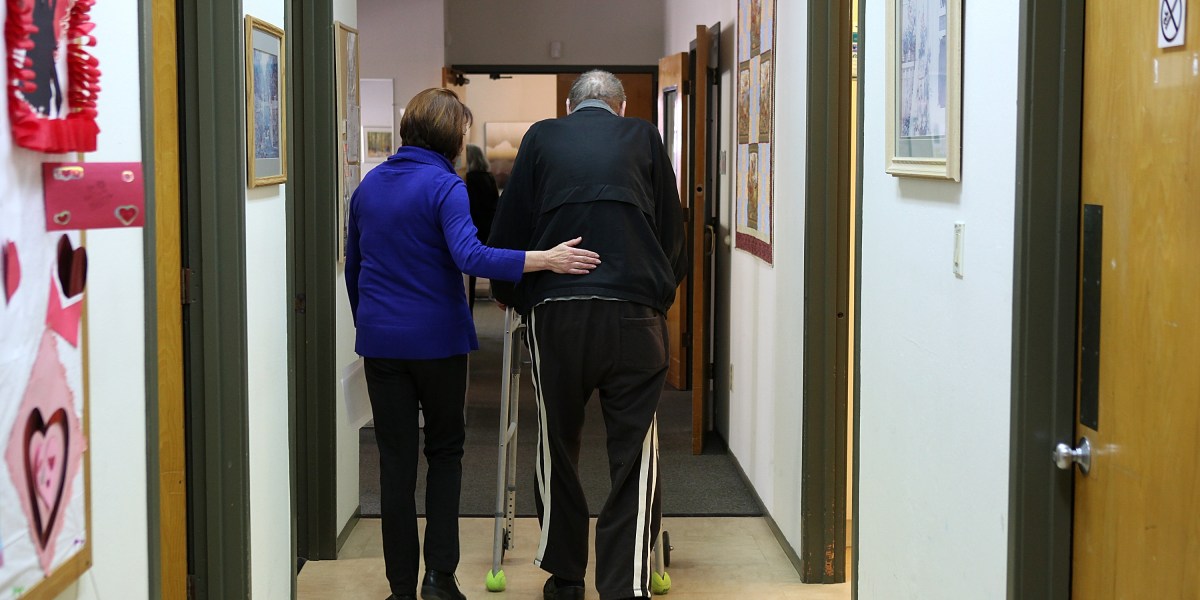
The healthcare sector also has an additional pressure to wrangle: How to care for an aging population when the domestic workforce isn’t doing it themselves.

A gap in geriatric care

According to the Population Review Bureau, the number of Americans aged 65 and older is projected to increase from 58 million in 2022 to 82 million by 2050—up 42%. There is, however, a relatively small pool of people ready to care for them.

“There’s a huge gap in geriatric care,” Dr Moreas tells Fortune. “I don’t talk to any medical students who say, ‘Oh, I want to go into geriatrics when I get out.’ Everybody says, ‘I want to go to dermatology or orthopedics.’”

“Our aging population is definitely increasing at a faster rate than our ability to take care of them. I don’t see that changing anytime in the near future. That’s one of the things that a lot of the international healthcare workers were able to fill: If you go to a nursing home or you go to a hospital on the night shift, it’s almost all international aides and nurses.”

He added: “When you’re talking about some of the other areas of medicine that are maybe not so lucrative like home health aides and and nurses and nursing aides, I have noticed that there is definitely a need for international people to be able to fill those positions because Americans just aren’t doing it, they’re not going into that.”

A study from the Baker Institute found that between 2007 and 2021 the share of the population in the U.S. that is foreign-born grew one percentage point, from 12.62% to 13.65%, and the share of foreign-born healthcare workers increased from 14.22% to 16.52%. Likewise, while the number of total workers in U.S. nursing care facilities declined pre-pandemic to COVID (down 1.8 million to 1.5 million), the portion of foreign-born workers in the sector rose, up to 18.21% in 2021 compared to 16.43% a decade prior.

The White House countered young, domestic talent can be called upon to fill holes in America’s health labor force. Spokeswoman Abigail Jackson told Fortune: “Over one in ten young adults in America are neither employed, in higher education, nor pursuing some sort of vocational training. There is no shortage of American minds and hands to grow our labor force, and President Trump’s agenda to create jobs for American workers represents this Administration’s commitment to capitalizing on that untapped potential while delivering on our mandate to enforce our immigration laws. 

“President Trump will continue growing our economy, creating opportunity for American workers, and ensuring all sectors have the workforce they need to be successful.”

The cost of motivating talent into the medical workforce could pile further pressure on an already stretched sector, warned Dr Moreas, and warned the U.S. may already be losing out on foreign-born talent because of changing goalposts on immigration policy. While he hasn’t encountered any individuals who have left the U.S. or are being blocked from coming due to changing policy, Dr Moreas said he does see more “fear” and uncertainty.

“I think it’s going to be harder for people to trust the fact that they can come to this country and be able to stay and work here,” Dr Moreas added. “Other countries are actually economically starting to do better and it may be more lucrative. Once upon a time it was a very good lifestyle to come to the United States, but now there are so many other countries that people can choose from to go to, so I have a feeling that our workforce is going to start decreasing in the areas that Americans aren’t going to want to go into.”

Question of confidence

The story is similar for New York urologist Dr David Shusterman, a refugee who left the Soviet Union for the U.S. in the 1980s.

Dr Shusterman’s concern is one of basic math: How to marry that rising reliance on foreign-born skilled labor with policies which are reducing net immigration. “Our medical schools are filled with foreign-born people, that’s really one of the issues. There’s a lot of positions that need filling right now, it’s hard to find a urologist, hard to find other specialties … we’ve been resorting to physician extenders—I have a lot of physician extenders in the office, but they’re also in short supply,” he tells Fortune. Physician extenders is an umbrella term for healthcare professionals who assist doctors to provide patient care, for example nurse practitioners or physician assistants.

Immigration policy at present means “a lot of good people, because the uncertainty, choose not to stay, or are more worried about staying” said Dr Shusterman. What’s needed is clarity, he said: “I know that at least 5% to 10% of the population of the urology programs are on visas, and those are people that if they want to stay here, they should be highly motivated to stay and not given the runaround treatment because these are people who are in super high demand. They would love to stay, mainly because of the reimbursement—they make more here than other places—and the reason they make more is because they’re needed.”

The expert advocated for the government—be it Trump 2.0 or thereafter—to lay out some clearer benchmarks on the skilled labor the U.S. warned to attract. While he believes the Trump administration is expediting some visas for skilled talent, he added: “My suggestion to the immigration department is to be much clearer about [saying] ‘This is what we need, if you study in these fields you have a clearer pathway. It’s something that is needed and in demand right now. And I stress that, that this is a highly productive group of individuals that is obviously going to work and make the country better because they have skills that are marketable.

“It would help if even employers were able to advertise like: We have these qualified positions that the government will approve for you if you apply for this position,” he added.

Four-year timeline

Trump’s policy action with regard to illegal immigration is often the first thing that comes to mind when the subject is raised. According to U.S. Immigration and Customs Enforcement (ICE) some 67,000 individuals have been detained in the 2025 fiscal year at the time of writing, and more than 71,000 people have been removed. That being said, the rate of detentions and removals for the first half of this fiscal year would still put the Trump 2.0 administration behind the rates ICE reported last year, before he was elected. So while the focus of the Trump administration on immigration and deportation may be sharper, the policy itself is no new thing. Indeed, this policy could change if voters’ views shift on the matter—and an aging population may prompt that change.

Based in Connecticut, reproductive endocrinologist Dr Shaun Williams is yet to see his practice, Illume Fertility, impacted by shifting policy. While demand for his specialty is increasing as women are continuing to choose to have children later in their lives, Dr Williams believes the industry is competitive enough to continue attracting and retaining talent.

Even looking at the healthcare industry more widely, he’s relatively unconcerned: “I don’t think there are any changes that happen over a four-year period that will cause any long-term effects to the healthcare industry here in the United States. It will work itself out. There will likely be exceptions for different things—if it’s difficult to get certain visas in certain areas—[but] none of these changes are permanent.”

That being said, Dr Williams is conscious that he is operating in one of the wealthier, better-connected parts of the country, and research shows that in less affluent, more rural parts of the country those four years may prove a long wait. According to national policy think tank, the Center for Healthcare Quality and Payment Reform, only 42% of rural hospitals in the U.S. offer labor delivery services, with more than 100 labor and delivery units closing in the past five years.

Staffing costs and availability are chief among the reasons, the organization adds, both because skilled individuals can’t be sourced in rural areas and because the traditional long hours and on-call schedules poses further hurdles for recruitment. “Rural maternity care is in a state of crisis, and more women and babies in rural communities will die unnecessarily until the crisis is resolved,” the center adds.


Source link

Continue Reading

Business

David Ellison’s billionaire dad got him a plane at 13. He flew in airshows then went to Hollywood

Published

on


David Ellison’s ascent to the summit of Hollywood power traces an unconventional flight path. At 13, the Oracle founder’s son received an extraordinary gift from his father: his own airplane. By 17, he was performing aerial acrobatics in professional airshows. Two decades later, he has traded the cockpit for the boardroom, steering his company through a $8 billion merger that placed him atop Paramount, with hopes of adding Warner Bros. to his trophy case.

The aviation obsession began early. After watching Top Gun as a child, David Ellison became fixated on flying. His billionaire father, Larry Ellison, purchased a plane for him at age 13, and they took lessons together. By 16, he was flying a high-performance German aerobatic aircraft capable of rolling 360 degrees in under a second. Wayne Handley, a pilot who worked with the family, told Variety that to “pry this airplane out of David’s hands, Larry bought him a top-of-the-line aerobatic airplane out of Germany, the Extra 300.”​

David Ellison soloed on his 16th birthday and began competing in airshows at 17. In 2003, at 20, he became the youngest member of the Stars of Tomorrow aerobatic team at the EAA AirVenture Show in Oshkosh, Wisconsin. He flew a Cap 232 painted in full Flyboys regalia to promote the 2006 film.

“I started flying aerobatics when I was 14,” he told Smithsonian Air & Space magazine. “I flew a bunch of airshows, a competition in an Unlimited, and I flew at Nationals.”​

The pivot to entertainment emerged gradually. It was while studying film at the University of Southern California that Ellison appeared in Flyboys, playing an American pilot fighting for the French in the World War I drama. The film cost $65 million but earned only $18 million, marking a brief acting career. ​

Ellison abandoned competitive flying and acting at the same time, dropping out of USC to focus on production. In 2006, he founded Skydance Media with financial backing from his billionaire father. The company’s name reflects Ellison’s passion for stunt flying, also known as “skydancing.”​

Skydance’s first major success came with the Coen brothers’ True Grit in 2011, which grossed over $250 million worldwide on a $38 million budget. This launched a partnership with Paramount that produced five Mission: Impossible films grossing $3.3 billion globally, two Star Trek movies, and the record-breaking Top Gun: Maverick, which is the 14th highest-grossing film of all time.

The Paramount merger, approved by federal regulators in August, culminates Ellison’s transformation from daredevil to mogul. Now 42, David is the chairman and CEO of Paramount Skydance, overseeing CBS, MTV, and Paramount Pictures. The deal faced obstacles including competing bids and political pressure from President Donald Trump, who extracted a multimillion-dollar settlement from Paramount over a 60 Minutes lawsuit.

Ellison’s strategy centers on technology integration. He plans to create a “studio in the cloud” with Oracle’s infrastructure, using AI to streamline production and reduce costs. The company will double theatrical releases while modernizing Paramount+’s streaming algorithms to minimize subscriber cancellations.

Competitors note he has become adept at managing financial outcomes while appeasing high-profile talent, two critical aspects of studio operations.

But Ellison still has that flyboy DNA: He has his pilot’s license to operate helicopters, perform aerobatics, and fly commercial and multi-engine aircraft. Now, the daredevil who once thrilled Oshkosh crowds is navigating a different kind of turbulence—a 113-year-old studio in an industry being reshaped by streaming giants and tech conglomerates.

For this story, Fortune journalists used generative AI as a research tool. An editor verified the accuracy of the information before publishing. 


Source link

Continue Reading

Business

CEO gives job candidates live feedback in interviews—and if they ‘get offended’ they’re not a fit

Published

on


For most candidates, feedback on how their interview went arrives days after an interview—if it arrives at all. But one CEO has decided that waiting is a waste of time. Instead, he’s started delivering his critiques to candidates on the spot (sometimes in front of a full panel) as part of the interview test. 

“Started to give candidates direct feedback during the interview process,” Gagan Biyani (who goes by @gaganbiyani) revealed in a recent X post. “Often in public during our panel interviews or live at the end of my 1:1 with them.”

The CEO of Maven, an education platform, and cofounder of another e-learning provider, Udemy, said it’s the “most telling part” of the interview—and often a deciding factor in whether they get offered the job or not. 

“If this is their nightmare, [the] candidate freezes up or even gets offended,” Biyani added it highlights straight away that they are “not a fit” for the company. “If this is exciting, they are more likely to join.”

The California-based chief revealed that he typically reserves the test for applicants that he wants to move forward with. But sometimes, Biyani admitted he’ll even throw the feedback test to candidates he liked who aren’t the perfect fit for the role.

And there’s no right or wrong answer per se—he’s even happy for candidates to scrap what they said moments earlier and pivot based on the critique: “No matter what, we expect the candidate to take the feedback in real-time and change their answers from then on out.” 

Mixed reactions to the interview tactic: ‘If your company doesn’t care about psychological safety, run this test’

The interview tactic has drawn a mixed response. Some commented that they “love it” and that it’s a great way to gauge a candidate’s ability to receive criticism and whether that can thrive under transparent communications. Many others were not so sure. 

“Publicly critiquing someone in a high-stakes, power-imbalance situation like this isn’t a test of ‘coachability.’ It’s a test of who is willing to suppress their nervous system response to humiliation, stress, and social threat in exchange for a job,” the most-liked response read. “Freezing, discomfort, or offense in that context isn’t fragility, it’s biology…. And filtering people out based on how well they override that isn’t selecting for resilience or a growth mindset. It’s selecting for compliance under pressure.”

Others highlighted that a candidate’s reaction in a high-stakes interview setting could be very different from day-to-day in the role, that some need time to sleep on feedback before responding, that it’s a “dehumanising” approach that would raise HR’s eyebrows, and ultimately could result in losing talent.

Career coach Kyle Elliott, EdD, echoed that “in 10 years of coaching more than 1,000 clients, no one has ever reported facing this type of situation.”

While feedback is perfectly normal, he said that the fact that it’s one-sided, based on a single interview without any prior rapport, with a job offer hinging on the response makes it problematic—and is unlikely to actually help test a candidate’s ability to do the job they’ve applied for. “This just reads like an insensitive science experiment.”

“If your company doesn’t care about psychological safety, likes to put people on the spot, and triggers trauma responses, I suppose you could run this test, Elliott added. “Otherwise, your interview process should mirror the candidate’s day-to-day work environment to get the best talent possible.”

How to handle live feedback in an interview

Live feedback is uncommon, but as Lewis Maleh, CEO of the global executive recruitment agency Bentley Lewis, warned, it is growing in popularity.

“We are seeing more companies experiment with stress testing candidates in various ways to assess how they perform under pressure,” he told Fortune. “I’ve heard of some tech CEOs and startup founders doing similar things, particularly in high-pressure roles where quick thinking and resilience are critical. But it’s definitely not mainstream practice.”

Maleh sees the logic. “If you’re hiring for a role where receiving feedback, adapting quickly, and performing under pressure are essential, testing those skills in real time makes sense,” he said. But “it absolutely can be cruel depending on how it’s executed.” Public critiques can intimidate even brilliant candidates, potentially ruling out top talent who simply don’t thrive in that scenario.

Either way, with tech companies often setting the pace for unconventional hiring and retention practices, similar tests could become more common across other sectors.

Maleh’s advice to candidates? Practice receiving feedback in real time. 

“Ask friends or mentors to critique your work or ideas on the spot and practice responding thoughtfully rather than defensively,” he added. “You can also use your favourite LLM chat (ChatGPT, Gemini, Grok) and ask it to “act as a very harsh interviewer” to give you practice.” 

“Focus on staying calm, asking clarifying questions, and showing you can incorporate feedback quickly.”

But don’t forget that interviews are a two-way street: “Remember that if a company’s interview process feels excessively harsh or performative, that might tell you something about their culture too.”


Source link

Continue Reading

Business

A divided Fed meets today as Wall Street watches for 4 key words from Powell: ‘in a good place’
Published

on


The chances of the Fed delivering another interest rate cut tomorrow are 90%, according to bets tracked by the CME FedWatch Fed funds futures index. But Wall Street has already priced that in. The S&P 500 ticked down 0.35% yesterday but remained near its all-time high and futures were flat this morning. In fact, traders have already moved on from the decision itself, which they regard as a done deal, even though the Federal Open Markets Committee is sharply divided over whether a cut should actually take place.

Instead, they will be looking closely for any change in wording or tone in U.S. Federal Reserve Chairman Jerome Powell’s official statement after today’s meeting and tomorrow’s new rate announcement, and in his remarks to the press when he takes questions. 

Jefferies analysts Thomas Simons and Michael Bacolas will be watching for whether Powell says four words in particular: “In a good place.” If he says that phrase, it perhaps implies that he is not leaning toward a further rate cut in January. If he does not use that phrase, he may be open to more cuts after this month.

“The most important aspect of the Fed’s communication on Wednesday is going to be whether Powell characterizes policy as ‘in a good place’, as he did for the first several months of 2025 when the Fed was on hold, or if he repeats his description of policy being ‘modestly restrictive’ or ‘somewhat above neutral’. In the case of the latter, the door will remain open to further cuts in early 2026,” they told clients in a note seen by Fortune. “We do not expect that he will say policy rates are ‘in a good place’, but that will be the phrase to watch out for.” 

The context, of course, is that Powell is famously guided by the data. No matter what he says tomorrow, his decision in January will be based on incoming macroeconomic information between then and now.

And it’s not just Powell’s decision. He presides over an FOMC that is almost evenly divided against itself. Roughly half its members are wary of creating further new rounds of cheaper money that may be inflating a bubble in the stock market. The other half sees an economy on the verge of faltering, with rising unemployment, that needs easier money to avoid recession.

At the last Fed meeting, “there was a sharp division beneath the surface” of the FOMC, according to Macquarie’s David Doyle and Chinara Azizova. “Eight of 19 participants saw the policy rate in the 3.5 to 3.75% range [below where it is now at 3.75%]. This division is likely to remain apparent in the December update.”

“Given the likelihood for dissents, the growing differences in forward-looking policy projections are likely to be addressed. The chair is likely to emphasize that this is to be expected when the dual mandate is in tension due to rising unemployment and still elevated inflation,” they said.

Unemployment is trending upward, as shown in this chart from Macquarie:

At Goldman Sachs, chief U.S. economist David Mericle is also looking for signs of dissent. “There will most likely be two hawkish dissents in the statement, and we expect five participants to register soft dissents,” he told clients. “But we are not sure that all of this would add up to meaningful new information for the market.” 

Those dissents will hinge on how Fed members feel about the employment market, which seems to be weakening by the day. 

“It is not realistic to expect the FOMC to box itself in too much by signaling a very strong bias toward a pause in January because if the labor market is still actively softening at that point, a cut might be appropriate. In fact, participants will be even more uncertain than usual about what will be appropriate at the next meeting because we are now two employment reports behind schedule,” Mericle told clients.

Goldman estimates that U.S. job growth is below the “breakeven” rate vs job cuts:
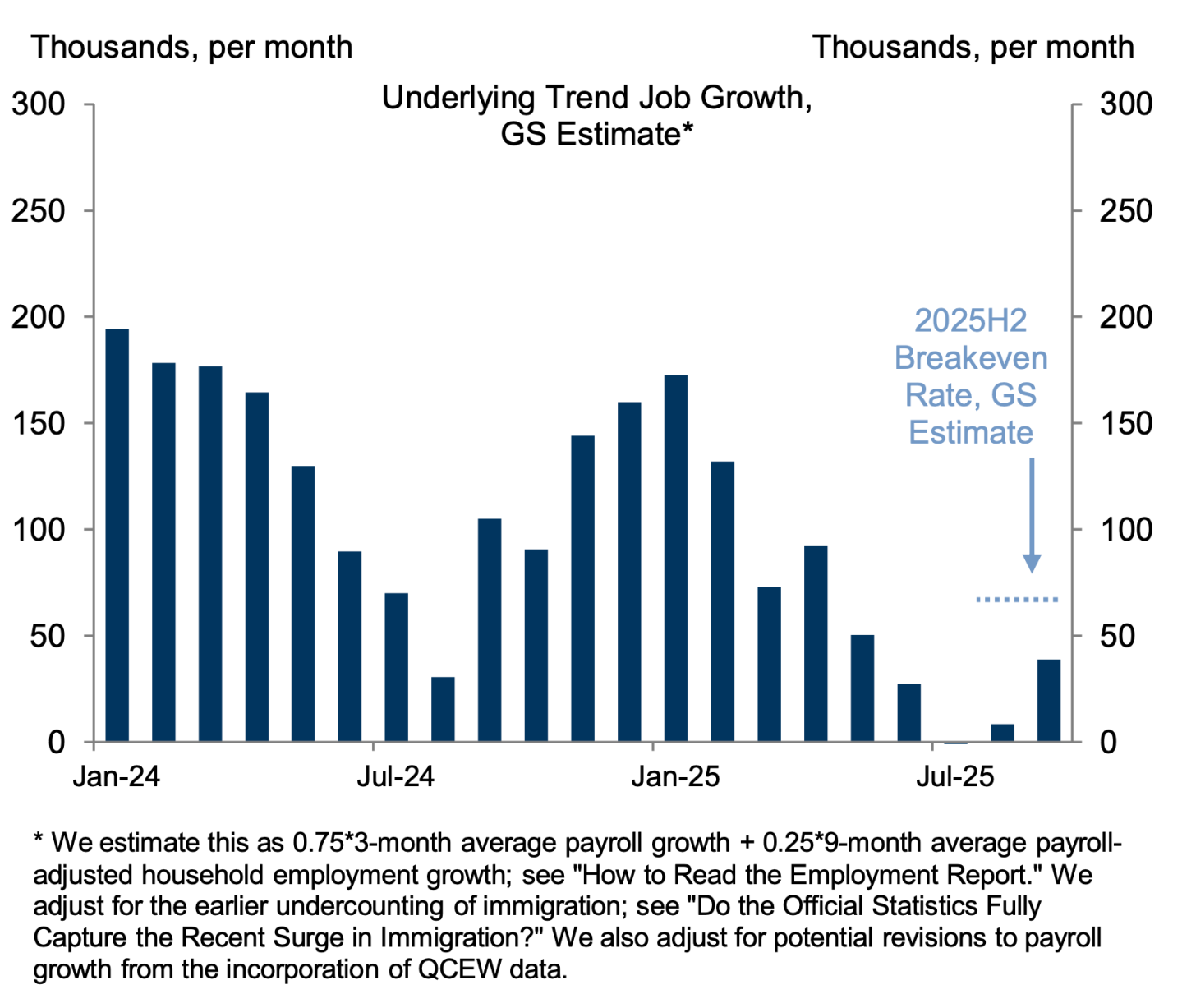
Those missing employment reports—cancelled by the U.S. government shutdown—will leave the Fed more dependent than usual on anecdotal or imperfect private employment data. The Fed’s “beige book,” a periodic summary of quotes from American businesses, shows that employers are increasingly not creating new jobs. 

“Last week’s Beige Book suggested that labor demand is weakening via less hiring rather than layoffs – a fragile equilibrium in the labor market that will keep the Fed in a risk management mindset,” Oxford Economics analyst Michael Pearce.

Private employer data is equally gloomy, according to Bill Adams, chief economist for Comerica Bank in Dallas. ADP, Revelio Labs, and Challenger, Gray, & Christmas—three companies that compile private market jobs data—all saw payrolls falling in the last few months, he told Fortune. “Challenger, Gray, & Christmas reported employers announced plans for 71,000 job cuts in November, up 24% from the same month last year. They cited restructuring, market and economic conditions, and artificial intelligence as key reasons for layoff announcements,” he said. 

If the labor market continues to deteriorate, then it becomes less likely that Powell will say interest rates are “in a good place” and more likely that the Fed will deliver future cuts in 2026.

Here’s a snapshot of the markets ahead of the opening bell in New York this morning:

  • S&P 500 futures were flat this morning. The last session closed down 0.35%. 
  • STOXX Europe 600 were flat in early trading. 
  • The U.K.’s FTSE 100 was flat in early trading. 
  • Japan’s Nikkei 225 was up 0.14%. 
  • China’s CSI 300 was down 0.51%.
  • The South Korea KOSPI was down 0.27%.
  • India’s NIFTY 50 was down 0.47%. 
  • Bitcoin slid to $90K.


Source link

Continue Reading

Trending

Copyright © Miami Select.
