Connect with us

Business

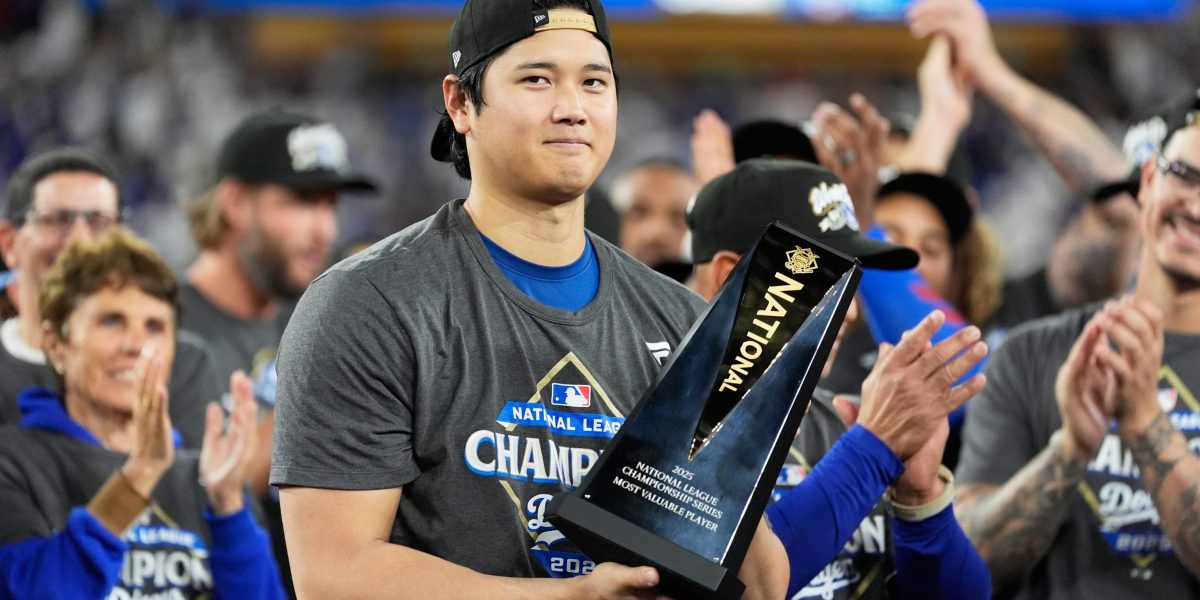
Dodgers superstar Shohei Ohtani plays one of the greatest games in baseball history, throwing 10 strikeouts and hitting 3 home runs

Published

on


When Shohei Ohtani’s third home run rocketed off his bat and streaked toward the left-field bleachers, the few fans still sitting at Dodger Stadium rose frantically, as if every single seat in the sold-out building had received a shock.

At the plate and on the mound, Ohtani was simply electrifying in Game 4 of the National League Championship Series while he conjured one of the greatest single-game performances in baseball history — perhaps even all of sports.

The Los Angeles Dodgers’ two-way superstar delivered the 13th three-homer game in postseason annals Friday night, connecting in the first, fourth and seventh innings for three epic solo shots traveling a combined 1,342 feet.

He was similarly brilliant on the mound, throwing scoreless, two-hit ball into the seventh inning with 10 strikeouts and a masterful variety in his 100 pitches.

Ohtani also did it all at an extraordinarily important moment for his team: The Dodgers’ 5-1 victory over the Milwaukee Brewers sent the defending champions back to the World Series with a four-game sweep of the majors’ best regular-season squad.

“That was probably the greatest postseason performance of all time,” Dodgers manager Dave Roberts said. “There’s been a lot of postseason games. And there’s a reason why he’s the greatest player on the planet. What he did on the mound, what he did at the bat, he created a lot of memories for a lot of people.”

After the raucous postgame celebration of the Dodgers’ second straight NL pennant since he joined the club, Ohtani attempted to deflect some of the spotlight to his teammates.

“There were times during the postseason where Teo (Teoscar Hernández) and Mookie (Betts) picked me up, and this time around, it was my turn to be able to perform,” Ohtani said through his interpreter. “And I think just looking back over the course of the entire postseason, I haven’t performed to the expectation, but I think today we saw what the left-handed hitters could do.”

One left-handed hitter in particular carried the Dodgers to the World Series — and Ohtani, who reached base four times in four plate appearances, even identified the perfect capper to his historic evening.

“This is really a team effort, so I hope everybody in LA and Japan and all over the world can enjoy a really good sake,” said Ohtani, a connoisseur of the famed Japanese rice wine, while the crowd roared.

Ohtani earned the NLCS MVP award almost solely on the strength of this one iconic game. He was 2 for 11 with a triple and three walks in the first three games of the series.

He had been in an October slump by his lofty standards, going 6 for 38 in the postseason and sitting on an eight-game homer drought after hitting a franchise-record 55 in the regular season.

That’s the nature of Ohtani’s boundless talent, however: He can transform into a sporting superhero seemingly whenever he chooses, and the mound was his telephone booth in Game 4.

“The way he was struggling this postseason, and not to let it affect him and keep his psyche, his confidence, the same, is really impressive,” Roberts said. “So we knew that he was going to come through at some point. And what better night to do it while he was pitching, too.”

After Ohtani struck out three Brewers in the top of the first inning, he hit the first leadoff homer by a pitcher in major league history during the bottom half — and his night of incredible feats was just beginning.

His second homer was a jaw-dropping, 469-foot drive that cleared the pavilion roof in right-center — a place where few homers ever land — after leaving his bat at 116.9 mph.

His seventh-inning shot settled in the left-center bleachers and crushed the Brewers, who had finally chased him from the mound by getting two runners on in the top of the inning, only to go scoreless anyway when reliever Alex Vesia escaped the jam.

The three-time MVP is the first player with a three-homer postseason game since Chris Taylor did it for the Dodgers in October 2021. Kiké Hernández, Ohtani’s current teammate, also accomplished the feat for Los Angeles in the 2017 NLCS.

Ohtani became the third pitcher and first in 87 years to hit three homers in a game in which he was a starting pitcher, according to the Elias Sports Bureau. The others were Jim Tobin for the Boston Braves on May 13, 1942, and Guy Hecker for Louisville on Aug. 15, 1886.

Ohtani, who hadn’t gone deep since hitting two in Los Angeles’ playoff opener against Cincinnati, is the first Dodgers player with two multihomer games in one postseason. He also became the first player with two homers in any game with 116 mph or higher exit velocity since Statcast started tracking in 2015.

And the right-hander was outstanding on the mound as well.

He issued two early walks but didn’t allow a hit until Jackson Chourio led off the fourth with a ground-rule double. Ohtani stranded him with a grounder and two strikeouts.

He got two more punchouts in the fifth and sixth, with Dodgers fans rising for ovations each time he walked back to the dugout to exchange his glove for a bat.

While his two-way role requires extensive off-field work to stay ready for both jobs, Ohtani had pitched in only two games over the past 30 days before Game 4, thanks to the permutations of the Dodgers’ schedule.

In his last regular-season start, Ohtani pitched six scoreless innings of five-hit ball against Arizona on Sept. 23, throwing a season-high 91 pitches. In his MLB postseason mound debut Oct. 4, he gave up three runs over six innings with nine strikeouts to earn the victory in Los Angeles’ 5-3 win at Philadelphia in the Division Series opener.

Ohtani also had the motivation of matching his fellow Dodgers starters, who have been phenomenal on the mound ever since the playoff race got serious.

The Dodgers’ rotation held batters in September to an MLB record-low .173 average for a single month. Since the postseason began, Los Angeles’ four starting pitchers — Blake Snell, Yoshinobu Yamamoto, Tyler Glasnow and Ohtani — have allowed just 10 earned runs while pitching 64 1/3 innings with 81 strikeouts over their 10 playoff games.

Ohtani and the Dodgers have earned a week off before the World Series begins next Friday at either Toronto’s Rogers Centre against the Blue Jays or Chavez Ravine against the Seattle Mariners.

This club has struggled with long layoffs in past postseasons, but Ohtani acknowledged he can use a break — and the Dodgers will spend at least the next couple of days basking in the brilliance they witnessed while punching their ticket to the Fall Classic.

“I do see it as a positive in terms of being able to rest, both as a position player and as a pitcher,” Ohtani said. “We’ve had some off days, but we’ve played some very meaningful games that were very stressful.”



Source link

Continue Reading

Business

International deals race forward to end China’s hold on critical minerals since US can’t do it alone

Published

on


Pini Althaus saw the signs. In 2023, he left the company he founded, USA Rare Earth, to develop critical minerals mining and processing projects in central Asia, after realizing that the U.S. will need all the international help it can get to end China’s supply chain dominance.

“I realized we only have a handful of large critical minerals projects that were going into production between now and 2030,” Althaus, chairman and CEO of Cove Capital, told Fortune. “I understood that we’re going to have to supplement the United States critical minerals supply chain with materials coming in from our allied and friendly countries.”

Over a series of decades, China built up its stranglehold on much of the world’s critical minerals supply chains, including the 17 rare earths, used to make virtually all kinds of high-performance magnets and parts for vehicles, computers, power generation, military defense, and more. The rest of the world deferred to Beijing in exchange for cheap prices.

Amid an ongoing tariff war with the U.S.—and a temporary truce—the Trump administration is racing to build up domestic mining and processing capabilities, while also developing the global partnerships necessary to eventually undermine China, which controls 90% of the world’s rare earths refining.

In October, Trump inked a deal with Australia for both countries to invest $3 billion in critical minerals projects by mid-2026. Australia is home to the largest publicly traded critical minerals miner in the world, Lynas Rare Earths. Trump then signed a series of bilateral critical minerals deals in eastern and southeastern Asia, including Japan, Malaysia, Thailand, Indonesia, and Cambodia. The U.S. also has new deals with Ukraine, Argentina, the Democratic Republic of Congo, Rwanda, Kazakhstan, and more.

Althaus is specifically developing mining and processing facilities for tungsten—a heat-resistant metal used in electronics and military equipment—and rare earths in Kazakhstan and Uzbekistan. He sees the most potential in former Soviet Union nations in central Asia.

“The Soviets spent many decades exploring and developing mines. Many of their databases have been left and are quite meticulous,” Althaus said. “This gives companies looking to develop projects in central Asia a jumpstart compared to what would be here in the United States, where most of the opportunities are greenfield—very early stages, very high risk, and very little appetite for investment.”

In November, the Ex-Im Bank offered Cove Capital a $900 million financing letter of interest for the $1.1 billion Kazakh tungsten projects. A separate letter of interest was received from the U.S. International Development Finance Corporation.

Jeff Dickerson, principal advisor for Rystad Energy research firm, said only a long-term, coordinated effort—essentially a “wartime” approach—both domestically and with international partnerships can lead to success. But it cannot be done without new projects with foreign allies. “The challenge is that the U.S. doesn’t have a strong pipeline of mature mineral projects that are shovel ready,” he said. 

“The cycle of China extracting concessions on the back of mineral geopolitics and weakening the U.S. strategic negotiating position will likely continue without a coordinated, long-term response during the current moment of heightened attention to critical minerals,” Dickerson said, questioning whether the U.S. will maintain a concerted focus for years to come.

New emphasis

The Trump administration is increasingly making financial partnerships with critical minerals developers—even becoming a majority shareholder of U.S. rare earths miner MP Materials—and offering deals for floor-pricing mechanisms to offset China’s recurring dumping practices that aim to eliminate competition.

A native Australian turned New Yorker, Althaus is, naturally, a big fan of this approach. Chinese price dumping has crippled global competition and scared away potential investors, he said.

“By providing a price floor, it removes the question marks; it removes the instability; it removes the most significant risk in funding a project that’s about to go into production,” Althaus said. “It creates a predictability where you can take geology all the way through to profitability. I think there should be a global effort to create transparent markets and prices for the key critical minerals.”

Critical minerals are increasingly included in U.S. negotiations for all foreign deals. In the tariff agreement with Indonesia, for instance, the Asian nation agreed to lift export bans on nickel. The White House leveraged its military support for Ukraine by demanding the rights to its critical minerals in return. And the recent U.S. bailout of Argentina included a partnership on critical minerals mining.

In addition to its strategic defense location, rare earths are even a reason Trump continues to show interest in annexing Greenland from Denmark.

Veteran geologist Greg Barnes, who founded the massive Tanbreez mining project, which remains in development, briefed Trump at the White House during his first presidential term. This year, Critical Metals acquired 92.5% ownership of the Tanbreez project.

Critical Metals CEO Tony Sage is keen to supply the U.S. with desired rare earths, and the company recently received a letter of intent for a $120 million Ex-Im Bank loan. The goal is to start construction by the end of 2026.

“There’s an absolute need to make sure that more than 50% of the supply of these heavy rare earths come from outside of China—mined and processed outside of China,” Sage told Fortune.

Regardless of any long-shot annexation bids, Sage said Greenland can and should be a key ally to the U.S. for critical minerals. “They definitely don’t want to be part of the U.S., but I think they’ll be pro-U.S.,” he said.

For his part, Althaus said he sees all the international deals as progress, and not as competition for his Cove Capital.

“I think it’s a positive, and I think we’ll start to see a lot more happen in the coming months in terms of the U.S. and collaboration with other countries.”


Source link

Continue Reading

Business

Amazon’s new Alexa aims to detangle chaos in the household, like whether someone fed the dog

Published

on


It’s 10 p.m. after a long day when you walk in the door and wonder aloud: “Did anyone feed the dog? Who fed the dog,” Panos Panay says he calls out to his family of six.

Turns out, nobody fed the dog and so all the kids “scatter to their corners,” he told Fortune’s Brainstorm AI audience in San Francisco on Monday. 

The senior vice president of devices and services at Amazon says the new generative AI-powered Alexa+, which runs on Echo hardware and can integrate with other devices like Amazon’s Ring security cameras, aims to ease the constant mental load in a household: remembering whether the pets ate, restaurants each family member pitched and saw vetoed, and regular grocery orders. The idea is to have “ambient” artificial intelligence around your house so that devices can assist in tasks, chores, and other household command center issues, said Panay.

The new Alexa+ is much more conversational, Panay said, and you no longer have to pronounce everything perfectly and discretely in order for it (or her, as Panay refers to the virtual assistant) to understand you.

“She’s the best DJ on the planet, in my opinion,” said Panay. “You have a personal shopper, you have a butler, you have a personal assistant, you have your home manager. Different people use Alexa for different things, and now she’s pretty much supercharged,” Panay said.

In addition to confirming that the dogs have not been fed, Panay said he used Alexa+ on Sunday night to head off another age-old debate: where the family should go for dinner. Both dinner decisions and pet chores are “classic fight[s] in my house,” Panay told the Brainstorm AI audience.

His youngest had previously suggested a few restaurants she wanted to visit for a quick bite and hadn’t yet been to, and Panay asked Alexa to remind them which ones his daughter suggested specifically. It was a sushi joint and she enjoyed it, Panay said. That type of ambient listening and assistance with debate is the point, he said, and stops people needing to pull out their phones and start typing and scrolling for information.   

From there, Panay said Alexa can also take more concrete actions like making a reservation on dining platform OpenTable, ordering delivery on nights in, getting an Uber, and handling home issues such as telling you how many packages were delivered or the number of guests who stopped by. Panay said Amazon has more than 150 partners to aid in these integrations, although there is work ahead to get more partners on board, he added.  

Thus far, Alexa+ has been rolled out to early-access users and this week the product is available to those on a lengthy waitlist, said Panay, and it’s been boosted by Amazon’s advertising. This week, the product is being released to anyone with an Echo device. The business monetization model involves “flywheels” from Amazon’s $2.4 trillion retail ecosystem, particularly around shopping for clothes, groceries, and other consumer items. “If you’re shopping on the grocery list and order groceries often enough, Alexa knows what you’re doing, and ultimately, can just order ahead of time for you moving forward,” he said.

Ultimately, Panay envisions users wanting “your assistant everywhere you go” because “the more it understands about you, the more informed it is, the better it can serve your needs.” And while Panay said there will be continued innovation from Amazon in this space, he refused to reveal any specific products. He said Amazon has a “lab full of ideas,” but most won’t make it out of that lab. 


Source link

Continue Reading

Business

Australia will start banning kids from social media this week

Published

on


Starting this Wednesday, many Australian teens will find it near impossible to access social media. That’s because, as of Dec. 10, social media platforms like TikTok and Instagram must bar those under the age of 16, or face significant fines. Australian Prime Minister Anthony Albanese called the pending ban “one of the biggest social and cultural changes our nation has faced” in a statement.

Much is riding on this ban—and not just in Australia. Other countries in the region are watching Canberra’s ban closely. Malaysia, for example, said that it also plans to bar under-16s from accessing social media platforms starting next year. 

Other countries are considering less drastic ways to control teenagers’ social media use. On Nov. 30, Singapore said it would ban the use of smartphones on secondary school campuses. 

Yet, governments in Australia and Malaysia argue a full social media ban is necessary to protect youth from online harms such as cyberbullying, sexual exploitation and financial scams.

Tech companies have had varied responses to the social media ban. 

Some, like Meta, have been compliant, starting to remove Australian under-16s from Instagram, Threads and Facebook from Dec. 4, a week before the national ban kicks in. The social media giant reaffirmed their commitment to adhere to Australian law, but called for app stores to instead be held accountable for age verification.

“The government should require app stores to verify age and obtain parental approval whenever teens under 16 download apps, eliminating the need for teens to verify their age multiple times across different apps,” a Meta spokesperson said.

Others, like YouTube, sought to be excluded from the ban, with parent company Google even threatening to sue the Australian federal government in July 2025—to no avail.

However, experts told Fortune that these bans may, in fact, be harmful, denying young people the place to develop their own identities and the space to learn healthy digital habits.

“A healthy part of the development process and grappling with the human condition is the process of finding oneself. Consuming cultural material, connecting with others, and finding your community and identity is part of that human experience,” says Andrew Yee, an assistant professor at the Nanyang Technological University (NTU)’s Wee Kim Wee School of Communication and Information.

Social media “allows young people to derive information, gain affirmation and build community,” says Sun Sun Lim, a professor in communications and technology at the Singapore Management University (SMU), who also calls bans “a very rough tool.”

Yee, from NTU, also points out that young people can turn to platforms like YouTube to learn about hobbies that may not be available in their local communities. 

Forcing kids to go “cold turkey” off social media could also make for a difficult transition to the digital world once they are of age, argues Chew Han Ei, a senior research fellow at the Lee Kuan Yew School of Public Policy in the National University of Singapore (NUS).

“The sensible way is to slowly scaffold [social media use], since it’s not that healthy social media usage can be cultivated immediately,” Chew says.

Enforcement

Australia plans to enforce its social media ban by imposing a fine of 49.5 million Australian dollars (US$32.9 million) on social media companies which fail to take steps to ban those under 16 from having accounts on their platforms.

Malaysia has yet to explain how it might enforce its own social media ban, but communications minister Fahmi Fadzil suggested that social media platforms could verify users through government-issued documents like passports. 

Though young people may soon figure out how to maintain their access to social media. “Youths are savvy, and I am sure they will find ways to circumvent these,” says Yee of NTU. He also adds that young may migrate to platforms that aren’t traditionally defined as social media, such as gaming sites like Roblox. Other social media platforms, like YouTube, also don’t require accounts, thus limiting the efficacy of these bans, he adds.

Forcing social media platforms to collect huge amounts of personal data and government-issued identity documents could also lead to data privacy issues. “It’s very intimate personally identifiable information that’s being collected to verify age—from passports to digital IDs,” Chew, from NUS, says. “Somewhere along the line, a breach will happen.”

Moving towards healthy social media use

Ironically, some experts argue that a ban may absolve social media platforms of responsibility towards their younger users. 

“Social media bans impose an unfair burden on parents to closely supervise their children’s media use,” says Lim of SMU. “As for the tech platform, they can reduce child safety safeguards that make their platforms safer, since now the assumption is that young people are banned from them, and should not have been venturing [onto them] and opening themselves up to risks.”

And rather than allow digital harms to proliferate, social media platforms should be held responsible for ensuring they “contribute to intentional and purposeful use”, argues Yee.

This could mean regulating companies’ use of user interface features like auto-play and infinite scroll, or ensuring algorithmic recommendations are not pushing harmful content to users.

“Platforms profit—lucratively, if I may add—from people’s use, so they have a responsibility to ensure that the product is safe and beneficial for its users,” Yee explains. 

Finally, conversations on safe social media use should center the voices of young people, Yee adds.

“I think we need to come to a consensus as to what a safe and rights-respecting online space is,” he says. “This must include young people’s voices, as policy design should be done in consultation with the people the policy is affecting.”


Source link

Continue Reading

Trending

Copyright © Miami Select.