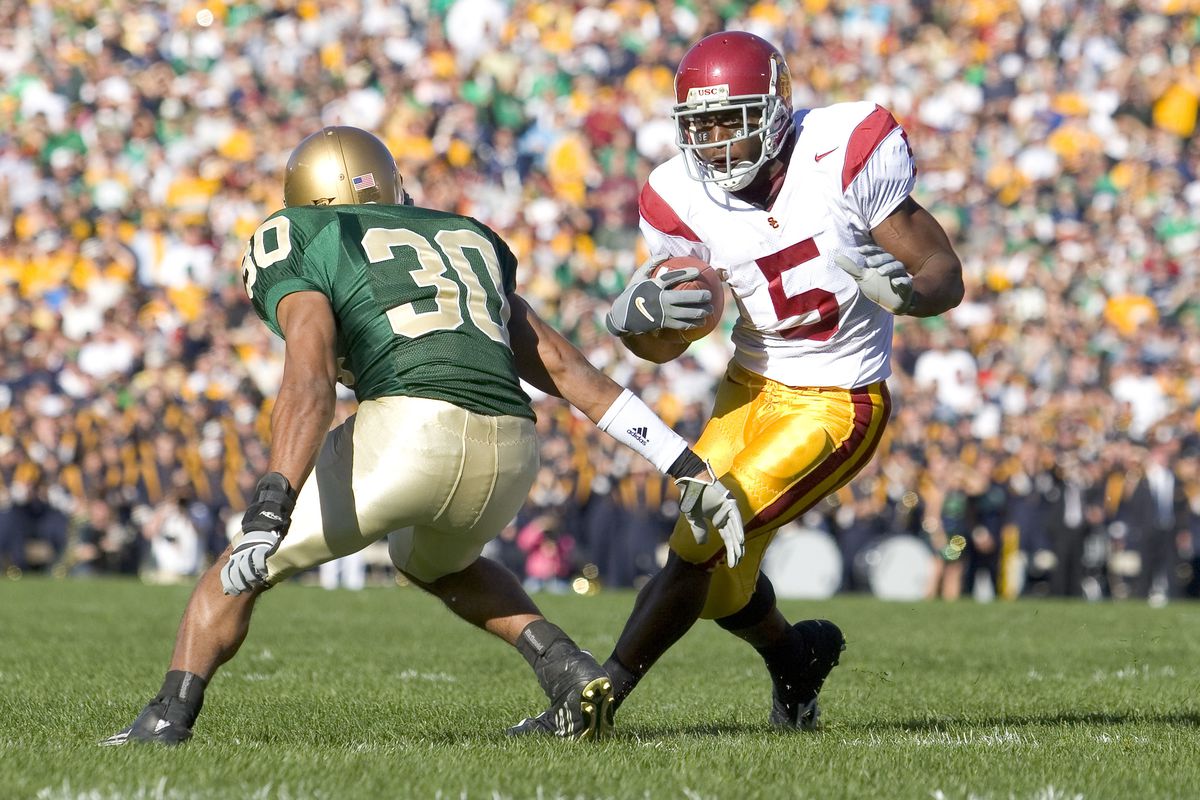
Saturday Night Lights: USC vs. Notre Dame Rekindles College Football’s Most Storied Rivalries
By Jim Williams, Senior Columnist – Capital Sports Network
On Saturday night, under the primetime lights of South Bend, the No. 7 USC Trojans will clash with the No. 10 Notre Dame Fighting Irish in a matchup that transcends rankings and records. Both teams enter the week of October 12th, 2025, nationally ranked in the AP Poll, setting the stage for another chapter in college football’s longest-running transcontinental rivalry. With playoff implications looming and legacies on the line, this isn’t just a game—it’s a cultural moment.
How It All Began: A Coast-to-Coast Connection Forged in Friendship
The USC–Notre Dame rivalry began not with animosity, but with a handshake. In 1926, Notre Dame’s legendary coach Knute Rockne accepted an invitation from USC’s athletic director to bring the Irish west for a game that would help both programs gain national exposure. The idea was simple: pit two Catholic-rooted institutions against each other in a battle of grit, tradition, and coast-to-coast pride. That first meeting in Los Angeles sparked a tradition that has endured nearly a century, surviving wars, coaching changes, and seismic shifts in the college football landscape.
McKay vs. Parseghian: The Golden Era of Tactical Brilliance
The 1960s and early ’70s saw the rivalry reach new heights, thanks to two coaching titans: USC’s John McKay and Notre Dame’s Ara Parseghian. McKay’s Trojans were known for their punishing ground game and West Coast swagger, while Parseghian’s Irish brought cerebral precision and Midwestern toughness.
In 1964, Parseghian’s first year, Notre Dame edged USC 17–0, signaling a new era.
McKay responded in 1967 with a 24–7 win en route to a national title.
The 1974 game remains iconic: USC trailed 24–6 before scoring 49 unanswered points in one of the greatest comebacks in college football history.
These matchups weren’t just games—they were chess matches played on grass, with national titles often hanging in the balance.
Legends of the Rivalry: Icons Who Defined the Series
Some of college football’s most iconic names have taken the field in this rivalry:
USC Trojans:
Marcus Allen: The Heisman winner ran wild in the early ’80s.
Matt Leinart: Cool under pressure, he led USC to a dramatic win in 2005.
Reggie Bush: Electrifying in open space, Bush’s performances against Notre Dame were highlight-reel staples.
Notre Dame Fighting Irish:
Joe Montana: “The Comeback Kid” engineered a legendary rally in 1978.
Tim Brown: The 1987 Heisman winner was a nightmare for USC’s secondary.
Brady Quinn: His battles with Leinart defined mid-2000s college football.
These players didn’t just play—they etched their names into rivalry lore.
Games That Echo Through Time
1974: USC’s 49-point second-half explosion remains one of the most shocking turnarounds in sports history.
1988: Notre Dame’s 27–10 win over No. 2 USC helped propel the Irish to a national championship.
2005: The “Bush Push” game—Leinart’s last-second TD aided by Reggie Bush—still sparks debate and heartbreak in South Bend.
2012: Notre Dame’s 22–13 win sealed an undefeated regular season and a trip to the BCS title game.
Each game adds a layer to the rivalry’s mythology, with drama that rivals any Hollywood script.
Saturday Night Forecast: Fireworks, Grit, and Legacy
Expect fireworks in South Bend. USC’s high-octane offense, led by Heisman candidate quarterback Jalen Reese, will test Notre Dame’s elite secondary anchored by All-American safety Malik Hart. The Irish, powered by a bruising run game and a top-five defense, aim to control the clock and the narrative.
This isn’t just about rankings—it’s about pride, legacy, and the enduring power of a rivalry that spans generations and geography. When the ball kicks off Saturday night, history will be watching.
college championship weekend The 2025 college football season kicks off with one of the most electrifying Week 1 slates in recent memory. With playoff contenders
By: Matthew Weatherby
White smoke has risen from the Nittany Lion atop Beaver Stadium. Penn State has its new Head Coach in Matt Campbell. It was 54 long days since the Nittany Lions fired now Virginia Tech Head Coach James Franklin. They got turned down, people paid, and honestly publicly humiliated throughout the process. Now Campbell from Iowa State is set to take over in Happy Valley. Hoping to calm the mobs coming for Pat Kraft and his job.
This report came a few minutes ago from ESPN’s Pete Thamel, who said Penn State was finalizing a deal for Matt Campbell to become the head coach.
Penn State has finally found its guy, and funny enough, it is a similar route they took when they hired James Franklin in 2014. Franklin’s pedigree was that of a guy who appeared to do more with less. He was the most successful Vanderbilt Head coach until Clark Lea.
Campbell is the same. He won at his first stop, being Toledo’s Head Coach, where he went 35-15, good for a .700 winning percentage. Since he took the job at Iowa State, he has enjoyed some similar success, going 72-55 from 2016-25.
Now to the doing more with less portion. Over the 11 recruiting classes that he brought in at Iowa State, the average ranking was 55.8 in the national standings. Not exactly that of a top-tier program. He has developed that talent, however, with guys like Brock Purdy and Breece Hall being stars in the NFL now.
He also won Coach of the Year 3 times in the BIG 12, receiving the award in 2017, ’18, and ’20. Campbell was also the 2015 MAC Coach of the Year.
With the influx of cash I expect Campbell to receive, in terms of NIL money for the roster, it is not unreasonable to think of this as a great hire. With his coaching pedigree, you would expect the results he was able to give at Iowa State to only be magnified with a bigger brand and budget at Penn State.
What Campbell means for Penn State
It means that Pat Kraft might actually be able to sleep peacefully tonight. He has been contacting seemingly everyone, trying to get them to come to Happy Valley. None of those came to fruition; instead, he was getting them paid at the places they were already employed.
Here, the question that reigns supreme: will it be enough?
This search was an unmitigated disaster, from the inability to get anyone to take their money, all of the negative press, and the rumors of Jimmy Sexton freezing Penn State out for the way they handled Franklin. It could not have been worse for Penn State. You pair that with a group of Paterno people who wanted Terry Smith to be the Head Coach. I wonder if this hire is enough to calm the waters in Happy Valley.
One thing I do know for sure is that winning cures all. Matt Campbell might just be the guy to save Pat Kraft.
Capital Sports Network will be your home for Let ’em Run Happy Hour
Let ’em Run is breaking down races at some new venues, and we will continue to expand our horizons with a variety of tracks, as we listen to what our viewers and readers have to say.
We are breaking down interesting races at Laurel Park and Turfway Park (a little nighttime action) that will be run on Saturday. Then we turn our attention to Aqueduct on Saturday, where there is The Remsen Gr2, a Kentucky Derby prep, and the signature race…The Cigar Mile.
Saturday Roundup Reminder
Be sure to tune into the Saturday “Let ’em Run Roundup” at 12:30 where we will bring even more insight after any scratches and other changes. So catch us this weekend on multiple streaming apps and social channels!!
Race 6 — 2:23 EST — The Maryland Juvenile — 125K — 7 Furlongs (Dirt) Some talented 2 y.o.’s line up for this race, at the always tricky distance for young runners at 7 furlongs. I am going to lean on #3 Sometime 9-2. Was ambitiously placed in the Iroquois against some of the best milers in the division. Breeding out of Take Charge Indy, who came in 1st at The Florida Derby and The Clark Handicap, so the talent is there. The #4 Biker Bailey 4-1 came out of a Md 20k, but took over the field and posted a 70 BSF. Could go to the front and not look back. Bet = $10 Ex Box 3,4 = $20
Saturday 12/6 — Turfway Park
Race 7 — 8:55 EST — The Boone County — 125K — 1 ¼ (Synthetic) Big field to choose from gives us plenty of options and value to boot. Jockey Fernando De La Cruz hops aboard #10 Swift Delivery 5-1, 1 of 2 Mark Casse entrants. A failed turf experiment, in between two Gr3 races on synthetic, make this horse the one to beat. Tough post, but De La Cruz can work out a trip and close on the field. The #1 Funtastic Again 5-1, is the horse for course and surface. Has ran in a steady diet of 6 Graded races last 6x, and now gets relief and a good post to go to the front. Jockey Gerado Corrales is very familiar with this runner.
Saturday 12/6 — Aqueduct (Races 7–11)
Race 7 — 2:11 EST — Alw 88K N1X — 1 Mile (Dirt)
Nice start to the late P5 for Let ’em Run, with a big field of 12 runners. Hard to look past #6 Life and Times 8-5. As a student of pace figures, this runner has an early pace figure of 142!! Out of Justify, and 2nd time out runners for that sire often improve…scary. Likely to have some company up front, but just too fast. Bet = P5 = 6 / All / All / 6 / 2 = $78 (based on current entries)
Race 8 — 2:39 EST — The NY Stallion Series — 500K (Fillies) — 7 Furlongs (Dirt)
Another full field of 2 y.o. fillies running at 7 furlongs. Going with #12 Daniella Marie 6-1, the entry for the “other Chad”… trainer Chad Summers, who is heating up and excellent with 2.y.o’s. Jockey Kendrick Caramouche stays on, and never really asked her in last, when she won by 9 ¼ lengths. Likely post time fave #10 Hot Currency 7-2, looking to improve with stud jockey Flavian Prat retaining the mount.
Race 9 — 3:08 EST — The Remsen Gr2 — 250K — 1 ⅛ (Dirt)
Kentucky Derby prep race, with 12 runners ready to go. The #11 Talkin 5-1 for trainer Danny Gargan is my top choice. Gargan is looking to hit the Derby trail again with a good one here, out of top Sire Good Magic. Runner beat Further Ado in Maiden, and that runner is labeled as a Derby favorite, so why not this guy. Jockey Kendrick Caramouche has options from a tough post, with interesting Brisnet early and late pace figures both high, and nearly the same (early 106 / late 102). Once again the Flavian Prat runner #2 Paladin 3-1 will get much deserved attention.
Race 10 — 3:37 EST — The Cigar Mile Gr2 — 500K — 1 Mile (Dirt)
Really can’t see anyone beating the fast and talented #6 Phileas Fogg 8-5. Two new wrinkles; with blinkers going on and jockey Joel Rosario taking the mount. Trainer Rodriguez Gustavo gave him a break pointing to this race, and said “it’s showtime“; when asked how he was doing!!
Two notes per Brisnet, lone E speed, and best pace to the 6 furlong distance, by a lot. So should have company early, but will then pull away to the wire.
Race 11 — The NY Stallion Series — 500K — 7 Furlongs
Once again the Big A putting out a big field for bettors. Trainer Butch Reid has #2 Parker Boone 8-5 ready to make some noise. Runner won by 12 ¼ 1st time out and was under wraps early. Naysayers will say “who did he beat”, but runners out of Solomini are often very good, very early. Will have other speed to deal with, but a ground saving post should seal the deal.
Final Notes
Stay tuned as we continue to grow, and tune in on Saturday for our 12:30 Podcast, with scratches and changes affecting our picks. And as the saying goes, Let ‘em Run.
NFL and COLLEGE FOOTBALL – THE sec How Sports Is Saving Broadcast TV: The Rise of Live Programming in a Streaming-Dominated Era
Escalating costs of NFL and MLB renewals, combined with cable decline and streaming fragmentation, are likely to make ESPN, Amazon, Apple, CBS, NBC, Fox, and YouTube more cautious about paying significantly higher college football rights fees. This financial pressure could slow down aggressive expansion and reduce the incentive to add ACC schools like Florida State, Clemson, North Carolina, and Miami, especially since their recent on-field performance has weakened their market value.
NFL & MLB renewals dominate budgets: The NFL’s Thanksgiving 2025 ratings shattered records, proving why networks will commit billions more to retain rights. MLB’s upcoming renewal adds another heavy obligation.
Streaming entrants already stretched: Amazon, Apple, and YouTube are investing heavily in NFL packages and global sports, limiting their appetite for additional college conference deals.
Cable volatility: Cord-cutting erodes traditional revenue streams, forcing networks to be more selective with rights investments.
College Conference Dynamics
Big Ten & SEC remain secure: Their multibillion-dollar deals ($8B+ for Big Ten, $3B for SEC) ensure stability and make them the only conferences positioned to expand further but only if there is more money to get from the media partners.
ACC locked in: ESPN extended its deal through 2036, giving the conference stability but limiting renegotiation. This makes poaching ACC schools less financially attractive unless ESPN adjusts terms.
Big 12 opportunism: Benefited from Pac-12’s collapse, but future expansion depends on whether networks see value in adding mid-tier programs.
Risks for ACC Schools
Performance matters: Florida State, Clemson, UNC, and Miami have struggled with subpar seasons, reducing their bargaining power. Networks are less likely to pay premiums for underperforming brands.
Revenue-sharing pressures: Following the House v. NCAA settlement, schools must share revenue with athletes, increasing the need for higher payouts. If networks won’t pay more, weaker conferences risk losing schools without replacement value.
Exposure vs. payout trade-off: Streaming platforms may prefer cherry-picking marquee matchups rather than funding entire conferences, further reducing incentives to add schools.
Likely Outcomes
Slower expansion: Networks will prioritize retaining NFL/MLB rights over funding new college realignment.
Selective poaching: Big Ten and SEC may still target top ACC schools if they rebound competitively, but only if the economics justify it.
ACC stability (for now): ESPN’s long-term deal through 2036 makes immediate exits difficult, though lawsuits from FSU and Clemson could test that structure.
Bottom Line
The financial strain of NFL and MLB renewals means networks are unlikely to pay dramatically more for college football in the near term. That reduces the incentive for conferences to expand aggressively, making another Pac-12-style collapse less likely in the short run — but leaving underperforming ACC schools vulnerable if their value doesn’t rebound.