Connect with us

Business

Jamie Dimon calls Zohran Mamdani’s movement ‘Marxist on paper,’ but he’s offering his help: ‘Get involved and grow up’

Published

on


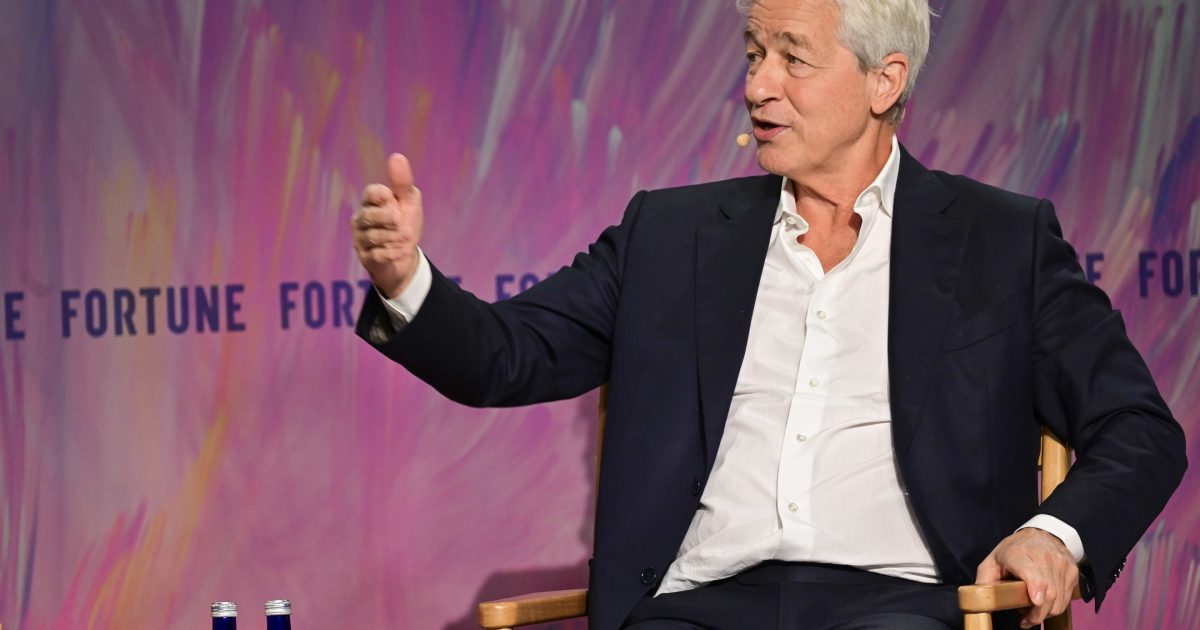
Jamie Dimon, CEO of JPMorgan Chase, long considered Wall Street’s most Democrat-friendly executive, has broken with the party this year, calling them “idiots” with “little brains” in July. He added some fierce criticism of New York City’s leading mayoral candidate, the Democratic Socialist assemblyman Zohran Mamdani, from Queens, calling him “more a Marxist than a socialist.” Then, something interesting happened, as Bloomberg reported on a Mamdani charm offensive that included direct engagement with Dimon. The New York Times‘ Dealbook reported recently that this effort has only deepened since, with Mamdani talking to many “key power brokers” behind the scenes. When Dimon sat down with Fortune at the Most Powerful Women summit earlier this week, he said he will be around to help.

“If he becomes mayor, so be it,” Dimon told Fortune editor-in-chief Alyson Shontell. Without directly alluding to any private conversations between the two, Dimon wondered aloud, “what does he really think? You know, he was part of that socialist democratic thing, which literally is more Marxist than socialist — and I read it — but I don’t know what he believes in that.” Dimon added that Mamdani is “talking to a lot of people, he’s convinced a lot of people [that] he’s going to change [and] he wants to learn.” Dimon shrugged, saying he doesn’t know if that will truly be the case. “You know, some people are what they are, they’re not going to change.”

Dimon, whose bank just unveiled a gleaming new bet on New York City in the form of a new, multibillion-dollar headquarters that dominate a stretch of midtown Manhattan, said he’s seen lots of mayors come and go. “A lot of these folks have never run something, and all of a sudden they’re running a huge bureaucracy” where people expect results on crime, sanitation, even potholes. “Those things are not Democrat or Republican,” and most mayors realize they’ve got to deliver those results. In Mamdani’s case, he added, “I would hope for the best of this case, and New York will survive,” adding in a shot at another liberal mayor who Dimon previously claimed never called him once in eight years: “You know, we survived [Mayor] Bill de Blasio.”

‘Capitalism has a lot to fix’

Still, Dimon said, even though he believes New York is resilient, “it is odd to have the bastion of American capitalism with a socialist” looking likely to be elected, but he used the moment to reflect on what that says about the capitalism system itself. “Capitalism has a lot to fix,” he said, adding that he doesn’t think everything about it is working. He touched on the idea of free markets, and implicitly the efficient markets hypothesis: “We’ve never had free markets, like totally free, you need properly regulated systems and disclosures.” Adding that many regulators are doing good work, that doesn’t mean some regulations weren’t overdone. To Dimon’s point, Mamdani’s appeal has proven so far to be broad among New Yorkers, but his base of so-called Democratic Socialists is youthful and millennial-influenced, comprising many members of a generation who have a markedly less favorable view on capitalism than their forebears.

Despite ideological differences, Dimon vowed to offer his support to Mamdani—or any mayor—facing the challenge of governing New York. “If he becomes mayor, I will call him and offer my help,” Dimon said. While bound by regulatory constraints that limit direct political involvement due to JPMorgan’s business dealings with the city, he remained adamant about his role as a civic partner. “We will help them. You know, I am a patriot. I help governors, mayors, presidents. We help people around the world,” Dimon stated, signaling that the greater mission is to serve residents regardless of political leadership.​

The giant sucking sound

The JPMorgan CEO also talked briefly about the national political scene, arguing that not even “the most liberal Democrat room” would say the government is well run and efficient. “How many of you think if you gave Washington another $1 trillion, that you would be better off, that poor people would be better off?”

Pressed on the question of President Trump’s tariffs policy, Dimon demurred, saying he had to be very careful about the details and discussing the various legal precedents. He added that he thought the government made a good deal when it controversially took a stake in MP Materials, which JPMorgan advised on as a bank. “They signed a long-term contract, which these companies need to survive,” and it’s a “reasonable thing to do” for the government to see its investment payoff, on national security grounds. He declined to comment on a similar deal where the government invested directly in Intel, with critics arguing the government has never entered private enterprise in such a scale. Then he took another shot at the politically loaded subject of DEI (diversity, equity and inclusion) and the party he said has “big hearts and little brains,” the Democrats: “And remember, whatever you think of it, if Democrats do it, it terrifies me. They’ll be dictating to us every social value system they believe, and that’ll be that … we’ll look like Europe in 10 years.”

Dimon summed up his worldview by saying he looks at it “a little bit like realpolitik,” referencing the German phrase meaning “the politics of reality” that dates back to the 19th century, emphasizing a pragmatic approach to politics and diplomacy that prioritizes practical considerations over ideological ones. “Get involved and grow up,” Dimon said. “That’s the goal we got.”

Recent polling indicates Zohran Mamdani has maintained a strong lead in the New York City mayoral race, solidifying his position as the mayoral favorite despite challenges from rivals Andrew Cuomo and Curtis Sliwa. In the first general election mayoral debate, which took place days after Dimon’s interview, Mamdani’s performance helped reassure supporters and keep his momentum, although opponents are still aggressively questioning his proposals and readiness for office.


Source link

Continue Reading

Business

‘Creativity is the new productivity’: Bob Iger on why Disney chose to be ‘aggressive’

Published

on


In a landmark move that signals a definitive shift in how major media conglomerates approach artificial intelligence (AI), OpenAI has gone from the company that had unapproved Disney princesses being made from its tools to a $1 billion partnership with the house of mouse itself. Disney CEO Bob Iger unpacked the deal jointly with OpenAI CEO Sam Altman in a TV interview with CNBC’s Squawk on the Street, explaining “we’d rather participate in the rather dramatic growth, rather than just watching it happen and essentially being disrupted by it.” He also reframed the issue of how AI is reshaping entertainment, business, even work itself: “Someone once said to me that creativity is the new productivity, and I think you’re starting to see that more and more.”

The deal, which brings Disney’s intellectual property to OpenAI’s video generation platform Sora, is structured to balance “aggressive” intellectual property protection with a willingness to embrace inevitable technological disruption, Iger said. Under the terms of the three-year agreement, Disney will license approximately 200 characters for use within Sora, allowing users to create short-form videos featuring iconic figures ranging from Mickey Mouse to Star Wars personalities.

Iger framed the partnership not as a concession to AI, but as a necessary evolution—and one that is actually good for human artists. This is because the deal does not include name and likeness, nor does it include character voices. “And so, in reality, this does not in any way represent a threat to the creators at all, in fact, the opposite. I think it honors them and respects them, in part because there’s a license fee associated with it.” Iger stressed repeatedly Disney wants to be on the cutting edge of how technology reinvents entertainment. “No human generation has ever stood in the way of technological advance, and we don’t intend to try.”

The partnership stands in stark contrast to Disney’s relationship with other tech giants. On the same day the OpenAI deal was announced, Disney sent a cease-and-desist letter to Google regarding alleged misuse of IP. Iger explained the divergence in approach by noting that, unlike Google, OpenAI has agreed to “honor and value and respect” Disney’s content through a licensing fee and safety guardrails. “We have been aggressive at protecting our IP, and we have gone after other companies that have not honored our IP,” Iger said, adding conversations with Google had failed to “bear fruit.”

A win-win partnership?

For OpenAI, reportedly under pressure from the aforementioned Google—whose Gemini 3 has been hailed by AI luminaries such as Salesforce billionaire Marc Benioff—the deal represents a validation of its generative video technology. Altman told CNBC user demand for Disney characters was “sort-of off the charts,” and he envisioned a future in which fans can generate custom content, such as a “Buzz Lightyear custom birthday video” or a personalized lightsaber scene. Altman argued the partnership would unlock “latent creativity” in the general public by lowering the skill and effort required to bring ideas to life.

The collaboration will also extend to Disney’s own streaming platform. Iger revealed plans to integrate “user prompted Sora-generated content” directly into Disney+. He said specifically Disney has “wanted for a long time to have what we will call user-generated content on our platform,” suggesting this partnership is a defensive move with regard to streaming giant YouTube and social media epicenter TikTok, which is partially under the control of the Ellison family that also controls entertainment rival Paramount.

The deal includes undisclosed warrants, giving Disney a financial stake in OpenAI’s success. Iger confirmed the warrants and declined to offer more specifics. He compared this forward-thinking approach to Disney’s 2005 decision to license shows to iTunes, viewing the OpenAI partnership as the modern equivalent of boarding a “profound wave” of societal change.

Iger revealed the groundwork for this deal was laid several years ago, saying he had first met Altman in 2022, when he was retired from Disney, before his comeback as CEO. Altman gave Iger a “bit of a road map” about where OpenAI was headed, and Disney has been “extremely impressed” with OpenAI’s growth since then, with all of Altman’s predictions from 2022 coming true a lot faster than either party realized. Iger added Disney sees great opportunities to license other product from OpenAI in the years ahead, which he sees being a huge push in “essentially accomplish[ing] a lot of what we feel we need to accomplish in the years ahead.”


Source link

Continue Reading

Business

Why Jerome Powell’s latest rate cut still won’t help you get a lower mortgage rate

Published

on


For the third meeting in a row, the Federal Reserve cut interest rates—a “hawkish” move in an effort to help a softening labor market. The 0.25% cut brought the interest rate range to 3.5% to 3.75%—but economists and housing experts warn that’s not going to affect mortgage rates in the way potential homebuyers were hoping for. 

Chen Zhao, head of economics research at Redfin, wrote in a Wednesday post that the Fed’s December interest rate cut won’t move mortgage rates “because markets have already priced it in.” 

The Federal Reserve controls the Federal funds rate, which is a rate that banks charge each other and is more closely tied to credit cards, personal loans, and home-equity lines. A standard 30-year mortgage, on the other hand, is a long-term loan, and the pricing of those loans are tied more closely to yields on longer-term bonds like the 10-year Treasury and mortgage-backed securities. 

“Since this rate cut was no surprise, the markets have taken it in stride,” 43-year mortgage industry veteran Melissa Cohn, regional vice president of William Raveis Mortgage, told Fortune. She said more dropping shoes in terms of economic data will be the real turning point: “The future of bond yields and mortgage rates will be determined as new data on jobs and inflation get released.”

The current mortgage rate is 6.3%, according to Mortgage News Daily, which is of course much higher than the sub-3% rate that homebuyers from the pandemic era remember, although it’s also a far cry from the 8% peak in October 2023

“The committee’s projections and Chair Jerome Powell’s remarks indicate that this will be the last interest cut for a while,” Zhao wrote. “Given the underlying economic fundamentals of 3% inflation coupled with a weakening—but not recessionary—labor market, the Fed is likely to hold steady in the near future.

“Mortgage rates are unlikely to fall or rise by much,” she continued.

How mortgage rates affect housing affordability

Mortgage rates are just one piece of the housing affordability puzzle. While it may feel as if it’s the major roadblock in the ability to buy a home—especially having a recent memory of the pandemic housing boom—mortgage rates are only one factor. 

To put it in perspective, Zillow reported earlier this year not even a 0% mortgage rate would make buying a house affordable in several major U.S. cities. 

Let that sink in. 

Even without any interest accrued on a loan, homebuying is still out of reach for the typical American. Much of the affordability crisis has to do with home prices, which are more than 50% higher than in 2020. This has locked out new homebuyers from entering the market and current homeowners from selling. 

The mortgage rate drop required to make an average home affordable (to about 4.43%) for the typical buyer is “unrealistic,” according to Zillow economic analyst Anushna Prakash.  

“It’s unlikely rates will drop to the mid-[4% range] anytime soon,” Arlington, Va.–based real estate agent Philippa Main told Fortune. “And even if they did, housing prices are still at historic highs.” With 11 years of experience, Main is also a licensed mortgage loan officer.

To be sure, some economists see some light at the end of the tunnel for homebuyers plagued by high mortgage rates and home prices.

“For prospective buyers who have been waiting on the sidelines, the housing market is finally starting to listen,” wrote First American chief economist Mark Fleming in an Aug. 29 blog post. First American’s analysis takes into account inflation, and Fleming said: “The price of a house today is not directly comparable to the price of that same house 30 years ago.”


Source link

Continue Reading

Business

OpenAI debuts GPT-5.2 in effort to silence concerns it is falling behind its rivals

Published

on


OpenAI, under increasing competitive pressure from Google and Anthropic, has debuted a new AI model, GPT-5.2, that it says beats all existing models by a substantial margin across a wide range of tasks.

The new model, which is being released less than a month after OpenAI debuted its predecessor, GPT-5.1, performed particularly well on a benchmark of complicated professional tasks across a range of “knowledge work”—from law to accounting to finance—as well as on evaluations involving coding and mathematical reasoning, according to data OpenAI released.

Fidji Simo, the former InstaCart CEO who now serves as OpenAI’s CEO of applications, told reporters that the model should not been seen as a direct response to Google’s Gemini 3 Pro AI model, which was released last month. That release prompted OpenAI CEO Sam Altman to issue a “code red,” delaying the rollout of several initiatives in order to focus more staff and computing resources on improving its core product, ChatGPT.

“I would say that [the Code Red] helps with the release of this model, but that’s not the reason it is coming out this week in particular, it has been in the works for a while,” she said.

She said the company had been building GPT-5.2 “for many months.” “We don’t turn around these models in just a week. It’s the result of a lot of work,” she said. The model had been known internally by the code name “Garlic,” according to a story in The Information. The day before the model’s release Altman teased its imminent rollout by posting to social media a video clip of him cooking a dish with a large amount of garlic.

OpenAI executives said that the model had been in the hands of “Alpha customers” who help test its performance for “several weeks”—a time period that would mean the model was completed prior to Altman’s “code red” declaration.

These testers included legal AI startup Harvey, note-taking app Notion, and file-management software company Box, as well as Shopify and Zoom.

OpenAI said these customers found GPT-5.2 demonstrated a “state of the art” ability to use other software tools to complete tasks, as well as excelling at writing and debugging code.

Coding has become one of the most competitive use cases for AI model deployment within companies. Although OpenAI had an early lead in the space, Anthropic’s Claude model has proved especially popular among enterprises, exceeding OpenAI’s marketshare according to some figures. OpenAI is no doubt hoping to convince customers to turn back to its models for coding with GPT-5.2.

Simo said the “Code Red” was helping OpenAI focus on improving ChatGPT. “Code Red is really a signal to the company that we want to marshal resources in one particular area, and that’s a way to really define priorities and define things that can be deprioritized,” she said. “So we have had an increase in resources focused on ChatGPT in general.”

The company also said its new model is better than the company’s earlier ones at providing “safe completions”—which it defines as providing users with helpful answers while not saying things that might contribute to or worsen mental health crises.

“On the safety side, as you saw through the benchmarks, we are improving on pretty much every dimension of safety, whether that’s self harm, whether that’s different types of mental health, whether that’s emotional reliance,” Simo said. “We’re very proud of the work that we’re doing here. It is a top priority for us, and we only release models when we’re confident that the safety protocols have been followed, and we feel proud of our work.”

The release of the new model came on the same day a new lawsuit was filed against the company alleging that ChatGPT’s interactions with a psychologically troubled user had contributed to a murder-suicide in Connecticut. The company also faces several other lawsuits alleging ChatGPT contributed to people’s suicides. The company called the Connecticut murder-suicide “incredibly heartbreaking” and said it is continuing to improve “ChatGPT’s training to recognize and respond to signs of mental or emotional distress, de-escalate conversations and guide people toward real-world support.” 

GPT-5.2 showed a large jump in performance across several benchmark tests of interest to enterprise customers. It met or exceeded human expert performance on a wide range of difficult professional tasks, as measured by OpenAI’s GDPval benchmark, 70.9% of the time. That compares to just 38.8% of the time for GPT-5, a model that OpenAI released in August; 59.6% for Anthropic’s Claude Opus 4.5; and 53.3% for Google’s Gemini 3 Pro.

On the software development benchmark, SWE-Bench Pro, GPT-5.2 scored 55.6%, which was almost 5 percentage points better than its predecessor, GPT-5.1, and more than 12% better than Gemini 3 Pro.

OpenAI’s Aidan Clark, vice president of research (training), declined to answer questions about exactly what training methods had been used to upgrade GPT-5.2’s performance, although he said that the company had made improvements across the board, including in pretraining, the initial step in creating an AI model.

When Google released its Gemini 3 Pro model last month, its researchers also said the company had made improvements in pretraining as well as post-training. This surprised some in the field who believed that AI companies had largely exhausted the ability to wring substantial improvements out of the pretraining stage of model building, and it was speculated that OpenAI may have been caught off guard by Google’s progress in this area.


Source link

Continue Reading

Trending

Copyright © Miami Select.