
Fashion
With its new Paris Atelier, the Estée Lauder group is banking on accelerating fragrance innovation

By
AFP
Published
October 16, 2025
Acceleration is a watchword in Stéphane de La Faverie’s strategic vocabulary, and the CEO of American cosmetics group Estée Lauder intends to harness innovation to speed up time to market across the group’s brands.
This week, at the inauguration of the Atelier at Estée Lauder’s Maison des Parfums, the CEO—who has been steering the group since the start of the year and in February presented a recovery and reorganisation plan called “Beauty Reimagined”, aimed at putting innovation at the heart of the group’s strategy—announced: “We will triple the number of new launches in less than a year.”
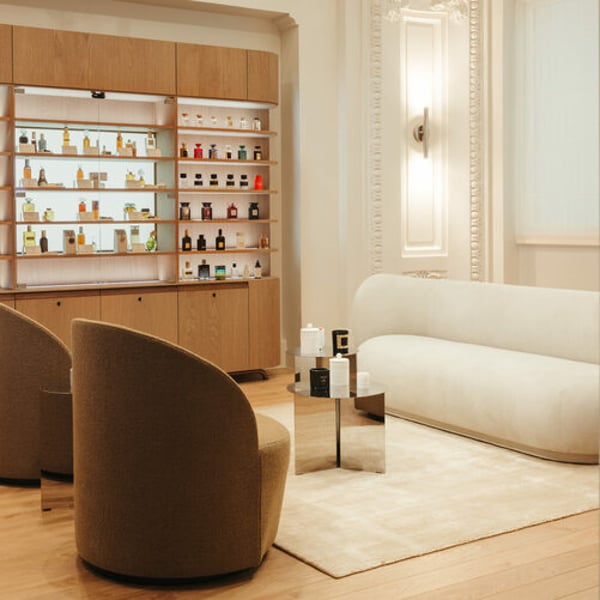
In the world of luxury and prestige fragrances, the Atelier, the new innovation centre located on the fourth floor of its newly inaugurated Maison des Parfums at 14–16 rue Volney, represents a key asset in this respect.
“Today, we once again want to put innovation at the heart of the Estée Lauder Group’s story, particularly in the world of perfume with the Maison des Parfums and the Atelier,” said Stéphane de La Faverie, addressing journalists in a lounge with walls adorned with historic photos of Mrs Estée Lauder.
“The perfume category has accelerated sharply since the Covid years. We can see this in the luxury segment, with brands such as Frédéric Malle, By Kilian and Le Labo, as well as in the prestige segment, with expansion all over the world. One of the reasons we decided to establish the Maison des Parfums and the Atelier in France—and in Paris in particular—was that it would place the Atelier at the heart of the birthplace of perfumery worldwide. It was very clear to me that being in France gave us access to olfactory, technical and creative talent by being close to Cosmetic Valley and not far from Grasse, but also to our partners, as well as to all the perfume houses.”
The group’s management envisions more fluid and faster communication between technical perfumers on the fourth floor, who benefit from state-of-the-art tools and processes, and the brands’ creative and marketing teams located on the lower floors. This should help reduce the time it takes to bring a new product to market by 30% to 50%.

These new products are designed to meet the needs of different markets as the high-end beauty sector continues to grow.
“Many European countries have a perfume penetration of 50% or more of the total beauty market,” explained the CEO, who noted that this justifies the group’s presence in France.
“In the United States, perfume represents a third of the beauty market, while in Asia, in China, Japan and South Korea, perfume penetration varies between 10% and 20%. This is linked to the cultural relationship with perfume, but there is growth everywhere linked to accelerating demand for niche fragrances. Globally, consumers have wanted access to exceptional fragrances with ingredients, olfactory accords and stories of great richness.”
He added that while in Europe fragrance is a mainstay of beauty, in the United States the growth of recent years has brought the fragrance category back to the forefront of beauty consumption. Fragrance consumption worldwide has evolved, driven in particular by greater access to niche or luxury brands, but also by a new pattern of use: some consumers layer fragrances or choose different scents depending on the occasion.
“Perfume represents $2.5 billion in sales for the group”, which achieved $14.3 billion in sales (-8%) over its 2024/2025 financial year, de La Faverie told the press.
“Over the last five years, fragrance has grown by 10%. Our investment in the Atelier aims to put our foot on the accelerator on fragrance worldwide.”

For the time being, the group has not announced how many people will be joining the Atelier, or how much will be invested in its development. But the project has been entrusted to a specialist in fragrance innovation. Lucas Nanini, who has worked for groups such as Procter & Gamble and Coty, is coordinating this new division. To generate innovation and acceleration, he explains that the approach is intended to be new for the group, but also open, drawing on the Cosmetic Valley ecosystem, French Tech and the CNRS.
“We have a laboratory, different equipment, different spaces. This allows us to interact on several levels. We can integrate creation, co-creation and actual prototyping. But we also have advanced molecular analysis tools and formulation areas,” explained the executive, who particularly highlighted the highly technical system that recycles the air more than ten times per hour to eliminate olfactory pollution.

“Another key element is building teams and the talents that have been added to the workforce to truly achieve complementarity of expertise. We now have in-house technical perfumers, evaluators and formulators, but also skills more commonly found in the tech industry or in entrepreneurship, with innovation marketing specialists and project managers who apply the agile methodologies we generally see in AI.”
These are major aspects, as the group intends to harness technologies, particularly generative artificial intelligence, to accelerate its launches. To this end, all data are collected and consolidated “to build predictive models to enable us to create higher-performing fragrances, but also to develop tools to speed up regulatory-related assessments. Today, fragrance regulations are quite strict, and complying with them slows development, whereas the speed of AI development will allow us to accelerate on these fronts.”
Beyond acceleration, on the fragrance design side, Céline Roux, who has worked at Jo Malone for 17 years, also sees new opportunities for development.
“We are in a very, very dynamic market, with over 6,000 fragrance launches a year. What we are looking for is meaning. We are in the business of emotion, of magic, but supported by science. And that is where the Atelier is going to help us,” said Roux, explaining the difficulty of capturing fruit scents in particular.

“Ingredients are very important; I wanted a natural pear. We worked for two years on this project to obtain an exclusive natural pear note. I had to carry out research and turn to the food industry. I now have a home base in Paris, with a ‘Music Room’ where I can meet all the players—and move faster. This is necessary because sometimes we have to respond quickly to certain trends. This does not mean we will necessarily release more products—there is a necessary period for reflection—but we will be able to move more quickly with technological solutions in development.”
Kilian Hennessy also sees a major advantage in integrating a fragrance innovation centre.
“A great perfume is first and foremost an accord that does not resemble any perfume from the past, that opens up a new olfactory route. It is an original accord that requires either an overdose of a component that others have not used or could not afford, or new raw materials that are a bit like different colours on a palette,” explained the perfumer. “The discovery of new components is at the heart of creation. The Atelier will enable us to work on this both in co-distillation and in headspace, a technology that captures volatile notes in the air.”
He explains that these tools will provide exclusive access to materials, and also establish direct sourcing for certain very high-priced raw materials. “Having direct access to raw material sourcing will enable us to use much larger quantities and bring a colour the consumer will never have smelled before. Ultimately, the only thing that counts is bringing new emotions!”

New fragrances, reaching the market more quickly, are therefore expected to appear in the coming months. But beyond speed, the American group wants to set itself apart in terms of creation. This applies to fragrances in classic formats, as well as creams, mists and candles.
“In the consumer world, there is never a moment when you can rest on your laurels and say ‘that’s it, we have mastered it’. Someone will always invent something new. As the saying goes: only the paranoid survive,” William Lauder, 65, grandson of the brand’s founder and chairman of the board, who was also present at the inauguration, told the press earlier. This Parisian Maison des Parfums seems to have the tools to enable the group to manage this paranoia as effectively as possible.
With AFP
This article is an automatic translation.
Click here to read the original article.
Copyright © 2025 AFP. All rights reserved. All information displayed in this section (dispatches, photographs, logos) are protected by intellectual property rights owned by Agence France-Presse. As a consequence you may not copy, reproduce, modify, transmit, publish, display or in any way commercially exploit any of the contents of this section without the prior written consent of Agence France-Presses.



Elon Musk’s wealth has soared past $600 billion—he’s now worth double the next richest person alive, Google’s cofounder Larry Page

Mexico City Congress Session Descends Into Brawl, Watch Wild Video

Frasers in latest ‘next-gen’ department store opening at Queensgate Peterborough
-

 Politics8 years ago
Congress rolls out ‘Better Deal,’ new economic agenda
-
Entertainment8 years ago
New Season 8 Walking Dead trailer flashes forward in time
-
Politics8 years ago
Poll: Virginia governor’s race in dead heat
-
Entertainment8 years ago
The final 6 ‘Game of Thrones’ episodes might feel like a full season
-
Entertainment8 years ago
Meet Superman’s grandfather in new trailer for Krypton
-
Politics8 years ago
Illinois’ financial crisis could bring the state to a halt
-
Business8 years ago
6 Stunning new co-working spaces around the globe
-
Tech8 years ago
Hulu hires Google marketing veteran Kelly Campbell as CMO