“Got Chucks on with Saint Laurent” declared Mark Ronson and Bruno Mars in their 2014 hit Uptown Funk. Yves Saint Laurent held its fashion show in Paris a few weeks ago. But where were the Chucks? Likely stuck on a retailer’s discount rack.
Converse has posted revenue declines for eight consecutive quarters. – Converse
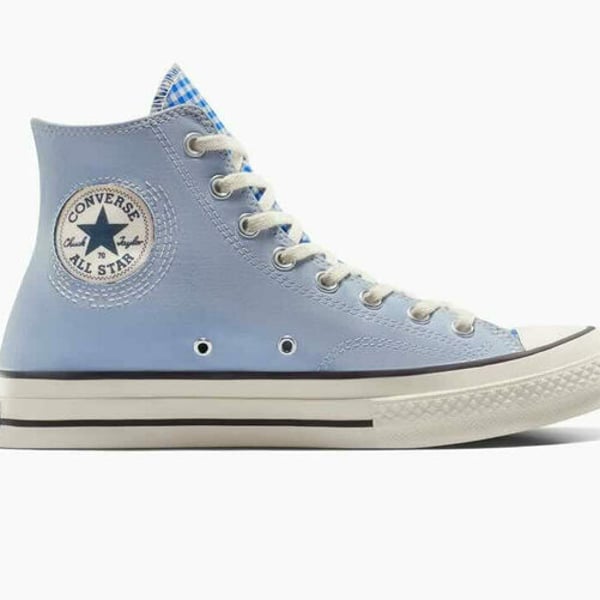
Elliott Hill, Nike Inc.’s chief executive officer, revealed a day after the Saint Laurent show that sales at Converse, maker of the Chuck Taylor All Star sneaker, had fallen 28% excluding currency movements in the sportswear giant’s first quarter. Rather than suffer the distraction of trying to put the minor brand on a stronger footing, Hill should sell Converse- or at least be open to offers.
As the heat from Adidas AG’s Samba sneaker fades, consumers are looking for alternatives. Converse tends to go in and out of style. It was hot in the early aughts and so should be getting a lift from the adoption of other fashion favourites from that era, such as skinny jeans and khaki jackets. But so far, consumers don’t seem to be swapping the three stripes of Adidas for the starred ankle logo of Chucks.
Hill is trying to change that. He told analysts when he announced first-quarter earnings that he had installed new management at Converse, and that the Chuck Taylor shoe was in the “early stages of a global market reset.” Nike would take “aggressive actions to better position the brand for profitable growth in the future.” He didn’t specify what that meant, but it likely involves clearing out stale shoes before introducing new ones, as Nike has been doing with its Air Force 1s, Air Jordan 1s and Dunks. Given the task of turning the Nike juggernaut, Converse is a distraction Hill doesn’t need.
The footwear brand is expected to generate revenue of $1.4 billion this year, according to data compiled by Bloomberg, and could achieve a sales multiple of 1-2 times according to David Swartz, an analyst at Morningstar. Given that Nike bought Converse for just $305 million back in 2003, it’s unlikely a sale at $1.4 billion to $2.8 billion would trigger any write-down.
For a company with expected revenue of almost $47 billion this year, those sale proceeds won’t move the needle financially for Nike. The real value in offloading Converse would be allowing Hill to focus on his two most pressing tasks: addressing nimble upstarts such as On Holding AG and Deckers Outdoor Corp.’s Hoka in the athletic market, and taking on Adidas in more fashion-forward styles.
Hill would be in good company by disposing of a non-core asset. Last month, VF Corp. agreed to sell its workwear division Dickies to Bluestar Alliance for $600 million in cash. Earlier this year, Levi Strauss & Co. offloaded Dockers to Authentic Brands Group for as much as $391 million.
The brand would be a good fit with VF Corp.’s portfolio, according to Morningstar’s Swartz. But the owner of Vans and The North Face has been a seller rather than a buyer recently to cut its debt load. As well as disposing of Dickies, it sold streetwear name Supreme to Ray-Ban maker EssilorLuxottica SA a year earlier for $1.5 billion. Although VF has made a dent in its borrowings, buying Converse would be a stretch.
Alternatively, private equity may be interested. After all, 3G Capital agreed to buy Skechers USA Inc. for $9.4 billion in May. Although that deal was a smart play on an ageing population, Converse is just the right size for a financial buyer flush with cash. They might calculate that freed from the shadow of the Nike brand, Converse would unleash a wave of creativity and turbocharge sales. And by the time private equity needs an exit – typically three to five years – VF might be in a position to buy.
A sale of Converse wouldn’t be risk free. First, tariffs have depressed footwear valuations. Neither Foot Locker Inc., which in May agreed to be bought by Dick’s Sporting Goods Inc., nor Skechers achieved knockout prices. The fact that Converse is underperforming doesn’t help either. Second, there’s a danger that whoever buys Converse turns it into a success- and another competitor to Nike. Authentic Brands has invested heavily in Reebok, and this seems to be paying off, with sales rising to $5 billion in 2023 from $1.6 billion in 2020.
But Hill has so much on his plate that a disposal still makes sense. Faced with tariffs, many consumers staying cautious and a muscular competitor in the form of Adidas CEO Bjorn Gulden, Hill doesn’t have many easy wins. Selling Converse would be one.
Czech streetwear specialist Footshop told FashionNetwork.com about its ambitions for the French market. It has now set its sights on Rue de Rivoli in Paris’s 1st arrondissement for its French flagship, FashionNetwork.com has learned. The opening date for this sixth store has not yet been announced.
63 Rue de Rivoli (Paris 1st arrondissement) – Google Street View
With this address, Footshop secures a 237 square-metre, three-storey store, where the retailer will be flanked by menswear label Delaveine and Ray-Ban on one side, and by Bershka and Uniqlo on the other. Opposite, the building at 126 Rue de Rivoli, previously occupied by C&A, will in 2027 house a Radisson Collection hotel and 3,000 square metres of retail space.
Launched in Prague in 2012 by Peter Hajducek, Footshop will be well placed to attract shoppers from both Forum des Halles and the neighbouring Samaritaine. Aiming to become the European leader in streetwear, the company positions itself as a response to an increasingly discerning customer base.
The brand’s flagship in Prague – Footshop
This approach has prompted Nike, Adidas Originals, Puma, New Balance, Asics, and Birkenstock to collaborate with the retailer, which operates flagships in Prague, Budapest, Bucharest, Bratislava, and Warsaw, but relies primarily on online sales. The company recently said that its digital platforms, Footshop and Queens, are said to have generated 82 million visits and 585,000 downloads in one year.
After achieving sales of 61.6 million euros (75% generated internationally) in 2024, the company is expected to reach 82 million euros in 2025, representing annual growth of 40%.
This article is an automatic translation. Click here to read the original article.
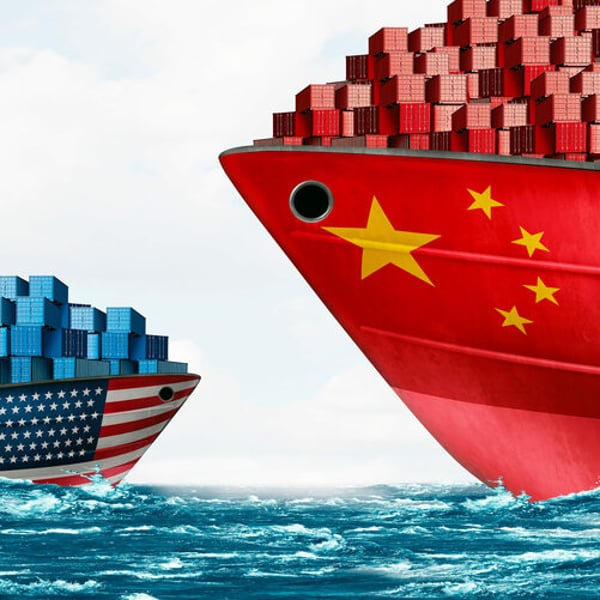
Donald Trump’s new tariffs have not curbed US textile and apparel imports, which held steady at $80.5 billion over the first three quarters. While China, the country’s leading supplier, saw shipments fall by 27% over the period, buyers simply shifted their orders to other Asian countries.
Shutterstock
The publication of these figures was delayed until December by the “shutdown,” which saw the US federal government shut down amid bitter budget negotiations. The consequences of the all-out tariff stand-off launched by the White House in April were widely anticipated; they can now be quantified.
China, the trade adversary singled out by Donald Trump, exported “only” $14.3 billion of textiles and apparel to the US market over nine months. This represents a 27% decline over the January to September period, yet China remains the US’s leading supplier.
Above all, China’s decline masks an acceleration in US orders from its direct competitors. Imports of textiles and apparel from South-East Asia rose by 15.9% to $24.3 billion.
A reshaping of US sourcing
Donald Trump sought to curb the influx of foreign production. In the end, the US president merely succeeded in shifting its origin slightly. To offset the new tariffs, US buyers turned to other countries that were sometimes less heavily taxed and, above all, offered lower production costs.
Vietnam, the US’s second-largest supplier of textiles and apparel, posted a 14.6% increase. In the ranking of suppliers, Vietnam is followed by India, up 10%, and, above all, Bangladesh, with a surge of 18.2%. Strong gains were also recorded by Cambodia (+25.8%), Indonesia (+12.9%), and Pakistan (+9.3%).
Imports from the USMCA area (US, Mexico, and Canada), where political tensions were high, remained broadly stable (-0.9%) at $3.8 billion, of which $3 billion came from Mexican production.
Europe holds steady
The European Union, the seventh-largest supplier of textiles and apparel to the US, posted a modest 1.9% increase to $4.04 billion worth of goods. This is a notable improvement on the 2.6% decline recorded in 2024.
Italy, at $1.9 billion, was stable over nine months, as was Portugal at $469 million. Germany accelerated by 9.3% to $373 million, while France rose by 2.2% to $330 million.
In the Euromed region, US customs figures show a 6.6% drop for Turkish goods, to $1.7 billion. Egypt was up 16.4% to $1.1 billion, while Morocco was down 16% to $177 million and Tunisia up 8.2% to $81 million.
Trends that began in January
This slowdown is all the more evident in light of the figures recorded in 2024. At that time, China exported $26 billion worth of textiles and apparel to the US, an increase of 3.5% that exceeded the total growth of American imports in this field (+2.6%).
After the election of Donald Trump and ahead of “Liberation Day”, the April 2 event marking the announcement of new tariffs, panic gripped US buyers. In the first quarter, they suddenly accelerated their textiles and apparel imports by 9.4% compared with the January to March 2024 period.
China captured only 3.6% of this increase, whereas other countries less targeted by Washington benefited far more from the situation. These included Vietnam (+14%), India (+20%), Bangladesh (+25%), Indonesia (+20%), Cambodia (+15.8%), and Pakistan (+10.5%).
This article is an automatic translation. Click here to read the original article.
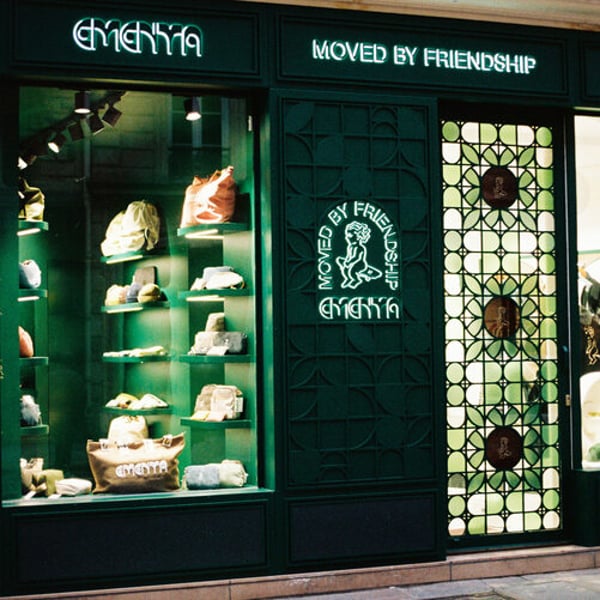
Just a stone’s throw from the bustle of Paris’ Les Halles, Ementa’s new boutique at 11, rue Montmartre gleams in green. The brand, ‘driven by friendship,’ has been revealing itself there, beyond its stained-glass doorway, since its official opening on December 6. It marks a new milestone for founders Emídio Silva, Nikita Gorev, and Raphael Castilho, whose adventure began amid Portugal’s markets.
Ementa opened its first boutique outside Portugal in Paris – Ementa
Born directly from the skateboarding world, Ementa launched in 2007. The three friends, then students at Academia da Amadora near Lisbon, shared the dream of creating their own label, inspired by the sponsor pieces from their sporting circle. They knew little about running a business, but that didn’t stop them. They took out a loan and financed production of their first thousand T-shirts.
A retail turning point beginning in 2021
By 2021, time had passed, but Ementa remained active. That year, an opportunity arose to open its first boutique at LX Factory in the Portuguese capital. The shop was fitted out almost entirely in the DIY spirit cherished by its founders. Around six months later, Ementa opened a second brick-and-mortar shop on Rua da Boavista, near Cais do Sodré, again in Lisbon.
The majority of its production is based in Portugal – Ementa
The third shop opened in 2023: Ementa’s flagship in Chiado, a lively district in southern Lisbon. ‘This project represented a far greater challenge than the previous ones,” the brand notes. “In 2024, we opened a boutique dedicated to collaborations with artists and exclusive collections, located right next to our first boutique at LX Factory,” it continues. The time then seemed ripe for Ementa to venture beyond the capital. On August 10, 2024, it inaugurated its fifth boutique, on Rua Sá da Bandeira in Porto- a ‘major challenge’ for the brand.
A mid-range positioning
This retail journey culminates today with the Paris opening. The brand also works with 27 stockists in total, including seven in France, one in Italy, two in Germany, and two in the Netherlands, with the remainder in Portugal. Its products are therefore available in several European countries. “Our aim is to be represented by avant-garde stockists with a sophisticated image and clear objectives,” says the brand.
Ementa draws inspiration from the world of skateboarding – Ementa
Drawing on its skateboarding heritage, the Portuguese brand’s offer spans a wide range of ready-to-wear pieces, including jackets, jumpers, screen-printed sweatshirts and T-shirts, cropped polo shirts, corduroy trousers, jeans, and accessories. As a lifestyle brand, Ementa also offers plenty of scarves, socks, sunglasses, caps, a few pieces of jewellery, and bags. Its prices sit below those of brands such as Palace Skateboards and Drôle de Monsieur, even though the majority of its production takes place in northern Portugal.
Ementa now aims to maintain a rhythm of a drop every fortnight, to bridge the gap between its autumn-winter and spring-summer collections. The brand hopes to continue its retail adventure with new openings, strengthening its existing boutiques, and international expansion.
This article is an automatic translation. Click here to read the original article.