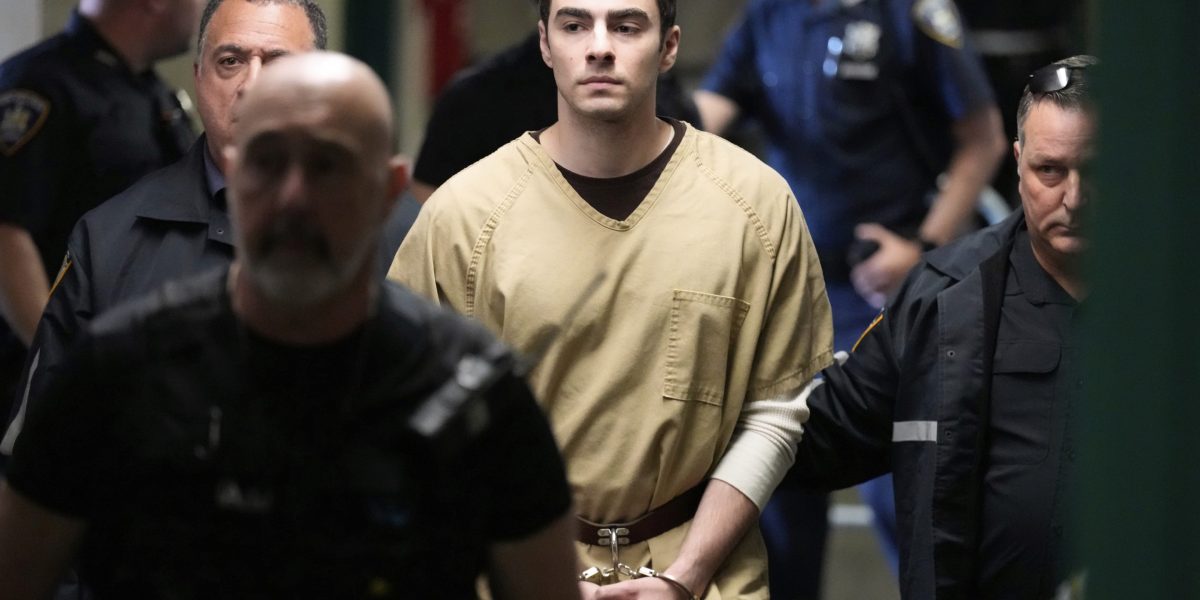
Lawyers for Luigi Mangione asked a New York federal judge Saturday to dismiss some criminal charges, including the only count for which he could face the death penalty, from a federal indictment brought against him in the December assassination of UnitedHealthcare’s chief executive.
In papers filed in Manhattan federal court, the lawyers said prosecutors should also be prevented from using at trial his statements to law enforcement officers and his backpack where a gun and ammunition were found.
They said Mangione was not read his rights before he was questioned by law enforcement officers, who arrested him after Brian Thompson was fatally shot as he arrived at a Manhattan hotel for an investor conference.
They added that officers did not obtain a warrant before searching Mangione’s backpack.
Mangione, 27, has pleaded not guilty to state and federal charges in the fatal shooting of Brian Thompson on Dec. 4 as he arrived at a Manhattan hotel for his company’s annual investor conference.
The killing set off a multi-state search after the suspected shooter slipped away from the scene and rode a bike to Central Park, before taking a taxi to a bus depot that offers service to several nearby states.
Five days later, a tip from a McDonald’s about 233 miles (375 kilometers) away in Altoona, Pennsylvania, led police to arrest Mangione. He has been held without bail since then.
Last month, lawyers for Mangione asked that his federal charges be dismissed and the death penalty be taken off the table as a result of public comments by U.S. Attorney General Pam Bondi. In April, Bondi directed prosecutors in New York to seek the death penalty, calling the killing of Thompson a “premeditated, cold-blooded assassination that shocked America.”
Murder cases are usually tried in state courts, but prosecutors have also charged Mangione under a federal law on murders committed with firearms as part of other “crimes of violence.” It’s the only charge for which Mangione could face the death penalty, since it’s not used in New York state.
The papers filed early Saturday morning argued that this charge should be dismissed because prosecutors have failed to identify the other offenses that would be required to convict him, saying that the alleged other crime — stalking — is not a crime of violence.
The assassination and its aftermath has captured the American imagination, setting off a cascade of resentment and online vitriol toward U.S. health insurers while rattling corporate executives concerned about security.
After the killing, investigators found the words “delay,” “deny” and “depose,” written in permanent marker on ammunition at the scene. The words mimic a phrase used by insurance industry critics.
Fortune Global Forum returns Oct. 26–27, 2025 in Riyadh. CEOs and global leaders will gather for a dynamic, invitation-only event shaping the future of business.
Apply for an invitation.