Connect with us

Business

Browser wars, a hallmark of the late 1990s tech world, are back with a vengeance—thanks to AI

Published

on


The early days of the internet saw intense competition between graphical web browsers: Netscape Navigator faced off against Microsoft’s Internet Explorer. No sooner had Explorer won that conflict than a new war for marketshare erupted between Explorer, Mozilla’s Firefox, and Google Chrome. This time Chrome emerged as the dominant player, with a marketshare that has been above 60% for most of the past decade, while the next closest rival, Apple’s Safari, has been stuck in the mid-teens.

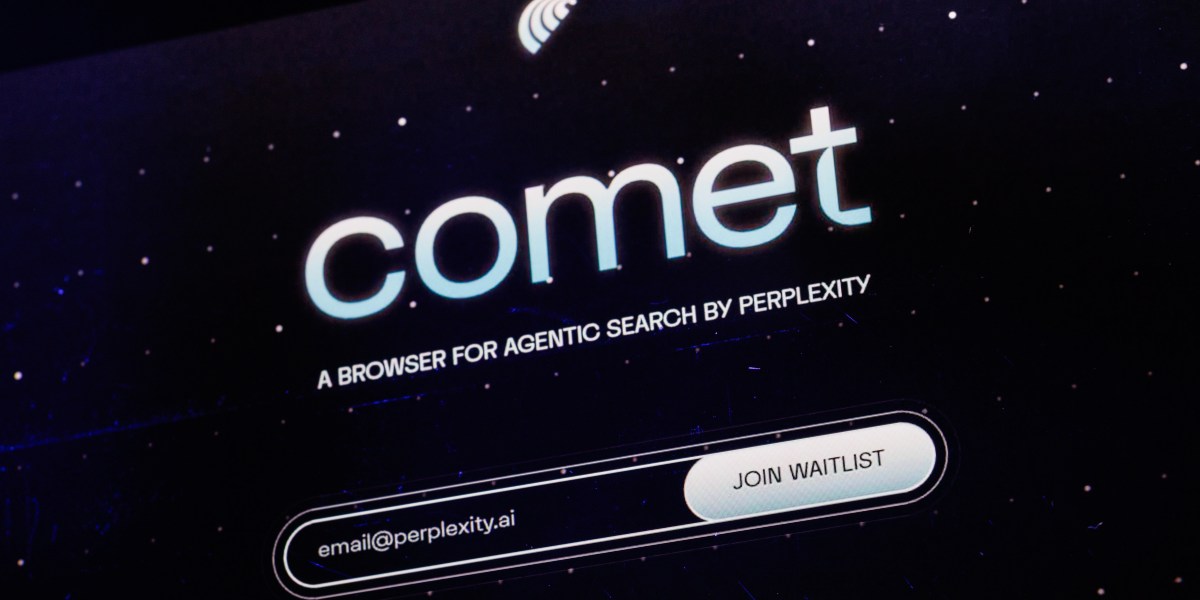
But now, AI is shaking up the browser market, with companies beginning to incorporate new generative and agentic AI capabilities directly into the web navigation tool. That in turn is sparking a fierce new war for users, with Google Chrome, now enhanced with Google’s AI model Gemini, fighting upstarts like Perplexity, with its Comet AI browser, and battered veterans of past browser fights, like Opera, trying to get their mojo back with AI enhancements too.

For nearly two decades, the basic browsing experience, aside from a few minor improvements, remained largely unchanged. Users typed a url in the navigation bar, or typed a search query in that same space—a feature that Opera first pioneered but which was soon copied by Google—and the browser takes the user to that web address or a search results page, which displays a list of links. Click on a link and the browser takes you to that web page.

Now, tech companies are betting that users want a new kind of experience: a browser that can answer questions, not just provide a list of links, and that can do far more than just navigate a user to a web page—one that can perform tasks for the user on that page, such as booking travel or completing a purchase.

“This is probably the biggest shift since we’ve seen the browser itself become the gateway to the internet. For 30 years, the browser was about navigation. Type, click, explore. Now, with AI, it’s changing the model completely. It’s moving from browsing to delegating,” George Chalhoub, assistant professor at UCL Interaction Centre, told Fortune.

Tech companies, including Perplexity and Opera, have already launched agentic AI browsers that can perform tasks on behalf of users. Perplexity’s Comet combines a web browser with a built-in AI agent that can read pages, summarize information, and even perform multi-step actions, such as booking appointments or sending emails. Similarly, Opera’s Neon introduces features like “Do,” which can carry out actions on a user’s behalf, and “Cards,” which store custom workflows and prompts for repeated use.

“The browser wars are starting and the competition is heating up because browsers today are the operating system of your applications,” Krystian Kolondra, EVP Browsers at Opera, told Fortune. “The browser world is extremely important because it is more aware than the operating system itself about what’s happening on your pages.”

The vision for AI-powered browsing reframes the traditional browser as not just a tool for access, but as the primary interface through which AI agents operate.

“The whole notion of search changed. It’s not to point to the place where you can find your answer or do your thing, but to give you that answer and do that thing,” Himanshu Tyagi, co-founder of the open-source AI company Sentent, said. “We are moving to sort of a dark internet, in the sense that it’s not meant for just humans. It’s meant for bots to consume and process information. Bots do things and give humans the final thing.”

If the third round of browser wars is already underway, the battlefield looks very different from the days when the main axes of competition were things like speed and tab management. This time, it’s about which company can deliver the most seamless AI-powered experience while navigating heightened privacy issues and convincing users to change long-established habits. While major players like Google still dominate, nimble newcomers are testing the limits of what a browser can do.

The third browser wars

The second round of browser wars concluded with Google Chrome’s dominance, mostly due to its speed and integration with the wider Google ecosystem. Most browsers are now also underpinned by Chromium, a free and open-source web browser project, which was primarily developed and maintained by Google. Chromium is essentially a back-end system that determines how a browser goes out to find a particular web address, using an index of web pages Google maintains, and how it renders that web page.

While Google still dominates the search market and has taken steps to integrate AI into the search experience, its market share has been slipping. According to analysts at Third Bridge, in July, Google’s global search market share dropped below 90% for the first time in 10 years.

This could be due to the increased popularity of AI search engines like Perplexity or competition from AI chatbots like OpenAI’s ChatGPT, which launched its own Search tool in October last year. In a survey from brokerage firm Evercore ISI conducted last year, ChatGPT respondents saying ChatGPT was their top search provider increased to 5% from 1% four months prior.

That said, the popularity of Chome as a browser has not noticeably declined. While people may be sending their search queries to ChatGPT or Perplexity, when they use those services on desktop, they are mostly still using a tab in Chrome to do so.

And given the technical complexity and cost of building a browser from scratch, most AI companies are unlikely to develop their own back-end web indexing. Nearly every “AI browser” on the market today, including Perplexity’s Comet, is built on Chromium.

Building a browser entirely from scratch is complex and resource-heavy. To do so, a company would have to recreate everything from how web pages are rendered and memory is managed, to encryption systems, sandboxing, video playback, and constant security patching. Even Microsoft, once Google’s fiercest rival in the browser space, eventually abandoned its own engine and rebuilt Edge on Chromium.

“It’s literally reinventing the wheel,” Chalhoub said. “I don’t see any company building its browser from scratch.”

A unified interface

But why are AI companies so keen to have a browser of their own? Perplexity, for example, raised eyebrows earlier this year when it made an unsolicited cash offer of $34.5 billion for Google Chrome.

“The browser is what we live in during the day on our desktop devices,” Dmitry Shevelenko, Chief Business Officer of Perplexity, told Fortune earlier this year. “It’s just an incredibly powerful canvas, and in terms of being able to create value for users, it gives us a much bigger surface area… it requires us to know more about you and have more context.”

The real prize for these companies isn’t web navigation; it’s control of the gateway to the rest of users’ digital lives, including a lot of other web-based software applications. Most companies are betting that the true value of AI will be unlocked when AI agents have access to a user’s entire ecosystem—emails, calendar, messages, and documents—and can perform tasks across them seamlessly.

“There’s this myth of the ‘everything app,’” Tyagi said. “AI is only magical when it’s everywhere with you in a single, unified interface. If you have to use one app for your glasses, another on your phone, and another on your laptop, that’s not a complete experience. The magic is when there’s one interface that goes with you everywhere and is always engaging with your context.”

Most AI companies are working on autonomous assistants with the aim of getting them moving fluidly between a user’s various applications. But they are pursuing varying approaches to accomplish this.

OpenAI appears to be trying to position ChatGPT as a version of this universal interface, not through a browser, but by integrating third-party apps directly into the chatbot so users can search, shop, plan travel, and manage files without ever leaving the conversation.

But changing user habits is never easy, and the idea of browsing the web is deeply ingrained in users.

“Changing user habits takes time, especially when it comes to something as fundamental as how we explore the web,” Chalhoub said. “For most people, the browser is the oldest and most familiar tool we use online. In terms of physical experience, we trust it so much because it’s stable and predictable.”

However, Chalhoub noted that it’s often small conveniences that drive major behavioral shifts. “If an AI browser can slowly start saving me time, booking travel automatically, or summarizing articles, I think people will adapt much faster than we expect.”

In many ways, AI-enabled browsers, such as Comet or Gemini in Chrome, are a hybrid, or half-way house, between the idea of chatbots as the universal interface, where a human user has no direct access to the web at all, and the traditional, human-driven web browsing experience. The advantage of an AI browser is that it lets both the human and AI model access the web in exactly the same way—even at the same time, with the agent able to work alongside a person, or work on one process in one tab while the human user works on a different task in another. With the web browser, there’s no need to create an entirely new protocol through which the AI model interacts with the content and data of third-parties, such as Anthropic’s Model Context Protocol (MCP), which is being used to power a lot of “agentic” experiences in chatbots.

The privacy problem

Agentic AI browsers have access to much more user data than traditional search engines, which brings about a host of privacy concerns. By design, these tools see far more of what users do online, and can even infer why a user is acting in certain ways.

“Browsers have always been powerful data collection tools, and when you add AI to the mix, that power multiplies,” Chalhoub said. “An AI-powered browser doesn’t just observe your behavior; it can infer your intentions, habits, and even your mood. Every prompt or summary becomes a data point about you, so the information has to be handled responsibly and not used for advertising or profiling.”

Chalhoub also warned that with AI in the loop, it makes it much harder for users to know where their data goes. “It’s definitely a privacy risk, not because AI is inherently bad, but it has more context and intention in one place. So companies really have to be responsible in this regard,” he said.

It’s already unclear how far a user’s conversations with AI chatbots are confidential. For example, OpenAI CEO Sam Altman recently warned that users currently have no legal protection over their ChatGPT conversations if subpoenaed. Letting an AI agent crawl through emails, texts, and other highly sensitive data could risk exposing deeply personal information if not handled carefully, raising serious questions about how much control users really have over their own data.

Tech companies, for their part, are aware of the new risks around privacy introduced by AI agents. Kolondra said that Opera’s Neon only processes data when users ask it to, like when summarizing a page, and all requests are end-to-end encrypted. “We don’t use that data to train our models,” he added.



Source link

Continue Reading

Business

Databricks CEO Ali Ghodsi says company will be worth $1 trillion by doing these three things

Published

on


Ali Ghodsi, the CEO and cofounder of data intelligence company Databricks, is betting his privately held startup can be the latest addition to the trillion-dollar valuation club.

In August, Ghodsi told the Wall Street Journalthat he believed Databricks, which is reportedly in talks toraise funding at a $134 billion valuation, had “a shot to be a trillion-dollar company.” At Fortune’s Brainstorm AI conference in San Francisco on Tuesday, he explained how it would happen, laying out a “trifecta” of growth areas to ignite the company’s next leg of growth.

The first is entering the transactional database market, the traditional territory of large enterprise players like Oracle, which Ghodsi said has remained largely “the same for 40 years.” Earlier this year, Databricks launched a link-based offering called Lakehouse, which aims to combine the capabilities of traditional databases with modern data lake storage, in an attempt to capture some of this market.

The company is also seeing growth driven by the rise of AI-powered coding. “Over 80% of the databases that are being launched on Databricks are not being launched by humans, but by AI agents,” Ghodsi said. As developers use AI tools for “vibe coding”—rapidly building software with natural language commands—those applications automatically need databases, and Ghodsi they’re defaulting to Databricks’ platform.

“That’s just a huge growth factor for us. I think if we just did that, we could maybe get all the way to a trillion,” he said.

The second growth area is Agentbricks, Databricks’ platform for building AI agents that work with proprietary enterprise data.

“It’s a commodity now to have AI that has general knowledge,” Ghodsi said, but “it’s very elusive to get AI that really works and understands that proprietary data that’s inside enterprise.” He pointed to the Royal Bank of Canada, which built AI agents for equity research analysts, as an example. Ghodsi said these agents were able to automatically gather earnings calls and company information to assemble research reports, reducing “many days’ worth of work down to minutes.”

And finally, the third piece to Ghodsi’s puzzle involves building applications on top of this infrastructure, with developers using AI tools to quickly build applications that run on Lakehouse and which are then powered by AI agents. “To get the trifecta is also to have apps on top of this. Now you have apps that are vibe coded with the database, Lakehouse, and with agents,” Ghodsi said. “Those are three new vectors for us.”

Ghodsi did not provide a timeframe for attaining the trillion-dollar goal. Currently, only a handful of companies have achieved the milestone, all of them as publicly traded companies. In the tech industry, only big tech giants like Apple, Microsoft, Nvidia, Alphabet, Amazon, and Meta have managed to cross the trillion-dollar threshold.

To reach this level would require Databricks, which is widely expected to go public sometime in early 2026, to grow its valuation roughly sevenfold from its current reported level. Part of this journey will likely also include the expected IPO, Ghodsi said.

“There are huge advantages and pros and cons. That’s why we’re not super religious about it,” Ghodsi said when asked about a potential IPO. “We will go public at some point. But to us, it’s not a really big deal.”

Could the company IPO next year? Maybe, replied Ghodsi.


Source link

Continue Reading

Business

New contract shows Palantir working on tech platform for another federal agency that works with ICE

Published

on


Palantir, the artificial intelligence and data analytics company, has quietly started working on a tech platform for a federal immigration agency that has referred dozens of individuals to U.S. Immigration and Customs Enforcement for potential enforcement since September.

The U.S. Citizenship and Immigration Services agency—which handles services including citizenship applications, family immigration, adoptions, and work permits for non-citizens—started the contract with Palantir at the end of October, and is paying the data analytics company to implement “Phase 0” of a “vetting of wedding-based schemes,” or “VOWS” platform, according to the federal contract, which was posted to the U.S. government website and reviewed by Fortune.

The contract is small—less than $100,000—and details of what exactly the new platform entails are thin. The contract itself offers few details, apart from the general description of the platform (“vetting of wedding-based schemes”) and an estimate that the completion of the contract would be Dec. 9.Palantir declined to comment on the contract or nature of the work, and USCIS did not respond to requests for comment for this story.

But the contract is notable, nonetheless, as it marks the beginning of a new relationship between USCIS and Palantir, which has had longstanding contracts with ICE, another agency of the Department of Homeland Security, since at least 2011. The description of the contract suggests that the “VOWS” platform may very well be focused on marriage fraud and related to USCIS’ recent stated effort to drill down on duplicity in applications for marriage and family-based petitions, employment authorizations, and parole-related requests.

USCIS has been outspoken about its recent collaboration with ICE. Over nine days in September, USCIS announced that it worked with ICE and the Federal Bureau of Investigation to conduct what it called “Operation Twin Shield” in the Minneapolis-St. Paul area, where immigration officials investigated potential cases of fraud in immigration benefit applications the agency had received. The agency reported that its officers referred 42 cases to ICE over the period. In a statement published to the USCIS website shortly after the operation, USCIS director Joseph Edlow said his agency was “declaring an all-out war on immigration fraud” and that it would “relentlessly pursue everyone involved in undermining the integrity of our immigration system and laws.” 

“Under President Trump, we will leave no stone unturned,” he said.

Earlier this year, USCIS rolled out updates to its policy requirements for marriage-based green cards, which have included more details of relationship evidence and stricter interview requirements.

While Palantir has always been a controversial company—and one that tends to lean into that reputation no less—the new contract with USCIS is likely to lead to more public scrutiny. Backlash over Palantir’s contracts with ICE have intensified this year amid the Trump Administration’s crackdown on immigration and aggressive tactics used by ICE to detain immigrants that have gone viral on social media. Not to mention, Palantir inked a $30 million contract with ICE earlier this year to pilot a system that will track individuals who have elected to self-deport and help ICE with targeting and enforcement prioritization. There has been pushback from current and former employees of the company alike over contracts the company has with ICE and Israel.

In a recent interview at the New York Times DealBook Summit, Karp was asked on stage about Palantir’s work with ICE and later what Karp thought, from a moral standpoint, about families getting separated by ICE. “Of course I don’t like that, right? No one likes that. No American. This is the fairest, least bigoted, most open-minded culture in the world,” Karp said. But he said he cared about two issues politically: immigration and “re-establishing the deterrent capacity of America without being a colonialist neocon view. On those two issues, this president has performed.”


Source link

Continue Reading

Business

CoreWeave CEO: Despite see-sawing stock, IPO was ‘incredibly successful’ amid challenges of tariff timing

Published

on


CoreWeave has been rocked by dizzying stock swings—with its stock currently trading 52% below its post-IPO high—and a frequent target of market commentators, but CEO Michael Intrator says the company’s move to the public markets has been “incredibly successful. And he takes the public’s mixed reaction in stride, given the novelty of CoreWeave’s “neocloud” business which competes with established cloud providers like Amazon AWS and Google Cloud.

“When you introduce new models, introduce a new way of doing business, disrupt what has been a static environment, it’s going to take some people some time,” Intrator said Tuesday at Fortune’s Brainstorm AI conference in San Francisco. But, he added, more people are beginning to understand the CoreWeave’s business model.

“We came out into one of the most challenging environments,” Intrator said of CoreWeave’s March IPO, which occurred very close to President Trump’s “Liberation Day” tariffs in April. “In spite of the incredible headwinds, we’re able to launch a successful IPO.”

CoreWeave, which priced its IPO at $40 per share, has experienced frequent severe up-and-down price swings in the eight months since its public market debut. At its closing price of $90.66 on Tuesday, the stock remains well above its IPO price.

As Fortune reported last month, CoreWeave’s rapid rise has been fueled by an aggressive, debt-heavy strategy to stand up data centers at unprecedented speed for AI customers. And for now, the bet is still paying off. In its third-quarter results released in November, the company said its revenue backlog nearly doubled in a single quarter—to $55.6 billion from $30 billion—reflecting long-term commitments from marquee clients including Meta, OpenAI, and French AI startup Poolside. Both earnings and revenue came in ahead of Wall Street expectations.

But the numbers were not all celebratory. CoreWeave disclosed a further increase in the debt it has taken on to finance its expansion, and it revised its full-year revenue outlook downward—suggesting that, even with historic demand in the pipeline.

With media headlines calling CoreWeave a “ticking time bomb,” with critics calling out insider stock sales, circular financing accusations and an overreliance on Nvidia, Intrator was asked whether he felt CoreWeave was misunderstood.

“Look, we built a company that is challenging one of the most stable businesses that exist—that cloud business, these three massive players,” he said, referring to AWS, Microsoft Azure and Google Cloud.  I feel like it’s incumbent on CoreWeave to introduce a new business model on how the cloud is going to be built and run. And that’s what we’re doing.” 

He repeatedly framed CoreWeave not as a GPU reseller or traditional data-center operator but as a company purpose-built from scratch to deliver high-performance, parallelized computing for AI workloads. That focus, he said, means designing proprietary software that orchestrates GPUs, building and colocating its own infrastructure, and moving “up the stack” through acquisitions such as Weights & Biases and OpenPipe.

Intrator also defended the company’s debt strategy, saying CoreWeave is effectively inventing a new financing model for AI infrastructure. He pointed to the company’s ability to repurpose power sources, rapidly deploy capacity, and finance large-scale clusters as proof it is solving problems incumbents never had to face.

“When I look back at history of the company, it took us a year with with a company investor like Fidelity, before they were like, ‘Oh, I get it,’” he said. “So look, we’ve been public for eight months. I couldn’t be prouder of what the company has accomplished.” 


Source link

Continue Reading

Trending

Copyright © Miami Select.