Connect with us

Business

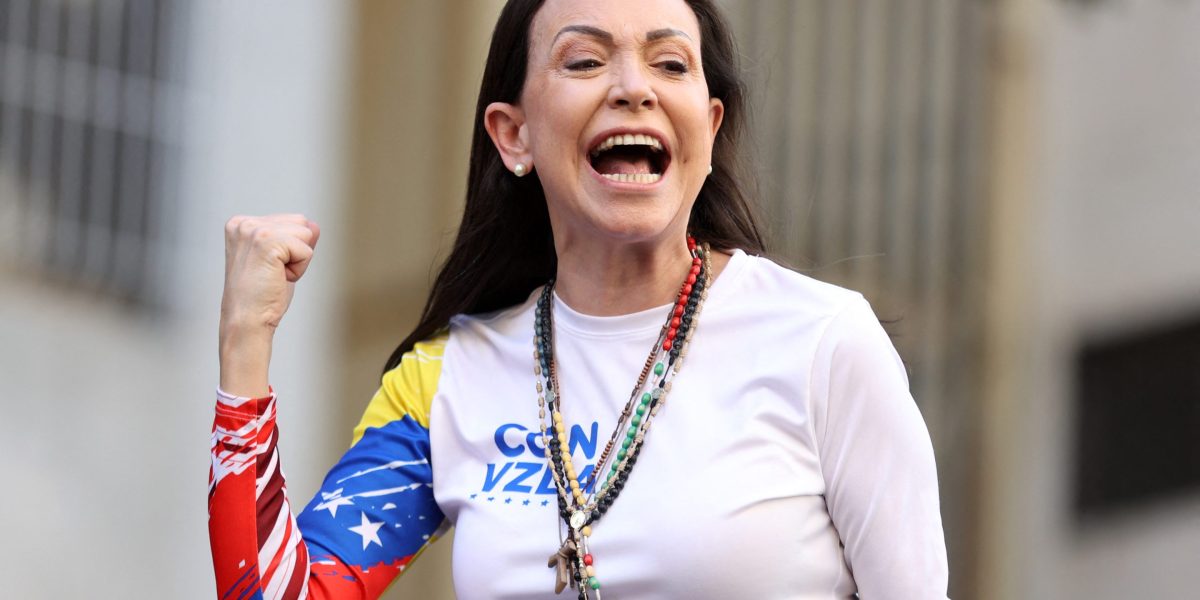
‘Oh my god’: Watch the emotional moment Venezuela’s ‘Iron Lady’ María Corina Machado discovers she won the Nobel Peace Prize

Published

on


A pre-dawn phone call from the Norwegian Nobel Institute to Venezuela on Friday morning captured a genuine moment of surprise and emotion. Kristian Berg Harpviken, director of the Norwegian Nobel Institute, called Venezuelan opposition leader María Corina Machado—his hands and voice both shaking—to deliver the news.

“Oh my god,” she said repeatedly.​

The Norwegian Nobel Institute released the audio recording of the call on YouTube, X, and other social media just minutes before the official announcement in Oslo. Harpviken, speaking from Oslo, told Machado: “I’m calling to inform you that in a few minutes it shall be announced here at the Nobel Institute that you will be awarded the Nobel Peace Prize for 2025.” After her repeated exclamations of shock, he quoted directly from the official announcement, explaining she was receiving the prize “for her tireless work promoting democratic rights for the people of Venezuela and for her struggle to achieve a just and peaceful transition from dictatorship to democracy.”

“I have no words,” Machado said during the phone call. “I thank you so much. But I hope you understand this is a movement. This is an achievement of a whole society. I am just one person. I certainly do not deserve this.”

Machado said she felt “honored, humbled, and very grateful on behalf of the Venezuelan people,” but added, “we’re not there yet. We’re working very hard to achieve it, but I’m sure that we will prevail, and this is certainly the biggest recognition to our people that certainly deserve it.”

María Corina Machado: A Leader in hiding

A 58-year-old industrial engineer, Machado—who got the nickname of Venezuela’s “Iron Lady” due to her adoration of, and similarities to, former U.K. Prime Minister Margaret Thatcher—has spent much of the past year living in hiding within Venezuela, facing death threats and an arrest warrant from President Nicolás Maduro’s government. The Norwegian Nobel Committee described her as “one of the most extraordinary examples of civilian courage in Latin America in recent times” and praised her as a “key, unifying figure in a political opposition that was once deeply divided.”

Jørgen Watne Frydnes, chair of the Norwegian Nobel Committee, emphasized the significance of her decision to remain in Venezuela despite the personal risk.

“Despite serious threats against her life, she has remained in the country, a choice that has inspired millions,” he said during Friday’s announcement.

Machado’s recognition comes as Venezuela has undergone what the Nobel Committee called a transformation “from a relatively democratic and prosperous country to a brutal, authoritarian state that is now suffering a humanitarian and economic crisis.” Most Venezuelans now live in deep poverty despite the country’s vast oil reserves, with nearly 8 million people having fled the country.

The crisis intensified following Venezuela’s disputed July 2024 presidential election. Machado was barred from running despite winning the opposition primary, leading her to support Edmundo González Urrutia as the opposition candidate. While the government-controlled National Electoral Council declared Maduro the winner with 51% of the vote, the opposition presented evidence from 80% of polling stations showing González had won decisively.

González fled to Spain in September 2024 after an arrest warrant was issued, but Machado chose to remain in Venezuela. She made a brief public appearance during opposition protests in January, but has otherwise remained concealed.

A life of opposition

Born in Caracas on Oct. 7, 1967, Machado comes from an upper-class family and earned degrees in industrial engineering and finance before entering politics in 2002 as cofounder of Súmate, a vote-monitoring organization. She served in the National Assembly of Venezuela from 2011 to 2014, winning a record number of votes, before being expelled by the regime.

Machado leads the Vente Venezuela opposition party and helped found the Soy Venezuela alliance in 2017, uniting pro-democracy forces across political divides. She established the Atenea Foundation in 1992 to help street children in Caracas and was a Yale World Fellow, and both Machado and González were awarded the European Parliament’s Sakharov Prize in December 2024.

The White House criticized the Nobel Committee’s decision on Friday, with spokesman Steven Cheung posting on X: “President Trump will continue making peace deals, ending wars, and saving lives… The Nobel Committee proved they place politics over peace.” Trump had repeatedly claimed he deserved the award for his role in resolving conflicts, including the recent Gaza ceasefire negotiations.

In her post-award interview with the Nobel Institute, Machado emphasized the collective nature of Venezuela’s democratic struggle.

“I accept this as a recognition to our people, to the millions of Venezuelans that are anonymous and are risking everything they have for freedom, justice and peace,” she said.

Whether Machado will be able to attend the December ceremony in Oslo remains uncertain due to security concerns. When asked about her chances of attending, she expressed optimism: “I trust the Venezuelan people and I trust our allies. I definitely believe we are in the final stage of a very long, painful struggle for freedom. Certainly it would be the highest honor to represent my country and meet you personally.”

The prize carries a monetary award of 11 million Swedish kronor (approximately $1.15 million). Machado becomes only the 20th woman to receive the Nobel Peace Prize since its inception in 1901 and the first Venezuelan recipient. For now, she remains in hiding in Venezuela, continuing her fight for democracy in what the Nobel Committee describes as an increasingly authoritarian world.

​You can watch Machado learn the news of her award in the Nobel Prize’s video below.

For this story, Fortune used generative AI to help with an initial draft. An editor verified the accuracy of the information before publishing.


Source link

Continue Reading

Business

A San Francisco woman just gave birth in a Waymo robotaxi — and Waymo says it’s not the first time

Published

on


 Self-driving Waymo taxis have gone viral for negative reasons involving the death of a beloved San Francisco bodega cat and pulling an illegal U-turn in front of police who were unable to issue a ticket to a nonexistent driver.

But this week, the self-driving taxis are the bearer of happier news after a San Francisco woman gave birth in a Waymo.

The mother was on her way to the University of California, San Francisco medical center Monday when she delivered inside the robotaxi, said a Waymo spokesperson in a statement Wednesday. The company said its rider support team detected “unusual activity” inside the vehicle and called to check on the rider as well as alert 911.

Waymo, which is owned by Google’s parent company, Alphabet, declined to elaborate on how the vehicle knew something was amiss.

The company has said it has cameras and microphones inside as well as outside the cars.

The taxi and its passengers arrived safely at the hospital ahead of emergency services. Jess Berthold, a UCSF spokesperson, confirmed the mother and child were brought to the hospital. She said the mother was not available for interviews.

Waymo said the vehicle was taken out of service for cleaning after the ride. While still rare, this was not the first baby delivered in one of its taxis, the company said.

“We’re proud to be a trusted ride for moments big and small, serving riders from just seconds old to many years young,” the company said.

The driverless taxis have surged in popularity even as they court higher scrutiny. Riders can take them on freeways and interstates around San Francisco, Silicon Valley, Los Angeles and Phoenix.

In September, a Waymo pulled a U-turn in front of a sign telling drivers not to do that, and social media users dumped on the San Bruno Police because state law prohibited officers from ticketing the car. In October, a popular tabby cat named Kit Kat known to pad around its Mission District neighborhood was crushed to death by a Waymo.


Source link

Continue Reading

Business

What it takes to be wealthy in America: $2.3 million, Charles Schwab says

Published

on


“If I had a million dollars… I’d be rich,” the Barenaked Ladies sang in their hit 1988 song.

At the time, a million dollars felt like a lot. But as inflation and tariffs have made essentially everything more expensive, that amount of money doesn’t feel like all that much at all. In fact, Americans now think it takes an average of $2.3 million to be considered wealthy, according to a Charles Schwabreport.

The financial services firm surveyed 2,200 adults between the ages of 21 to 75 from April 24 to May 23, so a variety of generations offered their input. The average response for what it takes to be considered “financially comfortable” was $839,000. 

While the reported $2.3 million was a slight drop from last year’s Modern Wealth Survey at $2.5 million, it’s still 21% higher than the 2021 figure of $1.9 million.

Respondents also reported the bar to achieve monetary wealth feels as if it’s increasing, and 63% said it feels like it takes more money to be wealthy today compared to last year, citing the impacts of inflation, a worsening economy, and higher taxes.

Brad Clark, founder and CEO of financial advisory firm Solomon Financial, said these sentiments are relatively reflective of what he hears from his clients. There are a large number of millionaires in the U.S. when you factor in all assets, he told Fortune, but this typically includes their home, meaning their investable assets are typically less than $1 million.

“With so many middle-class Americans being considered millionaires, it stands to reason that the average individual would consider $2.3 million to be wealthy, as it may seem out of reach,” Clark said. 

But experts said being considered wealthy doesn’t necessarily equate being opulent in all life choices. 

The $2.3 million figure is “not luxury for everyone, but security. It’s wanting to have a house, retire well, have family, and have one’s time,” William “Bill” London, a lawyer and partner at Kimura London & White LLP who routinely handles high-net-worth families and individuals in divorces and estate cases, told Fortune. “Affluence is not about excess, but about reducing anxiety.”

What it means to be wealthy for different generations

The Charles Schwab survey showed when compared with other generations, Gen Z tends to set lower thresholds for what it takes to be wealthy and financially comfortable—$1.7 million and $329,000, respectively. Meanwhile, millennials and Gen Xers say it takes $2.1 million to be wealthy, and $2.8 million for baby boomers. 

That may have to do with how exactly different generations define wealth. Earlier generations like baby boomers more frequently frame wealth in terms of security, London said, with a focus on property, pension, and assets that get passed down. Younger generations, on the other hand, more frequently consider experiences, freedom from debt, and lifestyle decisions, he added.

“More of my younger clients are more concerned about breathing space and time than they are about a big house or pricey assets,” London said. “Their definition of wealth is more about lifestyle than about acquisition.”

But it could also be the fact younger generations have a harder time acquiring large assets like a home due to comparatively high mortgage rates and home prices. 

“Millennials and Gen Z are justifiably pessimistic about the prospects of home ownership, which historically was the most common way for Americans to build wealth,” Markus Schneider, associate professor and chair of the economics department at University of Denver, told Fortune. “There are lots of reasons why millennials and Gen Z may feel less secure about the world than the boomers did when they were the same age, and that may also impact how they feel about their wealth.”

Despite the differences among generations, experts agree it takes more than money to feel wealthy—and it shows in the Charles Schwab report. Some of the most popular personal definitions of wealth include happiness, physical health, mental health, quality of relationships, accomplishments, amount of free time, and material possessions.

“You don’t have to look too far to find a study that shows how depressed ultra-wealthy people often are. If you are defining wealth solely based on dollars, you likely will be disappointed when you achieve the number,” Clark said. “True wealth is being able to use your assets to free up your time to benefit those around you. The happiest people tend to be those with a greater purpose in life.”

A version of this story was published on Fortune.com on July 10, 2025.


Source link

Continue Reading

Business

Netflix’s takeover of Warner Brothers is a nightmare for consumers

Published

on


If the government approves Netflix’s megadeal to buy Warner Brothers Discovery—the parent company of HBO Max and the mammoth library of Warner Bros. content—it would be a disaster for consumers and a deathblow for Hollywood. Giving the world’s largest streaming platform even more control over what Americans watch and what content gets produced will mean fewer options for consumers and, inevitably, higher prices.

There is another path forward. Paramount Skydance has submitted its own hostile bid to compete with Netflix’s. Combining Paramount Skydance with Warner Bros. Discovery would create a new competitor with the scale and resources necessary to challenge Netflix’s dominant grasp on the streaming and entertainment landscape. That deal would maintain – and arguably enhance – competition in the space, bolstering cost discipline and choices for consumers. Importantly, Paramount has also said it remains committed to theatrical releases, a stark contrast to Netflix, whose leadership has written off theaters as outdated and anti-consumer.

Instead, the Netflix acquisition of Warner Brothers will create an entity that would dominate the media industry. This year, Netflix announced its largest-ever subscriber increase to over 300 million users, making it the largest Subscription Video on Demand (SVOD) service in the U.S. and the world.

On the same day it released its subscriber increase it also announced a price hike. If this is any indication of what Netflix does when it has increased market power, consumers can expect higher subscription prices in a less competitive market.

Netflix promotes itself as an innovator: as recently as October, CEO Ted Sarandos told investors that the company is “more builders than buyers.” But its skyhigh bid for Warner Brothers suggests that its trendsetter days have peaked and it’s now pivoting toward acquisition for subscriber growth rather than spending money to create new content.

The streaming giant’s recent dispute with Hollywood writers, which ended with a $42 million settlement, seems to confirm Netflix’s pivot away from investing in new content. One industry analyst opined that “a Netflix purchase of Warner would be a death knell for some of the movie business’s most important aspects, properties, and long-held traditions.”

The merger between Warner Brothers and Netflix threatens to push the industry past a dangerous tipping point: The combined company would command about 30 to 40 percent of the market, giving it enough power to dictate the terms of engagement to consumers, content creators, and distributors alike.

The effect on the market could be significant, with some market analysts fearing that it would put an end to the so-called streaming wars. That’s hardly positive news for consumers, who reap the benefits of more content, greater innovation, and lower prices when companies have to compete for viewers.

The downstream impacts of the merger are also problematic for the market: A Warner Brothers acquisition would allow Netflix to exert its newfound power over theaters (it has a notorious reputation for refusing wide-release feature films), writers and creative directors, and the entire entertainment industry ecosystem that relies on the entertainment industry. Director James Cameron, a major player in the market, warned that a merger with Netflix would be a “disaster.”

The increased power the acquisition of Warner would give Netflix is not lost on federal trust busters: Senior White House officials raised concerns last month that a merger with the streaming giant could stifle competition and suggested that the FTC would be compelled to initiate an in-depth investigation of the transaction.

Open markets and robust competition drive innovation, which helps keep prices low, but when a handful of firms dominate an industry, competition disappears. Big Tech’s power has already shown us what happens when companies become “too big to challenge,” and Big Media seems to be intent on replicating that playbook.

The purpose of antitrust law should not be to regulate innovation out of existence, but to ensure that markets remain open, competitive, and aligned with the interests of consumers and the broader economy.

Warner Brothers’ leadership may believe that it is getting the best deal from Netflix. But the merger will surely face intense regulatory scrutiny, and for good reason—it would do a disservice to American consumers.

The opinions expressed in Fortune.com commentary pieces are solely the views of their authors and do not necessarily reflect the opinions and beliefs of Fortune.


Source link

Continue Reading

Trending

Copyright © Miami Select.