Business
Top analyst on concerns about Nvidia fueling an AI bubble: ‘We’ve seen this movie before. It was called Enron, Tyco’
A top Wall Street analyst has sounded an alarm over the U.S. equity bull market, warning that its remarkable run is built on a precariously narrow foundation: a surge in spending on, and optimistic assumptions about, infrastructure for artificial intelligence (AI). This spending has fueled a boom in the shares of most of the so-called Magnificent 7 and a few dozen related businesses, which have now come to account for roughly 75% of the S&P 500’s returns since the rally of the last few years began.
The commentary on September 29 by Morgan Stanley Wealth Management’s chief investment officer, Lisa Shalett, frames the current market boom as a “one-note narrative” almost entirely dependent on massive capital expenditures in generative AI, raising questions about its durability as economic and competitive risks start to mount. Shalett’s critique came squarely in the middle of some people in the AI field — and many financial commentators around Wall Street —fretting at market exuberance and beginning to talk openly about a bubble.
In an interview with Fortune, Shalett said she was “very concerned” about this theme in markets, saying her office had broadened from a belief that the market would only bid up seven or 10 stocks to roughly 40. “At the end of the day … this is not going to be pretty” if and when the generative AI capital expenditure story falters, she said.
Shalett said she’s worried about a “Cisco moment” like when the dotcom bubble burst in 2000, referring to the company that was briefly the most valuable company in the world before an 80% stock plunge. [By “Cisco moment” did she mean a whole bunch of circular financing coming back to bite the company? If so, that would be worth adding/briefly explaining.] When asked how close we are to such a moment, Shalett said probably not in the next nine months, but very possibly in the next 24. When you look at the actual spending and the amount of capital coming into the space, “we’re a lot closer to the seventh inning than the first or second inning,” she said.
‘Starting to do what all ultimate bad actors do’
Shalett’s comments centered on several recent multibillion-dollar deals to scale up data-center infrastructure. As notable substacker and former Atlantic writer Derek Thompson recently noted in a post titled “This is how the AI bubble will pop,” so much money is being spent to support AI’s energy-consumption needs that it’s the equivalent of a new Apollo space mission every 10 months. (Tech companies are spending roughly $400 billion this year alone on data-center infrastructure, while the Apollo program allocated about $300 billion in today’s dollars to get to the moon from the 1960s to the ’70s.)
What’s more than a little concerning to Shalett is that one company alone, Nvidia—the most valuable company in the history of the world, with an over $4.5 trillion market cap—is at the center of a significant number of these deals. In September alone, Nvidia invested $100 billion in OpenAI in a massive deal, just days after pledging $5 billion to Intel (the Intel agreement was tied to chips, not data-center infrastructure, per se).
Fortune‘s Jeremy Kahn reported in late September on significant concerns about “circular” financing, or Nvidia’s cash essentially being recycled throughout the AI industry. Shalett sees this as a major concern and a major sign that the business cycle is headed toward some kind of endgame. “The guy at the epicenter, Nvidia, is basically starting to do what all ultimate bad actors do in the final inning, which is extending financing, they’re buying their investors.”
Shalett expanded on her concerns by saying that companies around Nvidia “are starting to become interwoven.” She noted that OpenAI is partially owned by Microsoft, but now Nvidia has also made an investment in the startup, while Oracle and AMD each have their own purchasing agreements with OpenAI. But OpenAI also has a data-center deal with tech giant Oracle, with the “bad news,” Shalett notes, that this deal is “totally debt-financed.” OpenAI also struck a deal in October with chip-maker AMD that allows OpenAI to buy up to 10% of AMD. “Essentially, Nvidia’s main competitor is going to be partially owned by OpenAI, which is partially owned by Nvidia. So, Nvidia can ‘own’ a piece of its largest competitor. It is totally circular and increases systemic risk.”
When reached for comment, a spokesperson for Nvidia said, “We do not require any of the companies we invest in to use Nvidia technology.”
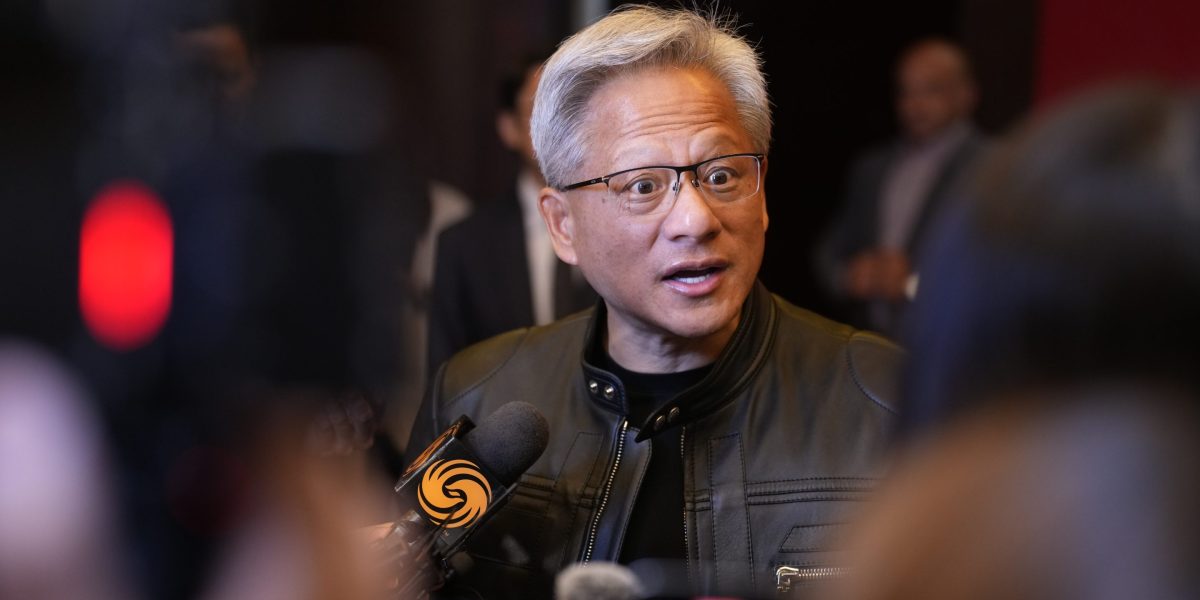
Nvidia CEO Jensen Huang discussed the OpenAI investment in an appearance on the Bg2 podcast with Brad Gerstner and Clark Tang on September 25, calling it an “opportunity to invest” and part of a partnership geared toward helping OpenAI build their own AI infrastructure. When asked about the allegation of circular financing in general and the Cisco precedent in particular, Huang talked about how OpenAI will fund the deal, arguing that it will have to be funded by OpenAI’s future revenues, or “offtake,” which he pointed out are “growing exponentially,” and by its future capital, whether it’s raised by a sale of equity or debt. That will depends on investors’ confidence in OpenAI, he said, and beyond that, it’s “their company, it’s not my business. And of course, we have to stay very close to them to make sure that we build in support of their continued growth.”
Shalett said that she and her team were “starting to watch” for signs of a bubble popping, highlighting the deal announced roughly a week before OpenAI struck its $100 billion data-center deal with Nvidia, when it struck another with Oracle worth $300 billion. Analysts at KeyBanc Capital Markets estimated that Oracle will have to borrow $100 billion of that amount—$25 billion a year for the next four years.
“Every morning the opening screen on my Bloomberg is what’s going on with CDS spreads on Oracle debt,” Shalett said, referring to credit default swaps, the financial instrument that was obscure before the Great Financial Crisis, but infamous for the role it played in a global market meltdown. CDSs essentially serve as insurance to investors in case of insolvency by a market entity. “If people start getting worried about Oracle’s ability to pay,” Shalett said, “that’s gonna be an early indication to us that people are getting nervous.” She added that all the indications to her speak of the end of a cycle and history is littered with cautionary tales from such times.
Oracle did not respond to requests for comment.
90% growth since the last bear market
Since the October 2022 bear market bottom and the launch of ChatGPT, according to Shalett’s calculations, the S&P 500 has soared 90%, but most of these gains have come from a small group of stocks. The so-called “Magnificent Seven”—including high-profile names like Nvidia and Microsoft—plus another 34 AI data-center ecosystem companies, are responsible for, as cited by Shalett and separately by JP Morgan Asset Management’s Michael Cembalest, about three-quarters of overall market returns, 80% of earnings growth, and a staggering 90% of capital spending growth in the index. Comparatively, the other 493 names in the S&P 500 are up just 25%—showing just how concentrated the rally has become.
The so-called “hyperscaler” companies alone are now spending close to $400 billion annually on capex supporting AI infrastructure, Morgan Stanley Wealth Management calculated. The economic influence of AI capex is now immense, contributing an estimated 100 basis points—fully one percentage point—to second-quarter GDP growth, according to Morgan Stanley’s research. This pace outstrips the rate of underlying consumer spending growth by tenfold, underscoring its centrality to both market performance and broader economic data.
“People conflate AI adoption, which is in the first inning, with the capex infrastructure buildout, which has been going full-out since 2022,” Shalett told Fortune. She cited concerns about the prominence of private equity and debt capital coming into play, as that “tends to produce bubbles, because it may be unspoken-for capacity.” In other words, people have money to burn and they’re throwing it at things that may not pay off.
Shalett waved away macro theories about the labor market or the Federal Reserve. “We think that’s missing the forest for the trees because the forest is entirely rooted in this one story” about AI infrastructure. Morgan Stanley’s bull-case mid-2026 price target for the S&P 500 is an eye-popping 7,200, but Shalett highlights that even the most optimistic outlook admits that risk premiums, credit spreads, and market volatility do not seem to fully account for the vulnerabilities lurking beneath the AI-fueled advance.
Shalett’s analysis suggests that AI capex maturity is approaching and some possible slowdowns are already visible. For instance, hyperscalers have already seen free-cash-flow growth turn negative, a sign that investment may have outpaced underlying technology returns. Strategas, an independent research firm, estimates that hyperscaler free cash flow is set to shrink by more than 16% over the next 12 months, putting pressure on lofty valuations and forcing investors to demand more discipline in how these funds are deployed.
Shalett was asked about data centers’ disproportionate impact on GDP throughout 2025, which media blogger Rusty Foster of Today in Tabs described as: “Our economy might just be three AI data centers in a trench coat.” The Morgan Stanley exec said “That’s what makes this cycle so fragile,” adding that at some point, “we’re not gonna be building any data centers for a while.” After that, it’s just a question of whether you crash: “Do you have a mild 1991-92-style recession or does it really become bad?”
A more bullish case
Bank of America Research weighed in on the semiconductors sector in a Friday note, writing that vendor financing in the space, especially Nvidia’s $100 billion commitment to OpenAI, has been “raising eyebrows.” Nevertheless, the team, led by senior analyst Vivek Arya, argued that the deal is structured by performance and competitive need, rather than pure speculative frenzy.
In an interview with Fortune, Arya explained why he wasn’t worried despite the “optics” being pretty obviously bad. “It’s very easy to say, ‘Oh, Nvidia is giving [OpenAI] money and they are buying chips with that money” and so on, but he argued the headlines are misleading about how much money is actually being spent and the $100 billion sticker price on the OpenAI deal “scared everyone.” Noting that the deal has multiple tranches that will play out over several years to come, he said it’s not like Nvidia is “just handing a $100 billion check to OpenAI [and saying] you know, go have fun.”
“Nvidia didn’t fund all of it,” Arya said of the wider generative AI capex boom. Citing public filings, Arya argued that Nvidia’s entire investment in the AI ecosystem is in fact less than $8 billion or so over the last 12 months, not such a large figure after all. And he’s still bullish on Nvidia and OpenAI, he added, because he sees them as the winners of this particular story. “We think they are going to be among the four or five ecosystems that come up. It’s not like Nvidia is going and investing in every one of those ecosystems, right? They’re only investing in one of those five, which is, of course, the most disruptive,” that being OpenAI.
When asked about his own fears of a bubble, Arya actually sounded a calmer but strikingly similar tune to Shalett. “I’m extremely comfortable with what will happen in the next 12 months,” Arya said, “And I have high sense of optimism about what will happen in the next five years. But can there be periods of digestion in between? Yeah.” Explaining that this is the nature of any infrastructure cycle, “it’s not always up and to the right.” In other words, after the next nine months in Shalett’s opinion and the next year in Arya’s, the data-center buildout endgame could be in play. “When these data centers are built,” Arya said, “they are not built for today’s demand. They’re built with some anticipation of demand that will develop in the next, you know, 12 to 18 months. So, are they going to be 100% utilized all the time? No.”
Rising worries about a bubble
Some of the biggest names in tech and Wall Street offered were hedging hard about the possibility of a bubble on Friday. Goldman Sachs CEO David Solomon and Jeff Bezos, both speaking at a tech conference in Turin, Italy, said they were seeing the same patterns as Shalett. Solomon said the massive amounts of spending weren’t fundamentally different from other booms and busts. “There will be a lot of capital that was deployed that didn’t deliver returns,” he said. That’s no different from how investment works. “We just don’t know how that will play out.”
Bezos characterized it as “kind of an industrial bubble,” arguing that the infrastructure would pay off for many years to come.
OpenAI CEO Sam Altman, who got markets jittery in late August when he mentioned the B-word, was asked again to comment on the subject while touring (what else?) a giant new data center in Texas. “Between the 10 years we’ve already been operating and the many decades ahead of us, there will be booms and busts,” Altman said. “People will overinvest and lose money, and underinvest and lose a lot of revenue.”
For his part, Cisco CEO John Chambers, one of the faces of the dotcom bubble, told the Associated Press on October 3 that he sees “a lot of tremendous optimism” about AI that is similar to the “irrational exuberance on a really large scale” that marked the internet age. It indicates a bubble to him, but only “a future bubble for certain companies. Is there going to be train wreck? Yes, for those that aren’t able to translate the technology into a sustainable competitive advantage, how are you going to generate revenue after all the money you poured into it?”
When asked whether the size of this potential bubble represents uncharted waters for the economy, especially considering the one-note nature of the long bull market, Shalett said Wall Streeters are always evaluating risk. But putting on her “American citizen hat,” she warned about the media consolidation that sees Oracle’s founder Larry Ellison also now playing a major role in TikTok (as part of a buying consortium of Trump-friendly billionaires) and Paramount in Hollywood and CBS News in New York (through his son, David Ellison, the media company’s new owner). Shalett said she’s worried about “groupthink” filtering into the functioning of markets. “That is not something that most of us have experienced in our lifetimes,” she said. “You stop factoring in risk premiums into markets, there is no bear case to anything.”
