
Fashion
Paris is torn between Elie Saab’s working girl and the whimsical creations of Japanese designers

Published
October 5, 2025
Japan’s leading fashion houses once again made a major splash at Paris Fashion Week on Saturday, as evidenced on the sixth day of the women’s ready-to-wear shows for spring-summer 2026 by three of the country’s most emblematic labels: Junya Watanabe, Noir by designer Kei Ninomiya, and Comme des Garçons. On the same day, Elie Saab sent his army of power women down the catwalk.
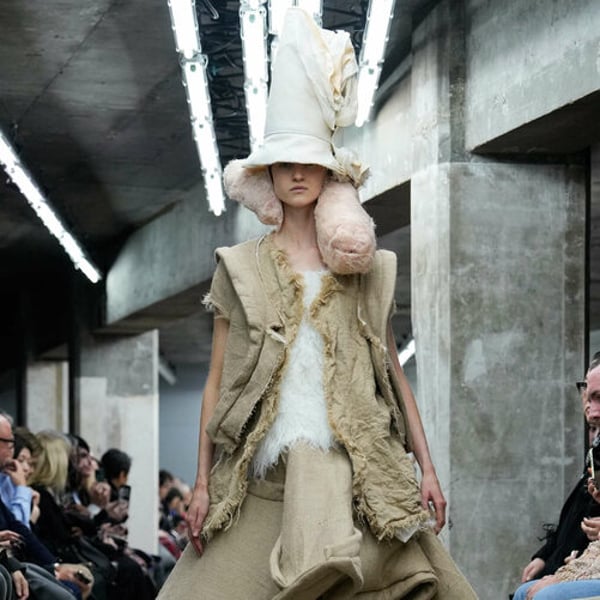
As so often, it was Rei Kawakubo‘s show for Comme des Garçons that moved us most and left the deepest impression. In today’s chaotic world, where catastrophes and human tragedies follow one after another, the designer seemed intent on returning to origins, reconnecting with the values of the Earth. Folk songs and traditional tunes accompanied the show.
A procession of amorphous, swollen silhouettes advanced, draped in great swathes of burlap, hemp or linen, hastily knotted, or in old lace sheets, curtains and bedspreads. Some jackets appeared to be cut directly from the large beige canvas sacks used to store potatoes and other produce from the land. A waistcoat and goat-hair coats completed this rustic look.
These sculptural garments, generated by the play of layering, volume and padding techniques, lent a sense of solemnity to the whole. Topped with battered top hats and cotton-wool hair in pastel shades, the models evoked rag dolls or cloth puppets—old crones or witches—burned in the countryside in January in antiquity to lay the past year to rest and celebrate a richer, more auspicious new season.

This season, Junya Watanabe pushed the boundaries further in his experimental exploration of clothing, delivering a breathtaking collection in which constructions were constantly reinvented, with unexpected intrusions along the way. The Japanese designer folded, with complete ease, the ordinary elements of the textile universe and everyday life into his creations—objects and accessories that usually pass unnoticed.
The result was at once surreal and playful. Old white lace parasols unfurled like a corolla at the hem of a summer dress, while a flock of straw hats created a ruffled volume at the collar and across the shoulders of a long evening gown in nude-coloured guipure lace.
Bright red pumps adorned the shoulders of a black sheath. A cascade of metallic cutlery formed the sleeves of a crinkled silver nylon T-shirt. Rendered in gold, knives and forks compose intriguing sculptures on a shoulder or a flank. The emblematic coat hanger completed this kind of “prévert inventory”: trench coats, shirt dresses and polka-dot dresses were threaded onto it two or three at a time, then secured to either side of the body.

At Noir, Kei Ninomiya continued to explore three-dimensional structures through a mathematical approach. By infinitely multiplying elements as modules—flowers, stars or metal cones, for example—he created fairytale, sculptural ensembles. The show opened with a series of white tulle petticoats paired with sparkling, silver, carapace-like tunics.
The models’ faces were masked or hidden by bulky headdresses, reminiscent of aggregates of quartz crystals or other organic forms. In black and white, they also appeared in unexpected fluorescent hues (pink, orange, and yellow). Paradoxically, behind this whimsical appearance lies a rather classic, even retro wardrobe, composed of prim white blouses, black balloon or pleated skirts, and suits with gathered ruffles. Not forgetting platform moccasins set on a platform and fitted with a small stiletto heel.
These outfits were enhanced by harnesses or cage tunics slipped over the garments, to which all manner of spectacular structures were attached: a giant star covered in precious stones, a basket-dress-shaped grid formed by a Meccano-like chain, clouds of tulle, glittering garlands and other fabric petals.

A change of register at Elie Saab. The mood evoked the electric air of the great metropolises. In the darkness, the sound of heels echoed on the pavement. Suddenly, silhouettes emerged in a fog bathed in a ruddy glow. The first model cut across the catwalk. The tone is set—a little like “Bright Lights, Big City”.
The look was that of the working girl: a chic, tailored suit; a pencil skirt with a back slit; a silk blouse with a plunging neckline; or little polka-dot tops. She’s as at ease in pleat-front trousers as in a strapless python-skin dress, and has never looked more elegant than simply wearing a flowing camel trench that slips over her skin, or a jacket and T-shirt with those sensual, floaty silk trousers with a denim effect.
Her favourite game? Mix & match. She happily pairs Prince of Wales check with polka dots, a leather skirt with a metallic-fringed tank top, a worn leather jacket with an openwork sequinned skirt. For evening, the Elie Saab woman pulls out all the stops with glittering draped maxi dresses or shorter dresses with long trains.
This article is an automatic translation.
Click here to read the original article.
Copyright © 2025 FashionNetwork.com All rights reserved.
Published
January 21, 2026
To coincide with Milan Fashion Week, the S|STYLE 2025- Denim Lab is setting up at Fondazione Sozzani for an edition devoted to the future of sustainable denim and water management in the textile industry. Led by the S|STYLE Sustainable Style platform, founded in 2020 by independent journalist and curator Giorgia Cantarini, this initiative forms part of an ongoing programme of research and experimentation into responsible innovations applied to contemporary fashion.
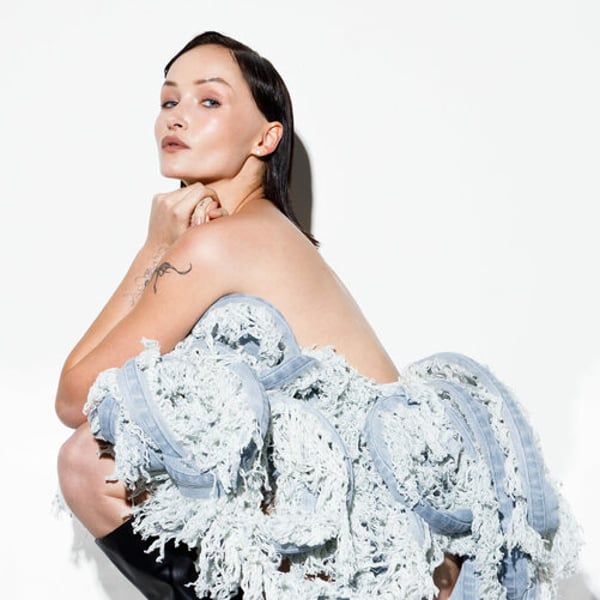
The exhibition, open to the public on September 27 and 28, features a site-specific art installation by Mariano Franzetti, crafted from recycled and regenerative denim. Conceived as an immersive experience, it brings fashion design, technological innovation and artistic expression into dialogue.
Water: a central issue in fashion sustainability
Developed in collaboration with Kering‘s Material Innovation Lab (MIL), the Denim Lab brings together a selection of young international designers invited to create a denim look using low-impact materials and processes. They benefit from technical support and access to textiles developed with innovative technologies aimed at significantly reducing water consumption, chemical use, and the carbon footprint of denim production.
This edition places water at its core, an essential issue for a fabric whose production has traditionally demanded substantial volumes of water, from cotton cultivation through to dyeing and finishing. Denim therefore serves as an emblematic testing ground, both familiar and closely associated with the environmental challenges facing the fashion industry.

The fabrics were developed by PureDenim Srl, a specialist in low-impact dyeing techniques, while treatments and finishes were applied by Tonello Srl, a recognised leader in sustainable washing and finishing technologies. The selected designers, from Europe, Asia, and Africa, each offer a distinctive interpretation of denim, blending formal exploration, textile innovation and reflection on the contemporary uses of clothing.
This article is an automatic translation.
Copyright © 2026 FashionNetwork.com All rights reserved.
Fashion
GoldenTree to buy about $200 million of Saks Global bankruptcy financing, Bloomberg News reports


As risk skyrockets, current and former CFOs are in demand for audit committees

The Denim Lab project examines the environmental impact of denim at Milan Fashion Week

Exclusive: Alphabet’s CapitalG names Jill Chase and Alex Nichols as general partners
-

 Politics8 years ago
Congress rolls out ‘Better Deal,’ new economic agenda
-
Entertainment9 years ago
New Season 8 Walking Dead trailer flashes forward in time
-
Politics9 years ago
Poll: Virginia governor’s race in dead heat
-
Politics8 years ago
Illinois’ financial crisis could bring the state to a halt
-
Entertainment9 years ago
The final 6 ‘Game of Thrones’ episodes might feel like a full season
-
Entertainment9 years ago
Meet Superman’s grandfather in new trailer for Krypton
-
Business9 years ago
6 Stunning new co-working spaces around the globe
-
Tech8 years ago
Hulu hires Google marketing veteran Kelly Campbell as CMO