
Fashion
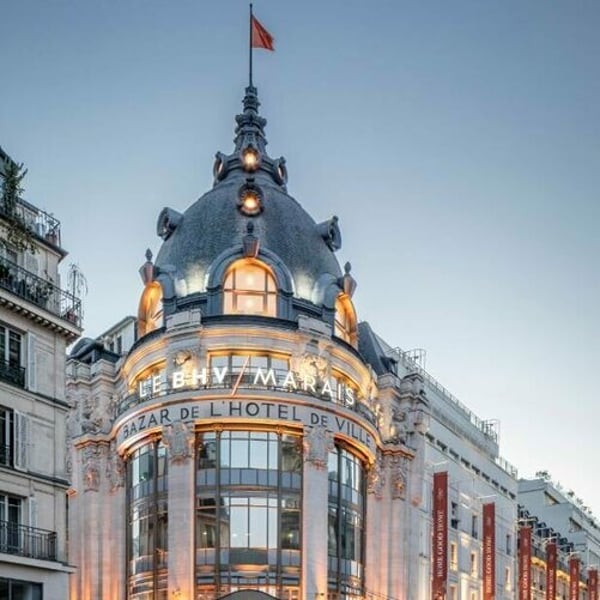
Shein’s arrival at BHV Marais: Brands pull out, the plan to buy the freehold is jeopardised

Published
October 4, 2025
Discontent had been simmering around the historic Parisian department store on Rue de Rivoli. The announcement that Shein would take a floor in November further widened the rift between brands and management. For months, BHV’s brands and suppliers have been grappling with unpaid invoices owed by the management of the department store founded in 1856, which was taken over by the Merlin family’s Société des Grands Magasins (SGM) from the Galeries Lafayette group in 2023.
Until October 1, little was said publicly about the discontent and the behind‑the‑scenes negotiations. Store management communicated sporadically to reassure partners and, according to our information, paid part of the sums owed. The brands, although increasingly irritated, kept their difficulties—and their questions about BHV Marais’ plans—under wraps. In mid‑September, a clumsy email from the sales department sent to all brands without hiding individual addresses (information revealed by our colleagues at L’Informé) fanned the flames of revolt. According to our information, several dozen brands then decided to share their situations to put pressure on the department store’s teams.
But with the high‑profile announcement of Shein’s arrival in November, taking over more than 1,000 square metres on the sixth floor of the main building, the mood has shifted from grumbling to anger since October 1. Brands are speaking out, and many French labels are expressing bitterness.
Bitter brands
“We had decided a few days before the announcement to end our presence at BHV,” explained Guillaume Gibault, founder of underwear brand Le Slip Français.
“It was a rather difficult decision, as the store had placed its trust in us almost from the brand’s beginnings. And it was a good and important point of sale, with one of our employees highly committed. But the problem is that since the takeover, we’ve been dealing with unpaid invoices. You make your sales, you pay your staff… but you don’t receive your revenue. We understand there can sometimes be difficult periods due to renovations or certain payment terms. But for the past two years, communication has been very complicated and we’ve had to chase our sales proceeds constantly; it affected many brands, amounting to millions of euros in total. When it becomes that widespread, it looks like a modus operandi. In such cases, everyone has to take responsibility. We were no longer aligned, so we decided to pull out. And seeing this decision involving Shein, we were right.”
At the root of the brands’ discontent are these payment difficulties. The Union Française des Industries de la Mode et de l’Habillement says it has identified more than 7 million euros in unpaid invoices, even though many international groups do not share information on these matters. While these conglomerates remain discreet for now, many brands interviewed by FashionNetwork.com say they have received no information since July about the amounts outstanding.

“BHV presented us with payment plans on several occasions, but they were not honoured. They paid us little by little, so we never left,” explained Guillaume Alcan, founder of the Odaje brand, who notes that the amounts owed rose to as much as 100,000 euros. “We told them that such an outstanding balance with them was untenable for our business. And we decided to leave.”
It is the same story at Maison Lejaby, where Xavier Martin has been working since last year to relaunch the lingerie brand.
“If the unpaid invoices are intentional, then this practice is purely dishonest. Because the Merlin family, moreover, prides itself on having brought BHV’s accounts back into the black,” said the executive.
“Otherwise it’s incompetence, and clearly the management of such an entity should not be in their hands. In any case, they show immense contempt for their suppliers.”
The brand pulled out on October 1, the day Shein’s arrival was announced. Martin observes: “Brands as a whole are dismayed. There are hundreds of us who are not being paid and our products, by and large, have nothing to do with fast fashion—quite the opposite. So any influx of traffic, if there is one, will be to the detriment of most of them.”
For its part, BHV, contacted by FashionNetwork, says it is in discussions with brands and suppliers to explain its concept, and maintains that some of the players already present welcomed Shein’s arrival. Furthermore, SGM points out that the issue of unpaid invoices is linked to an IT problem that could be resolved in October or November.
For many, waiting is no longer an option—especially as numerous observers decry the lack of clarity surrounding BHV’s commercial project and its future organisation, with the closure of the Homme building at 36 Rue de la Verrerie in the coming months and the consolidation of the menswear offer onto a single floor. In fact, Shein’s arrival was the decisive trigger.
“I’m deeply shocked to see a historic Parisian department store welcome Shein within its walls. We are present there with AIME, but this decision does not correspond to our values or to what we stand for: a more responsible fashion and beauty industry, more respectful of people and the planet,” explained the founder of beauty brand AIME in a LinkedIn post.
“We can’t turn a blind eye. By integrating Shein, BHV is sending a very negative signal to the entire sector. I think it’s our responsibility, as brands, to take a clear stand. With François Morrier, we intend to withdraw AIME from BHV. And I invite all brands sharing these convictions to consider this decision with us. Our collective choices shape the future of our industry.”
“We had been wondering about the situation at BHV for several months,” explained Antoine Tinel of retail agency The Lifestyle Company. “We were offering the Ipanema brand in footwear, and Barbour, which performs well. But the announcement of Shein’s arrival dispelled our doubts. It confirmed our decision: we won’t be taking on any new seasons.”
Frédéric Merlin, who argues that Shein’s entry is an opportunity to attract customers en masse to BHV, maintains that other players present in his department store have expressed their satisfaction with the project. The fact remains, however, that this decision is likely to significantly reshape BHV’s fashion and accessories range with Shein’s arrival. It is, therefore, a gamble.
What future for the financing of the purchase of the BHV premises?
A gamble made all the more daring by the fact that SGM has been trying for months to finalise the bank financing package that would enable it to purchase the BHV premises. And this agreement with Shein may well scupper the process.

Indeed, after months of questions over the feasibility of such a takeover, SGM’s general management was able to announce on June 17 the opening of exclusive negotiations with Banque des Territoires. The aim of this tie‑up with the public financing vehicle? To be backed by a strategic partner to bring other banking partners on board and finalise the acquisition from the Galeries Lafayette group. The deadline for closing the deal was originally set for the end of June 2025.
According to our information, the transaction has still not been completed. And, judging by communications from Caisse des Dépôts—on which Banque des Territoires directly depends, and which recalls that the latter “is only involved in a real estate project in which SGM would have a majority stake”—the institution did not take kindly to being kept in the dark about plans involving the ultra‑fast‑fashion platform, stating that it “is not in favour of it.”
It was even less persuaded by the arguments about protecting retail that were associated with the move: “We would like to remind you that any investment decision by Caisse des Dépôts and its subsidiaries is strictly conditional on respect for the values that underpin our action: supporting a responsible, local economy, promoting ecological transition and assisting local authorities and players in the field in their positive‑impact projects. These principles form an inescapable framework, and any project supported by Caisse des Dépôts must adhere to them.”
MPs Olivia Grégoire (LREM‑Paris) and Antoine Vermorel‑Marques (LR‑Loire) have taken up the issue. And, in an appeal to the Prime Minister to speed up the establishment of the expected joint committee on the so‑called “anti‑fast‑fashion” law targeting Shein in particular, they called on the management of Caisse des Dépôts not to support the project of a player partnering with Shein.
“Whatever they may say, whatever they may deny, welcoming Shein into our department stores is a betrayal of the heritage of our couturiers and a denial of our history,” Grégoire went on to explain in a LinkedIn post.
“The Banque des Territoires, which was in discussions with SGM about a possible takeover of the BHV premises, could not commit public funds to a project that would jeopardise our fashion industry. I know its commitment, and that of its chairman, Olivier Sichel, to local commerce: they would never support an operation offering a showcase for ultra‑fast‑fashion, contrary to their primary mission.”
In the face of this mounting pressure, SGM once again asserts that its approach is aimed at revitalising its retail spaces and says it wants its project to be understood: “We understand the questions and concerns raised by this announcement, but we are maintaining our dialogue with elected officials, partners and all players in the sector to explain the reality and the positive implications of this partnership.”
There is no doubt that the department store’s more than 1,000 employees are hoping for a positive outcome for their jobs.
While the amount of the agreement with Shein to set up across 1,200 square metres has not been disclosed, the question arises as to whether SGM could now do without the firm backing of Banque des Territoires for its project to buy the BHV premises. Les Echos suggests that another player could enter the fray. A bluff? Whatever the case, by choosing to play the Shein card, Merlin seems to be engaged in a very high‑stakes poker game.
This article is an automatic translation.
Click here to read the original article.
Copyright © 2025 FashionNetwork.com All rights reserved.


Published
December 5, 2025
Burberry has named a new chief operating and supply chain officer as well as a new chief customer officer. They’re both key roles at the recovering luxury giant and both are being promoted from within.
Matteo Calonaci becomes chief operating and supply chain officer, moving from his role as senior vice-president of strategy and transformation at the firm.
In his new role, he’ll be oversee supply chain and planning, strategy and transformation, and data and analytics. He succeeds Klaus Bierbrauer, who’s currently Burberry supply chain and industrial officer. Bierbrauer will be leaving the company following its winter show and a transition period.

Meanwhile, Johnattan Leon steps up as chief customer officer. He’s currently currently Burberry’s senior vice-president of commercial and chief of staff. In his new role he’ll be leading Burberry’s customer, client engagement, customer service and retail excellence teams, while also overseeing its digital, outlet and commercial operations.
Both Calonaci and Leon will join the executive committee, reporting to Company CEO Joshua Schulman.

Schulman said of the two execs that the appointments “reflect the exceptional talent and leadership we have at Burberry. Both Matteo and Johnattan have been instrumental in strengthening our focus on executional excellence and elevating our customer experience. Their deep understanding of our business, our people, and our customers gives me full confidence that their leadership will help drive [our strategy] Burberry Forward”.
Copyright © 2025 FashionNetwork.com All rights reserved.

Published
December 5, 2025
Traditional and occasion wear designer Puneet Gupta has stepped into the world of fine jewellery with the launch of ‘Deco Luméaura,’ a collection designed to blend heritage and contemporary aesthetics while taking inspiration from the dramatic landscapes of Ladakh.
“For me, Deco Luméaura is an exploration of transformation- of material, of story, of self,” said Puneet Gupta in a press release. “True luxury isn’t perfect; it is intentional. Every piece is crafted to be lived with and passed on.”
The jewellery collection features cocktail rings, bangles, chokers, necklaces, and statement evening bags made in recycled brass and finished with 24 carat gold. The stones used have been kept natural to highlight their imperfect and unique forms and each piece in the collection has been hammered, polished, and engraved by hand.

Designed to function as wearable art pieces, the colourful jewellery echoes the geometry of Art Deco while incorporating distinctly South Asian imagery such as camels, butterflies, and tassels. Gupta divides his time between his stores in Hyderabad and Delhi and aims to bring Indian artistry to a global audience while crafting a dialogue between designer and artisan.
Copyright © 2025 FashionNetwork.com All rights reserved.


Takeaways from Tallahassee — North Florida Winter Wonderland

Mark Zuckerberg says the ‘most important thing’ he built at Harvard was a prank website

Let’s Get Lit with These Hanukkah Essentials
-

 Politics8 years ago
Congress rolls out ‘Better Deal,’ new economic agenda
-
Entertainment8 years ago
New Season 8 Walking Dead trailer flashes forward in time
-
Politics8 years ago
Poll: Virginia governor’s race in dead heat
-
Entertainment8 years ago
The final 6 ‘Game of Thrones’ episodes might feel like a full season
-
Entertainment8 years ago
Meet Superman’s grandfather in new trailer for Krypton
-
Politics8 years ago
Illinois’ financial crisis could bring the state to a halt
-
Business8 years ago
6 Stunning new co-working spaces around the globe
-
Tech8 years ago
Hulu hires Google marketing veteran Kelly Campbell as CMO