Connect with us

Business

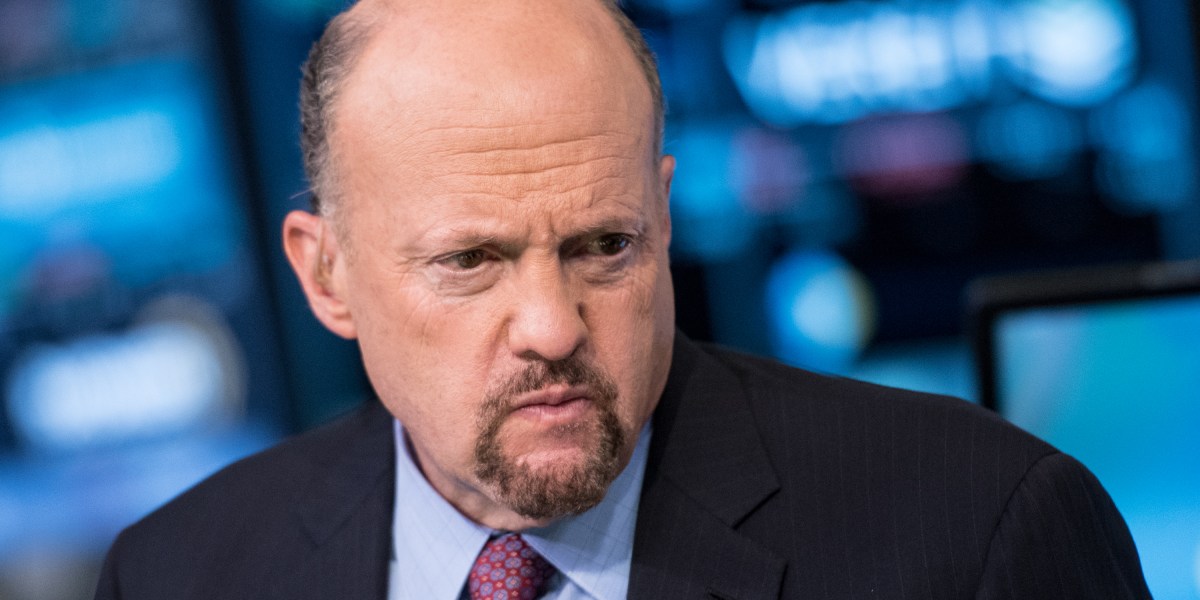
Jim Cramer: The case of Nvidia, the stock I loved so much in 2017 that I named my dog after it

Published

on


Not long ago I was coming back from a haircut, a rare trip for me outside the New York Stock Exchange, and I heard a man’s voice calling me from the curb just behind Fearless Girl, a sculpture by the artist Kristen Visbal that I never fail to grin at when she catches my eye. 

“Jim, can I shake your hand?” the man asked. 

One day I will get over the fact that nice people want to stop and talk to me, tell me how they are doing in the market or how much they like “the show.” I always have time to say hello or give a fist pump, even a hug if demanded. 

This time, it was a man named Jeremy, who said, “I want to show you something.” His wife said, “It’s something that has allowed me to retire.” Jeremy opened an app filled with stock listings, and he jabbed one line, a line that said “Nvidia, $2,545,000.” Jeremy told me that’s what I made for him. That’s what allowed his wife, a schoolteacher in New Hampshire, to retire. 

“I can’t thank you enough,” he said. To which I replied with the most logical of points: “Jensen deserves the thanks, not me.” 

I was referring to Jensen Huang, the CEO of my finest stock pick ever, the tiny semiconductor business that is now one of the world’s three largest companies, jousting with Microsoft and Apple over the past couple of years for the honor. 

How did Jeremy know to buy Nvidia when I mentioned it? For the same reason tens of thousands of people bought Nvidia on June 20, 2017, when I told the world that I loved the company so much that I renamed my dog after it. That rescue mutt had been known for years as Everest, but enough of that. 

Taking into account a couple of stock splits the company has had since then, Nvidia traded at just under $4 at the time. Less than $4 invested that day would have gotten you $136 by the end of December 2024. Meaning $1,000 would have turned into $34,622—and $10,000 would have grown into a $346,218 win. Not too bad. But how did I realize that this company would become a $4 trillion holding? I renamed my dog to finally get people’s attention on what I thought, hoped, and truly believed would be the greatest stock story of all time. 

Everywhere I go now—at home or on vacation (and not just domestically), I meet people who thank me for Nvidia. I want to talk about it here not because I am a genius—I am decidedly not—but because it all comes back to process. Let me show you my work so you can have the confidence to seize on my process and build your own. 

One of my earliest (of hundreds of ) pushes for Nvidia on Mad Money was on September 30, 2009. My interest in the company’s story, which I’d known years earlier but never paid much attention to, had been piqued by, of all places, a Best Buy conference call. The electronics retailer had discussed how netbooks were becoming a big growth category, so I looked up who was making the graphic processing units, or GPUs, for those types of computers. I learned that Nvidia—a company I had previously known only as a gaming chip maker—was the leader in the space, and I recommended the stock. 

Taking into account splits, it was at 38 cents at the time. Jump ahead a few months, to June 2010. That was when I first had the chance to interview Nvidia’s CEO, a young guy named Jensen Huang. He wore a motorcycle jacket. He didn’t seem like an executive. He seemed like a gamer. A video gamer. 

I mostly liked that he wasn’t the same as everyone else I interviewed. He didn’t seem to care much about anything other than fast chips. I was instantly smitten. I redoubled my efforts to talk up the company’s stock after an interview I did a bit later with the CEO of Audi North America. I had come to his showroom to ask some questions, because the cars are universally considered to be well made. When the interview ended, I asked him why his cars ran so well. He said, “It’s the technology.” 

I knew not to be satisfied with that answer. After what might have qualified as badgering, I finally got him to tell me who made the components. 

“Nvidia.” 

“Impossible,” I said. “But they make gaming chips,” I replied. 

He wanted to know if I thought he was making it up. And I knew then that there was something special here. Nvidia had in fact pretty much cornered the market on speedy chips, not just in game consoles but in cars, too. I just hadn’t realized it. The Audi CEO told me that Nvidia’s chips were lightning fast, much faster than Intel’s. 

I couldn’t wait to get back to the office and dig in deeper. I couldn’t wait to connect with Jensen Huang and learn more. 

But he wasn’t an easy man to get to know. I emailed. I told him quarter after quarter what a terrific company he had. But I didn’t hear back. Not until I mentioned to him that my daughter was doing service work helping troubled teens not far from where he grew up in Oregon did he respond—and he did so in an incredibly gracious way. 

What I saw when I went to Nvidia’s headquarters was nothing short of phenomenal. Those gaming chips, the ones that ended up in the Audi? They were going to revolutionize the world. They were going to be used for something called artificial intelligence, real science-fiction devices that could generate near-lifelike images through mathematical computation and then make them perfect. 

There were periods between 2020 and 2022 when I recommended Nvidia multiple times a week or, between my three shows, multiple times a day. I couldn’t help myself. How could everyone not see what was about to occur? A machine aided by a Nvidia chip could see, it could hear, it could think! 

And then, one day, in November 2022, a man named Sam Altman, an old friend of Jensen’s, came out with ChatGPT, some six years after Jensen had hand-delivered Nvidia’s first AI supercomputer to OpenAI back in 2016. The world changed. One day it seemed that only a handful of people knew about AI. Then millions did, an astoundingly quick adoption. 

The rest—including in May 2023, when Nvidia had the biggest positive earnings surprise a company has ever delivered, beating expectations handily and then offering a quarterly revenue forecast that was $4 billion above expectations—is history. 

“But how can I find the next Nvidia?” you ask me. Okay, okay. You can’t afford an Audi, not that the head of Audi North America would help you anyway. You didn’t know that Nvidia’s chips could be used for more than gaming. You didn’t believe in a guy in a black leather jacket. How could you have spotted this one? 

The answer is that even if you can’t spot Nvidia, you can spot something that will make you rich, I promise you. Every once in a while—not never, decidedly not never—an Nvidia comes along. 

When I was a kid at Goldman Sachs, back in the mid-1980s, there was a fellow who ran the research department named Lee Cooperman. I was so young back then that I still had hair. I idolized Lee, and still do, because he never stopped having and talking about new ideas. One day, Lee said to me, “You ought to tell your clients to buy shares in Berkshire Hathaway.” My head was spinning. What did he mean? That was a clothing company, right? Did he wear their shirts? He was testing me. No way that Lee, one of our nation’s greatest investors, would ever be telling me to buy shares of a shirt company, would he? The one with the advertisement of the man with an eye patch? (I was thinking of Hathaway shirts, a fine company until it went broke in 2002. Not a great investment.) 

Rather than show off my ignorance, I asked him, “Why that company?” 

He looked at me like I was an idiot. “Warren Buffett. Go read his annual report, let me know.” 

I read it. Then I read it again. And again. Then I went back down to the research floor and told Lee I saw what he meant. “Then tell your clients to buy it.” That’s just what I did. After the fifth time, I gave up. The stock was selling for $1,400 a share, and who the heck wanted to buy a $1,400 stock? Certainly not anyone I was talking to. So I just dropped it. Never made another call on it because of the resistance to the price tag. Now that it is north of $700,000, that original price tag per share seems like a ridiculous reason not to buy the stock, doesn’t it? 

Again, you could say not fair: You had a genius tell you about Berkshire Hathaway. You spotted Nvidia from your day-to-day Mad Money work. Guilty on all counts. But how many times have you heard of Warren Buffett in the past 10, 20, 30, or 40 years? And you could always recall the name of my dog; everybody could.

Excerpted from HOW TO MAKE MONEY IN ANY MARKET. Published by TKTKTK. Copyright © 2025 by Jim Cramer. All Rights Reserved.


Source link

Continue Reading

Business

Netflix to buy Warner Bros. in $72 billion cash, stock deal

Published

on


Netflix Inc. agreed to buy Warner Bros. Discovery Inc., marking a seismic shift in the entertainment business as a Silicon Valley-bred streaming giant tries to swallow one of Hollywood’s oldest and most revered studios.

Under terms of the deal announced Friday, Warner Bros. shareholders will receive $27.75 a share in cash and stock in Netflix, valuing the business at $82.7 billion including debt. The total equity value of the deal is $72 billion. Warner Bros. will spin off cable networks such as CNN and TNT into a separate company before concluding the sale of its studio and HBO to Netflix. 

Media mergers of this scale have a rocky history and this one is expected to bring intense regulatory scrutiny in the US and Europe. The deal combines two of the world’s biggest streaming providers with some 450 million subscribers. Warner Bros.’ deep library of programming gives Netflix content to sustain its lead over challengers like Walt Disney Co. and Paramount Skydance Corp. 

The acquisition, which confirmed a Bloomberg report Thursday, presents a strategic pivot for Netflix, which has never made a deal of this scope in its 28-year history. With the purchase, Netflix becomes owner of the HBO network, along with its library of hit shows like The Sopranos and TheWhite Lotus. Warner Bros. assets also include its sprawling studios in Burbank, California, along with a vast film and TV archive that includes Harry Potter and Friends. 

“I know some of you are surprised we are making this acquisition,” Netflix co-Chief Executive Officer Ted Sarandos said on a call with analysts Friday. He noted that Netflix has traditionally been known to be builders, not buyers. “But this is a rare opportunity that will help us achieve our mission to entertain the world.”

Netflix shares were down 3.5% Friday afternoon in New York. They have declined about 17% since the streaming leader emerged as an interested party in October. Some investors and analysts have interpreted this deal to mean Netflix was worried it couldn’t expand its current business, a theory co-CEO Greg Peters dismissed.

Warner Bros. stock was up about 5.2% midday in New York. It has almost doubled since reports of deal talks with Paramount emerged in September. Play Video

The news concludes a flurry of dealmaking over the past few months that began with a series of bids by Paramount. That prompted interest from Comcast Corp. and Netflix, who were both chasing just the studios and streaming business. All three submitted sweetened bids earlier this week, with Paramount ultimately offering $30 a share for all of Warner Bros. Discovery, arguing that its proposal offered a smoother path to regulatory approval. Netflix won out in the end although significant hurdles remain before the deal can close, which the company expects it can do in the next 18 months.

Paramount could still try to raise its bid, take its offer directly to shareholders or sue to try and block the Netflix deal. The company had no comment.

California Republican Darrell Issa wrote a note to US regulators objecting to any potential Netflix deal, saying it could result in harm to consumers. Netflix has argued that one of its biggest competitors, however, is Alphabet Inc.’s YouTube, and that bundling offerings could lower prices for subscribers. Netflix accounts for between 8% and 9% of TV viewing in the US each month, according to Nielsen. It accounts for closer to 20% or 25% of streaming consumption.

Analysts at Oppenheimer said platforms such as Reels, TikTok and YouTube competing for viewers’ time should help the deal pass antitrust review. 

It was 15 years ago that Time Warner CEO Jeff Bewkes, who oversaw Warner Bros. and HBO, shrugged off the threat posed by Netflix, comparing the then fledgling company to the Albanian Army. As Netflix began to invest in original programming, Sarandos declared that Netflix wanted to become HBO before HBO figured out streaming.

Sarandos succeeded and Netflix led the streaming takeover of Hollywood while HBO struggled to respond to the rise of on demand viewing and the decline of cable. Bewkes agreed to sell Time Warner to AT&T in 2016, the beginning of a decade of turmoil for HBO and Warner Bros., storied brands that are about to have their fourth owner in a decade.

Warner Bros. put itself up for sale in October after receiving three acquisition offers from Paramount, which were rejected, opening the door for Netflix and Comcast. Peters said he didn’t see the logic of these big transactions at Bloomberg’s Screentime conference in October, but Sarandos privately pushed for the deal.

The bidding got contentious, with Paramount accusing Warner Bros. of operating an unfair process that favored Netflix. The Netflix offer topped Paramount’s when combining the money for the studio and streaming business with the estimated value of the networks. The two sides agreed to the deal Thursday night. 

Under terms of the agreement, Warner Bros. shareholders will receive $23.25 in cash and $4.50 in Netflix common stock. Moelis & Co. is Netflix’s financial adviser. Wells Fargo is acting as an additional financial advisor and, along with BNP Paribas and HSBC Holdings, is providing $59 billion in debt financing, according to a regulatory filing, one of the largest ever loans of its kind. Allen & Co., JPMorgan Chase & Co. and Evercore are serving as financial advisers to Warner Bros. Discovery.

Netflix agreed to pay Warner Bros. a termination fee of $5.8 billion if the deal falls apart or fails to get regulatory approval. “We’re highly confident in the regulatory process,” Sarandos said Friday.

In addition to streaming overlap, regulators will also likely look at the impact on theatrical releases, which Netflix has traditionally eschewed in favor of prioritizing content on its platform.

Netflix said it will continue to release Warner Bros. movies in theaters and produce the studio’s TV shows for third parties — two major changes in how it does business. The company was a little short on details of exactly how it will integrate the different businesses, but Netflix said it expects to maintain Warner Bros.’ current operations and build on its strengths.

The deal will allow Netflix to “significantly expand” US production capacity and invest in original content, which will create jobs and strengthen the entertainment industry, the company said. The combination is also expected to create “at least $2 billion to $3 billion” in cost savings per year by the third year.

Warner Bros. Discovery CEO David Zaslav was the architect of combining Warner Bros. and Discovery in 2022, a deal he hoped would create a viable competitor to Netflix. But the company’s share price tanked in response to a series of public miscues and the continued decline of the cable network business. 

While performance rebounded a bit over the last year, the company never quite became the streaming dynamo Zaslav envisioned. He’ll continue to run the company through its spinoff and sale. The two companies haven’t yet agreed on him having any role at Netflix.

The traditional TV business is in the midst of a major contraction as viewers shift to streaming, the world that Netflix dominates. In the most recent quarter, Warner Bros. cable TV networks division reported a 23% decline in revenue, as customers canceled their subscriptions and advertisers moved elsewhere.


Source link

Continue Reading

Business

Mark Zuckerberg renamed Facebook for the metaverse. 4 years and $70B in losses later, he’s moving on

Published

on


In 2021, Mark Zuckerberg recast Facebook as Meta and declared the metaverse — a digital realm where people would work, socialize, and spend much of their lives — the company’s next great frontier. He framed it as the “successor to the mobile internet” and said Meta would be “metaverse-first.”

The hype wasn’t all him. Grayscale, the investment firm specializing in crypto, called the Metaverse a “trillion-dollar revenue opportunity.” Barbados even opened up an embassy in Decentraland, one of the worlds in the metaverse. 

Five years later, that bet has become one of the most expensive misadventures in tech. Meta’s Reality Labs division has racked up more than $70 billion in losses since 2021, according to Bloomberg, burning through cash on blocky virtual environments, glitchy avatars, expensive headsets, and a user base of approximately 38 people as of 2022.

For many people, the problem is that the value proposition is unclear; the metaverse simply doesn’t yet deliver a must-have reason to ditch their phone or laptop. Despite years of investment, VR remains burdened by serious structural limitations, and for most users there’s simply not enough compelling content beyond niche gaming.

A 30% budget cut 

Zuckerberg is now preparing to slash Reality Labs’ budget by as much as 30%, Bloomberg said. The cuts—which could translate to $4 billion to $6 billion in reduced spend—would hit everything from the Horizon Worlds virtual platform to the Quest hardware unit. Layoffs could come as early as January, though final decisions haven’t been made, according to Bloomberg. 

The move follows a strategy meeting last month at Zuckerberg’s Hawaii compound, where he reviewed Meta’s 2026 budget and asked executives to find 10% cuts across the board, the report said. Reality Labs was told to go deeper. Competition in the broader VR market simply never took off the way Meta expected, one person said. The result: a division long viewed as a money sink is finally being reined in.

Wall Street cheered. Meta’s stock jumped more than 4% Thursday on the news, adding roughly $69 billion in market value.

“Smart move, just late,” Craig Huber of Huber Research told Reuters. Investors have been complaining for years that the metaverse effort was an expensive distraction, one that drained resources without producing meaningful revenue.

Metaverse out, AI in

Meta didn’t immediately respond to Fortune’s request for comment, but it insists it isn’t killing the metaverse outright. A spokesperson told the South China Morning Post that the company is “shifting some investment from Metaverse toward AI glasses and wearables,” point­ing to momentum behind its Ray-Ban smart glasses, which Zuckerberg says have tripled in sales over the past year.

But there’s no avoiding the reality: AI is the new obsession, and the new money pit.

Meta expects to spend around $72 billion on AI this year, nearly matching everything it has lost on the metaverse since 2021. That includes massive outlays for data centers, model development, and new hardware. Investors are much more excited about AI burn than metaverse burn, but even they want clarity on how much Meta will ultimately be spending — and for how long.

Across tech, companies are evaluating anything that isn’t directly tied to AI. Apple is revamping its leadership structure, partially around AI concerns. Microsoft is rethinking the “economics of AI.” Amazon, Google, and Microsoft are pouring billions into cloud infrastructure to keep up with demand. Signs point to money-losing initiatives without a clear AI angle being on the chopping block, with Meta as a dramatic example.

On the company’s most recent earnings call, executives didn’t use the word “metaverse” once.


Source link

Continue Reading

Business

Robert F. Kennedy Jr. turns to AI to make America healthy again

Published

on


HHS billed the plan as a “first step” focused largely on making its work more efficient and coordinating AI adoption across divisions. But the 20-page document also teased some grander plans to promote AI innovation, including in the analysis of patient health data and in drug development.

“For too long, our Department has been bogged down by bureaucracy and busy-work,” Deputy HHS Secretary Jim O’Neill wrote in an introduction to the strategy. “It is time to tear down these barriers to progress and unite in our use of technology to Make America Healthy Again.”

The new strategy signals how leaders across the Trump administration have embraced AI innovation, encouraging employees across the federal workforce to use chatbots and AI assistants for their daily tasks. As generative AI technology made significant leaps under President Joe Biden’s administration, he issued an executive order to establish guardrails for their use. But when President Donald Trump came into office, he repealed that order and his administration has sought to remove barriers to the use of AI across the federal government.

Experts said the administration’s willingness to modernize government operations presents both opportunities and risks. Some said that AI innovation within HHS demanded rigorous standards because it was dealing with sensitive data and questioned whether those would be met under the leadership of Health Secretary Robert F. Kennedy Jr. Some in Kennedy’s own “Make America Health Again” movement have also voiced concerns about tech companies having access to people’s personal information.

Strategy encourages AI use across the department

HHS’s new plan calls for embracing a “try-first” culture to help staff become more productive and capable through the use of AI. Earlier this year, HHS made the popular AI model ChatGPT available to every employee in the department.

The document identifies five key pillars for its AI strategy moving forward, including creating a governance structure that manages risk, designing a suite of AI resources for use across the department, empowering employees to use AI tools, funding programs to set standards for the use of AI in research and development and incorporating AI in public health and patient care.

It says HHS divisions are already working on promoting the use of AI “to deliver personalized, context-aware health guidance to patients by securely accessing and interpreting their medical records in real time.” Some in Kennedy’s Make America Healthy Again movement have expressed concerns about the use of AI tools to analyze health data and say they aren’t comfortable with the U.S. health department working with big tech companies to access people’s personal information.

HHS previously faced criticism for pushing legal boundaries in its sharing of sensitive data when it handed over Medicaid recipients’ personal health data to Immigration and Customs Enforcement officials.

Experts question how the department will ensure sensitive medical data is protected

Oren Etzioni, an artificial intelligence expert who founded a nonprofit to fight political deepfakes, said HHS’s enthusiasm for using AI in health care was worth celebrating but warned that speed shouldn’t come at the expense of safety.

“The HHS strategy lays out ambitious goals — centralized data infrastructure, rapid deployment of AI tools, and an AI-enabled workforce — but ambition brings risk when dealing with the most sensitive data Americans have: their health information,” he said.

Etzioni said the strategy’s call for “gold standard science,” risk assessments and transparency in AI development appear to be positive signs. But he said he doubted whether HHS could meet those standards under the leadership of Kennedy, who he said has often flouted rigor and scientific principles.

Darrell West, senior fellow in the Brooking Institution’s Center for Technology Innovation, noted the document promises to strengthen risk management but doesn’t include detailed information about how that will be done.

“There are a lot of unanswered questions about how sensitive medical information will be handled and the way data will be shared,” he said. “There are clear safeguards in place for individual records, but not as many protections for aggregated information being analyzed by AI tools. I would like to understand how officials plan to balance the use of medical information to improve operations with privacy protections that safeguard people’s personal information.”

Still, West, said, if done carefully, “this could become a transformative example of a modernized agency that performs at a much higher level than before.”

The strategy says HHS had 271 active or planned AI implementations in the 2024 financial year, a number it projects will increase by 70% in 2025.


Source link

Continue Reading

Trending

Copyright © Miami Select.