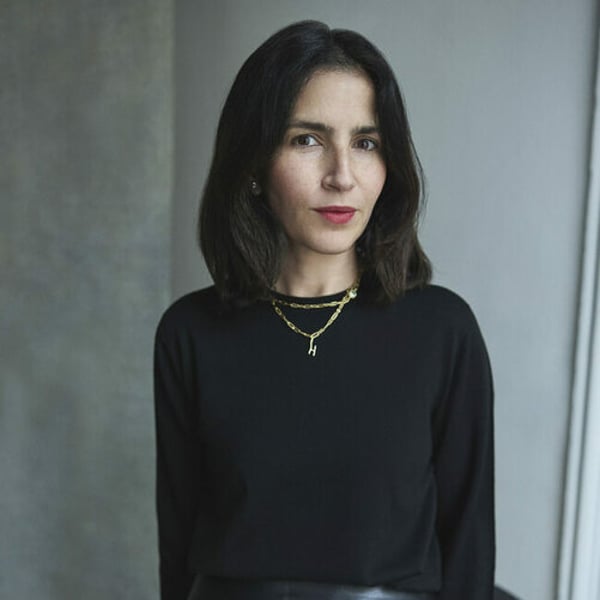
Nine years after opening her first store in Venice, Los Angeles, eyewear designer Ahlem Manai-Platt will open a second location in Melrose Place in a few weeks, her fifth worldwide after Paris, New York, and San Francisco. Having partnered with investment group 1686 a few months ago, the designer has new projects in the works.
FashionNetwork: You are opening your second store in Melrose Place soon. Why did you choose a second location in Los Angeles, and why did you choose the Melrose Place neighborhood?
Ahelm Manai-Platt: Los Angeles is a city that holds a very special place in my history. It’s where it all began for Ahlem, where I took the risk of launching the brand without a specific plan, simply with the intuition that something had to exist differently. It’s also a city that has given me immense freedom—a more instinctive, less codified way of living and creating. The first boutique on Abbot Kinney had that pioneering energy. Melrose Place is another step forward. It’s a place that speaks more of maturity, elegance, and intimacy. I wanted to create a space that reflects the brand’s evolution and tells another facet of its story.
FNW: Each boutique you open has its own particular design style. What can we expect from your Melrose Place location?
A.M.P.: For me, each store is like a page in a diary: it has to reflect my state of mind at the time of its creation. Melrose Place will be very different from the others. The idea was to create a place that doesn’t look like a store but more like a domestic space, like a quiet house where every detail has a purpose. The materials will be noble, raw, timeless: metal, wood, and plaster. The atmosphere will be both soothing and intense, very refined but never cold. I want people to feel comfortable there, to want to stay—even without buying anything.
FNW: A bespoke service will also be offered in-store. What does this involve and why focus on bespoke services?
A.M.P.: Bespoke services probably best embody what I love about this profession: human interaction, dialogue, and creativity that arises from an encounter. It goes far beyond the product: it’s about listening to a personality, understanding a look, a gesture, a world, and then giving shape to all of that in a frame. It’s also a way of resisting the idea of fast consumption. Creating a unique object takes time, attention, and care. And that’s exactly what I want to defend.
FNW: Los Angeles is the city where it all began for you. You also lived there for a few years. Is California a key market for your brand?
A.M.P.: Yes, of course. But beyond the market, it’s above all an emotional place for me. It’s a city that shaped my vision: the relationship with light, space, and time. Everything is different there. California also has this very free way of appropriating objects—without codes, without snobbery—and that deeply corresponds to what I wanted to create with Ahlem: glasses that you wear naturally, because they become a part of you.
Ahlem Melrose Place store will open in a few weeks – Ahlem
FNW: Other openings are planned in the United States. Which cities are you targeting and what is your overall strategy for the American market?
A.M.P.: There will be a second store in NYC, of course. Chicago too. But I’m not looking to open stores everywhere. Each opening must make sense, tell a story, and extend our universe. The idea is to create few, but very good ones. Our goal is to build deeply rooted places that become meeting points with our community.
FNW: You are leaving for Japan in a few days. How do you explain the Japanese enthusiasm for your brand?
A.M.P.: I think the Japanese can immediately sense when something is sincere. They have a culture of craftsmanship, precision, and skill, which resonates deeply with our way of working. They notice the details, even those that are left unsaid.
FNW: Do you have ambitions to open stores in Japan as well?
A.M.P.: Yes, there will probably be an opening there. I would like to create a place in Tokyo that is a kind of silent, almost spiritual temple, centered around the idea of the gaze.
FNW: Generally speaking, is the Asian market, including China and Korea, a key area of development for you?
A.M.P.: Absolutely. But once again, I don’t approach things solely from a commercial perspective. Asia has a very strong appreciation for well-made objects, authentic craftsmanship, and brands with soul. It’s this audience that I want to reach, rather than focusing on volumes or figures.
Access to the VIP room at Ahlem Melrose Place store – Ahlem
FNW: You have partnered with the 1686 investment group for several months now. How is your relationship going?
A.M.P.: I never imagined opening up my capital. I have always been very independent. But I really connected with them on a personal level. They understand my vision, they respect my creative process, and above all, they don’t try to change it. This partnership was born out of a desire to grow without betraying myself. And so far, it’s working very well.
FNW: Is retail development one of the main objectives of this partnership, and what overall strategy are you planning together?
A.M.P.: Yes, it’s an important part of the project, but it’s not the only one. It’s also about consolidating the brand, strengthening our teams, continuing to manufacture better, and creating even more exceptional products. We want to build something sustainable and solid that will still be relevant in ten or twenty years’ time.
FNW: In terms of products, are there any developments or new releases to look forward to?
A.M.P.: Always. That’s what drives me forward. There are new materials, new shapes, unexpected collaborations. And above all, the desire to push the boundaries even further. I also want to explore more bespoke designs and very limited series, almost like works of art. It’s a direction that fascinates me.
FNW: Five years after leaving Los Angeles, how do you feel in Paris? No regrets about leaving California?
A.M.P.: No regrets. Paris is my city. It shaped me, it sometimes hurt me, but above all it gave me a depth that I wouldn’t have found anywhere else. This is where I feel legitimate, aligned, rooted. And even though California continues to live within me, Paris is the only place where I can create with my whole truth.
UK footfall down in November? Blame the Budget and bad weather. Those two important factors damaged shoppers’ desire to venture out, resulting in an albeit slender 0.8% year-on-year dip in footfall last month, with all types of destinations suffering. It was also the seventh consecutive footfall decline, noted the latest British Retail Consortium (BRC)/Sensormatic report
Image: Nigel Taylor
That meant visits to high streets were down 1.2% in November and down from a 0.6% rise in October; shopping centre footfall dipped 1.3% last month, down from a 0.9% dip in October; and retail park visits were down 0.4% in November, but were better than a 0.5% dip in October.
The BRC also noted that November’s Storm Claudia prompted many consumers to search online for Black Friday deals throughout November, leading some to not visit physical stores on Black Friday.
But there was good news, with some northern UK cities – including Manchester and Sheffield – continuing to buck the trend, “recording positive footfall for the eighth consecutive month”.
So with many shoppers holding off on store visits until this month, Helen Dickinson, chief executive of the British Retail Consortium, said: “With the Golden Quarter in full swing, retailers are continuing to invest what they can to entice customers into stores over Christmas.
“However, as we approach the New Year, given the downward trend in footfall across recent years, we need a comprehensive strategy to revitalise our high streets and shopping centres, from better transport, affordable parking, to a reformed planning system to enable faster, better development.”
Andy Sumpter, Retail Consultant EMEA for Sensormatic, added: “November may have been dominated by caution, but there are glimmers of hope. The Golden Quarter isn’t over yet, and with four of our predicted Top Five shopping days still to come, the festive season could deliver the lift retailers need. A last-minute rush may top off the year, turning caution into celebration. With the right balance of value, convenience, and experience, there’s still time to make December count.”
The world’s largest fashion retailer staged a stock-market comeback this week as Inditex SA’s push to differentiate itself from fierce ultra-low-price competition shows signs of bearing fruit.
Inside a Zara store – Zara
The owner of Zara, Bershka, and Massimo Dutti has seen its shares jump 14%, putting them on track for their best week in five years. Strong third-quarter results, coupled with accelerating November sales, were seen as evidence of the company’s resilience against weaker consumer sentiment.
This week’s surge put the stock on course for an annual gain, after what had previously looked like a lacklustre 2025. Inditex- whose second-largest market is the US- had been punished for its exposure to tariffs and a weaker greenback, amid concerns about softening consumer demand and intensifying competition from Chinese fast-fashion firms.
While its 10% rise this year trails the 50% jump for UK retailer Next Plc and the 19% gain at Sweden’s Hennes & Mauritz AB, Inditex is now outperforming the broader European retail sector. Analysts have welcomed the firm’s push to steer its Zara and Massimo Dutti brands further into the premium segment as it seeks to outmuscle competitors such as Shein and Temu. “The strategy is not to chase ultra-low prices, but to deliver premium-looking products at a good-value price point,” Alphavalue analyst Jie Zhang wrote in a note.
After this week’s rally, Inditex is trading at a substantially higher valuation than peers at 26 times forward earnings- on par with luxury behemoth LVMH. The firm’s strong third-quarter earnings reinforce “the quality of the business and will make investors question whether the right peer group for this company is luxury rather than retail in our view,” said Deutsche Bank AG analyst Adam Cochrane.
Inditex’s latest trading update spurred upward earnings revisions and price target upgrades, with more bullishness among brokers likely to follow, as the current consensus 12-month forward price target doesn’t leave any room for further upside. “These growth levels should provide reassurance of the continued opportunity for outperformance, including into 2026,” said JPMorgan & Chase Co. analyst Georgina Johanan.
A partnership between Agromethod Labs and CITEVE is advancing hydroponic cotton cultivation, a project that could make Portugal the only country in Europe to host the entire cotton value chain, from fibre to clothing.
Agromethod Labs was founded earlier this year with the mission of developing more sustainable, future-oriented agricultural solutions. Its founder, Raquel Maria, a chemist by training with a long track record in academic research, explains that the impetus to create thestart-upstemmed from a personal concern.
“Academia allows us to change the world on a small scale. I felt it was time to bring that knowledge into the real world and have a greater impact on future generations,” she told Portugal Têxtil.
Although Agromethod Labs works across several fields, cotton quickly stood out, building on previous research, notably by researcher Filipe Natálio, currently at the Applied Biomolecular Sciences Unit (UCIBIO) of the School of Science and Technology at Universidade Nova de Lisboa (NOVA FCT). “But we want to continue working on other types of crops and other seeds. Agromethod Labs is bigger than cotton,” she says.
Approaching CITEVE marked a turning point. According to the founder, the hydroponic cotton project “was very much on paper” and required initial investment and a solid technological partner. “CITEVE was decisive. It came along at the right time and finally gave us the opportunity to get started with something that we had already thought about extensively, but which was not yet in a position to move forward,” she says.
The collaboration has made it possible to implement a functional mini pilot, already with measurable results, and to prepare the next phase: a larger-scale pilot that will incorporate vertical farming to maximise the production area.
Advantages and challenges
Hydroponic cultivation offers significant advantages, notes Raquel Maria. “We can grow anywhere in the world, without reliance on sunlight and without geographical limitations,” she explains. It also enables continuous production. “We are no longer limited to a single annual harvest. We can get three or four harvests a year,” she says.
Early results also show improvements in the fibre. “We have obtained cotton with better mechanical properties and greater whiteness, which can reduce some stages in textile processing,” says Raquel Maria.
Even so, the founder of Agromethod Labs recognises that there are challenges, particularly in terms of costs, since this cultivation technique is more expensive. However, incorporating vertical farming in the new pilot could help. “If we double the production area, we can get closer to the economic viability we want,” she believes. Considering the higher costs and added value of the fibre, the raw material produced “in the initial phase will be directed to specialised markets,” she says.
The small-scale production carried out in a room at CITEVE has already made it possible to produce yarn from hydroponic cotton. The next symbolic goal will be “to make a T-shirt and be able to say that it was made with cotton produced in Portugal would be wonderful,” confesses Raquel Maria.
With expansion planned for the next six months, the aim will be to significantly increase production and take an important step closer to the market. According to the founder of Agromethod Labs, the Portuguese textile industry has already started to show enthusiasm. “There have been several expressions of interest. We are completely open to collaborating with Portuguese companies,” she says.
However, the ambition goes beyond fibre production. “Portugal could be the only country in Europe to have the entire value chain- from raw material to end product- in a single territory. That would be a milestone for the country,” concludes Raquel Maria.
This article is an automatic translation. Click here to read the original article.