Two young, but experienced designers – Nicolas Di Felice at Courrèges and Julien Klausner at Dries Van Noten – were welcome reminders of how to create distinctive fashion for house founded by revolutionary creators. Both have the same alma mater – La Cambre in Brussels.
Courrèges: Blinded by the Sun
The best designer in fashion these days, at least when it comes to self-editing, is Nicolas Di Felice, whose latest show for Courrèges was a model lesson in precision, punch and polish.
Courrèges Spring/Summer 2026 collection
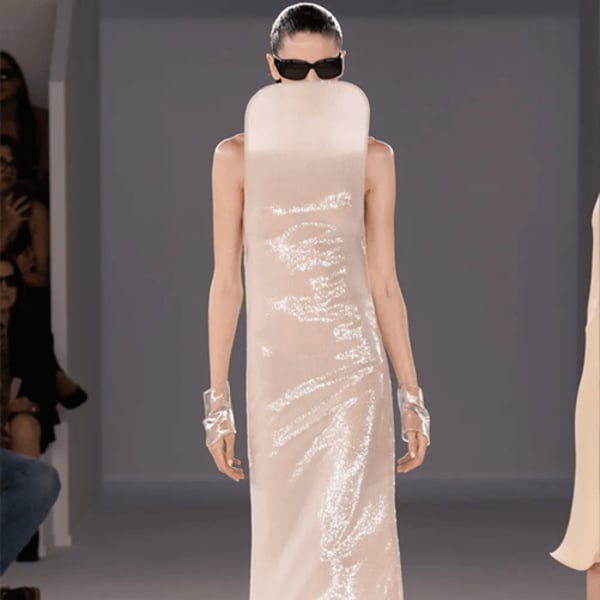
Once again, Di Felice created a bright white set – a perfect circle, with rings of circular benches inside a 19th-century wrought iron market. But then went into overdrive with uber-bright overhead lighting, worthy of an exam in the “Squid Game”. So bright, Courrèges sent out natty pairs of all-black sunglasses with each invitation to provide protection.
“I was thinking of blinded by the sun in the sense what is true and what is fake. Too much information. It’s all a bit overwhelming. That’s where I started,” said Nicolas, seconds before Kering chairman François-Henri Pinault, whose empire includes Courrèges, embraced him briefly with a huge smile.
His opening looks were cold in icy blue, and his silhouettes tight, the models faces veiled to block out the sun. Before gradually loosening up and making most of the collection in natural fabrics, along with lean-and-mean leathers. So even if the line was neat and strict, the clothes looked comfortable.
Playing on André Courrèges’ DNA, especially his ’60s ideas, but courageously. Like taking André’s signature miniature belts and making several cocktails ingeniously out of scores of tiny belts.
Flat shoes, glove-like sling-backs or transparent boots all had great zest, as did the soundtrack. Churning galactic funk co-composed by Nicolas and Erwan Sene, interspersed with a French voice telling you the temperature of the hour. Only a French female accent can make that sounds sexy.
Courrèges Spring/Summer 2026 collection in Paris
Ending with a series of sun shield oblong shapes, taken from cars, but used in futuristic dresses. Futurism, which André Courrèges invented in fashion, can often look hackneyed today. But Di Felice always manages to give it optimism and belief, which the future that it should ideally represent.
In the half-decade since he joined Courrèges in 2020 from Louis Vuitton, Di Felice has turned its show into one of the hottest half-dozen in fashion. Thousands of fans scream and chant his guests into each show.
Courrèges may not be a giant house, but it is the hottest today within the Kering/Artemis luxury empire. And the biggest single reasons for that is Di Felice. And a management that is smart enough to let him do what he wants.
Dries Van Noten: Tried and tested
One almost felt one was in Scandinavia at the latest show of Dries Van Noten. So similar were the prints to Verner Panton’s designs of the 1970s. Or, indeed, to Marimekko colors of the past decade.
Not that they didn’t look easy on the eye, yet somehow very familiar. Otherwise, this was a polished performance by designer Julian Klausner. His latest women’s collection for the house blended street style, rich fabrics and ladylike twists: très Dries Van Noten in other words.
Staged inside a completely unadorned art space in the Palais de Tokyo, except for 400 Louis XVI chairs and the guests. All focused on the clothes, led out by quite a few little jackets, which turned out to be inspired by surfer silhouettes and wetsuit shapes – though with added small pleats, ruffles and color. Made in light, airy colors – lime, lichen, pale gray or canary yellow – all had charm.
“Joyful, optimistic… Like the ’60s was,” argued Klausner – an ex-Maison Margiela staffer – in a group chat post-show. Finishing shoes, sleeves, collars, T-shirts with strass and crystals, suggesting the shimmering light of the sea.
Respecting Dries rich history as a tailor, Julien cut some great nobleman’s coats – soaring collars, angled pockets and majestic proportions. Making them in broken disk or tropical leaf prints, very posh Panton. And once again a little too familiar.
Coming after his stellar menswear collection in June, this all felt like a slight step back.
But still highly competent. Dries, in effect, is in very safe hands.
Specialist outdoor clothing producer Dryrobe has won a trademark case against a smaller label. The win for the business, which produces waterproof towel-lined robes used by cold water swimmers, means the offending rival must now stop selling items under the D-Robe brand within a week.
Image: Dryrobe
A judge at the high court in London ruled the company was guilty of passing off its D-Robe changing robes and other goods as Dryrobe products and knew it was infringing its bigger rival’s trademark reports, The Guardian newspaper.
The company said it has rigorously defended its brand against being used generically by publications and makers of similar clothing and is expected to seek compensation from D-Robe’s owners for trademark infringement.
Dryrobe was created by the former financier Gideon Bright as an outdoor changing robe for surfers in 2010 and became the signature brand of the wild swimming craze.
Sales increased from £1.3 million in 2017 to £20.3 million in 2021 and it made profits of £8 million. However, by 2023 sales had fallen back to £18 million as the passion for outdoor sports waned and the brand faced more competition.
Bright told the newspaper the legal win was a “great result” for Dryrobe as there were “quite a lot of copycat products and [the owners] immediately try to refer to them using our brand name”.
He said the company was now expanding overseas and moving into a broader range of products, adding that sales were similar to 2023 as “a lot of competition has come in”.
On Friday, France demanded a series of measures from Shein to demonstrate that the products sold on its website comply with the law, but dropped its initial request for a total three-month suspension of the online platform, which had been based on the sale of child-like sex dolls and prohibited weapons.
Shutterstock
At a hearing before the Paris court, a lawyer representing the state said that Shein must implement controls on its website, including age verification and filtering, to ensure that minors cannot access pornographic content. The state asked the court to impose a suspension of Shein’s marketplace until Shein has provided proof to Arcom, the French communications regulator, that these controls have been implemented.
Shein deactivated its marketplace- where third-party sellers offer their products- in France on November 5, after authorities discovered illegal items for sale, but its site selling Shein-branded clothing remains accessible. The state invoked Article 6.3 of France’s Digital Economy Act, which empowers judges to order measures to prevent or halt harm caused by online content.
“We don’t claim to be here to replace the European Commission,” the state’s lawyer said. “We are not here today to regulate; we are here to prevent harm, in the face of things that are unacceptable.” At the time of writing, the hearing is still ongoing.
In a statement issued last week, the Paris public prosecutor’s office said that a three-month suspension could be deemed “disproportionate” in light of European Court of Human Rights case law if Shein could prove that it had ceased all sales of illegal products. However, the public prosecutor’s office said it “fully supported” the government’s request that Shein provide evidence of the measures taken to stop such sales.
France’s decision comes against a backdrop of heightened scrutiny of Chinese giants such as Shein and Temu under the EU’s Digital Services Act, reflecting concerns about consumer safety, the sale of illegal products, and unfair competition. In the US, Texas Attorney General Ken Paxton said on Monday that he was investigating Shein to determine whether the fast-fashion retailer had violated state law relating to unethical labour practices and the sale of dangerous consumer products.
This article is an automatic translation. Click here to read the original article.
BasicNet’s Kappa turns back the sporting clock for its new AW25 collection, which celebrates “local heroes in football” with a community-focused campaign “honouring the places and people that inspire a lifelong love of the game”.
Image: Kappa
The campaign shines a light on local talent Tyrone Marsh in his hometown of Bedford, revisiting the streets, pitches and community spots “that shaped his football journey”.
Local photographer Simon Gill, who had pictured Marsh during many home and away games, not only “captures the Bedford Town player in the spaces that helped define his skill”, but also highlights the brand’s “rich football heritage with contemporary streetwear energy, creating visuals that pay tribute to community, culture and grassroots football”.
The journey includes Hartwell Drive, the early days of his after-school kickabouts, Hillgrounds Road, synonymous with Bedford football culture, and then onto Faraday Square, locally identified by the concrete pitches and community spirit.
To reflect that journey, the AW25 collection “offers a sense of nostalgia” with Kappa’s long-standing history in fashion and sports “seen through the Omini logo placements and 222 Banda strip”.
The campaign sees Marsh wearing Kappa styles including the Lyman and Uriah Track Tops paired with the Ulrich Track Pants in classic colourways including navy and light blue.
The wider collection includes track tops, track pants, shorts, polos, sweatshirts and T-shirts, available at select retailers across the UK including 80s Casual Classics, Terraces Menswear and RD1 Clothing.