Connect with us

Politics

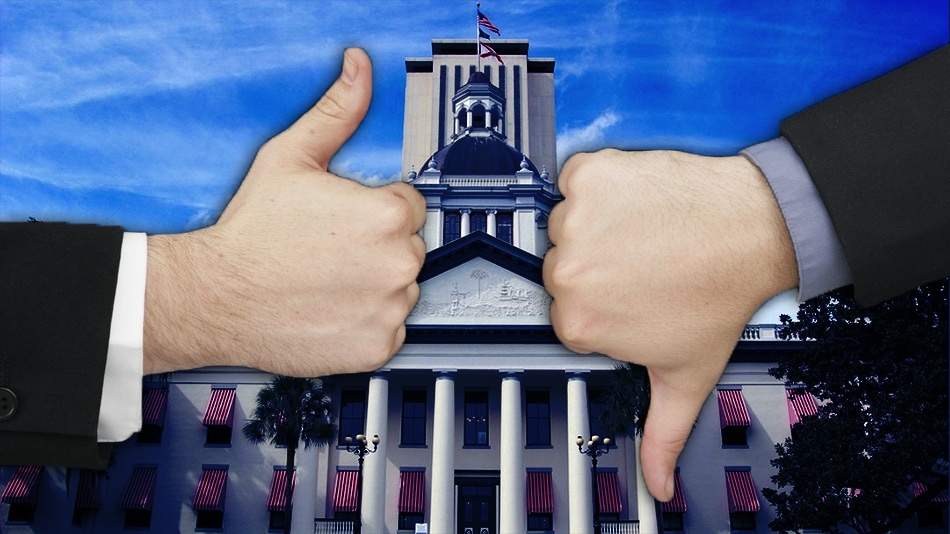
Winner and Loser of the Week in Florida politics — Week of 9.21.25
Published

on


Come on, FSU.

After years of watching programs like Georgia, Alabama, Clemson and Ohio State dominate the playoff conversation, this was supposed to be the renaissance year for Florida college football (sorry, Gators). And next Saturday’s mammoth matchup between the Hurricanes and Seminoles was set to be the epicenter, with rumors that ESPN’s Gameday would set up shop in Tallahassee.

And then, one of the Goliaths fell.

The University of Virginia stunned Florida State Friday night in double overtime, putting a dent in what FSU hoped to be a revival season following a historically bad 2024 campaign.

Mike Norvell’s program was hoping to further cement its case as not just the top team in the Sunshine State, but a legitimate contender on the national stage. Instead, that momentum and swagger was shot down by the Cavaliers.

Were the Seminoles looking past Virginia toward the showdown with “The U”? Or was FSU’s early season dominance a mirage all along, propped up by beating low-level teams and a win over an Alabama squad that still hasn’t proven it’s at the same level as the Nick Saban era?

It’s hard to say. Maybe it’s a bit of both, or maybe it’s neither and the team just underperformed for other reasons.

And look, next Saturday’s matchup is still a good one. It still offers a chance for both squads to show that Florida football — long the sport’s gold standard — is ready to dominate again.

But the aura of the game certainly got knocked down a peg following FSU’s fumble Friday. Here’s hoping we still get a competitive game.

Now, it’s onto our weekly game of winners and losers.

Winners

Honorable mention: Chassahowitzka River Campground. The Chassahowitzka River Campground scored a major win this week after months of uncertainty about its future.

The Southwest Florida Water Management District voted unanimously to approve a 40-year lease with Citrus County to take over management of the 40-acre site, keeping it in public hands and ensuring continued access for residents and visitors.

The campground, located on the banks of the Chassahowitzka River, had faced potential closure after a series of hurricanes left significant damage. District officials had floated the idea of shutting down the site or even selling it off, raising alarm among residents who cherish the river and surrounding springs as a recreational and environmental treasure.

That possibility sparked an outpouring of community activism, with local residents, conservation groups and outdoor enthusiasts pushing county leaders and the district to find a solution that preserved public access.

Under the new agreement, the district will retain ownership of the property but Citrus County will handle day-to-day operations, maintenance and improvements. The district also pledged up to $200,000 to help with capital repairs and upgrades, giving the county a runway to stabilize and improve the campground in the years ahead.

For Citrus County residents and the many Floridians who consider “the Chaz” a natural gem, the decision represents a victory for grassroots advocacy and collaborative problem-solving. Instead of losing a beloved public space, the campground will continue to serve campers, paddlers and nature lovers while remaining protected for future generations.

Almost (but not quite) the biggest winner: Miami Dade College. This week Miami Dade College became a central actor in a major political project, endorsing the state’s plan to place Donald Trump’s presidential library on college property.

The MDC Board of Trustees approved transferring a 2.63-acre parking lot adjacent to the historic Freedom Tower to the state, setting the stage for a vote by the Florida Cabinet to deed the land at its Sept. 30 meeting.

Once the Cabinet signs off, MDC will anchor one of the most visible — and controversial — projects in recent memory. MDC gains proximity to power and national attention. The school leadership, including President Madeline Pumariega, has publicly welcomed the project, describing it as “historic” for the institution.

Some critics, including former MDC President Eduardo Padrón, have decried the move as “unimaginable,” warning that the land was once intended for institutional expansion and that the decision lacked robust public discourse.

From MDC’s perspective, the college is now a key partner in what could become one of Florida’s most attention-grabbing civic landmarks.

The biggest winner: University of Central Florida. UCF has officially achieved the status of a “Preeminent State Research University,” a designation that places it among Florida’s top public institutions.

This milestone recognizes UCF’s significant advancements in research, student success, and faculty excellence. To attain this status, UCF met 12 of the 13 established metrics, including a notable 60% four-year graduation rate.

UCF’s journey to preeminence began in 2022 when it was named an “emerging preeminent” institution after meeting three-fourths of the criteria. Since then, the university has made significant strides, culminating in this recent designation.

Achieving preeminent status not only enhances UCF’s reputation but also provides access to additional state funding, further supporting its mission to deliver high-quality education and contribute to Florida’s workforce development. The accomplishment underscores UCF’s role as a leading institution in the state’s higher education landscape.

Losers

Dishonorable mention: Joseph Ladapo. Florida’s Surgeon General likes to talk tough and make broad, sweeping claims about vaccines when it comes to other people.

But when faced with a direct question this week about his own family’s vaccination status, Ladapo had a chance to confirm he’s putting his money where his mouth is.

“Some of the questions are just so funny,” Ladapo said. “And you know this idea of ‘Well, do you vaccinate? Did you take the COVID shot?’ … I actually don’t care about sharing information about that.”

Oh, great!

“I really don’t care at all.”

Perfect, here we go.

But I won’t. And I won’t because I’m not going to participate in the silly games that so much of the media chooses to partake in instead of the substantive parts of the issues.”

Well OK then.

It’s interesting because Ladapo in the past has had no problem screaming from the rooftops about his skepticism regarding vaccines, regardless of whether he has sound evidence to back it up.

So one would think he would follow through with that advice in his personal life. But suddenly, Ladapo went mum.

Look, we have no idea about the vaccine status of Ladapo or Gov. Ron DeSantis, who also punted on the question during this week’s presser. But one would think they would be ready to lead by example and not just be content with riding the wave of anti-establishment feelings on the Right via their repeated comments undercutting confidence in vaccines.

Unless the political benefit, rather than actual scientific rigor, is the point.

Almost (but not quite) the biggest loser: Brightline. Brightline’s momentum hit a wall this week as its planned Stuart station stalled in the face of a funding snafu.

Martin County officials had budgeted on a $45 million grant from the Federal Railroad Administration (FRA) to underwrite most of the station’s projected $60 million cost. But instead, the FRA denied the grant.

The agency did announce a new funding program with a broader $5 billion pool of eligible projects. Martin County can now apply for a piece of that pot.

But after missing out on the original grant, the station’s opening has been pushed out significantly — now projected for no earlier than 2028 — and Martin County is forced to reapply under tougher competition. County officials say they’ll submit their revised application by the Jan. 7, 2026 deadline, with decisions expected by Summer that year.

Without the federal backing, the financial equation is shaky. County leaders acknowledge that if they don’t secure the grant, the station project could be dead in the water.

Moreover, the optics of a for-profit rail company relying heavily on public subsidies, now with broken timelines, invites more skepticism. Brightline’s brand is dented by this stumble.

The biggest loser: Ryan Routh. This week, Routh was convicted on all federal charges tied to his failed 2024 assassination plot against Trump.

The jury delivered its decision after just a few hours of deliberation, rejecting Routh’s attempts to portray himself as harmless or misinterpreted. Prosecutors had built a case that he had scoped out Trump’s route, hidden in shrubbery with a functioning rifle and aimed in Trump’s direction before fleeing.

Given the gravity of the charges — including attempted assassination of a major presidential candidate, assault of a federal officer, and firearms violations — Routh is now staring at a sentence that could amount to life behind bars.

As the nation grapples with repeated instances of political violence, Routh’s reckoning will be a cautionary tale for fringe actors.


Post Views: 0


Source link

Continue Reading

Politics

Debra Tendrich turns ‘pain into policy’ with sweeping anti-domestic violence proposal

Published

on


Florida could soon rewrite how it responds to domestic violence.

Lake Worth Democratic Rep. Debra Tendrich has filed HB 277, a sweeping proposal aimed at modernizing the state’s domestic violence laws with major reforms to prevention, first responder training, court safeguards, diversion programs and victim safety.

It’s a deeply personal issue to Tendrich, who moved to Florida in 2012 to escape what she has described as a “domestic violence situation,” with only her daughter and a suitcase.

“As a survivor myself, HB 277 is more than legislation; it is my way of turning pain into policy,” she said in a statement, adding that months of roundtables with survivors and first responders “shaped this bill from start to finish.”

Tendrich said that, if passed, HB 277 or its upper-chamber analogue (SB 682) by Miami Republican Sen. Alexis Calatayud would become Florida’s most comprehensive domestic violence initiative, covering prevention, early intervention, criminal accountability and survivor support.

It would require mandatory strangulation and domestic violence training for emergency medical technicians and paramedics, modernize the legal definition of domestic violence, expand the courts’ authority to order GPS monitoring and strengthen body camera requirements during investigations.

The bill also creates a treatment-based diversion pathway for first-time offenders who plead guilty and complete a batterers intervention program, mental-health services and weekly court-monitored progress reporting. Upon successful completion, charges could be dismissed, a measure Tendrich says will reduce recidivism while maintaining accountability.

On the victim-safety side, HB 277 would flag addresses for 12 months after a domestic-violence 911 call to give responders real-time risk awareness. It would also expand access to text-to-911, require pamphlets detailing the medical dangers of strangulation, authorize well-check visits tied to lethality assessments, enhance penalties for repeat offenders and include pets and service animals in injunctions to prevent coercive control and harm.

Calatayud called it “a tremendous honor and privilege” to work with Tendrich on advancing policy changes “that both law enforcement and survivors of domestic abuse or relationship violence believe are meaningful to protect families across our communities.”

“I’m deeply committed to championing these essential reforms,” she added, saying they would make “a life-or-death difference for women and children in Florida.”

Organizations supporting HB 277 say the bill reflects long-needed, practical reform. Palm Beach County firefighters union IAFF Local 2928 said expanded responder training and improved dispatch information “is exactly the kind of frontline-focused reform that saves lives.”

The Florida Police Benevolent Association called HB 277 a “comprehensive set of measures designed to enhance protections” and pledged to help advance it through the Legislature.

The Animal Legal Defense Fund praised provisions protecting pets in domestic violence cases, noting research showing that 89% of women with pets in abusive relationships have had partners threaten or harm their animals — a major barrier that keeps victims from fleeing.

Florida continues to see high levels of domestic violence. The National Coalition Against Domestic Violence estimates that 38% of Florida women and 29% of Florida men experience intimate-partner violence in their lifetimes — among the highest rates in the country.

With costs rising statewide, HB 277 also increases relocation assistance through the Crimes Compensation Trust Fund, which advocates say is essential because the current $1,500 cap no longer covers basic expenses for victims fleeing dangerous situations.

Tendrich said survivors who contributed to the bill, which Placida Republican Rep. Danny Nix is co-sponsoring, “finally feel seen.”

“This bill will save lives,” she said. “I am proud that this bill has bipartisan support, and I am even more proud of the survivors whose bravery drives every line of this legislation.”


Source link

Continue Reading

Politics

Ash Marwah, Ralph Massullo battle for SD 11 Special Election

Published

on


Even Ash Marwah knows the odds do him no favors.

A Senate district that leans heavily Republican plus a Special Election just weeks before Christmas — Marwah acknowledges it adds up to a likely Tuesday victory for Ralph Massullo.

The Senate District 11 Special Election is Tuesday to fill the void created when Blaise Ingoglia became Chief Financial Officer.

It pits Republican Massullo, a dermatologist and Republican former four-term House member from Lecanto, against Democrat Marwah, a civil engineer from The Villages.

Early voter turnout was light, as would be expected in a low-key standalone Special Election: At 10% or under for Hernando and Pasco counties, 19% in Sumter and 15% in Citrus.

Massullo has eyed this Senate seat since 2022 when he originally planned to leave the House after six years for the SD 11 run. His campaign ended prematurely when Gov. Ron DeSantis backed Ingoglia, leaving Massullo with a final two years in office before term limits ended his House career.

When the SD 11 seat opened up with Ingoglia’s CFO appointment, Massullo jumped in and a host of big-name endorsements followed, including from DeSantis, Ingoglia, Agriculture Commissioner Wilton Simpson, U.S. Sens. Ashley Moody and Rick Scott, four GOP Congressmen, county Sheriffs in the district, and the Florida Chamber of Commerce.

The Florida LGBTQ+ Democratic Caucus is endorsing Marwah.

Marwah ran for HD 52 in 2024, garnering just 24% of the vote against Republican John Temple

Massullo has raised $249,950 to Marwah’s $12,125. Massullo’s $108,000 in spending includes consulting, events and mail pieces. One of those mail pieces reminded voters there’s an election.

The two opponents had few opportunities for head-to-head debate. The League of Women Voters of Citrus County conducted a SD 11 forum on Zoom in late October, when the two candidates clashed over the state’s direction.

Marwah said DeSantis and Republicans are “playing games” in their attempts to redraw congressional district boundaries.

“No need to go through this expense,” he said. “It will really ruin decades of progress in civil rights. We should honor the rule of law that we agreed on that it’ll be done every 10 years. I’m not sure why the game is being played at this point.”

Massullo said congressional districts should reflect population shifts.

“The people of our state deserve to be adequately represented based on population,” he said. “I personally do not believe we should use race as a means to justify particular areas. I’m one that believes we should be blind to race, blind to creed, blind to sex, in everything that we do, particularly looking at population.”

Senate District 11 covers all of Citrus, Hernando and Sumter counties, plus a portion of northern Pasco County. It is safely Republican — Ingoglia won 69% of the vote there in November, and Donald Trump carried the district by the same margin in 2024.


Source link

Continue Reading

Politics

Miles Davis tapped to lead School Board organizing workshop at national LGBTQ conference

Published

on


Miles Davis is taking his Florida-focused organizing playbook to the national stage.

Davis, Policy Director at PRISM Florida and Director of Advocacy and Communications at SAVE, has been selected to present a workshop at the 2026 Creating Change Conference, the largest annual LGBTQ advocacy and movement-building convention.

It’s a major nod to his rising role in Florida’s LGBTQ policy landscape.

The National LGBTQ Task Force, which organizes the conference, announced that Davis will present his session, “School Board Organizing 101.” His proposal rose to the top of more than 550 submissions competing for roughly 140 slots, a press note said, making this year’s conference one of the most competitive program cycles in the event’s history.

His workshop will be scheduled during the Jan. 21-24 gathering in Washington, D.C.

Davis said his selection caps a strong year for PRISM Florida, where he helped shepherd the organization’s first-ever bill (HB 331) into the Legislature. The measure, sponsored by Tampa Democratic Rep. Dianne Hart, would restore local oversight over reproductive health and HIV/AIDS instruction, undoing changes enacted under a 2023 expansion to Florida’s “Parental Rights in Education” law, dubbed “Don’t Say Gay” by critics.

Davis’ workshop draws directly from that work and aims to train LGBTQ youth, families and advocates in how local boards operate, how public comment can shape decisions and how communities can mobilize around issues like book access, inclusive classrooms and student safety.

“School boards are where the real battles over student safety, book access, and inclusive classrooms are happening,” Davis said. “I’m honored to bring this training to Creating Change and help our community build the skills to show up, speak out, and win — especially as PRISM advances legislation like HB 331 that returns power to our local communities.”

Davis’ profile has grown in recent years, during which he jumped from working on the campaigns and legislative teams of lawmakers like Hart and Miami Gardens Democratic Sen. Shevrin Jones to working in key roles for organizations like America Votes, PRISM and SAVE.

The National LGBTQ Task Force, founded in 1973, is one of the nation’s oldest LGBTQ advocacy organizations. It focuses on advancing civil rights through federal policy work, grassroots engagement and leadership development.

Its Creating Change Conference draws thousands for four days of training and strategy-building yearly, a press note said.


Source link

Continue Reading

Trending

Copyright © Miami Select.