
Fashion
Milan unveils multifaceted vision of womanhood at Sportmax, Blumarine and Institution
Published
September 26, 2025
On Friday, the fourth day of the womenswear ready-to-wear shows, Milan’s fashion scene showcased the breadth of its creativity with a packed programme in which a host of houses came to the fore, from established names and young labels to emerging talents, expressing a thousand and one facets of femininity. From Sportmax’s minimalist, chic woman to Blumarine’s romantic dark lady, via the sculptural matryoshka of Institution by Galib Gassanoff, spring/summer 2026 promises to be exciting.
Sportmax opened proceedings early in the morning with a beautiful collection that struck the perfect balance between raw minimalism and a diffuse sense of softness. Most looks were monochrome, beginning with an ultra-light palette of powdery, nude and cream tones that caught the light, and moving through to head-to-toe black. Silhouettes were elongated, sometimes to excess, as with faded baggy jeans so long they coil around the ankles.
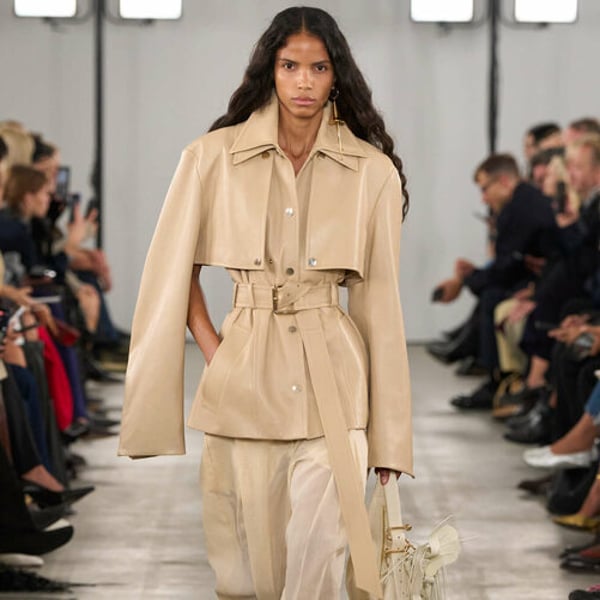
Highly structured trench coats, sleeveless maxi coats, double jackets and leather blousons are cut with precise lines in crisp wools, gabardines and supple leathers, falling straight down the body.
Yet the overall impression was one of lightness — of floating, even — heightened by the introduction of airy, sheer fabrics, such as satin silk that ripples through long, fluid dresses, or organza used to make T-shirts and trousers, to stand in for jacket panels to lighten them, or as fine layers superimposed on certain looks.
To emphasise movement, garments were often layered one over another or deconstructed, as in these long leather trench coats whose upper part detaches into a Perfecto-bolero, reminiscent of the shoulder capes of yesteryear under which one can slip the arms with complete freedom. A multitude of gilt bells worn as earrings, bracelets or necklaces also set the rhythm with a heady chime.

The Blumarine woman also revealed her dual personality, by turns romantic and dark, through a wardrobe full of contrasts — between flou and tailoring, soft and deep hues.
“I wanted to explore the idea of a Gothic romanticism transported into spring. Fragility and freedom clash with strength and power. It’s up to the audience to decide which of these two attitudes will prevail,” said creative director David Koma backstage, adding that in the end, “it’s the soft side that stands out more, supported by structure.”
The fluctuating aspect of the outfits and the play of transparencies tipped the balance towards a hyper-feminine, sensual aesthetic. Twirling ribbons and cascades of chiffon ruffles compose vaporous blouses, dresses and capes. Airy silks and chiffons were layered, sometimes gathered, smocked or fringed. Black lace and guipure steered everything towards a slightly sultry boudoir world. Large crosses in sparkling stones, worn as earrings or layered as multiple pendants, underscored this subversive streak.
The designer also called on the butterfly, the Italian house’s emblematic motif. With their colourful wings, a multitude alight as embroidery on a cardigan or on a sheer, flesh-toned dress. Elsewhere, a butterfly encircled the bust on a white lace bra-top. Sometimes it morphed into a dragonfly and — on closer inspection — even a spider.
The duality of the Blumarine woman was very much in evidence. The pagoda sleeves of the sinuous frock coats and peignoirs with long trains that dress her for evening were reminiscent of butterfly wings as they are of bat wings.

With his new brand Institution, Azeri-born Georgian Galib Gassanoff offered one of the most compelling propositions on the Milanese scene. This has not escaped the very select Milanese boutique Antonia, which is dedicating its windows to him this week. After a well-received debut collection in February, the designer pursued his project with coherence, offering more commercial pieces this season, which he will show next week in Paris at the Maison Pyramide showroom.
For next summer, Gassanoff continues to draw on the ancestral know-how of Azerbaijan, in particular the braiding technique used to make woven or knotted carpets. He reprised this process, replacing wool threads with reclaimed shoelaces to create sculptural dresses and tops. He also introduced reedmace (Typha latifolia), which grows in marshes and is woven by women in the south of the country. Working with these communities, he had them braid a series of majestic, swirling gowns and a poncho.
Another inspiration is the “chepken”, a traditional coat with oversleeves. The designer transformed this piece into a tailored jacket, nipped in and rounded at the sides. The curved shape recalls Christian Dior’s famous Bar suit, but here the construction was modernised. Two long panels of fabric fall from the shoulders like stoles, under which the arms can slip. In another version, the jacket was slit at the sides and these two false sleeves fold over the front, tied around the chest, transforming it into an elegant top.
A host of other ingenious ideas also proved alluring. Like a top whose front was covered with white wooden buttons from the archives of historic button-maker Ascoli Bottoni; smock-like organza overlays, puffed out at belly height, that encased the silhouette in different colours; or large apron-like leather plastrons, fashioned from long shoelace straps or various braids, worn hanging from the neck.
This article is an automatic translation.
Click here to read the original article.
Copyright © 2025 FashionNetwork.com All rights reserved.