With Hypecult emblazoned across his black T-shirt, French rapper Aupinard is delivering a set blending R&B rhythms with bossa nova sounds. It is Thursday evening in a former industrial workshop in Paris’s 11th arrondissement, now converted into an events venue. The perfect setting to bring together Parisian urban-culture influencers and personalities, as well as representatives from numerous brands, with a single objective: to celebrate the launch of a new streetwear e-commerce site, Hypecult.
Rapper Aupinard at the launch of Hypecult on September 25. – Paul Fogiel
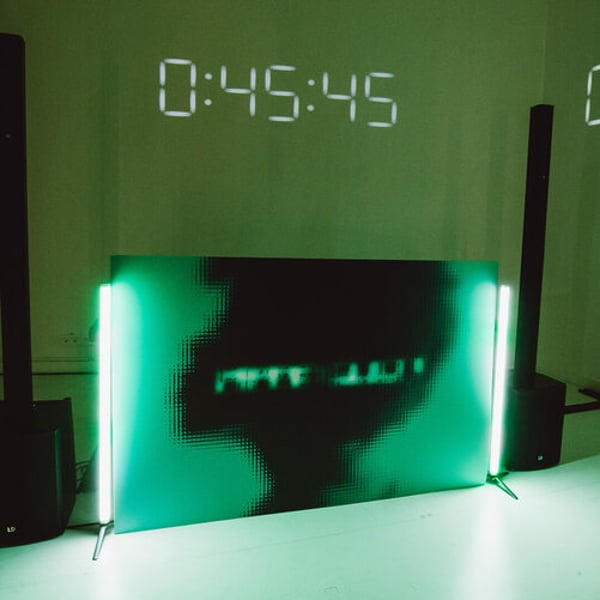
The concept behind this new player was unveiled with a live site launch at 7:30 pm and a scenography devised by the creative agency Wave, showcasing an on-trend selection from Clarks, New Balance, Saucony, Puma, Adidas and Dr. Martens.
Behind this new player is e-tailer Spartoo, which announced at the beginning of the year that it was preparing this launch for September. “We’re very proud to be launching a site dedicated to streetwear culture. Hypecult is aimed at 18-35-year-olds, with a particular focus on young women,” explained Boris Saragaglia, CEO of Spartoo. “We have worked with agencies specialising in this space. We’ve had very positive feedback from most brands, and Adidas and New Balance have been particularly supportive of the project.”
Hypecult is entering a market where bricks-and-mortar giants such as JD Sports, Foot Locker and Courir occupy significant space, and where a constellation of independent multi-brand retailers jostle for position.
Hypecult’s universe expressed through scenography and product showcasing – Paul Fogiel
At launch, the site features around fifty brands, mainly established names in ready-to-wear and footwear, with a total of more than a thousand products. Alongside Adidas and New Balance, Asics, Saucony, Patagonia, Levi’s, Hoff, Lacoste, Dickies, Daily Paper, Barbour and New Era have backed the newcomer.
“Some of these partners have a very wide offering, but we worked with them on the selection,” explained Spartoo’s CEO. “In sneakers, for example, we have access to Tier 1 and Tier 2 assortments, with trend-led models that are far more fashion-forward than those we offer on Spartoo. And, gradually, we’ll be adding a range of streetwear brands that are more niche but popular in this space.”
Edwin, Champion and Minimum will be arriving shortly, and Hypecult will also offer collections by Bisous Skateboard, Gramicci and Homecore.
As for the site’s UX—whether the typography used, colour codes, brand visuals and films, or its architecture—Hypecult aligns with the sector’s conventions. Particular attention has been paid to editorial content. Even though the Spartoo name does not appear on the site, the new entrant will have to prove its legitimacy in the sector. Boris Saragaglia pointed out that “there are many generalist fashion pure players, but there is a less competitive space available, particularly for women’s products and streetwear.”
However, while the setbacks of sites specialising in limited-edition sneakers have freed up space in e-commerce, many specialist multi-brand retailers across France have their own sites with tightly curated selections. Alongside heavyweight Parisian players Starcow and Shinzo, and SNS, which also has a shop in Paris, Hypecult will have to differentiate itself from the online activity of Marseille-based Hype, The Hype in Amiens and Hype-Shoes, which has boutiques in Nice and Cannes.
A prospect that doesn’t faze Spartoo’s co-founder.
“I see even greater potential than for Spartoo,” he said, stressing that Hypecult needs to take the time to establish itself within the community.
For the Grenoble-based company, which will present its quarterly results on Monday, this development also carries strategic weight. Against a backdrop of slowing activity among online players, Spartoo notes that its long-standing customer base, mainly women and families, is affected by consumer budget constraints. Diversifying its customer profiles with targeted propositions while offering the same level of service (free delivery and returns, payment in instalments, and customer service) should enable it to find new growth drivers and mitigate risk.
This article is an automatic translation. Click here to read the original article.
The demerger of Unilever‘s ice cream division, to be named ‘The Magnum Ice Cream Company,’ which had been delayed in recent months by the US government shutdown, will finally go ahead on Saturday, the British group announced.
Reuters
Unilever said in a statement on Friday that the admission of the new entity’s shares to listing and trading in Amsterdam, London, and New York, as well as the commencement of trading… is expected to take place on Monday, December 8.
The longest federal government shutdown in US history, from October 1 to November 12, fully or partially affected many parts of the federal government, including the securities regulator, after weeks without an agreement between Donald Trump‘s Republicans and the Democratic opposition.
Unilever, which had previously aimed to complete the demerger by mid-November, warned in October that the US securities regulator (SEC) was “not in a position to declare effective” the registration of the new company’s shares. However, the group said it was “determined to implement in 2025” the separation of a division that also includes the Ben & Jerry’s and Cornetto brands, and which will have its primary listing in Amsterdam.
“The registration statement” for the shares in the US “became effective on Thursday, December 4,” Unilever said in its statement. Known for Dove soaps, Axe deodorants and Knorr soups, the group reported a slight decline in third-quarter sales at the end of October, but beat market expectations.
Under pressure from investors, including the activist fund Trian of US billionaire Nelson Peltz, to improve performance, the group last year unveiled a strategic plan to focus on 30 power brands. It then announced the demerger of its ice cream division and, to boost margins, launched a cost-saving plan involving 7,500 job cuts, nearly 6% of the workforce. Unilever’s shares on the London Stock Exchange were steady on Friday shortly after the market opened, at 4,429 pence.
This article is an automatic translation. Click here to read the original article.
Burberry has named a new chief operating and supply chain officer as well as a new chief customer officer. They’re both key roles at the recovering luxury giant and both are being promoted from within.
Matteo Calonaci becomes chief operating and supply chain officer, moving from his role as senior vice-president of strategy and transformation at the firm.
In his new role, he’ll be oversee supply chain and planning, strategy and transformation, and data and analytics. He succeeds Klaus Bierbrauer, who’s currently Burberry supply chain and industrial officer. Bierbrauer will be leaving the company following its winter show and a transition period.
Matteo Calonaci – Burberry
Meanwhile, Johnattan Leon steps up as chief customer officer. He’s currently currently Burberry’s senior vice-president of commercial and chief of staff. In his new role he’ll be leading Burberry’s customer, client engagement, customer service and retail excellence teams, while also overseeing its digital, outlet and commercial operations.
Both Calonaci and Leon will join the executive committee, reporting to Company CEO Joshua Schulman.
JohnattanLeon – Burberry
Schulman said of the two execs that the appointments “reflect the exceptional talent and leadership we have at Burberry. Both Matteo and Johnattan have been instrumental in strengthening our focus on executional excellence and elevating our customer experience. Their deep understanding of our business, our people, and our customers gives me full confidence that their leadership will help drive [our strategy] Burberry Forward”.
Traditional and occasion wear designer Puneet Gupta has stepped into the world of fine jewellery with the launch of ‘Deco Luméaura,’ a collection designed to blend heritage and contemporary aesthetics while taking inspiration from the dramatic landscapes of Ladakh.
Hints of Ladakh’s heritage can be seen in this sculptural evening bag – Puneet Gupta
“For me, Deco Luméaura is an exploration of transformation- of material, of story, of self,” said Puneet Gupta in a press release. “True luxury isn’t perfect; it is intentional. Every piece is crafted to be lived with and passed on.”
The jewellery collection features cocktail rings, bangles, chokers, necklaces, and statement evening bags made in recycled brass and finished with 24 carat gold. The stones used have been kept natural to highlight their imperfect and unique forms and each piece in the collection has been hammered, polished, and engraved by hand.
An eclectic mix of jewels from the collection – Puneet Gupta
Designed to function as wearable art pieces, the colourful jewellery echoes the geometry of Art Deco while incorporating distinctly South Asian imagery such as camels, butterflies, and tassels. Gupta divides his time between his stores in Hyderabad and Delhi and aims to bring Indian artistry to a global audience while crafting a dialogue between designer and artisan.