Connect with us

Business

Fed officials and data keep signaling Wall Street won’t get continued cuts

Published

on


U.S. economic data keeps coming back stronger than expected, and frankly it’s raining on the parade for markets.

For the majority of 2025, investors have been hankering after multiple base interest rate cuts from Jerome Powell and the Federal Open Market Committee (FOMC), knowing it would kickstart cheaper borrowing and foster economic activity. The general consensus was that once the Fed was confident enough to start cutting, it would spell a change in the weather: A move toward the greatly-anticipated “normalization” of the funds rate.

So when the FOMC cut in September this apparent fact was not only baked in by markets, but so too were the cuts expected to come for the rest of the year.

Unfortunately, the economy is faring far better than many estimated—meaning the Fed may not be forced into further action as quickly as anticipated.

Markets continued to struggle yesterday—the third day in a row—with Deutsche Bank’s Jim Reid noting: “The main catalyst was a strong batch of U.S. data, which meant investors dialled back their expectations for rapid Fed rate cuts, and pushed front-end Treasury yields higher. So that meant rate-sensitive sectors like tech took a hit, with the Magnificent 7 dragging down the broader equity market.”

That sums up the counterintuitive position traders are in at the moment: When healthy economic data actually works against the sentiment of analysts and investors. The data this week should have reassured them: Weekly jobless claims fell to 218,000 for the week ended September 20, GDP increased at an annual rate of 3.8% for Q2 2025, according to a third estimate from the Bureau of Economic Analysis.

With the labor market softening (the economy added less than 30,000 jobs according to most recent data), analysts had hoped this would push the Fed to continue cutting. But with inflation—the pesky other side of the Fed’s mandate—remaining elevated at near 3% (ahead of its target at 2%) that gives the Fed just enough reason to remain cautious.

Kevin Khang, Vanguard’s senior international economist, wrote in a note seen by Fortune this week: “It’s no surprise that every hint of a dovish Fed pivot is met with enthusiasm. But two realities about the yield curve—and the broader rate environment—are worth keeping in mind.”

“First, the short end of the curve will continue to be shaped by the Fed’s dual mandate of ensuring both price stability and maximum sustainable employment. Although inflation has come down meaningfully from its peak, it remains sticky. This is partly due to supply-side forces, including tariffs and an immigration slowdown.”

“At the same time, the labor market, though showing signs of softening, remains in balance by historical standards. These dynamics suggest that the Fed’s path to sustained rate cuts is narrow. With inflation poised to remain above its 2% target for a fifth consecutive year, the Fed is unlikely to ease the policy rate substantially—unless inflation somehow makes a more decisive move toward target sooner.”

The longer view

Undeterred by data suggesting the contrary, investors have continued to bank on a further cut coming in October. According to CME’s FedWatch barometer, investors are still banking on a 87.7% chance of a further 25bps cut in the October meeting.

Indeed, members of the FOMC have been signaling that while further cuts could be to come, anything beyond a meeting-to-meeting approach would be an error. As Mary Daly, president of the San Francisco Fed said in a speech Wednesday: “Moving forward, it is likely that further policy adjustments will be needed as we work to restore price stability while providing needed support to the labor market … But these are projections, not promises, and making good decisions will require us to anchor on our objectives, assess the tradeoffs, and decide, again and again.”

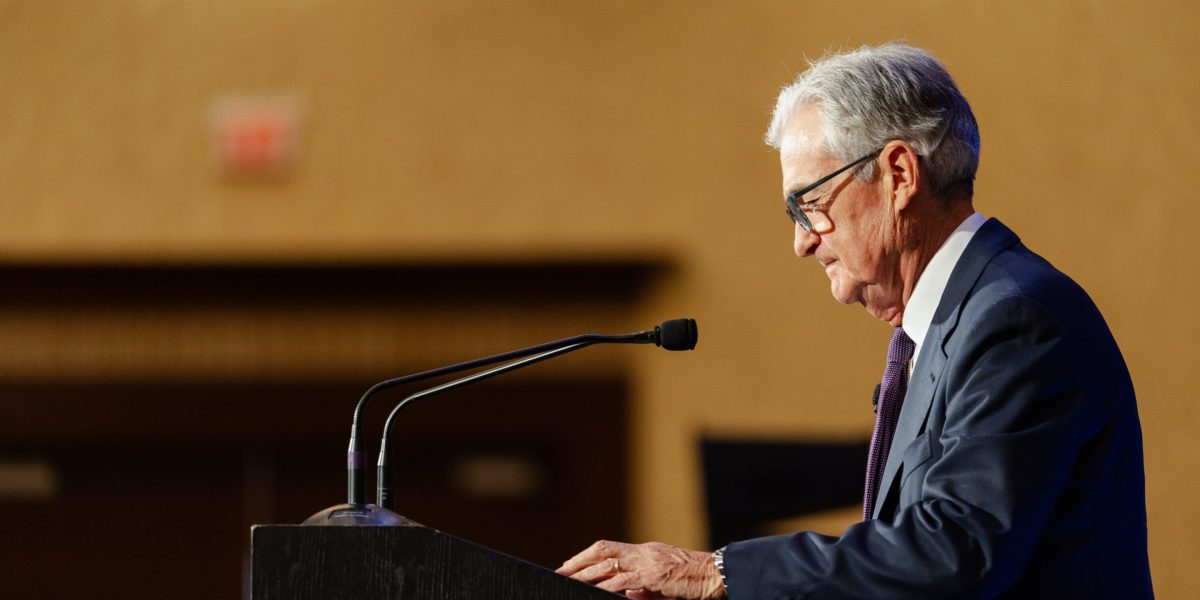
This steady approached was echoed by Chairman Jay Powell, who was given the nickname “Too Late” by the Oval Office, courtesy of his cautious approach to easing. But speaking in Rhode Island this week, Powell stuck by his measured approach: “Our policy is not on a preset course. We will continue to determine the appropriate stance based on the incoming data, the evolving outlook, and the balance of risks. We remain committed to supporting maximum employment and bringing inflation sustainably to our 2 percent goal.”

“Our success in delivering on these goals matters to all Americans. We understand that our actions affect communities, families, and businesses across the country.”

Here’s snapshot of the markets ahead of the opening bell in New York this morning:

  • S&P 500 futures were flat this morning. The index closed down 0.5% in its last session.
  • STOXX Europe 600 was up 0.31% in early trading. 
  • The U.K.’s FTSE 100 up 0.37% in early trading.
  • Japan’s Nikkei 225 was down 0.87%.
  • China’s CSI 300 was up 0.6%.
  • The South Korea KOSPI was down 2.45%.
  • India’s Nifty 50 was down 0.91% before the end of the session.
  • Bitcoin declined to $109.7K.
Fortune Global Forum returns Oct. 26–27, 2025 in Riyadh. CEOs and global leaders will gather for a dynamic, invitation-only event shaping the future of business. Apply for an invitation.


Source link

Continue Reading

Business

Former Amazon exec warns Netflix-WBD deal will make Hollywood ‘a system that circles a single sun’

Published

on


A Netflix-Warner Bros. merger would risk a monopsony where a single buyer wields enormous control over the marketplace, the former head of Amazon Studios warned.

Roy Price, who is now chief executive of the studio International Art Machine, wrote in a New York Times op-ed on Saturday that predictions of doom are nothing new in the film industry, pointing to the advent of TV, home video, streaming, and AI.

“But if Netflix acquires Warner Bros., this long-prophesied death may finally arrive, not in the sense that filmmaking will cease but in the sense that Hollywood will become a system that circles a single sun, materially changing its cultural output,” he added. “All orbits—every deal, every creative decision, every creative career—will increasingly revolve around the gravitational mass and imprimatur of one entity.”

To be sure, Netflix has said Warner Bros. operations will continue, and the studio’s films will still be released in theaters. Meanwhile, Warner’s TV channels will be spun off via a separate company, though HBO will be included in Netflix.

But Price said the danger “is not annihilation but centralization,” with the combined company accounting for an even bigger slice of overall content spending.

A reduction in bidders also means less content will be produced, while a separate development culture, set of tastes, and risk tolerances will be sidelined, he predicted.

“A Netflix merger with Warner Bros. would create a monopsony problem: too few buyers with too much bargaining power,” Price explained. “Writers, directors, actors, showrunners, puppeteers, visual effects artists—all are suppliers. The fewer buyers competing to hire them, the lower their compensation and the narrower their opportunities.”

Such reasoning sank Penguin Random House’s attempt to merge with Simon & Schuster that would’ve created a book publisher with too much leverage over authors, he pointed out.

Of course, the remaining players in Hollywood and content creation are giants in their own right as well. A KPMG survey of spending in 2024 put NBC Universal parent Comcast at the top with $37 billion, followed by Alphabet’s YouTube ($32 billion), Disney ($28 billion), Amazon ($20 billion), Netflix ($17 billion) and Paramount ($15 billion). Comcast and Paramount also made bids for Warner Bros.

Theater owners, producers and other creative workers have also voiced opposition to the deal. In addition to the business impact of a Warner Bros. takeover, other opponents raised even weightier concerns.

Oscar winner Jane Fonda sounded the alarm on a “constitutional crisis” and demanded that the Justice Department not use its regulatory power to “extract political concessions that influence content decisions or chill free speech.”

For its part, the Trump administration views the deal with “heavy skepticism,” sources told CNBC. The merger is expected to face exceptional antitrust scrutiny, and Netflix’s $5.8 billion breakup fee is among the biggest ever.

On Wall Street, analysts see a tech angle in the merger, namely the importance of content to train and power the next generation of AI models that will shape the entertainment industry’s future.

The acquisition of Warner Bros. would help Netflix stand out in an AI future, Divyaunsh Divatia, research analyst at Janus Henderson Investors, said in a note on Friday.

“They’re also levering up on premium entertainment at a time when competition on engagement from short form video is expected to intensify especially if AI models democratize video creation at an increasing rate,” he wrote.


Source link

Continue Reading

Business

25-year DEA veteran charged with helping Mexican drug cartel launder millions of dollars, secure guns and bombs

Published

on


A former high-level agent with the U.S. Drug Enforcement Administration and an associate have been charged with conspiring to launder millions of dollars and obtain military-grade firearms and explosives for a Mexican drug cartel, according to an indictment unsealed Friday in New York.

Paul Campo, 61, of Oakton, Virginia, who retired from the DEA in 2016 after a 25-year career, and Robert Sensi, 75, of Boca Raton, Florida, were caught in sting involving a law enforcement informant who posed as a member of the Jalisco New Generation Cartel, prosecutors said.

The cartel, also know as CJNG, was designated as a foreign terrorist organization by the U.S. in February.

U.S. Attorney Jay Clayton said Campo betrayed his DEA career by helping the cartel, which he said was responsible for “countless deaths through violence and drug trafficking in the United States and Mexico.”

Campo and Sensi appeared Friday afternoon before a magistrate judge in New York, who ordered them detained without bail. Their lawyers entered not guilty pleas on their behalf.

Campo’s lawyer, Mark Gombiner, called the indictment “somewhat sensationalized and somewhat incoherent.” He denied the two men had agreed to explore obtaining weapons for the cartel.

Prosecutors say pair talked of laundering money, obtaining weapons

Over the past year, Campo and Sensi agreed to launder about $12 million in drug proceeds for the cartel and converted about $750,000 in cash to cryptocurrency, thinking it was going to the group when it really went to the U.S. government, the indictment said. They also provided a payment for about 220 kilograms of cocaine they were told would be sold in the U.S. for about $5 million, thinking they would get a cut of the proceeds, prosecutors said.

The two men also said they would look into procuring commercial drones, AR-15 semiautomatic rifles, M4 carbines, grenade launchers and rocket-propelled grenades for the cartel, the indictment said.

Campo boasted about his law enforcement experience during conversations with the informant and offered to be a “strategist” for the cartel, authorities said. He began his career as a DEA agent in New York and rose to become deputy chief of financial operations for the agency, the indictment said.

Evidence in the case includes hours of recordings of the two men talking with the informant, as well as cellphone location data, emails and surveillance images, Assistant U.S. Attorney Varun Gumaste said in court Friday.

Sensi’s attorney, Amanda Kramer, unsuccessfully argued that Sensi should be freed while he awaits trial, saying he wouldn’t flee partly because he has multiple health problems, including injuries from a fall two months ago, early-stage dementia and Type II diabetes.

Sensi was convicted in the late 1980s and early 1990s of mail fraud, defrauding the government and stealing $2.5 million, said the prosecutor, Gumaste. He said evidence shows Sensi also was engaged in a scheme to procure military-grade helicopters for a Middle East country.

Other criminal cases have roiled the DEA

DEA Administrator Terrance Cole said in a statement that while Campo is no longer employed by the DEA, the allegations undermine trust in law enforcement.

The DEA has been roiled in recent years by several embarrassing instances of misconduct in its ranks. The Associated Press has tallied at least 16 agents over the past decade brought up on federal charges ranging from child pornography and drug trafficking to leaking intelligence to defense attorneys and selling firearms to cartel associates, revealing gaping holes in the agency’s supervision.

Starting in 2021, the agency placed new controls on how DEA funds can be used in money laundering stings, and warned agents they can now be fired for a first offense of misconduct if serious enough, a departure from prior administrations.

Campo and Sensi are charged with four conspiracy counts related to narcoterrorism, terrorism, narcotics distribution and money laundering.

____

Collins reported from Hartford, Connecticut. Associated Press writer Joshua Goodman in Miami contributed to this report.


Source link

Continue Reading

Business

‘You have an entire culture, an entire community that is also having that same crisis’: Colorado coal town looks anxiously to the future

Published

on


The Cooper family knows how to work heavy machinery. The kids could run a hay baler by their early teens, and two of the three ran monster-sized drills at the coal mines along with their dad.

But learning to maneuver the shiny red drill they use to tap into underground heat feels different. It’s a critical part of the new family business, High Altitude Geothermal, which installs geothermal heat pumps that use the Earth’s constant temperature to heat and cool buildings. At stake is not just their livelihood but a century-long family legacy of producing energy in Moffat County.

Like many families here, the Coopers have worked in coal for generations — and in oil before that. That’s ending for Matt Cooper and his son Matthew as one of three coal mines in the area closes in a statewide shift to cleaner energy.

“People have to start looking beyond coal,” said Matt Cooper. “And that can be a multitude of things. Our economy has been so focused on coal and coal-fired power plants. And we need the diversity.”

Many countries and about half of U.S. states are moving away from coal, citing environmental impacts and high costs. Burning coal emits carbon dioxide that traps heat in the atmosphere, warming the planet.

President Donald Trump has boosted coal as part of his agenda to promote fossil fuels. He’s trying to save a declining industry with executive orderslarge sales of coal from public landsregulatory relief and offers of hundreds of millions of dollars to restore coal plants.

That’s created uncertainty in places like Craig. As some families like the Coopers plan for the next stage of their careers, others hold out hope Trump will save their plants, mines and high-paying jobs.

Matt and Matthew Cooper work at the Colowyo Mine near Meeker, though active mining has ended and site cleanup begins in January.

The mine employs about 130 workers and supplies Craig Generating Station, a 1,400-megawatt coal-fired plant. Tri-State Generation and Transmission Association is planning to close Craig’s Unit 1 by year’s end for economic reasons and to meet legal requirements for reducing emissions. The other two units will close in 2028.

Xcel Energy owns coal-fired Hayden Station, about 30 minutes away. It said it doesn’t plan to change retirement dates for Hayden, though it’s extending another coal unit in Pueblo in part due to increased demand for electricity.

The Craig and Hayden plants together employ about 200 people.

Craig residents have always been entrepreneurial and that spirit will get them through this transition, said Kirstie McPherson, board president for the Craig Chamber of Commerce. Still, she said, just about everybody here is connected to coal.

“You have a whole community who has always been told you are an energy town, you’re a coal town,” she said. “When that starts going away, beyond just the individuals that are having the identity crisis, you have an entire culture, an entire community that is also having that same crisis.”

Phasing out coal

Coal has been central to Colorado’s economy since before statehood, but it’s generally the most expensive energy on today’s grid, said Democratic Gov. Jared Polis.

“We are not going to let this administration drag us backwards into an overreliance on expensive fossil fuels,” Polis said in a statement.

Nationwide, coal power was 28% more expensive in 2024 than it was in 2021, costing consumers $6.2 billion more, according to a June analysis from Energy Innovation. The nonpartisan think tank cited significant increases to run aging plants as well as inflation.

Colorado’s six remaining coal-fired power plants are scheduled to close or convert to natural gas, which emits about half the carbon dioxide as coal, by 2031. The state is rapidly adding solar and wind that’s cheaper and cleaner than legacy coal plants. Renewable energy provides more than 40% of Colorado’s power now and will pass 70% by the end of the decade, according to statewide utility plans.

Nationwide, wind and solar growth has remained strong, producing more electricity than coal in 2025, as of the latest data in October, according to energy think tank Ember.

But some states want to increase or at least maintain coal production. That includes top coal state Wyoming, where the Wyoming Energy Authority said Trump is breathing welcome new life into its coal and mining industry.

Planning for the future

The Coopers have gone all-in on geothermal.

“Maybe we’ll never go back to coal,” Matt Cooper said. “We haven’t (gone) back to oil and gas, so we might just be geothermal people for quite some time, maybe generations, and then eventually something else will come along.”

While the Coopers were learning to use their drill in October, Wade Gerber was in downtown Craig distilling grain neutral spirits — used to make gin and vodka — on a day off from the Craig Station power plant. Gerber stepped over his corgis, Ali and Boss, and onto a stepladder to peer into a massive stainless steel pot where he was heating wheat and barley.

Gerber’s spent three decades in coal. When closure plans were announced four years ago, he, his wife Tenniel and their friend McPherson brainstormed business ideas.

“With my background in plumbing and electrical from the plant it’s like, oh yeah, I can handle that part of it,” Gerber said about distilling. “This is the easy part.”

He used Tri-State’s education subsidies for classes in distilling, while other co-workers learned to fix vehicles or repair guns to find new careers. While some plan to leave town, Gerber is opening Bad Alibi Distillery. McPherson and Tenniel Gerber are opening a cocktail bar next door.

Everyone in town hopes Trump will step in to extend the plant’s life, Gerber said. Meanwhile, they’re trying to define a new future for Craig in a nerve-wracking time.

“For me, my products can go elsewhere. I don’t necessarily have to sell it in Craig, there’s that avenue. For someone relying on Craig, it’s even scarier,” he said.

Questioning the coal rollback

Tammy Villard owns a gift shop, Moffat Mercantile, with her husband. After the coal closures were announced, they opened a commercial print shop too, seeing it as a practical choice for when so many high-paying jobs go away.

Villard, who spent a decade at Colowyo as administrative staff, said she doesn’t understand how the state can throw the switch to turn off coal and still have reliable electricity. She wants the state to slow down.

Villard describes herself as a moderate Republican. She said political swings at the federal level — from the green energy push in the last administration to doubling down on fossil fuels in this one — aren’t helpful.

“The pendulum has to come back to the middle,” she said, “and we are so far out to either side that I don’t know how we get back to that middle.”

___

The Associated Press’ climate and environmental coverage receives financial support from multiple private foundations. AP is solely responsible for all content.


Source link

Continue Reading

Trending

Copyright © Miami Select.