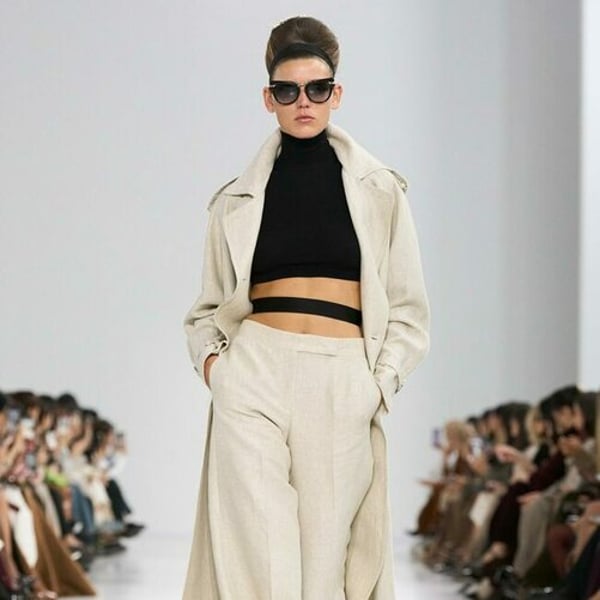
Three cohesive, cool and unexpected collections from Prada, Max Mara and Boss were timely reminders of why one comes to Milan — to see clothes of great distinction and impeccable finish that set global trends.
Prada: do not go gently into the night
Prada Spring/Summer 2026 – DR
In case one had forgotten, Prada is still the biggest game in Milan when it comes to fashion direction, élan and overall chic, as its latest collection presented Thursday usefully reminded us.
Even before the first models appeared, the brand had already stolen a march on its rivals, thanks to its meticulous invitation — a silver steel match box with a tiny white invite bearing a minuscule QR code. And it’s set, a giant lake of bright orange lacquer inside its mammoth show space in South Milan.
The brand’s heat can also be gauged by the thousands of fans outside who screamed in a gaggle of K-pop stars and influencers. Rock‑legend noise levels on the street.
Provocative but always polished, the collection contained a dozen or more nearly‑there bras, that fluttered slightly and were exposed within cut‑out tops, dresses and even aprons. Suggesting a racy soirée hostess, albeit one who lives in a giant loft or bohemian townhouse. Expect that look to go viral very quickly.
One could only admire the daring with which the design duo of Miuccia Prada and Raf Simons approached volume, whipping up all manner of dirndls, wrap, bubble or gathered skirts through alternating sheer fabrics or crumpled materials like technical taffeta. Unquestionably, the key fabric of the current season.
Or dreaming up exceptional dresses, cut pleated below the waist and military above. Finishing necklines, waists and the backs of shoes in bunches of strass and crystals. And accessorizing with soft acid‑hued gloves or a bold new backpack‑meets‑purse.
Often pairing these ideas with some superb light leather jackets — three‑button, peplum or draped.
Nothing about the palette suggested quiet luxury — salmon pink, blood orange, African violet, turquoise blue. Nor about the bold soundtrack, a super mashup of anthemic cuts by Art of Noise.
Coming one day before her former right hand at Miu Miu, Dario Vitale will stage his debut show for Versace, a brand that the Prada group bought after his appointment. One could not help admiring the tenacity and talent on display today at this show by Prada. Quite simply, the best collection so far anywhere, after 16 days on the international runway season.
Max Mara: Refined rococo
Max Mara Spring/Summer 2026 – DR
A smart change of gears at Max Mara, where the primary inspiration — rococo — led counterintuitively to an even more minimalist take on Max Mara’s classic wardrobe.
Riffing off everyone from Marie Antoinette and Madame de la Pompadour to David Bowie, Max Mara’s creative director Ian Griffiths turned the florid and floral elements of rococo into cool, understated detailing on some ravishing silhouettes.
Unlike the florid décor of 18th-century aristocratic life, there wasn’t a print insight, but nature’s curving shapes were at the center of this Spring/Summer 2026 collection.
Opening with a great series of slimline trenches and tops finished at the shoulders with small clouds of chiffon. Griffiths also sent out body‑con jackets or raincoats, that were backless and finished with funnel necks, or well lapels worn up.
His pants were drainpipes or cigarette shapes, elongating the silhouette, an effect heightened by the hair, stacked up into a pompadour — but of course.
For the evening, he dreamed up gauze petal dresses, playing on the fact that Rococo’s own key inspiration was nature.
“I wanted to show a little of the playful sexiness of Versailles. Or at least the illusion of playfulness,” smiled Griffiths, as a score of editors surrounded him with iPhones. Ian is very much loved by most critics, precisely because he creates clothes of great elegance that flatter and never look vulgar.
The U.K.‑born designer also played with a key Milan trend, exposing plenty of midriff — an expression of how today’s fashionista is a regular gym‑going, weight‑conscious gal.
Backed up by a brilliant mashup soundtrack that blended jazz funk and a magnificent organ concerto, Basso Ostinato was performed by André Van Vilet. Adding grandeur to a show staged impeccably inside the giant ice‑skating ring — Palazzo del Ghiaccio.
Boss: suitably on trend and message
Boss Spring/Summer 2026 – DR
With David Beckham sitting front row, Boss staged its latest show inside a giant former factory in north Milan. But if the setting was rather wrecked, the clothes were spruce and very spiffy.
Photographers went into a meltdown as the soccer ace approached the bench seats where Meghann Fahy of White Lotus fame, Aaron Pierre of Rebel Ridge, tennis champ Boris Becker and the house’s ever‑impeccable CEO Daniel Grieder all gathered.
On the catwalk, K-pop star Sound of Coops closed the show in an ankle‑grazing leather trench coat. After flirting with a number of brands, Sound of Coops committed as brand ambassador to Germany’s most storied fashion label, causing a sensation at the Met Gala in May by appearing in a custom Boss version of a Korean hanbok jeogori jacket.
Boss, at its best, is a smart distillation of contemporary trends made into flattering and functional clothes. Just like this collection, which featured fresh silk‑wool suits, double‑collar shirts, and expansive parkas for guys. Not a tie in sight.
For gals, gently volumed techy dresses and cocktails; mannish shirts and technical taffeta tops. Though the best looks were all the papery‑leather second‑skin shirt jackets, trenches and dusters. Hip without being pushy, stylish but not too avant-garde.
Creative director Marco Falcioni hung scarves, shards, strips and belts of fabric from multiple looks, adding a smart sense of movement to many outfits. Pants for women and men were mostly cut large, forgiving and long, covering half of all the footwear. The palette was soft ecru, putty, tobacco, black — unlike the invitation and runway — battered silver.
There was a bold sense of energy backed up by punchy, booming sounds by wizard DJ Michel Gaubert, a blend of Underworld dance‑party hits.
Helping to earn hefty applause for the burly and bearded designer Falcioni. He sportingly took his bow with a score of members of his design team. Nothing like a collegial designer. Respect.
Testoni hails from Bologna, Italy, but in 2022 the luxury footwear and accessories maker came under the umbrella of Chinese group Viva China, which controls the Li Ning brand (which has just shown at Milan Men’s Fashion Week) and the British brand Clarks, having previously been acquired by Hong Kong-based Sitoy Group in 2018. The Emilia-based label, founded in 1929 and specialising in men’s footwear, has since placed greater emphasis on womenswear and, following a rebrand from a.testoni to Testoni 1929, in 2025 opened a 200 square-metre flagship on Via Manzoni in Milan.
Testoni, “Bracciano” moccasin, AW 2026/27
The Milan boutique is part of the brand’s relaunch plan. In the same vein, the company has taken on a larger showroom to support retail and wholesale activities, at Via Sant’Andrea 21, where the presentation of the Autumn-Winter 2026/27 collection was held. “We currently operate 30 single-brand stores; we have just opened a new one in Taipei,” Philip Yau, CEO of Testoni, tells FashionNetwork.com. “They are located mostly in Asia- in China, Japan, South Korea and, indeed, Taipei. But after focusing on the Far East, we now want to look more to Europe, with Italy as a starting point, and then move on to the US.”
“We had a presence in America in the past, but we had closed the business there. Now we will reopen that market, where we were selling 10 million shoes every year. We have a large distribution centre in Hanover, near Philadelphia. Retailers such as Macy’s and Nordstrom, with whom we have established contacts, can help us successfully resume business in that market,” continues Yau, who is also aiming for “operational, logistics, marketing and other synergies with the brands Clarks and Li Ning and with the group’s market reach.” “Asia remains a strong base for us at Viva China, where we own many companies,” he says.
Testoni, “Moena” laser-cut sneaker, AW 2026/27
There are around 60 multi-brand stores that sell Testoni, making distribution highly selective at the top end. “Testoni has always been a more retail-oriented brand, but we are working to expand into wholesale as well, which we believe can be a strong driver of growth,” adds Testoni’s general manager, Enzo Vaccari. “So wholesale expansions are planned, especially in the US and other overseas markets. Nor are we neglecting e-commerce, which is quite small at present. It can do much more; we will work on it by leveraging the synergies we can establish with Clarks’ platform.”
Autumn-Winter 2026/27 has seen an increase in men’s styles and focuses on the Testoni brand’s core offer: loafers, moccasins, clean lines, no eccentricities, underscoring its craftsmanship. “In three years we will celebrate our 100th anniversary, so we have a very rich archive that could certainly form the basis of a museum,” Vaccari adds. “It is one of our dreams, because in our archive there are original products from the 1940s through the 1950s and 1960s, and we have all the original designs by Marisa Testoni, the daughter of Amedeo Testoni, the founder. At the moment, these materials are kept in Piazza XX Settembre, near the Montagnola in Bologna, but we are working to rethink the space and reorganise everything properly. We wanted Bologna to be the focal point of this project, because it is the city where we were born, where the company’s history lies.”
Testoni, AW 2026/27
Testoni also makes handbags, another line that has expanded in terms of styles, while men still account for 70% of revenue and production. “However, we are trying to achieve a better balance between the collections: we need to develop more bags dedicated to women,” Yau notes.
From a financial standpoint, the official 2025 year-end has yet to be finalised, so Philip Yau does not intend to disclose Testoni’s annual turnover, which nonetheless grew in the single digits. The leading markets are China, Taiwan and Hong Kong combined- Greater China- accounting for 40%, followed by Japan. “But the US is and will be a key market for Testoni and for the entire Viva China group, as is the Middle East, not only through wholesale distribution but also via retail openings currently under consideration,” explains Enzo Vaccari. “In America we have just returned; we want to find a major retailer, like Macy’s, which has more than 300 doors. In the meantime, there will be consolidation of retail in Asia, where we are looking at other markets, such as Singapore and Malaysia, which we would like to enter within a couple of years, depending on the opportunities that arise.”
This article is an automatic translation. Click here to read the original article.
Add designer to Jaden Smith’s considerable list of professions- along with actor, singer, and rapper- after the Californian creator dreamed up an impressive Dadaist display for his debut at Christian Louboutin.
Jaden Smith’s take on the world of Christian Louboutin – FashionNetwork.com
Evoking a whole plethora of influences from Greek mythology and the Great Paris Exhibitions to Dadaism and the great movement for Civil Rights, in an elaborate set in a disused warehouse in Montparnasse. Mount Parnassus, you will recall, was the home to nine muses in arts and sciences.
Two fine works of footwear even had Greek names: The Plato Loafer, a 2017 model with Swisscheese like holes, which Smith updates with the new Neo CL signature on a steel silver coin. And the Asclepius Sling- named after the ancient god of medicine- with the same emblematic coin detail and metallic hardware on the backstrap.
“I brought my personal interest on Greek mythology in as I thought it would resonate with people, as humans at the end of the day are all very similar. I’m combining my perspective of being an African American designer, linked to my more Dadaist thinking into the heritage of a French maison,” explained courteous 27-year-old.
Mythology meets luxury – FashionNetwork.com
Close by stood a Nam June Paik worthy mound of TVs, with video showing images of Martin Luther King’s 1963 March on Washington, The Sphinx, and clips from Dadaist filmmaker Hans Richter.
“That art piece is about the overdose of information we experience. This revolution that we are in the midst of right now. And the fact that information is being thrown at us all the time. And the psychological effects of looking at 10 screens at the one time. While also drawing correlations between my ancestry and Christian’s ancestry, and the history of art,” said Smith, attired in a giant gangster jeans, an oversized parka and pearl encrusted beanie.
Another installation was a broken temple with fluted columns on which were perched Jaden’s new bags. Notably a series of humungous backpacks and biker satchels, some with a dozen exterior zippered pockets with gold lettering reading- coins, pills, keys, tools, phone, documents, phones, and chargers. Alongside a surrealist tote finished like a bucket of overflowing paint and a Dadaist style back made in a black and white photo of an urban madding crowd.
Creator Jaden Smith – FashionNetwork.com
The whole space was dubbed Christian Louboutin Men’s Exhibition, as a small group of models bathed, inevitably, in red light, circulated wearing the new footwear and bags. Large red fabric rolls made into benches allowed one to enjoy a large video montage, including Jaden as a Wagnerian hero posed in front of gothic castles. Which is where we spotted founder Christian Louboutin, in a video stirring a large vat of red paint, before symbolically handing over a paintbrush to Jaden.
“It’s about craftmanship, extreme luxury, and highest level of design. That’s what Christian Louboutin is all about,” said Smith, describing the brand’s DNA.
Eyebrows were raised when Christian appointed Jaden to the position of creative director, as Parisian designers with two decades long CVs gritted their teeth that an untrained talent got such a coveted position. However, judging by this display, Jaden Smith has the chops, talent, and grace to be very effective in this role.
One suspects the gods of style and time are probably rather pleased.
To coincide with Milan Fashion Week, the S|STYLE 2025- Denim Lab is setting up at Fondazione Sozzani for an edition devoted to the future of sustainable denim and water management in the textile industry. Led by the S|STYLE Sustainable Style platform, founded in 2020 by independent journalist and curator Giorgia Cantarini, this initiative forms part of an ongoing programme of research and experimentation into responsible innovations applied to contemporary fashion.
Designers brought together for the S|STYLE 2025 – Denim Lab project – Denim Lab
The exhibition, open to the public on September 27 and 28, features a site-specific art installation by Mariano Franzetti, crafted from recycled and regenerative denim. Conceived as an immersive experience, it brings fashion design, technological innovation and artistic expression into dialogue.
Water: a central issue in fashion sustainability
Developed in collaboration with Kering‘s Material Innovation Lab (MIL), the Denim Lab brings together a selection of young international designers invited to create a denim look using low-impact materials and processes. They benefit from technical support and access to textiles developed with innovative technologies aimed at significantly reducing water consumption, chemical use, and the carbon footprint of denim production.
This edition places water at its core, an essential issue for a fabric whose production has traditionally demanded substantial volumes of water, from cotton cultivation through to dyeing and finishing. Denim therefore serves as an emblematic testing ground, both familiar and closely associated with the environmental challenges facing the fashion industry.
Outfit created for the Denim Lab by designer Gisèle Ntsama, one of the participants – Maison Gisèle
The fabrics were developed by PureDenim Srl, a specialist in low-impact dyeing techniques, while treatments and finishes were applied by Tonello Srl, a recognised leader in sustainable washing and finishing technologies. The selected designers, from Europe, Asia, and Africa, each offer a distinctive interpretation of denim, blending formal exploration, textile innovation and reflection on the contemporary uses of clothing.