
Politics
Florida man builds fortress of tires around Marion County property
When I was growing up in Pensacola, the local radio station often ran ads for a tire repair business whose slogan was, “Tires ain’t pretty.” I thought of that simple declaration this week when I heard the story of a big fight in Dunnellon over used tire disposal.
The person who told me the story is a woman in her 70s named Rita Gomez. She lives on a 30-acre parcel of land with a horse, a herd of cattle known as Zebu, and quite a few gopher tortoises. She’s far enough out in the country that her driveway is a mile long.
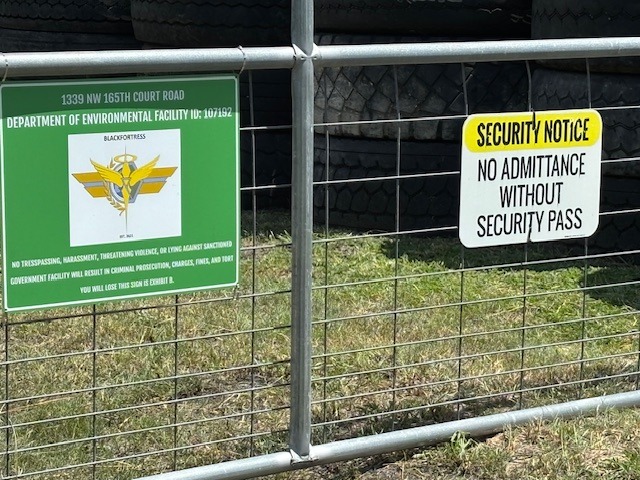
Next door to her is a 15-acre homesite whose owner has posted a sign calling it his “Black Fortress.” The primary feature of Black Fortress: its walls. They are made of stacks and stacks of black tires — truck tires, tractor tires, you name it.
It looks like someone invaded a Krispy Kreme to stack a bunch of the donuts on top of each other in rows. There are more than 1,500 tires forming this immense fence, perhaps as many as 2,000, Gomez said.
The property owner, whose name is Derek Peoples, has surrounded his entire property in Marion County with the stacks of used tires. Each tire is filled with dirt, mulch, or even (pee-ew!) horse poop, Gomez told me.
Now Peoples has begun lining his driveway with them too, she said.
“Something there is that doesn’t love a wall,” Robert Frost once wrote. I think that goes double for a wall made of smelly old tires.
“There is no justifiable reason for this environmental hazard in our community to continue to exist,” Gomez told me.
She sent me pictures of the tires as well as a photo of a sign that Peoples placed in front of the property advertising that it’s a government-run site. But it’s not.
“It is incorrect to claim your property is either a government facility or a solid waste facility,” an official of the Department of Environmental Protection (DEP) wrote to Peoples in February. The DEP informed him that his sign “is not accurate or correct” and warned him not to bring in any more tires.

So far, the sign is still there, and Gomez says she’s seen him bringing in more tires, too.
Still, Peoples’ fortress-like farm fence is far from the worst way that Floridians have disposed of old tires.
Like the moon
Tire disposal has been a problem ever since part-time Florida man Harvey Firestone first sold a set to go on one of part-time Florida man Henry Ford’s Model Ts.
The original plan was just to junk them. Toss those bald tires in the nearest landfill! Fill it to the rim with radials!
By the 2000s, there were some 300 million used tires thrown on the scrap heap annually, according to the U.S. Environmental Protection Agency (EPA). But they would routinely fill up with rainwater, breeding mosquitoes and attracting rats.
As another option, you could burn them.
But tire fires “often become major hazardous incidents affecting entire communities — frequently requiring neighborhood evacuations and long, drawn-out fire extinguishing operations” the EPA noted. “In 1983, a 7 million tire fire in Rhinehart, Va., issued a plume of smoke 3,000 feet high and nearly 50 miles long with air pollution emissions deposited in three states. It burned for nine months, polluting nearby water sources with lead and arsenic.”
Then someone came up with an even worse idea.
Beginning in the 1960s, people around Florida began lashing old tires together and dropping them in the water offshore to create “tire reefs.” Millions of tires went into these offshore sites over the next 30 years.
“At the time, it was thought that tire placement would increase reef populations, promote tourism and fishing activity, and improve habitats for fish species with minimal economic or environmental costs,” the National Oceanic and Atmospheric Administration (NOAA) reported.
Except it turns out the tire reefs were actually harming both the fish and the waterways. Oops!
“Unfortunately,” NOAA said, “after years of monitoring, scientists determined artificial tire reefs often have not improved fish populations as intended, and the tires have instead caused significant environmental harm. Tires can leach toxic chemicals into the water and can degrade into smaller particles, contributing to microplastic pollution.”
The most notorious tire reef in Florida is the Osborne Reef off Fort Lauderdale, which consists of more than 1 million tires. They’re damaging a real coral reef nearby, too.
A diver interviewed by NPR in 2007 described the underwater Osborne scene this way: “It’s like the moon or something. It’s weird. It doesn’t look like anything you can imagine. It’s just tires for as far as you can see down there.”
Dedicated divers have been steadily pulling the old tires out, but by one estimate there are still 500,000 left out there. Completing the cleanup may take another decade.
A similar but smaller disaster happened off Pinellas County. Evidence of what could go wrong cropped up just last year.
“A reef project from the 70s is turning into an environmental problem in Pinellas County as old tires wash onto the beach,” WTSP-TV reported in December. “Back-to-back hurricanes dislodged the tires, which were placed in the water decades ago to create artificial reefs.”
NOAA has awarded Pinellas a $2.2 million grant to clean up the mess it created, a process expected to take at least two more years.
OK, so piling the tires up in a landfill is bad. Burning them is bad. Dropping them offshore is bad. How about grinding them up and turning them into your child’s playground?
Nope. Turns out that’s bad for the kiddies.
“Children playing on tire crumb could potentially be exposed by ingestion of the product directly, by ingestion of surface water runoff through the product, by inhalation of dust, or by skin contact with the material or surface water runoff,” a 2005 study found.
I contacted Steven J. Laux, a solid waste expert at the University of Florida, to ask if there was any safe way to dispose of old tires. He said recycling works. The shredded components can become part of a new road, he said, meaning you could use new tires to drive on old tires. Your new tires could contain bits of old tires, too.
Because I am a curious guy, I checked. Guess where the biggest tire recycling plant in Florida is located: Marion County.
And I don’t think their perimeter fence is made out of Michelins, either.
Chicanery and clear springs
Dunnellon was founded more than a century ago amid some deliberate chicanery.
The town founder was a close-mouthed Ocala banker named John Dunn (where the “ellon” part came from, I don’t know). In 1890, he worked with the elaborately mustachioed Albertus Vogt and a chemist named R.R. Snowden to secretly amass as much acreage as possible after Vogt discovered a phosphate deposit while sinking a well.
They managed to pull together 13,000 acres, dug up as much phosphate as they could excavate, and shipped it out via river and then railroad. So many people showed up hoping for a piece of the action that Dunnellon got the unlikely nickname “Boomtown.”
By the 1920s, the phosphate deposit had played out, and the mining moved southward to Polk County. Little Dunnellon hung on, but just barely. In an official history of the city, the next significant event mentioned is the on-location filming of the 2001 horror movie “Jeepers Creepers.”
To me, though, Dunnellon’s finest feature is Rainbow Springs State Park, which began life as a privately owned tourist attraction in the 1930s.
The park offered glass-bottom boat tours, waterfalls built atop the old phosphate mines, and a monorail. You could enjoy watching a swim team called the Bahama Belles and even an occasional mermaid like at Weeki Wachee Springs.
But that rodent-oriented theme park in Orlando drew most would-be visitors away, and the new interstate bypassed the region, making the tourist tires turn elsewhere. In 1974, the Rainbow Springs private attraction closed. It reopened as a state park in 1995.
Needless to say, the main attraction remains the crystal waters. But Rainbow Springs, like many springs around the state, is now facing some serious problems, including nitrate pollution and decreases in the historic flow due to over-pumping of groundwater.
Now add “contaminated tire runoff” to the mix, and you can see why using tires to build a wall might be a problem.
Don’t tread on me
I tried multiple times in multiple ways to contact Peoples, the Fortress Builder, but he didn’t respond to my calls, texts or emails.
I read in some Marion County court records that when a process server tried to hand him a notice about being sued by a bank, he told her she was trespassing and ordered her off his property.
On the other hand, the somewhat confusing sign on his fence specifically says, “No Trespassing, Harassment, Threatening Violence or Lying Against Sanctioned Government Facility Will Result in Criminal Prosecution, Charges, Fines and Tort. You Will Lose. This Sign Is Exhibit B.” (No mention of what Exhibit A might be.)
Instead of “Black Fortress,” perhaps he should have just posted a picture of a bald tire with the slogan, “Don’t Tread On Me.”
I asked Rita Gomez how the tire wall got started four years ago.
“One day he dropped one tire,” she recalled. Gomez asked Peoples’ wife what was going on, and remembers her saying, “Don’t worry about it, this has nothing to do with you.”
But of course, it has had everything to do with the neighbors and the whole community.
Gomez told me when she saw what he was building, she began making repeated complaints to both Marion County and the state DEP. She was particularly steamed when she saw that the wall of tires was blocking the path of a threatened gopher tortoise.
I contacted both DEP and Marion County code enforcement about what’s happening with this literal embodiment of the “tires ain’t pretty” concept.
“The property owner originally used a limited number of tires filled with soil as planters and barriers,” Sarah Fayed of the DEP told me via e-mail. “In 2021, DEP issued a letter outlining limited beneficial use, but this was not intended as a perpetual authorization.”
After that February letter that told Peoples to stop bringing in tires, “any new tires placed since that time are not authorized by DEP,” she wrote. “DEP continues to monitor the matter and will evaluate next steps as appropriate.”
And Marion County spokesperson Stacie Causey told me that Peoples’ ever-growing tire collection is the basis of “an open investigation” for code enforcement.
Gomez shared with me a text that Peoples sent her four years ago, after getting wind of her first complaints about what he was doing. He threatened a lawsuit that he never filed.
“You all cannot dictate what we can do on our land,” he told her.
Yet, as any student of American civics knows, your local government’s zoning code and state and federal environmental regulations can and should dictate what you do or don’t do on your property.
That’s because — despite all the Florida politicians we’ve heard ranting and raving about the importance of property rights — what you do on your property can affect everyone around you, either via the air or the water. There is no “right to pollute” in either the state or federal constitution.
Legally speaking, this is where the rubber meets the road.
___
Craig Pittman reporting. Florida Phoenix is part of States Newsroom, a nonprofit news network supported by grants and a coalition of donors as a 501c(3) public charity. Florida Phoenix maintains editorial independence. Contact Editor Michael Moline for questions: [email protected].
Post Views: 0