Connect with us

Business

Mark Zuckerberg says he wants to ‘stay out of partisan politics’

Published

on


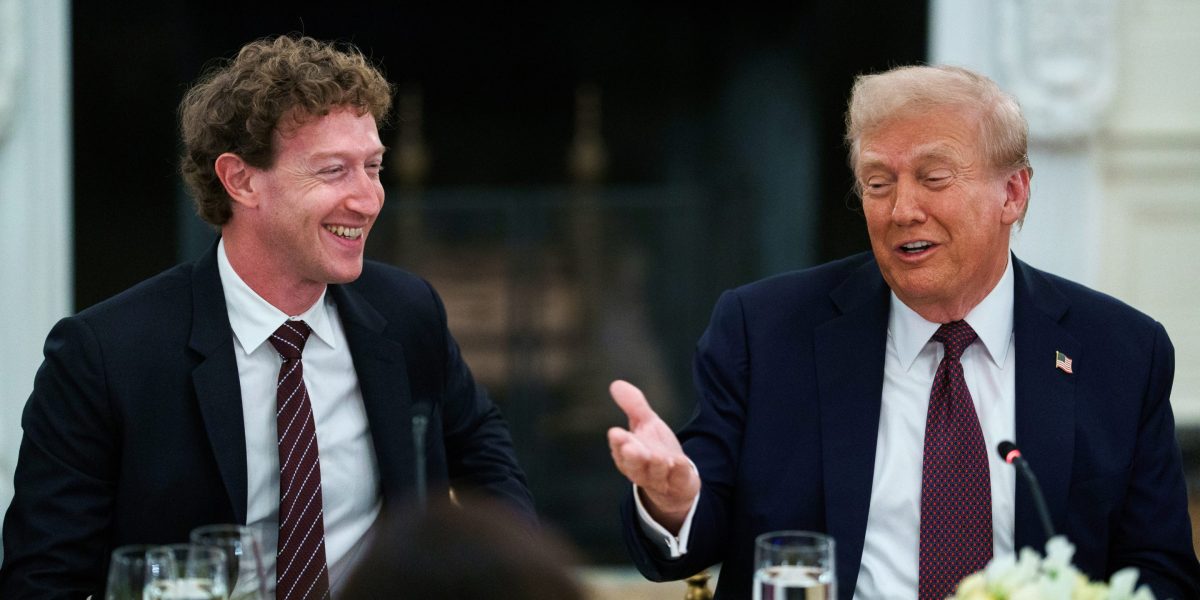
Meta CEO Mark Zuckerberg emphasized his desire to remain politically neutral during a recent interview with tech journalist Alex Heath on the Access podcast, saying “the thing that I want to stay out of is partisan politics” while discussing his evolving relationship with the Trump administration and a controversial $600 billion investment pledge.

The comments came as Zuckerberg addressed his recent pivot toward working more closely with President Donald Trump, including his announcement that Meta would invest “at least $600 billion through 2028” in U.S. infrastructure during a White House dinner with tech leaders. A hot-mic moment captured Zuckerberg apologizing to Trump afterward, saying “Sorry, I wasn’t ready. I wasn’t sure what number you wanted to go with.” (Susan Li, Meta’s CFO, later clarified Zuckerberg’s comment, saying the $600 billion figure represents “the total envelope” of the company’s U.S. investment plans through 2028, including data centers, infrastructure, and business operations.)

Despite his claims of political neutrality, Zuckerberg acknowledged the necessity of engaging with government officials. “We will always want to work with and have a good partnership and collaboration with governments,” the 41-year-old Facebook founder told Heath. “That’s going to be especially true in our home country, but it’s also true in other countries around the world where we serve large amounts of people.”

Zuckerberg explained his distinction between political engagement and partisan activity, suggesting his recent overtures to the Trump administration represent necessary business collaboration rather than ideological alignment.

“I think this administration for a number of reasons is definitely more forward-leaning on wanting to help build out infrastructure,” Zuckerberg said, referring to the current regulatory environment as more favorable to tech companies.

This stance marks a significant evolution from Zuckerberg’s previous political involvement. He was once a vocal advocate for progressive causes, co-founding immigration reform organizations and contributing hundreds of millions to election infrastructure in 2020. However, after facing criticism from both political parties, he began distancing himself from overtly political activities.

In a 2024 letter to Congress, Zuckerberg expressed regret over his company’s response to Biden administration pressure to moderate COVID-19 content and pledged neutrality going forward. “My goal is to be neutral and not play a role one way or another—or to even appear to be playing a role,” he wrote.

While Zuckerberg maintains his goal of political neutrality, his actions suggest a calculated approach to managing relationships with power centers rather than true disengagement from politics. His recent policy changes, including ending fact-checking partnerships and relaxing content moderation, have drawn criticism as concessions to conservative pressure rather than principled neutral positions. His recent appointments of Republican-leaning executives, including Joel Kaplan as global policy chief and UFC CEO Dana White to Meta’s board, have also signaled a strategic shift toward making Meta more conservative-friendly.

Zuckerberg’s Access interview also covered the company’s various artificial intelligence and super intelligence projects, as well as the build-out of infrastructure to make these technologies possible. But Zuckerberg said something interesting on the topic of Meta’s $600 billion investment into the U.S.: He acknowledged it’s objectively a ton of money, but conversely, not investing enough right now, given the company’s AI and AGI ambitions, could be even more damaging.

“If we end up misspending a couple of hundred billion dollars, I think that that is going to be very unfortunate obviously,” Zuckerberg said. “But what I’d say is I actually think the risk is higher on the other side. If you if you build too slowly and then super intelligence is possible in three years, but you built it out assuming it would be there in five years, then you’re just out of position on what I think is going to be the most important technology that enables the most new products and innovation and value creation and history.”

You can watch the full Access interview with Zuckerberg below:

Fortune Global Forum returns Oct. 26–27, 2025 in Riyadh. CEOs and global leaders will gather for a dynamic, invitation-only event shaping the future of business. Apply for an invitation.


Source link

Continue Reading

Business

Jerome Powell faces a credibility issue as he tries to satisfy hawks and doves on a divided Fed

Published

on


With the Federal Reserve split between increasingly hawkish and increasingly dovish policymakers, Chairman Jerome Powell is due to perform some serious log-rolling when the central bank meets this week.

Another rate cut is a near certainty after the Fed meeting ends on Wednesday, but the main question is what Powell will say about the prospects for more easing next month.

Wall Street expects a hawkish cut, meaning Powell is likely to avoid signaling a January cut to appease Fed hawks, after joining doves to lower rates this month.

“Chair Powell is facing the most divided committee in recent memory,” analysts at Bank of America said in a note on Friday. “Therefore, we think he will attempt to balance the expected rate cut with a hawkish stance at the press conference, just as he did in October.”

But at the same time, the Fed chief has also been insistent that policymakers are not on a pre-determined course and that rate moves depend on the data that come in.

As a result, BofA is doubtful that he can pull off a hawkish cut so easily, considering all the market-moving data that will come out between the two meetings, with some delayed due to the government shutdown.

The week after the Fed meeting, for example, jobs numbers for October and November, October retail sales, and the consumer price index for November will come out. And December readings for those indicators are likely to be released before the next meeting on Jan. 27-28.

“It will be difficult for Powell to send a credibly hawkish signal at the press conference,” analyst said.

BofA still sees a way for him to thread the needle. One option is for Powell to suggest that “significant further weakening” in the jobs data will be necessary to trigger a January cut.

Another option is to argue that 3.5%-3.75%—where benchmark rates would be if the Fed cuts again this week—isn’t restrictive after accounting for inflation, meaning the central bank is no longer weighing on the economy as much.

Similarly, JPMorgan chief U.S. economist Michael Feroli said he expects Powell to stress that after this week’s cut, rates will be close to neutral. So any additional easing would depend on meaningful deterioration in the labor market and not be predicated in risk management.

For now, Wall Street doesn’t expect a January cut, with 25% odds currently being priced in on CME Group’s FedWatch tool. But BofA thinks Powell will likely leave the door open for one.

“We wouldn’t be surprised if markets start pushing more aggressively for a Jan cut in the near term,” analysts predicted. “And the anticipation of this outcome might raise the probability of more dissents in Dec, since hawks might be inclined to dig their heels in instead of compromising.”


Source link

Continue Reading

Business

US vaccine advisers end decades-long recommendation for all babies to get hepatitis B shot at birth

Published

on


A federal vaccine advisory committee voted on Friday to end the longstanding recommendation that all U.S. babies get the hepatitis B vaccine on the day they’re born.

A loud chorus of medical and public health leaders decried the actions of the panel, whose current members were all appointed by U.S. Health Secretary Robert F. Kennedy Jr. — a leading anti-vaccine activist before this year becoming the nation’s top health official.

“This is the group that can’t shoot straight,” said Dr. William Schaffner, a Vanderbilt University vaccine expert who for decades has been involved with the Advisory Committee on Immunization Practices and its workgroups.

Several medical societies and state health departments said they would continue to recommend them. While people may have to check their policies, the trade group AHIP, formerly known as America’s Health Insurance Plans, said its members still will cover the birth dose of the hepatitis B vaccine.

For decades, the government has advised that all babies be vaccinated against the liver infection right after birth. The shots are widely considered to be a public health success for preventing thousands of illnesses.

But Kennedy’s advisory committee decided to recommend the birth dose only for babies whose mothers test positive, and in cases where the mom wasn’t tested.

For other babies, it will be up to the parents and their doctors to decide if a birth dose is appropriate. The committee voted 8-3 to suggest that when a family elects to wait, then the vaccination series should begin when the child is 2 months old.

President Donald Trump posted a message late Friday calling the vote a “very good decision.”

The acting director of the Centers for Disease Control and Prevention, Jim O’Neill, is expected to decide later whether to accept the committee’s recommendation.

The decision marks a return to a health strategy abandoned more than three decades ago

Asked why the newly-appointed committee moved quickly to reexamine the recommendation, committee member Vicky Pebsworth on Thursday cited “pressure from stakeholder groups,” without naming them.

Committee members said the risk of infection for most babies is very low and that earlier research that found the shots were safe for infants was inadequate.

They also worried that in many cases, doctors and nurses don’t have full conversations with parents about the pros and cons of the birth-dose vaccination.

The committee members voiced interest in hearing the input from public health and medical professionals, but chose to ignore the experts’ repeated pleas to leave the recommendations alone.

The committee gives advice to the director of the Centers for Disease Control and Prevention on how approved vaccines should be used. CDC directors almost always adopted the committee’s recommendations, which were widely heeded by doctors and guide vaccination programs. But the agency currently has no director, leaving acting director O’Neill to decide.

In June, Kennedy fired the entire 17-member panel earlier this year and replaced it with a group that includes several anti-vaccine voices.

Hepatitis B and delaying birth doses

Hepatitis B is a serious liver infection that, for most people, lasts less than six months. But for some, especially infants and children, it can become a long-lasting problem that can lead to liver failure, liver cancer and scarring called cirrhosis.

In adults, the virus is spread through sex or through sharing needles during injection drug use. But it can also be passed from an infected mother to a baby.

In 1991, the committee recommended an initial dose of hepatitis B vaccine at birth. Experts say quick immunization is crucial to prevent infection from taking root. And, indeed, cases in children have plummeted.

Still, several members of Kennedy’s committee voiced discomfort with vaccinating all newborns. They argued that past safety studies of the vaccine in newborns were limited and it’s possible that larger, long-term studies could uncover a problem with the birth dose.

But two members said they saw no documented evidence of harm from the birth doses and suggested concern was based on speculation.

Three panel members asked about the scientific basis for saying that the first dose could be delayed for two months for many babies.

“This is unconscionable,” said committee member Dr. Joseph Hibbeln, who repeatedly voiced opposition to the proposal during the sometimes-heated two-day meeting.

The committee’s chair, Dr. Kirk Milhoan, said two months was chosen as a point where infants had matured beyond the neonatal stage. Hibbeln countered that there was no data presented that two months is an appropriate cut-off.

Dr. Cody Meissner also questioned a second proposal — which passed 6-4 — that said parents consider talking to pediatricians about blood tests meant to measure whether hep B shots have created protective antibodies.

Such testing is not standard pediatric practice after vaccination. Proponents said it could be a new way to see if fewer shots are adequate.

A CDC hepatitis expert, Adam Langer, said results could vary from child to child and would be an erratic way to assess if fewer doses work. He also noted there’s no good evidence that three shots pose harm to kids.

Meissner attacked the proposal, saying the language “is kind of making things up.”

Health experts say this could ‘make America sicker’

Health experts have noted Kennedy’s hand-picked committee is focused on the pros and cons of shots for the individual getting vaccinated, and has turned away from seeing vaccinations as a way to stop the spread of preventable diseases among the public.

The second proposal “is right at the center of this paradox,” said committee member Dr. Robert Malone.

Some observers criticized the meeting, noting recent changes in how they are conducted. CDC scientists no longer present vaccine safety and effectiveness data to the committee. Instead, people who have been prominent voices in anti-vaccine circles were given those slots.

The committee “is no longer a legitimate scientific body,” said Elizabeth Jacobs, a member of Defend Public Health, an advocacy group of researchers and others that has opposed Trump administration health policies. She described the meeting this week as “an epidemiological crime scene.”

Republican Sen. Bill Cassidy, a liver doctor who chairs the Senate health committee, called the committee’s vote on the hepatitis B vaccine “a mistake.”

“This makes America sicker,” he said, in a post on social media.

The committee heard a 90-minute presentation from Aaron Siri, a lawyer who has worked with Kennedy on vaccine litigation. He ended by saying that he believes there should no ACIP vaccine recommendations at all.

In a lengthy response, Meissner said, “What you have said is a terrible, terrible distortion of all the facts.” He ended by saying Siri should not have been invited.

The meeting’s organizers said they invited Siri as well as a few vaccine researchers — who have been vocal defenders of immunizations — to discuss the vaccine schedule. They named two: Dr. Peter Hotez, who said he declined, and Dr. Paul Offit, who said he didn’t remember being asked but would have declined anyway.

Hotez, of the Texas Children’s Hospital in Houston, declined to present before the group “because ACIP appears to have shifted its mission away from science and evidence-based medicine,” he said in an email to The Associated Press.


Source link

Continue Reading

Business

Jamie Dimon on AI: ‘maybe one day we’ll be working less hard but having wonderful lives’

Published

on


JPMorgan Chase CEO Jamie Dimon reiterated a nuanced and overall upbeat view about the effect of artificial intelligence on the economy.

In an interview with Fox News’ Sunday Morning Futures, the head of the world’s biggest bank acknowledged businesses have been cautious about hiring lately but said it’s not related to AI and doubted that the technology will dramatically reduce jobs in the next year.

“For the most part, AI is going to do great stuff for mankind, like tractors did, like fertilizers did, like vaccines did,” he said. “You know maybe one day we’ll be working less hard but having wonderful lives.”

Dimon added that AI still needs proper regulation to mitigate the downside risks, just like other innovations throughout history.

He also repeated his earlier warning that AI will eliminate jobs, but urged people to focus on uniquely human skills like critical thinking, emotional intelligence, and communication.

If AI sweeps through the economy so quickly that workers can’t adapt to new roles in time, Dimon suggested the public sector and private sector have roles to play.

“We—government and we the companies, society—should look at how do we phase it in a way that we don’t damage a lot of people,” he explained. “We should have done a little bit more on trade assistance years ago when you had a town that got damaged by the closure of a plant. And that you can do: you can retrain people, relocate people, income assistance, early retirement.”

Meanwhile, AI is also creating jobs in the near term as new infrastructure requires more construction and fiber optics, he pointed out.

The comments were his latest on AI in recent months. In November, Dimon predicted AI will help the developed world transition to a shorter workweek of just three and a half days sometime in the next 20-40 years.

And at the Fortune Most Powerful Women Summit in October, he said governments and companies must plan for an AI future to avoid a social backlash.

“It will eliminate jobs. People should stop sticking their heads in the sand,” he warned.


Source link

Continue Reading

Trending

Copyright © Miami Select.