Connect with us

Business

Trump’s shock $100k gambit ‘inserts total chaos in existing H-1B process with basically a day’s noti

Published

on


President Donald Trump’slatest plan to overhaul the American immigration system has left some immigrant workers confused, forcing the White House on Saturday to scramble to clarify that a new $100,000 fee on visas for skilled tech workers only applies to new applicants and not to current visa holders.

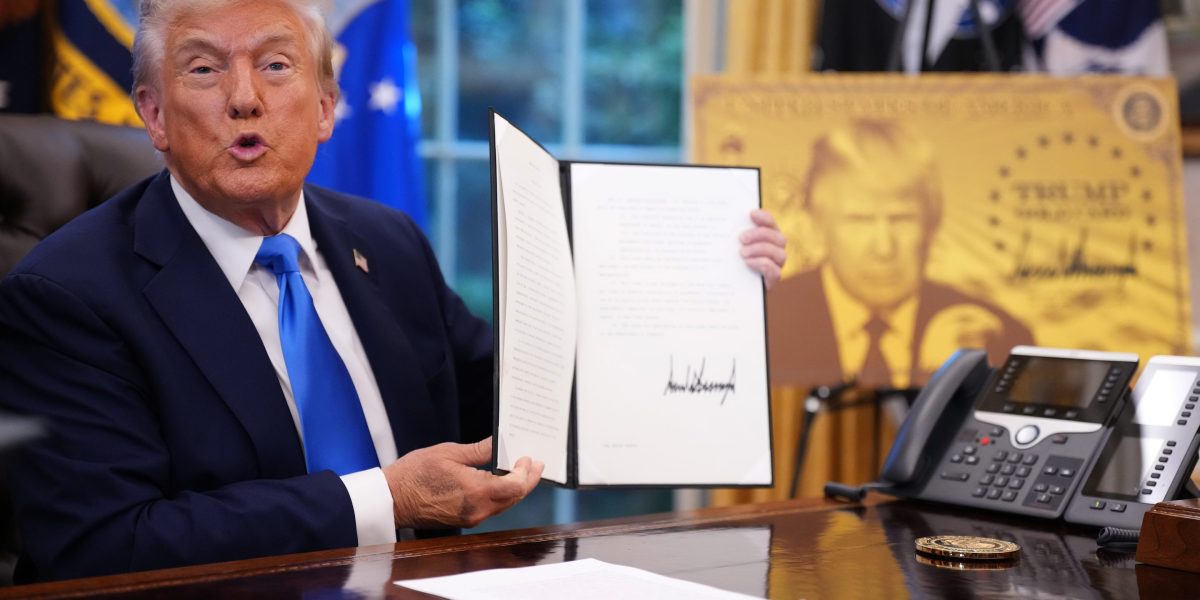
The president on Friday, with Commerce Secretary Howard Lutnick by his side, signed a proclamation that will require the new fee for what are known as H-1B visas — meant for high-skilled jobs that tech companies find hard to fill.

“Those who already hold H-1B visas and are currently outside of the country right now will NOT be charged $100,000 to re-enter,” White House press secretary Karoline Leavitt said in a posting on X. “This applies only to new visas, not renewals, and not current visa holders.”

The fee takes effect at 12:01 a.m. ET Sunday. It is scheduled to expire after a year. But it could be extended if the government determines that is in the interest of the United States to keep it.

The White House in a social media post also sought to make clear the new rule “does not impact the ability of any current visa holder to travel to/from the U.S.”

But immigration attorneys said that the White House move threatened to upend the lives of many skilled workers and has far-reaching impact on American business.

Kathleen Campbell Walker, an immigration attorney with Dickinson Wright based in El Paso, Texas, said in a posting on LinkedIn that the White House move “inserts total chaos in existing H-1B process with basically a day’s notice.”

Lutnick on Friday told reporters that the fee would be an annual cost for companies.

But a White House official said Saturday that it’s a “one-time fee.” Asked if Lutnick’s comments sowed confusion, the official, who was not authorized to comment publicly about the matter and spoke on the condition of anonymity, said the new fee “currently does not apply to renewals but that policy is under discussion.”

Meanwhile, India’s government expressed concern Saturday that the Trump administration move would dramatically raise the fee for visas that bring tech workers from there and other countries to the United States.

Trump also rolled out a $1 million “gold card” visa for wealthy individuals. The moves face near-certain legal challenges amid widespread criticism he is sidestepping Congress.

To be certain, if the moves survive legal muster, they will deliver staggering price increases. The visa fee for skilled workers would jump from $215.

India’s Ministry of External Affairs said Saturday that Trump’s plan “was being studied by all concerned, including by Indian industry.″ The ministry warned that ”this measure is likely to have humanitarian consequences by way of the disruption caused for families. Government hopes that these disruptions can be addressed suitably by the U.S. authorities.″

More than 70% of H-1B visa holders are from India.

Critics say the H-1B visas undercut American workers

H-1B visas, which require at least a bachelor’s degree, are meant for high-skilled jobs that tech companies find difficult to fill. Critics say the program undercuts American workers, luring people from overseas who are often willing to work for as little as $60,000 annually. That is well below the $100,000-plus salaries typically paid to U.S. technology workers.

Trump on Friday insisted that the tech industry would not oppose the move. Lutnick, meanwhile, claimed “all big companies” are on board.

Representatives for the biggest tech companies, including Amazon, Apple, Google and Meta, did not immediately respond to messages for comment. Microsoft declined to comment.

“We’re concerned about the impact on employees, their families and American employers,” the U.S. Chamber of Commerce said. “We’re working with the Administration and our members to understand the full implications and the best path forward.”

Lutnick said the change will likely result in far fewer H-1B visas than the 85,000 annual cap allows because “it’s just not economic anymore.”

“If you’re going to train people, you’re going to train Americans,” Lutnick said on a conference call with reporters. “If you have a very sophisticated engineer and you want to bring them in … then you can pay $100,000 a year for your H-1B visa.”

Trump also announced he will start selling a “gold card” visa with a path to U.S. citizenship for $1 million after vetting. For companies, it will cost $2 million to sponsor an employee.

Trump offers ‘Platinum Card’

The “Trump Platinum Card” will be available for $5 million and allows foreigners to spend up to 270 days in the U.S. without being subject to U.S. taxes on non-U.S. income. Trump announced a $5 million gold card in February to replace an existing investor visa — this is now the platinum card.

Lutnick said the gold and platinum cards would replace employment-based visas that offer paths to citizenship, including for professors, scientists, artists and athletes.

Critics of H-1Bs visas who say they are used to replace American workers applauded the move. U.S. Tech Workers, an advocacy group, called it “the next best thing” to abolishing the visas altogether.

Doug Rand, a senior official at U.S. Citizenship and Immigration Services during the Biden administration, said the proposed fee increase was “ludicrously lawless.”

“This isn’t real policy — it’s fan service for immigration restrictionists,” Rand said. “Trump gets his headlines, and inflicts a jolt of panic, and doesn’t care whether this survives first contact with the courts.”

Lutnick said the H-1B fees and gold card could be introduced by the president but the platinum card needs congressional approval.

Visas doled out by lottery

Historically, H-1B visas have been doled out through lottery. This year, Amazon was by far the top recipient of H-1B visas with more than 10,000 awarded, followed by Tata Consultancy, Microsoft, Apple and Google. Geographically, California has the highest number of H-1B workers.

Critics say H-1B spots often go to entry-level jobs, rather than senior positions with unique skill requirements. And while the program isn’t supposed to undercut U.S. wages or displace U.S. workers, critics say companies can pay less by classifying jobs at the lowest skill levels, even if the specific workers hired have more experience.

As a result, many U.S. companies find it cheaper to contract out help desks, programming and other basic tasks to consulting companies such as Wipro, Infosys, HCL Technologies and Tata in India and IBM and Cognizant in the U.S. These consulting companies hire foreign workers, often from India, and contract them out to U.S. employers looking to save money.

___

Ortutay reported from Oakland, Calif. Associated Press writers Adriana Gomez Licon in Ft. Lauderdale, Florida, Elliot Spagat in San Diego and Paul Wiseman in Washington contributed to this report.


Source link

Continue Reading

Business

This CEO went back to college at 52, but says successful Gen Zers ‘forge their own path’

Published

on


Being a successful college dropout is worn like a badge of honor for many in the business world. After all, some of the wealthiest leaders—Mark Zuckerberg, Bill Gates, and Larry Ellison—never finished their degrees, and they’re proud of it.

Lauren Antonoff once wore that badge, too. After her apartment burned down as a student at University of California, Berkeley, and she missed finishing her diploma, she still managed to break into tech, spending nearly two decades at Microsoft and later serving as a senior executive at GoDaddy. After building a career without the credential she was supposed to have, Antonoff took pride in proving she didn’t need it.

But after 25 years in the industry, Antonoff became burdened by what she felt was “unfinished business.” So in 2022, during a rare career break, she was back in a UC Berkeley lecture hall—this time as a 52-year-old peer among classmates half her age. Antonoff’s schedule was filled with courses in rhetoric, political science, and even biotech.

Going back to school wasn’t ultimately revolutionary for her career, she admitted to Fortune, but it did sharpen her perspective on adaptivity and staying focused on long-term goals—even when life takes unexpected turns.

“There are probably some people who approach college from like, ‘I’m going to do the assignment and do what I’m told,’” she told Fortune. “But the students I think that really thrive are the ones who forge their own path.”

Now, as CEO of Life360—the family location app worth more than $5 billion—she sees clear parallels between navigating a classroom and navigating the C-suite.

“That’s a lot of what CEOs do is look at the range of possibilities, figure out what the options are, and pick a path,” she added. “And pick a path knowing that you can’t know the future, knowing that you don’t get to know if you’re right until after and being the ones to shoulder that responsibility.”

Forging your own path can sometimes be somewhat of a privilege and can take time, Antonoff admitted. But, she said, small steps can create momentum. 

“I’m a big believer in finding your way in the world,” Antonoff said. “That’s not just about getting a job; if you don’t have a job, start something. If you don’t have a job, go volunteer someplace. In my experience, being active and working on problems that you’re interested in—one thing leads to another.”

The secret to reach the ‘highest levels of success’

Growing up, Antonoff thought she knew exactly where her career was heading: civil rights law. At UC Berkeley, she planned to study rhetoric and political science and then make the jump to law school.

But after buying her first MacBook to write papers, she found an unexpected fascination in technology—and began asking questions. That curiosity led her to the Berkeley Mac User group, where she realized tech might be more than just a hobby.

Her advice for Gen Z echoes that early pivot.

“Do what you love,” she said. “I think it’s very hard to reach the highest levels of success if you don’t have the energy and the passion. I think when you are excited about something, it sort of fuels those creative juices and those insights that allow you to chart the future and bring people along with you.”

In December 2022, Antonoff finally walked across the stage and added one long-awaited line to her résumé: B.A., UC Berkeley. By the following May, she had been named COO of Life360—and within two years, CEO.


Source link

Continue Reading

Business

It’s a sequel, it’s a remake, it’s a reboot: Lawyers grow wistful for old corporate rumbles as Paramount, Netflix fight for Warner

Published

on


Corporate-law scholars say the bidding war for Warner Bros. Discovery has become a strange kind of legal nostalgia trip, dragging Paramount back to center stage for the first time in decadesand reviving vintage doctrines from Revlon to the “Cuban beer” defense as Netflix tries to lock up a once‑in‑a‑generation deal. What looks on the surface like a clean strategic bolt‑on for the world’s biggest streamer is, in the eyes of the experts who teach this stuff, a big-budget Hollywood legacy act, following in the footsteps of the takeover sagas that defined 20th-century Tinseltown.​

Anyone who lived through the 1989 takeover that resulted in the landmark lawsuit Paramount Communications v. Time battle hears an echo. Back then, Time Inc. was trying to merge with Warner Communications when Paramount tried to blow up the deal with a rich hostile bid for Time itself, triggering a bidding war and a landmark Delaware ruling on when, and how, boards can say no.​ Of course, Time Warner emerged as a media powerhouse, reigning for decades before a 2000 tie-up with AOL that many consider to be the most disastrous merger in corporate history.

Anthony Sabino, a veteran legal practitioner and professor at St. John’s University in Queens, N.Y., who teaches those cases, called today’s fight “a sequel, not a reboot,” with Paramount, which is competing with Netflix to buy WBD, once again in the eye of a takeover hurricane. He pointed out that Paramount also fronted the 1994 Paramount v. QVC clash—also ultimately decided in Delaware—where Barry Diller’s QVC was rebuffed in favor of Sumner Redstone’s Viacomin a bid to buy Paramount, cementing the modernempire that has since mutated into Paramount Global and, as of 2024, Paramount Skydance.

The same brands and some of the same power players, from John Malone to Redstone’s successors, are back on the call sheet, only this time the battleground is streaming instead of cable and print.​ Diller himself agreed, telling The New York Times by email earlier this week, “yes, it is turning into a repeat.”

But the rapid turn of events that saw Netflix strike a binding deal worth $72 billion in equity (and nearly $83 billion including debt), only to see Paramount go public with an all-but hostile bid worth $77.9 billion in equity (and $108 billion including debt) has also brought a cosmetics name into the conversation, famous to corporate lawyers: Revlon.

The Revlon element

Named after the 1986 Delaware decision in Revlon v. MacAndrews & Forbes, the Revlon doctrine “governs sort of how you should behave when you’re selling [a] company, and it says you can’t favor, you can’t think about anything other than shareholder value,” according to Columbia law professor Dorothy Lund. She explained that in that deal, the hostile takeover of cosmetics firm Revlon by the famed financier Ronald Perelman in the mid-1980s, the Revlon CEO had a “deep personal antipathy” for Perelman and structured a deal with a different private equity buyer. Ultimately, the Delaware Supreme Court ruled that the board of Revlon, like every other company, has a “heightened responsibility to be an auctioneer and thinking about getting the best value for shareholders,” Lund said, “and what you can’t do is play favorites. Everything that you have to do has to be done in service of shareholder value.”

The announcement of the Netflix deal on Dec. 5 implied that Warner had made the best choice for shareholders by choosing the big-red streamer, but Paramount’s announcement the next business day, with a potentially higher bid, put the Revlon precedent in play, both Sabino and Lund explained. Paramount’s subsequent regulatory filing revealed what it claimed was a pattern of minimal engagement from major Warner stakeholders, including CEO David Zaslav and the so-called “cable cowboy” John Malone, who serves as chair emeritus, having stepped down from the board earlier this year while retaining significant stock. (Malone backed Diller and QVC in their ultimately unsuccessful 1994 bid for Paramount, as both Malone and Diller discussed in separate memoirs released in 2025.)

While Lund said that she doesn’t personally think there’s a strong Revlon claim quite yet, “I think the board has to be really careful what they do in the coming weeks,” because the Warner Bros. Discovery board can’t appear to be playing favorites for personal reasons. “Now the tricky thing is going to be, clearly everybody’s got money left on the table, right?” Lund noted that Paramount has indicated that its $30-per-share offer is not its last and best offer, while Netflix also has room to go up. “Now the board is in this tricky position of trying to engineer this deal to get the most value for shareholders.” They might well be compelled under their Revlon duty to either go back to Netflix and say they need a higher bid or go back to Paramount and take its bid seriously.

Lund said that the two-way fight between Paramount and Netflix is almost a fact pattern ripped from one of her exam books, with Paramount’s David Ellison effectively accusing CEO David Zaslav and the Warner board of violating their Revlon duties by favoring a more complex, slower Netflix package over a simple all‑cash offer. Lund also raised the Paramount vs. Time precedent, which was essentially about the choice of a merger partner on cultural rather than financial grounds. “You can’t say, ‘Well, I just like the culture,” which was an argument in that deal where one bidder was seen as more likely to preserve the Time culture. Boards can discount a higher price only for concrete reasons like firmer financing or cleaner regulatory paths, not because they like a bidder’s vibe, in other words.​ This is on display between Netflix, Warner and Paramount, with Ted Sarandos and David Zaslav reported to be on friendly terms, and Paramount’s regulatory filings suggesting a frosty distance between Zaslav and Ellison.

The clash of personalities is part of why experts lick their lips over media megamergers. “These are media personalities,” Sabino said, “and these folks are very powerful individuals … these are fantastically successful folks. And they don’t like it when you say no.”

Paul Nary, an assistant professor of management who teaches M&A and tracks dozens of mega‑deals at the Wharton School of Business, said “this is like my equivalent of a Super Bowl.” He highlighted the strange appeal that media assets tend to have over time, citing the mix of egos and what are perceived to be “marquee assets.” Speaking to the likely legal challenges involving Revlon and Time that will likely emerge between these two offers, Nary said a valuation dispute will be key. He said the Netflix and Paramount offers are close to each other, “depending on how much you assess the equity components, how you assess the value of the spin-out and all of these other things.”

The value of the spin-out, a company to be known as Discovery Global, stands to be much debated over the coming months, maybe even in court, but at least one analyst has put a number on the assets that Paramount wants to buy—and Netflix doesn’t, explaining the valuation gap. Bank of America Research analyst Jessica Reif Ehrlich and her team released a note on Dec. 7, after the Netflix deal and before the Paramount offer, estimating Netflix’s deal as worth more than $30 per share to WBD shareholders. Ehrlich’s team calculated Discovery Global as being worth roughly $3 per share, which would make Netflix’s $27.75-per-share offer richer than Paramount’s. But if Discovery Global was worth $4 per share, then Paramount’s deal could be seen as richer.

Cuban beer, Jewish dentists, and Gulf cash

Sabino argued that this case promises to recall even some more esoteric defenses, deep cuts like thetitles buried inside the Netflix library. He mentioned the “Jewish dentist” defense—a case from the 1970s where opponents of a deal warned that Jewish clients might shun a dental‑supply firm if a Kuwait-based investment vehicle succeeded.​

There was also the less successful “Cuban beer” defense that Sabino characterized as a variation of “Jewish dentist.” It arose in 2008 when InBev, aglobal beer conglomerate based in Belgium, tried to acquire the iconic American beer company Anheuser-Busch. Through a subsidiary, InBev had operations in Cuba, and Anheuser-Busch tried to raise these as a concern as it attempted to keep its independence. Sabino told Reuters at the time that it was a “brilliant but desperate move,” and AB InBev was ultimately formed out of the historic $107 billion merger.

The connection to these deals, of course, is the Middle Eastern funding component of the Paramount bid for WBD. Valued at $24 billion, the Middle Eastern backing was facilitated in part by Jared Kushner, President Trump’s son-in-law, and Sabino said he expects someone to ask whether Americans will ultimately really want Middle Eastern sovereign funds holding big stakes in a Hollywood, even though David Ellison claims that those stakes won’t involve any governance rights. Analyst Rich Greenfield of LightShed Partners challenged Ellison about this directly on a conference call about Paramount’s bid: “Just wondering if you could give us any color on why they’re investing so much with no governance, right? Like what’s the — is there any rationale you can provide?”

Ellison responded to Greenfield that the compelling “industrial logic” would create a company generating a lot of cash flow immediately. “When you look at that from a returns perspective, it’s incredibly attractive to—obviously, to all shareholders. And from that standpoint, I think that’s why our partners obviously are here.”

Referring to the Middle Eastern and Kushner-adjacent aspects of this story being different from the legal textbooks, Lund said “there are aspects of this that feel like a throwback, and there’s aspects of this that just feel so 2025.”

“Under Revlon,” she said, “you have to think about what’s going to create shareholder value. You think that would be a politically neutral thing, right? But when you have a president that’s out there saying, I’ve got a perspective on this, and I’m going to be involved in this, and that’s going to affect regulatory clearance. Now, all of a sudden, you have to worry about that whole political aspect of it as a part of your Revlon duty. And that’s very new.” Lund said dealmakers are confronting political entanglements that they haven’t had to confront before.

Sabino, by contrast, downplayed the political aspect as “overblown,” arguing that both offers ultimately turn on money and law, not party ties. “I think politics has very little to do with it, okay? Because again, the bottom line is, this is business. This is about money, okay?” The president, Sabino added, is a “very energetic guy” who “says a lot of stuff.” At the end of the day, Sabino said, he thinks Revlon and Time and shareholder value will win out, with Sarandos, Ellison and Warner, regardless of their political persuasion, playing M&A hardball. “These folks are deadly serious.”

Editor’s note: The author worked for Netflix from June 2024 through July 2025.


Source link

Continue Reading

Business

Oracle’s collapsing stock shows the AI boom is running into two hard limits: physics and debt

Published

on


Oracle’s rapid descent from market darling to market warning sign is revealing something deeper about the AI boom, experts say: no matter how euphoric investors became over the last two years, the industry can’t outrun the laws of physics—or the realities of debt financing.

Shares of Oracle have plunged 45% from their September high and lost 14% this week after a messy earnings report revealed it spent $12 billion in quarterly capital expenditures, higher than the $8.25 billion expected by analysts.

Earnings guidance was also weak, and the company raised its forecast for fiscal 2026 capex by another $15 billion. The bulk of that is going into data centers dedicated to OpenAI, Oracle’s $300 billion partner in the AI cycle. 

“We have ambitious achievable goals for capacity delivery worldwide,” Oracle co-CEO Clay Magouyrk said on an earnings call this week.

Investors worry how Oracle will pay for these massive outlays as its underlying revenue streams, cloud revenue and cloud-infrastructure sales, also fell short of Wall Street’s expectations. Analysts have described its AI buildout as debt-fueled, even though the company does not explicitly link specific debt to specific capital projects in its filings.

And by Friday, even the crown jewel of Oracle’s AI strategy—its OpenAI data centers—was showing cracks. Bloomberg disclosed that Oracle has pushed back completion of some U.S. data centers for OpenAI from 2027 to 2028 because of “labor and material shortages.” 

“It’s perfectly plausible that they’re seeing labor and materials shortages,” said data-center researcher Jonathan Koomey, who has advised utilities and hyperscalers including IBM and AMD. In his view, the AI boom is running directly into the difference between digital speed and physical speed. “The world of bits moves fast. The world of atoms doesn’t. And data centers are where those two worlds collide.”

Although Bloomberg didn’t identify which specific facilities were being delayed, Koomer said one likely candidate is Project Jupiter, Oracle’s gargantuan data-center complex proposed for a remote stretch of New Mexico. Local reporting has described Jupiter as a $160 billion-plus mega-campus, one of the most ambitious AI infrastructure projects ever attempted and a core piece of Oracle’s commitment to provide compute to OpenAI. 

Koomey describes an industry where capital can be deployed instantly, but the equipment that capital must buy cannot. The timelines for turbines, transformers, specialized cooling systems, and high-voltage gear have stretched into years, he explained. Large transformers can take four to five years to arrive. Industrial gas turbines, which companies increasingly rely on for building microgrids, can take six or seven. 

Even if a company is willing to pay a premium, the factories that produce these components cannot magically expand overnight, and the manufacturing industry trained to install them is already stretched thin. AI companies may want to move at the pace of model releases, but the construction and utility sectors operate on a fundamentally different timeline.

Koomey made it clear that the physical constraints he describes apply to all hyperscalers, but Oracle worries investors in particular because it’s getting into the AI infrastructure game late and tying much of its capex to one customer, OpenAI.  

“This happens every time there’s a massive shift in investment,” he said. “Eventually manufacturers catch up, but not right away. Reality intervenes.”

That friction becomes ever clearer once the financial limit enters the picture. While Oracle’s stock slide is dramatic, the bond-market reaction may be more important. Oracle’s bond yields blew out, with some newer notes that were once investment grade now trading like junk, as its credit-risk gauge hit the highest level since 2009. It signals that investors who lend to companies, historically the most sober observers of tech cycles, are beginning to reassess the risk of lending into the AI buildout. 

For the past few decades, the norm for tech companies was to pay for growth with earnings. Now many of them, including Oracle, are turning to credit markets to fund their sprawling expansions. According to a Bank of Americaanalysis, the five biggest AI hyperscalers—Google, Meta, Amazon, Microsoft and Oracle—have collectively issued roughly $121 billion in bonds this year to fund AI data-center buildouts, a level of issuance far above historical averages and one that signals a major shift toward debt financing for infrastructure.

Oracle, however, has made some of the biggest deals out of the five, like its $18 billion September bond sale. Its total stack of debt is roughly $100 billion. The other four are also in stronger cash positions and have higher credit ratings (AA/A vs Oracle in BBB area), and are able to generate large positive free cash flow. So while Oracle isn’t the only tech giant tapping the debt markets for its AI outlays, its size, cash generation, and credit ratings make it one of the most leveraged.

Debt investors do not necessarily need blowout returns; they just need certainty that they will get their money back, with interest. If confidence wavers even a little, yields rise. 

“This feels like the 1998 moment,” Anuj Kapur, CEO of CloudBees and a former tech executive during the dot-com era, told Axios. There’s enormous promise, but also enormous uncertainty about how quickly the returns show up. 

Koomer saw a simple throughline. 

“You have a disconnect between the tech people who have lots of money and are used to moving super fast, and the people who make the equipment and build the facilities, who need years to scale up their manufacturing,” he said.


Source link

Continue Reading

Trending

Copyright © Miami Select.