Connect with us

Business

Trump imposes $100,000 annual fee for H-1B visas and unveils $1 million ‘gold card’

Published

on


President Donald Trump on Friday signed a proclamation that will require a $100,000 annual visa fee for highly-skilled foreign workers and rolled out a $1 million “gold card” visa as a pathway to U.S. citizenship for wealthy individuals, moves that face near-certain legal challenges amid widespread criticism he is sidestepping Congress.

If the moves survive legal muster, they will deliver staggering price increases. The visa fee for skilled workers would jump from $215. The fee for investor visas, which are common in many European countries, would climb from $10,000-$20,000 a year.

H-1B visas, which require at least a bachelor’s degree, are meant for high-skilled jobs that tech companies find difficult to fill. Critics say the program is a pipeline for overseas workers who are often willing to work for as little as $60,000 annually, well below the $100,000-plus salaries typically paid to U.S. technology workers.

Trump on Friday insisted that the tech industry would not oppose the move. Commerce Secretary Howard Lutnick said “all big companies” are on board.

Representatives for the biggest tech companies, including Amazon, Apple, Google and Meta, did not immediately respond to messages for comment on Friday. Microsoft declined to comment.

Lutnick said the change will likely result in far fewer H-1B visas than the 85,000 annual cap allows because “it’s just not economic anymore.”

“If you’re going to train people, you’re going to train Americans.” Lutnick said on a conference call with reporters. “If you have a very sophisticated engineer and you want to bring them in … then you can pay $100,000 a year for your H-1B visa.”

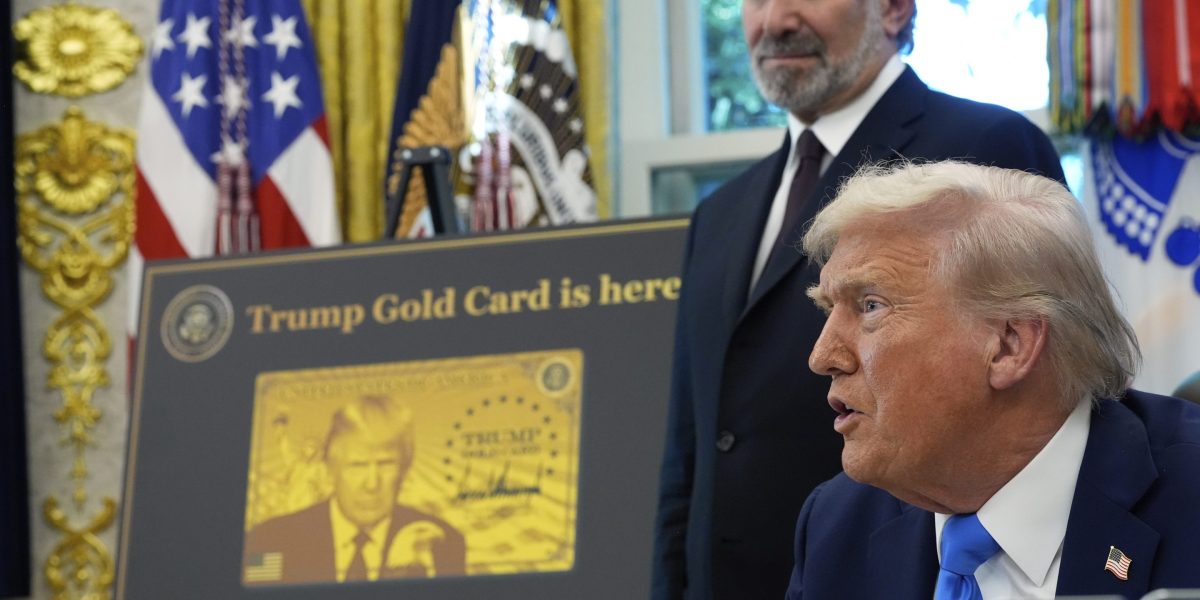
Trump also announced he will start selling a “gold card” visa with a path to U.S. citizenship for $1 million after vetting. For companies, it will cost $2 million to sponsor an employee.

The “Trump Platinum Card” will be available for a $5 million and allow foreigners to spend up to 270 days in the U.S. without being subject to U.S. taxes on non-U.S. income. Trump announced a $5 million gold card in February to replace an existing investor visa — this is now the platinum card.

Lutnick said the gold and platinum cards would replace employment-based visas that offer paths to citizenship, including for professors, scientists, artists and athletes.

Critics of H-1Bs visas who say they are used to replace American workers applauded the move. U.S. Tech Workers, an advocacy group, called it “the next best thing” to abolishing the visas altogether.

Doug Rand, a senior official at U.S. Citizenship and Immigration Services during the Biden administration, said the proposed fee increase was “ludicrously lawless.”

“This isn’t real policy — it’s fan service for immigration restrictionists,” Rand said. “Trump gets his headlines, and inflicts a jolt of panic, and doesn’t care whether this survives first contact with the courts.”

Lutnick said the H-1B fees and gold card could be introduced by the president but the platinum card needs congressional approval.

Historically, H-1B visas have been doled out through lottery. This year, Amazon was by far the top recipient of H-1B visas with more than 10,000 awarded, followed by Tata Consultancy, Microsoft, Apple and Google. Geographically, California has the highest number of H-1B workers.

Critics say H-1B spots often go to entry-level jobs, rather than senior positions with unique skill requirements. And while the program isn’t supposed to undercut U.S. wages or displace U.S. workers, critics say companies can pay less by classifying jobs at the lowest skill levels, even if the specific workers hired have more experience.

As a result, many U.S. companies find it cheaper to contract out help desks, programming and other basic tasks to consulting companies such as Wipro, Infosys, HCL Technologies and Tata in India and IBM and Cognizant in the U.S. These consulting companies hire foreign workers, often from India, and contract them out to U.S. employers looking to save money.

First lady Melania Trump, the former Melania Knauss, was granted an H-1B work visa in October 1996 to work as a model. She was born in Slovenia.

In 2024, lottery bids for the visas plunged nearly 40%, which authorities said was due to success against people who were “gaming the system” by submitting multiple, sometimes dubious, applications to unfairly increase chances of being selected.

Major technology companies that use H-1B visas sought changes after massive increases in bids left their employees and prospective hires with slimmer chances of winning the random lottery. Facing what it acknowledged was likely fraud and abuse, USCIS this year said each employee had only one shot at the lottery, whether the person had one job offer or 50.

Critics welcomed the change but said more needs to be done. The AFL-CIO wrote last year that while changes to the lottery “included some steps in the right direction,” it fell short of needed reforms. The labor group wants visas awarded to companies that pay the highest wages instead of by random lottery, a change that Trump sought during his first term in the White House.

Fortune Global Forum returns Oct. 26–27, 2025 in Riyadh. CEOs and global leaders will gather for a dynamic, invitation-only event shaping the future of business. Apply for an invitation.


Source link

Continue Reading

Business

What happens to old AI chips? They’re still put to good use and don’t depreciate that fast

Published

on


New AI chips seem to hit the market at a quicker pace as tech companies scramble to gain supremacy in the global arms race for computational power.

But that begs the question: What happens to all those older-generation chips?

The AI stock boom has lost a lot of momentum in recent weeks due, in part, to worries that so-called hyperscalers aren’t correctly accounting for the depreciation in the hoard of chips they’ve purchased to power chatbots.

Michael Burry—the investor of Big Short fame who famously predicted the 2008 housing collapse—sounded the alarm last month when he warned AI-era profits are built on “one of the most common frauds in the modern era,” namely stretching the depreciation schedule. He estimated Big Tech will understate depreciation by $176 billion between 2026 and 2028.

But according to a note last week from Alpine Macro, chip depreciation fears are overstated for three reasons.

First, analysts pointed out software advances that accompany next-generation chips can also level up older-generation processors. For example, software can improve the performance of Nvidia’s five-year-old A100 chip by two to three times compared to its initial version.

Second, Alpine said the need for older chips remains strong amid rising demand for inference, meaning when a chatbot responds to queries. In fact, inference demand will significantly outpace demand for AI training in the coming years.

“For inference, the latest hardware helps but is often not essential, so chip quantity can substitute for cutting-edge quality,” analysts wrote, adding Google is still running seven- to eight-year-old TPUs at full utilization.

Third, China continues to demonstrate “insatiable” demand for AI chips as its supply “lags the U.S. by several generations in quality and severalfold in quantity.” And even though Beijing has banned some U.S. chips, the black market will continue to serve China’s shortfalls.

Meanwhile, not all chips used in AI belong to hyperscalers. Even graphics processors contained in everyday gaming consoles could work.

A note last week from Yardeni Research pointed to “distributed AI,” which draws on unused chips in homes, crypto-mining servers, offices, universities, and data centers to act as global virtual networks.

While distributed AI can be slower than a cluster of chips housed in the same data center, its network architecture can be more resilient if a computer or a group of them fails, Yardeni added.

“Though we are unable to ascertain how many GPUs were being linked in this manner, Distributed AI is certainly an interesting area worth watching, particularly given that billions are being spent to build new, large data centers,” the note said.


Source link

Continue Reading

Business

‘I had to take 60 meetings’: Jeff Bezos says ‘the hardest thing I’ve ever done’ was raising the first million dollars of seed capital for Amazon

Published

on


Today, Amazon’s market cap is hovering around $2.38 trillion, and founder Jeff Bezos is one of the world’s richest men, worth $236.1 billion. But three decades ago, in 1995, getting the first million dollars in seed capital for Amazon was more grueling than any challenge that would follow. One year ago, at New York’s Dealbook Summit, Bezos told Andrew Ross Sorkin those early fundraising efforts were an absolute slog, with dozens of meetings with angel investors—the vast majority of which were “hard-earned no’s.”

“I had to take 60 meetings,” Bezos said, in reference to the effort required to convince angel investors to sink tens of thousands of dollars into his company. “It was the hardest thing I’ve ever done, basically.”

The structure was straightforward: Bezos said he offered 20% of Amazon for a $5 million valuation. He eventually got around 20 investors to each invest around $50,000. But out of those 60 meetings he took around that time, 40 investors said no—and those 40 “no’s” were particularly soul-crushing because before getting an answer, each back-and-forth required “multiple meetings” and substantial effort.

Bezos said he had a hard time convincing investors selling books over the internet was a good idea. “The first question was what’s the internet? Everybody wanted to know what the internet was,” Bezos recalled. Few investors had heard of the World Wide Web, let alone grasped its commercial potential.

That said, Bezos admitted brutal honesty with his potential investors may have played a role in getting so many rejections.

“I would always tell people I thought there was a 70% chance they would lose their investment,” he said. “In retrospect, I think that might have been a little naive. But I think it was true. In fact, if anything, I think I was giving myself better odds than the real odds.”

Bezos said getting those investors on board in the mid-90s was absolutely critical. “The whole enterprise could have been extinguished then,” he said.

You can watch Bezos’ full interview with Andrew Ross Sorkin below. He starts talking about this interview gauntlet for seed capital around the 33-minute mark.

This story was originally featured on Fortune.com


Source link

Continue Reading

Business

Google cofounder Sergey Brin said he was ‘spiraling’ before returning to work on Gemini

Published

on


Google cofounder Sergey Brin thought retiring from Google in 2019 would mean quietly studying physics for days on end in cafés. 

But when COVID hit soon after, he realized he may have made a mistake.

“That didn’t work because there were no more cafés,” he told students at Stanford University’s School of Engineering centennial celebration last week, Business Insider reported.

The transition from president of Google parent company Alphabet to a 40-something retiree ended up not being as smooth as he imagined, and soon after he said he was “spiraling” and “kind of not being sharp” as he stepped away from busy corporate life.

Therefore, when Google began allowing small numbers of employees back into the office, Brin tagged along and put his efforts into what would become Google’s AI model, Gemini. Despite being the world’s fourth-richest man with a net worth of $247 billion, retirement wasn’t for him, he said.

“To be able to have that technical creative outlet, I think that’s very rewarding,” Brin said. “If I’d stayed retired, I think that would’ve been a big mistake.”

By 2023, Brin was back to work in a big way, visiting the company’s office three to four times a week, the Wall Street Journalreported, working with researchers and holding weekly discussions with Google employees about new AI research. He also reportedly had a hand in some personnel decisions, like hiring. 

Skip forward to 2025 and Brin’s plans for a peaceful retirement of quiet study are out the window. In February, he made waves for an internal memo in which, despite Google’s three-day in-office policy, he recommended Google employees go into the company’s Mountain View, Calif. offices at least every weekday, and that 60 hours a week was the “sweet spot” of productivity.

Brin’s newfound efforts at work may have been necessary as OpenAI’s release of ChatGPT in 2022 caught the tech giant off guard, after it had led the field of AI research with DeepMind and Google Brain for years.

To be sure, Google for its part has been rising in the AI race. Analysts raved last month about Gemini 3, the company’s latest update to its LLM, and Google’s stock is up about 8% since its release. Meanwhile, OpenAI earlier this month declared a “code red,” its highest alert level, to improve ChatGPT. 

Brin added in the talk at Stanford that Google has an advantage in the AI arms race precisely because of the foundation it laid over years through its neural network research, its custom AI chips, and its data center infrastructure.

“Very few have that scale,” he said.


Source link

Continue Reading

Trending

Copyright © Miami Select.