Connect with us

Business

Billionaire Sara Blakely says she launched Spanx with just $5,000 from selling fax machines

Published

on


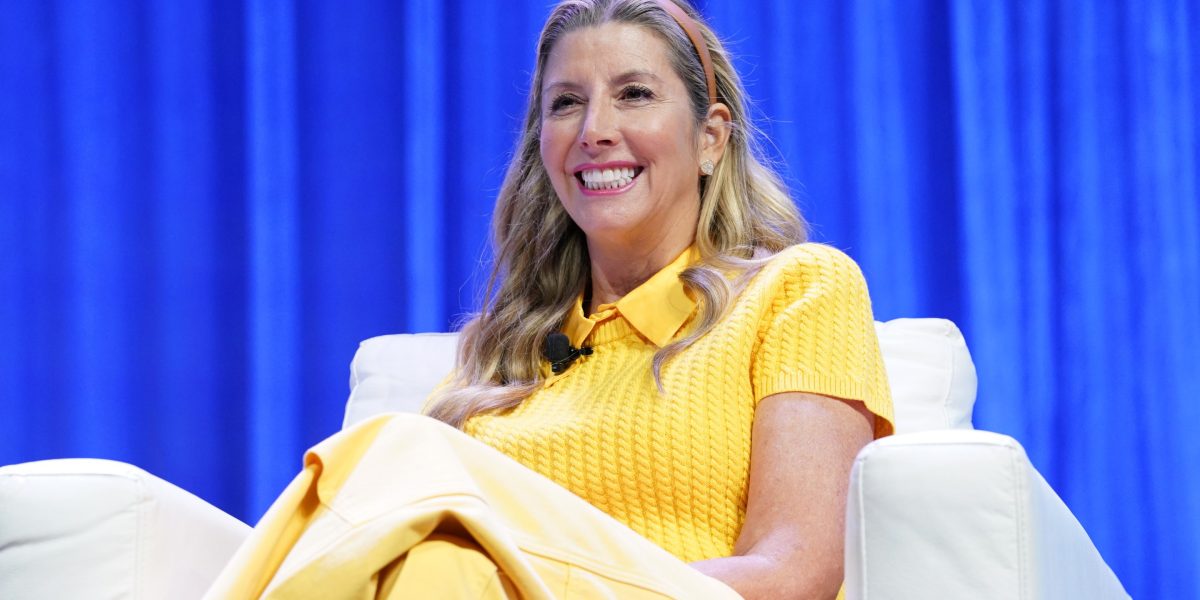
Imagine knocking on doors to sell fax machines—then, years later, becoming a billionaire. That’s exactly what Sara Blakely did. The 54-year-old founder of Spanx recently spoke with The School of Hard Knocks, a YouTube channel focused on financial literacy and entrepreneurial content, where she talked about how she built her own company—with money she saved up from years of selling fax machines, and with no outside investors.

“I started it with five grand from selling fax machines and self-funded the entire 21 years,” Blakely, currently worth an estimated $1.3 billion, said. “I sat down with myself and I was like, you wanna spend your five grand on a vacation? Or do you wanna try to bet on yourself?”

Blakely’s journey with Spanx began in 2000 when she was 29 years old, working as a national sales trainer for Danka, an office-supply company, after spending seven years selling fax machines door-to-door. Her breakthrough moment came from personal frustration: She wanted to wear white pants but couldn’t find the right undergarment to create smooth lines beneath them. Her solution—cutting the feet off control-top pantyhose—became the foundation for what would eventually become a $1.2 billion company.

Building an empire without investors

What sets Blakely apart from most entrepreneurs was her refusal to accept outside investment.

“I never had a single investor in Spanx other than me,” she said.

The Florida State University grad started Spanx while still working her day job at Danka, spending nights researching fabrics, patents, and trademark designs. She wrote her own patent application, secured the Spanx trademark for $150, and found a hosiery mill willing to produce her prototype after multiple rejections. But by disallowing outside investment, she maintained total control over her company, and its profits.

A breakthrough at Neiman Marcus

When asked about the craziest thing she did as a business owner when just starting out, Blakely said she had just secured placement for Spanx in Neiman Marcus, but after noticing she was put in a “pocket” in the store’s expansive hosiery department, she bought bins at Office Depot and placed them at every cash register throughout the store—”which is so, so not okay,” she admitted.

“Neiman Marcus has a very strict visual department, but everybody thought somebody else approved it,” she said. “So I was trying to get the product out of the sleepiest corner of the store and move it around to where the customers actually were … You do whatever it takes.”

Blakely said her unauthorized gamble paid off: Customers began buying the product “like crazy,” and by the time management discovered the placement, the CEO reportedly said, “whatever this girl is doing, let her keep doing it.”

“I always say, ask for forgiveness, not permission,” she added.

Thanks to Blakely’s efforts—and a timely inclusion on Oprah Winfrey’s “Favorite Things” list in November 2000—Spanx achieved $4 million in sales in its first year, and $10 million in its second year.

Strategic entrances and exits

In 2021, Blakely sold a majority stake in Spanx to private equity firm Blackstone at a $1.2 billion valuation, while retaining a significant equity position and becoming executive chairwoman. The deal marked the end of her 21-year run as sole owner, but bestowed her with billionaire status. (She had become a billionaire years earlier, but her net worth had dropped below $1 billion in 2020 during the pandemic).

When asked about her advice for young people aspiring to become billionaires, Blakely said it’s important to motivate yourself and not get discouraged by outside opinions and intrusive thoughts.

“In today’s world, ideas are the most vulnerable in the moment you have them,” she said. “I waited a year before I told any friends or family what I was working on, and that’s because I didn’t want ego to have to get involved too early. My family was like, ‘Sara, if it’s such a good idea, why hasn’t anybody already done it? Even if this is a good idea, the big guys will knock you off in six months, and you’ve spent your life savings on it.’ Had I heard those things the moment that I had the idea, I would probably still be selling fax machines.”

Fortune Global Forum returns Oct. 26–27, 2025 in Riyadh. CEOs and global leaders will gather for a dynamic, invitation-only event shaping the future of business. Apply for an invitation.


Source link

Continue Reading

Business

Bittensor just halved its supply. Here’s what that means

Published

on


Early on Monday, the supply of new cryptocurrency tied to Bittensor—a decentralized network of AI projects—dropped by half. The halving was the first the currency has experienced and came about by design, reflecting how Bittensor shares the same anti-inflationary architecture as Bitcoin. The event also serves a milestone for one of the most novel and ambitious cryptocurrencies to launch in years.

Currently, Bittensor has a market capitalization of $2.7 billion, according to the crypto analytics site CoinGecko. That pales in comparison to Bitcoin but is number 50 on the list of most popular cryptocurrencies. It also enjoys the backing of influential crypto billionaire Barry Silbert. At a time when AI is dominating the economy and the political discourse, Bittensor offers the promise of a decentralized alternative to Big Tech—provided it can keep picking up traction in the crypto world and beyond, and if its price holds up following the new drop in supply.

Here’s an overview of exactly what Bittensor is, who’s betting on its success, and what some crypto prognosticators say will come next after its halving:

What is Bittensor?

Founded by Jacob Steeves, a former Google engineer, in 2019, Bittensor is designed to repurpose the mechanics of Bitcoin for AI. In the world of Bitcoin, owners of fleets of computer servers leverage their processing power to process and secure cryptocurrency transactions. This is called Bitcoin mining.

Similarly, Steeves devised a system where fleets of computers compete to process AI computations. In exchange for their processing power, these “miners” receive Bittensor’s cryptocurrency, TAO. In aggregate, Bittensor is like a decentralized server farm for AI. “How did we create a supercomputer that is bigger than any government or corporation can create with a centralized entity?” Steeves said to Fortune in 2024.

Who’s betting on Bittensor?

Bittensor isn’t the most easily understood tech, but the protocol has had some serious backers. In 2024, the crypto venture capitalist Polychain held around $200 million of the cryptocurrency, another crypto VC Dao5 held $50 million, and the crypto conglomerate Digital Currency Group had around $100 million

Barry Silbert, the billionaire founder of Digital Currency Group, is such a believer in Bittensor that he’s founded his own startup called Yuma that’s dedicated to the cryptocurrency. “It is the thing that I’ve gotten most excited about since Bitcoin,” he said.

When did Bittensor halve and what will come next?

On Monday at 8:30 a.m. New York time, Bittensor reduced the amount of daily tokens it issues from 7,200 to 3,600. Like Bitcoin, the supply of Bittensor’s cryptocurrency is capped at 21 million.

In a research note, analysts at Grayscale, a crypto ETF issuer and a subsidiary of Barry Silbert’s Digital Currency Group, said that the halving could be a “positive catalyst for price.” Just a week before, the ETF issuer announced that trading in the U.S. had begun for a vehicle that gives investors exposure to Bittensor.

Sami Kassab, managing partner at Unsupervised Capital, a hedge fund dedicated to Bittensor, was similarly optimistic. “Halvings aren’t complicated. Historically, halvings have been bullish because there’s simply less inventory hitting the market, “ he said. “The same logic applies to TAO.”

Still, over the past 24 hours, the price of Bittensor’s cryptocurrency has dropped about TK% to $TK. That doesn’t mean the halving was a bust since the market often prices in such events ahead of time and, in the case Bitcoin, has often spurred subsequent booms. When Bitcoin last halved in April 2024, its price hovered around $65,000 shortly afterwards. But, by the end of the year, the world’s largest cryptocurrency had rocketed to above $100,000. 

This is Bittensor’s first halving. Its next will follow in late 2029, according to current projections.


Source link

Continue Reading

Business

Airbnb CEO Brian Chesky says he went to ‘night school’ for an hour every day with Barack Obama

Published

on


To build Airbnb into a billion-dollar business, Brian Chesky sometimes worked gruesome 100-hour weeks. However, on top of that, he would regularly carve out time to pick the brains of one of the most important people in the world: former President Barack Obama.

“At one point in 2018, we had a standing one-hour call every week, and I basically had my day job during the day, and then I had my night school with the former president, where I would get these assignments, but it changed my life,” Chesky has just revealed.

Speaking on Michelle Obama’s podcast IMO, he added: “I just was really shameless about reaching out to him, asking for advice, asking for mentorship, and he would meet with me, and he’d give me advice.” 

He recalled the 44th president of the United States advised him to avoid becoming like other leaders who are effectively “self-driving cars” without intention. Instead, he should always be thinking long and hard about relationships—with his friends, his success, and his company—and be more active with the impact he wants to make.

Fortune reached out to Chesky and former President Obama for comment. 

Finding a mentor in a president

After building Airbnb into a household name, Chesky faced a problem: He still wasn’t satisfied—nor necessarily happy. 

“The thing about being very successful in tech and making a lot of money and all this is no one ever told me how lonely it would become,” Chesky said to Michelle and Robinson. “And I started realizing, well, it’s weird, I had old friends that were middle-class, and I’ll be honest, a lot of them seemed happier than me at that point in my life.”

And he credits former President Obama with helping him realize that how he was feeling was completely normal: that “the more success you get, the more isolated you get.” 

“People dream of success, but what they don’t realize is a lot of with success comes disconnection to your past, to yourself, to your friends, and I think a lot of what I’ve tried to do the last handful of years is to reconnect, to not live a life of isolation,” Chesky said. 

Obama’s wisdom to Chesky was simple: He needed to be more hands-on with his relationships. That means instead of texting or calling a close friend once a year, stay constantly connected with them. Chesky said it’s a lesson he translated into his work as the leader of Airbnb.

“He told me something that I’ll never forget,” Chesky said. “He said you should institutionalize your intentions, so that even when you’re a public company, you can make sure not to compromise your vision. And what he meant by that, I think, was that you should be more thoughtful about what you’re making, why you’re making it, and the impact of what you’re making is on people.”

Chesky admitted Obama’s advice has made a “really, really big difference” at Airbnb. And while it may sound odd for a former President to effectively give a CEO homework, it’s something nothing new for Obama, who spent over a decade in the classroom teaching constitutional law at the University of Chicago before his jump into the political arena.

The ‘life hack’ to find success: Reach out to an old friend

The lessons learned from Chesky and President Obama’s relationship on finding success can be summarized into two simple steps: Seek out mentors and have friends outside of social media.

“For young people, the number one thing they need to learn how to do is how to learn,” Chesky said. “And some of the best ways to learn are from other people, and some of the best ways to learn from people are, again, in the real world.”

Moreover, rekindling old relationships is among what Chesky calls a “simple life hack” to make life happy.

“I think the vast majority of people, if they reach out to someone, someone will want to help them,” he added. “They reach out to an old friend, the old friend will want to reach back out to them, and that is the path for reconnection. It’s a path for relationships, and it’s a path for purpose.”

A version of this story originally published on Fortune.com on May 27, 2025.

More on career advice:

Join us at the Fortune Workplace Innovation Summit May 19–20, 2026, in Atlanta. The next era of workplace innovation is here—and the old playbook is being rewritten. At this exclusive, high-energy event, the world’s most innovative leaders will convene to explore how AI, humanity, and strategy converge to redefine, again, the future of work. Register now.


Source link

Continue Reading

Business

Why Birkin bags are a better investment than gold, according to an Hermès expert

Published

on


The value of a Birkin bag skyrockets from the moment it leaves the Hermès store.

That’s partly because not just any regular person can buy the bag. Only customers with a sizable purchase history at the brand are offered the opportunity to buy a “quota bag,” such as a Birkin or a Kelly.

But even Hermès’ most loyal shoppers don’t get to choose the exact Birkin model they want. The brand allows boutiques to purchase a select number of Birkins per season, and the style of the bags is rarely known ahead of time, according to Sotheby’s. The notoriously opaque process, nicknamed the Hermès Game, has only generated more desire for the bag—and even became the subject of a class-action lawsuit.

Looking to sidestep the Hermès Game and score the bag their heart desires, handbag enthusiasts shell out tens of thousands of dollars on the resale market. Thanks to its exclusivity and its status as an investment piece, a Birkin bag’s value is much higher than its sticker price of around $12,000.

“The resale value of particularly the Birkin and Kelly bags over the past 10 years has outpaced gold,” James Firestein, founder of luxury resale and authentication platform OpenLuxury, told Fortune.

Prior to starting his own company in 2022, Firestein spent a decade as a luxury authenticator, including two years as the director of authentication at Rebag. Over the course of his career, Firestein has seen a “perfect storm” of factors “bolster this wild ride upward.”

“I know several instances where people have doubled their money based on buying it 10 years ago, and reselling it today in pristine condition,” he said.

‘Like buying a Picasso’

For some buyers, a Birkin bag isn’t a high-end piece of arm candy, but a worthy investment. Of the Birkin owners he has worked with, Firestein estimates 75% actually use the bags, while the remaining 25% keep them in storage as investments. 

“It’s similar to buying a Piccaso and holding it in your home, because you can look at it, you can enjoy it,” Firestein said. “But then you ship it off in a couple of years and trade it for something else.”

The value of an Hermès bag can increase dramatically over time, Firestein said, depending on its color, material, and condition. Secondhand demand is so high partly because the resale market offers shoppers more options than the Hermès store, where customers are allowed one quota bag per year, and rarely get to choose the exact model they want. 

Firestein said the steepest price increase he has seen was a Black Togo 30 Birkin that doubled in value in five years. But price increases can be driven by trend cycles and changing demand—so it can be a “gamble,” he said.

“I wouldn’t say jump in with both feet at this point,” he said. “But if you got it in 2012, and you sold in 2019, that’s different.”

The Birkin legend

Before its handbags were spotted on the arms of Jane Birkin and Cardi B, Paris-based Hermès began in 1837 as a maker of horse harnesses. Over the course of six generations, it became a ready-to-wear and leather-goods powerhouse renowned for its craftsmanship.

As for the iconic Birkin bag, here’s how the legend goes: In 1984, the late actress Jane Birkin was seated next to Jean-Louis Dumas, executive chairman of Hermès at the time, on a flight from Paris to London. Birkin said she couldn’t find a bag that suited her needs as a young mother—so she sketched her dream design on a sick bag, according to CNN. Dumas infused the bag with equestrian elements, giving it the signature Hermès look.

“It was more of a subtle old-money brand,” Firestein said of Hermès’ status prior to the Birkin craze.

The Birkin slowly reached “it bag” status thanks to being spotted on the arm of many celebrities in the 1990s and 2000s—and on Sex and the City. But it wasn’t until the 2010s, when the online resale market reached the masses, that the hype went stratospheric.

Firestein credits e-commerce with enabling shoppers to buy a secondhand Hermès bag from any part of the world. Meanwhile, online forums allowed people to share the secrets of the Hermès Game once exclusive to the 1%. The Birkin became a collector’s item over time—and underground demand continues to fuel the resale market.

What’s in the bag?

Some people may desire Birkin bags because they’re so hard to get—but fans also celebrate the brand’s artisan manufacturing and 200-year legacy of craftsmanship.

Unlike brands owned by LVMH and Kering, which often share factories, Hermès only uses its own factories, says Firestein. Conglomerate-owned brands like Balenciaga, Gucci, and Saint Laurent also tend to use more mass-market materials that are cheaper and easier to get, Firestein explains.

“Their leather factories are only Hermès affiliates, and they only create Hermès leathers,” he said. “So you’re buying into part of that heritage, but then you’re also buying into a higher-quality material that they’ve been using for many, many years.”

Compared to other brands, Hermès’ quality is “top-tier,” Firestein said. And though he works with 43 different luxury brands, he admits to having an affinity for Hermès bags.

“They’re made to last for generations,” Firestein said. “And they’re just beautiful luxury objects at the end of the day—almost like sculptures.”

A version of this story published on Fortune.com on March 27, 2024.

Join us at the Fortune Workplace Innovation Summit May 19–20, 2026, in Atlanta. The next era of workplace innovation is here—and the old playbook is being rewritten. At this exclusive, high-energy event, the world’s most innovative leaders will convene to explore how AI, humanity, and strategy converge to redefine, again, the future of work. Register now.


Source link

Continue Reading

Trending

Copyright © Miami Select.