Connect with us

Business

Trump administration weights using tariff income to bail out farmers—who have been hurt by tariffs

Published

on


President Donald Trump is weighing a bailout program for farmers that would use tariff income, according to Agriculture Secretary Brooke Rollins. The U.S. agricultural industry is preparing for a harvest season that will likely be characterized by dwindling export opportunities and more expensive tools and equipment as a result of the administration’s aggressive tariff policy.

“There may be circumstances under which we will be very seriously looking to and announcing a package soon,” Rollins told the Financial Times on Wednesday, adding that using tariff income to finance the package would be “absolutely a potential.”

In April, Rollins announced the Trump administration would consider providing aid to farmers after trade groups responded critically to tariff plans.

The administration’s trade policies have already impacted the price of necessary tools for farmers, including a more-than-15% tariff rate on self-propelled machines like tractors and nearly 25% on herbicides and some pesticides, in part because of trade disputes with Canada, according to August data from the North Dakota State University Agricultural Trade Monitor. Agricultural machinery manufacturer John Deere has warned of the adverse impact of tariffs on its own business, including a $600 million hit from the levies in fiscal 2025. 

Retaliatory tariffs from China as a result of the trade war has also hobbled soybean farmers, who previously relied on China for more than 20% of its soybean exports. Chinese tariffs on the crop reached 34%, making U.S.-exported soybeans more expensive to Chinese importers than beans from Brazil. This effectively prices the U.S. out of the Chinese soybean market ahead of the autumn harvest season, according to the American Soybean Association.

“Retaliatory tariffs have blunted U.S. soybean growers’ advantage, restricting their access to the very market where demand is growing fastest,” the trade group said in an August report.

To be sure, not everyone in the agriculture industry is sour on Trump’s trade policies. Some farmers—such as shrimp farmers in Indiana—are celebrating the levies for blocking cheap foreign competitors from gaining U.S. market share. 

The U.S. Department of Agriculture has laid the blame of today’s agriculture struggles on former President Joe Biden, saying his administration inherited a good farm economy, but “erased” Trump’s efforts to keep interest rates low and open new markets, resulting in a $50 billion agricultural trade deficit. 

Agricultural exports reached an all-time high in 2022 under the Biden administration, according to USDA data. But despite the record, in 2023, imports exceeded exports by $21 billion.

The USDA did not provide Fortune any additional information about what a potential farmer bailout program would look like.

“We are constantly assessing the farm economy and exploring the need for further assistance but have not made a determination if an additional program is needed at this time,” a USDA spokesperson told Fortune in a statement.

How will a potential bailout impact farmers?

A bailout from the Trump administration may help to plug the economic holes left by trade dispute fallouts, but long-term erosion in certain agricultural markets will likely remain, according to Wendong Zhang, an associate professor of applied economics and policy at Cornell University’s SC Johnson School of Business.

“It will compensate for the immediate economic losses due to tariffs, but it doesn’t necessarily improve the long-term competitiveness of agriculture on the global stage,” Zhang told Fortune. “This doesn’t help address the reliability of the U.S. in using these policies on the global stage as well.”

A similar scenario played out in 2019, following the slew of tariffs Trump outlined in his first term, Zhang said. Between mid-2018 and 2019, U.S. farmers lost $27 billion in U.S. agricultural exports, according to a 2022 report from the USDA. As a result, Trump gave U.S. farmers $28 billion in subsidies, effectively making those losses whole, Zhang said.

However, economic impacts lingered. While the U.S. regained some of China’s soybean market share from Brazil, that market share remained below pre-retaliatory tariff levels one year after a trade deal was made, according to the USDA report.

Despite damage to the long-term health of the markets, farmers—a loyal constituency of Trump’s—have historically been supportive of tariffs and administrative aid, seeing the potential for long-term financial gain. According to a 2019 study from Zhang and his colleagues, more than half of farmers in Minnesota, Iowa, and Illinois were somewhat or strongly supportive of Trump’s tariffs on Chinese products, despite 76% of them recognizing U.S. farmers would take a hit from the levies. More than 60% admitted U.S. agriculture would lose markets as a result of the tariffs.

These farmers will likely maintain their attitudes about the Trump administration, but the impact of this round of tariffs will be harder to predict and parse through, Zhang explained. Unlike Trump’s first term, when the administration primarily went after trade with China, Trump has imposed tariffs on numerous countries, further complicating the U.S.’ place in global agricultural export markets.

“There’s so many players and so many potential products, and there’s so many moving parts that…it’s really hard to to really know which ones will be affected,” Zhang said.

Fortune Global Forum returns Oct. 26–27, 2025 in Riyadh. CEOs and global leaders will gather for a dynamic, invitation-only event shaping the future of business. Apply for an invitation.


Source link

Continue Reading

Business

A NIMBY revolt is turning voters in Republican strongholds against the AI data-center boom

Published

on


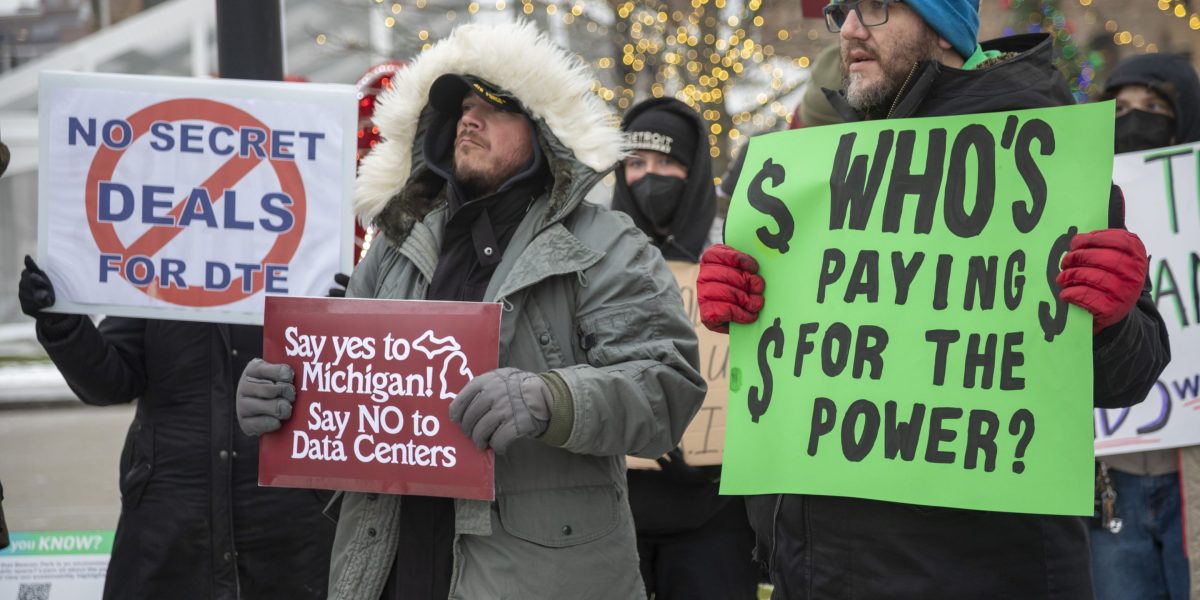
Silicon Valley and Washington sees data centers as the backbone of America’s AI future. Residents who live next to them see giant, humming boxes that throw diesel exhaust into the air, drive up energy costs, and steamroll the look and feel of their neighborhoods—“a plague,” as Virginian anti-data center activist Elena Schlossberg put it.

“If you live near a data center that’s being powered by these gas turbines, you simply cannot imagine living there,” she said. You can “hear the noise” in your home, added Schlossberg—who got into the fight a decade ago while trying, unsuccessfully, to stop Facebook from putting a data center next to her property. 

Virginia has long been the biggest data center hub of not just the country but the world, with northern Virginia alone hosting 13% of the globe’s data centers in 2023, according to a government report. And for just as long, residents have been locked into battles over what that footprint means for their communities.

Now, Schlossberg is leading a Virginia nonprofit group, Save Prince William County, to fight against the encroachment of even more data centers to power the AI boom. Data center power demand is expected to rise five-fold over the next decade, Deloitteprojects; reaching 176 gigawatts, the same amount as Australia and the United Kingdom’s entire power grids combined.

AI infrastructure builders, and the tech giants that plan to rely on the future data centers, argue that they’re essential to unlocking AI’s economic benefits. But in some of the states slated to house these projects, many of them politically purple-ish or even red—Virginia, Indiana, Ohio, Pennsylvania—voters are revolting, often successfully keeping them out of their neighborhoods. Indeed, in elections held last month, opposition to data centers helped tip elections in Democrats’ favor in Virginia and Republican-leaning Georgia.

“Folks realize they’re getting duped,” said Kerwin Olson, executive director of the Citizens Action Coalition, an environmental advocacy coalition based in Indiana. “It’s not just something they hear on Fox News or MSNBC anymore. It’s happening in their own backyard.”

Big Tech companies, Olson added, are showing up at local planning commissions and drainage boards asking for “huge giveaways”— tax abatements, zoning variances, special exceptions —”all to build a $3 billion box that creates maybe 30 jobs.”

“So they’re like, what’s in it for us?” Olson asked. 

Upcoming political battles

The first signs of what could be a broader political reckoning are appearing at the county level. In Prince William County—home to the fight over a proposed 2,000-acre “Digital Gateway” development near the Manassas battlefield—data centers have already forced recalls, resignations, and primary defeats of elected officials, Schlossberg said. The issue has become so radioactive that candidates in both parties now treat opposition to data-center expansion as a prerequisite for running, she added.

“It’s never been red versus blue,” Schlossberg said. “It’s people who live here versus people who want to industrialize where we live.”

That county could be a canary in the coalmine for what comes next, as Democrats and Republicans approach critical midterm congressional elections in 2026. Across key swing states, activists say the next wave of AI-driven projects will collide with a public that is far more organized and hostile than it was even two years ago. 

That tension is beginning to creep into politics. In Indiana, legislators publicly tout the state’s new data-center incentives while privately warning counties that the projects are not without tradeoffs. In Virginia, candidates now get asked—at libraries, at farmer’s markets, even at high school football games—whether they would support a temporary moratorium.

Olson said his group has been “buried” in calls from Hoosiers in every corner of the state—red, blue, rural, suburban—asking for help deciphering tax abatements and utility filings. “I’ve worked on energy issues for decades,” he said. “I have never seen anything like the scale of anger over this.”

When voters see those consequences firsthand, Olson said, they stop caring about geopolitical talking points. “You can tell people this is about beating China,” he said. But when their bill goes up, and their kids are sleeping in basements with headphones on because of the noise, they’re not thinking about China. 

At the heart of the backlash is a basic economic question that data-center backers haven’t convincingly answered: Why should the public subsidize infrastructure that serves some of the world’s richest companies?

Indiana’s first filing under its new “80/20” law—touted as a safeguard to make data centers pay most of the costs—still leaves ratepayers actually footing nearly 40% of the bill, Olson said. The organization he runs, Citizens Action Coalition, did an analysis that revealed that Hoosier households paid 17.5% more in utility bills in 2025 than the previous year. In Virginia, residents fear they will ultimately finance the transmission lines and new generation needed to serve hyperscale facilities.

“The public utility model was always a social contract,” Schlossberg said. “The data-center industry blew that up.”

In many ways, the backlash boils down to a trust problem. Residents don’t trust Big Tech, seeing the hyperscalers as being like “robber barons at the turn of the century” but with unprecedented demands for land, water, and power. Olson pointed to NDAs, closed-door negotiations, and local officials dining with tech consultants as signs that decisions are being made over communities’ heads and without local voters’ input. Layered onto that is a broader skepticism of AI itself: Many voters aren’t convinced they should remake their towns for what still feels like an unproven or overhyped technology.

“It’s like the Gilded Age, part two,” Olson said. “Only bigger.”


Source link

Continue Reading

Business

The job market is so bad, people in their 40s are resorting to going back to school instead of looking for work

Published

on


This year’s job market has been bleak, to say the least. Layoffs hit the highest level in 14 years, job openings are barely budging, and quits figures are plummeting. It’s no wonder people feel stuck and discouraged—especially as many candidates have been on the job hunt for a year.

But some mid-career professionals are working with the cards they’ve been dealt by going back to school. Many are turning to data analytics, cybersecurity, AI-focused courses, health care, MBA programs, or trade certifications for an “immediate impact on their careers,” Metaintro CEO Lacey Kaelani told Fortune.

Metaintro is a job-search engine with 2 million active users that runs on open-source data processing more than 600 million jobs in real time.

“We absolutely see this trend [of adults going back to school] accelerating,” Kaelani said. “In combination with layoffs over the recent years plus the rise of required AI skills, experience is no longer enough.”

Kelsey Szamet, an employment attorney with Kingsley Szamet Employment Lawyers, said she’s noticed people over the age of 40 to go back to grad school or earn certifications.

While it’s not necessarily a completely new phenomenon, it’s becoming more frequently now that the job market is the pits. 

Still, Szamet he sees “very consistent” reasons for people considering higher education at a later stage in life. Some believe they’ve “plateaued” in their career and education is the only option. Others have been affected by layoffs, and there are some “who have simply become burned out with work and want a meaningful profession,” she told Fortune

“Then, too, come life circumstances. Some people have fewer responsibilities, better financial security, or a sense they will never make a change if they put it off now,” she said, adding she’s seeing more people pivot out of “dying industries,” those whose salaries have stagnated, or those who have job-security fears.  

According to Hanover Research, the top master’s degrees on the rise include artificial intelligence, mechatronics, robotics, automation engineering, research methodology, quantitative methods, as well as construction engineering technology. 

The cost of going back to school

Sometimes going back to school can also just feel like delaying the inevitable: student loans and other living costs. 

While grad school can certainly offer the opportunity to level-up your career once you’ve completed a program, it comes with financial and personal sacrifices, like time. According to the National Center for Education Statistics, one year of grad school, on average, costs about $43,000 in tuition. That’s nearly 70% the average salary in the U.S.

“Going to school can be very beneficial, but it can be very costly too,” Szamet said. And, when people are older and going back to school, they should consider “the cost of education and how stressful it can be to juggle work and family responsibilities with education.” Overall, “one ought to assess if it will be a good investment,” she added. 

That’s why it’s important to do your homework. Some degree programs have a better return-on-investment than others. According to an ROI analysis by the Foundation for Research on Equal Opportunity, the median master’s degree increases lifetime earnings by $83,000, but some master’s degrees are worth more than $1 million. Computer science, engineering, and nursing are some of the highest-ROI master’s programs, with average ROIs of about $500,000, according to the Foundation for Research on Equal Opportunity analysis. 

Still, 40% of master’s degrees actually “have no net financial value at all,” according to the report.  

“In today’s job market, going back to school only works when it’s strategic and targeted [like a] specific technical certification in a high-demand field), but fails when it’s vague,” Kaelani emphasized. “It’s no longer ‘more education equals a better job.’”

This story was originally featured on Fortune.com


Source link

Continue Reading

Business

Female libido pill gets expanded approval for menopause by FDA

Published

on


U.S. health officials have expanded approval of a much-debated drug aimed at boosting female libido, saying the once-a-day pill can now be taken by postmenopausal women up to 65 years old.

The announcement Monday from the Food and Drug Administration broadens the drug’s use to older women who have gone through menopause. The pill, Addyi, was first approved 10 years ago for premenopausal women who report emotional stress due to low sex drive.

Addyi, marketed by Sprout Pharmaceuticals, was initially expected to become a blockbuster drug, filling an important niche in women’s health. But the drug came with unpleasant side effects including dizziness and nausea, and it carries a safety warning about the dangers of combining it with alcohol.

The boxed warning cautions that drinking while consuming the pill can cause dangerously low blood pressure and fainting. If patients have several drinks, the label recommends waiting a few hours before taking the drug, or skipping one dose.

Sales of Addyi, which acts on brain chemicals that affect mood and appetite, fell short of Wall Street’s initial expectations. In 2019, the FDA approved a second drug for low female libido, an on-demand injection that acts on a different set of neurological chemicals.

Sprout CEO Cindy Eckert said in a statement the approval “reflects a decade of persistent work with the FDA to fundamentally change how women’s sexual health is understood and prioritized.” The company, based in Raleigh, North Carolina, announced the FDA update in a press release Monday.

The medical condition for a troublingly low sexual appetite, called hypoactive sexual desire disorder, has been recognized since the 1990s and is thought to affect a significant portion of American women, according to surveys. After the blockbuster success of Viagra for men in the 1990s, drugmakers began pouring money into research and potential therapies for sexual dysfunction in women.

But diagnosing the condition is complicated because of how many factors can affect libido, especially after menopause, when falling hormone levels trigger a number of biological changes and medical symptoms. Doctors are supposed to rule out a number of other issues, including relationship problems, medical conditions, depression and other mental disorders, before prescribing medication.

The diagnosis is not universally accepted, and some psychologists argue that low sex drive should not be considered a medical problem.

The FDA rejected Addyi twice prior to its 2015 approval, citing the drug’s modest effectiveness and worrisome side effects. The approval came after a lobbying campaign by the company and its supporters, Even the Score, which framed the lack of options for female libido as a women’s rights issue.

___

This story has been updated to correct the age range of the FDA approval update. The agency approved the drug for postmenopausal women up to age 65, not older than 65.

___

The Associated Press Health and Science Department receives support from the Howard Hughes Medical Institute’s Department of Science Education and the Robert Wood Johnson Foundation. The AP is solely responsible for all content.


Source link

Continue Reading

Trending

Copyright © Miami Select.