
Fashion
Mandarina Duck targets €33.5 million revenue in 2025 as e-tail grows to include Canada


Translated by
Nicola Mira
Published
September 18, 2025
Italian handbag and luggage brand Mandarina Duck, owned by Korean group E-Land, is steering a steady course through a turbulent 2025. The brand is forecasting a revenue of €33.5 million for fiscal 2025, and expects to keep growing next year across all distribution channels, from direct retail to wholesale and e-tail.
Mandarina Duck’s retail footprint currently extends to approximately 600 retailers worldwide via the wholesale channel, 10 monobrand stores in Italy, two corners at El Corte Inglés department stores in Spain, the outlet stores at La Roca Village and Fidenza Village, as well as the recently revamped e-shop. The brand has told FashionNetwork.com the latter will soon be operational in a new market, Canada.
Mandarina Duck’s most recent physical stores feature the interiors concept first introduced with the store at Bergamo airport in Italy. It is the same adopted by the brand for the restyling of its stores in Venice, Florence Por Santa Maria and Bergamo, as well as the recent opening in Verona. A Mandarina Duck spokesperson told FashionNetwork.com that the concept “aims to standardise the brand’s retail image across all stores, reflecting Mandarina Duck’s values of movement, discovery and innovation, and offering customers an immersive, consistent in-store experience.” Mandarina Duck added that “the plan is to gradually upgrade all existing stores with the new look. The brand’s new spaces, whether physical or digital, will no longer be mere purchasing venues, but places of discovery and inspiration, forging a relationship with an increasingly demanding, connected audience.”

In 2025, monobrand stores are set to account for 30% of the revenue of Mandarina Duck, a brand inspired by travelling and the mandarin duck’s colourful plumage, with the wholesale channel accounting for 60%, e-tail for 5%, and other channels for the remaining 5%.
In terms of Mandarina Duck’s wholesale revenue, exports account for 59% of the total, and no new market openings are currently planned. Online sales outside Italy account for approximately 60% of the brand’s e-tail revenue, which is growing vigorously in both EU and non-EU markets.
In the campaign for the Fall/Winter 2025-26 collection, whose first drop is now available online and at physical stores, Mandarina Duck has paid tribute to Rotterdam’s architecture through a narrative focused on smart travelling with a light-hearted, stylish and insightful spirit. Piet Blom’s celebrated Cube Houses – a radical housing project developed in the 1970s by one of the Netherlands’ master architects – are an invitation to travel and make discoveries with a fun mood. The Cube Houses, conceived as a ‘house forest,’ act as inspiration for journeys in which adventure blends with leisure, and where choosing a hostel over a hotel places the unexpected wonder of human connections ahead of luxury. The campaign was devised by Mandarina Duck to showcase Rotterdam as a stage on which innovation and tradition converge, through the elegance of Erasmusbrug, known as ‘the swan,’ a bridge that symbolises the city’s urban charm, and the MVRDV-designed Depot, a section of the Boijmans Van Beuningen Museum, the world’s first art repository open to the public and an art curation benchmark.

The Fall/Winter 2025-26 collection includes the new Hunter Velvet model, a fresh interpretation of the Hunter design featuring soft velvet textures, available in four colours. Hunter Velvet is designed for city exploration, adding a chic touch to the line’s urban dimension. The Y-Lite line is made for escapades and city breaks, and features ultra-light materials and dynamic designs. New this season are the Smartduck line, designed for modern and stylish travel with its pared-down, functional shapes and useful compartments, and the Skyduck line, tough and lightweight, while a new version is available for the well-established Eco Coated line, made with 100% recycled polyester fabrics.
Copyright © 2025 FashionNetwork.com All rights reserved.
Fashion
Second-hand retailer Cash Converters strengthens Portugal presence with new shop at UBBO Amadora
Published
December 16, 2025
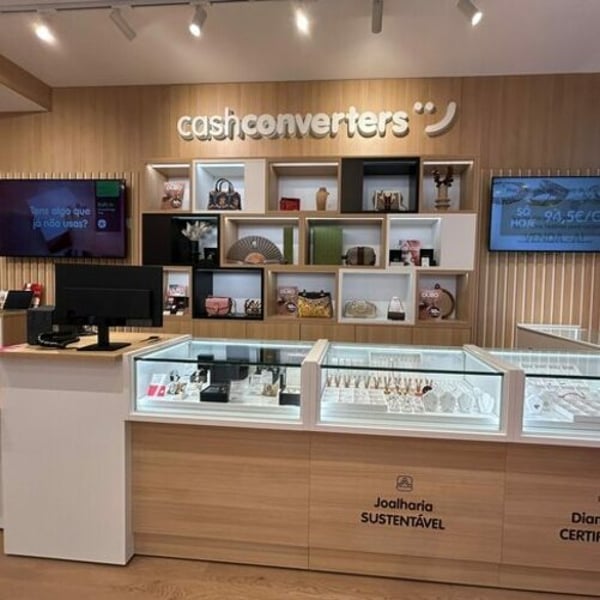
Australian multinational Cash Converters, a leading brand in the purchase and sale of second-hand items, founded in Perth, Australia, in 1984 by Brian Cumins and present in Portugal since 2003, has just opened a new store at the UBBO shopping centre in Amadora, the company said in a statement, adding that this new unit covers 72 square metres and features “an updated and distinctive concept,” broadening categories and focusing on “unique pieces, collectors’ items and discontinued products given a new lease of life”. This is the sixth opening in the Portuguese market.
The main highlights are second-hand luxury items, “such as watches, bags, and jewellery from leading brands, as well as a space dedicated to the exclusive ‘Jewellery with a Soul’ collection, created by Cash Converters from 100% recycled gold and designed for those who value pieces with history and identity. Customers will also find IT, TV and audio equipment, consoles and video games, photography and video, sports, DIY and small domestic appliances,” the statement notes.
According to Francisco Parra, CEO of Cash Converters in Spain and Portugal: “The Portuguese market has shown a clear commitment to buying and selling second-hand products, and the results bear this out. In 2025, the average monthly number of items purchased in our stores in Portugal grew by 9% on the previous year, while the average ticket increased by 12%. These indicators reinforce our expansion strategy in the country for the coming years, with the aim of bringing more and more people closer to the circular economy through quality products.”

The arrival at UBBO of the Australian chain specialising in the purchase and sale of second-hand items, which operates brick-and-mortar stores in Lisbon and Porto as well as through its official online store, “marks another step towards the democratisation of sustainable consumption in Portugal and the valuing of objects that deserve to continue to be used and appreciated,” the note stresses, adding that Cash Converters “now has 83 stores across the Iberian Peninsula, reinforcing its expansion strategy based on proximity and convenience.”
In Portugal, the brand currently has physical stores in Lisbon and Porto, located at Rua Pinheiro Chagas, 101B (near Lisbon’s El Corte Inglés), Rua José Rodrigues Migueis, 1, and Rua António Pereira Carrilho, 5 (central Lisbon); Rua Quinta do Paizinho, 2, Alfragide/Carnaxide, and at the UBBO Shopping Centre, Pontinha (Greater Lisbon); and Rua de Fernandes Tomás, 432 (downtown Porto).

This article is an automatic translation.
Click here to read the original article.
Copyright © 2025 FashionNetwork.com All rights reserved.



Michelle and Barack Obama Had Plans With the Reiners That Fateful Night

Second-hand retailer Cash Converters strengthens Portugal presence with new shop at UBBO Amadora

New poll shows Byron Donalds maintains front-runner status in GOP Primary
-

 Politics8 years ago
Congress rolls out ‘Better Deal,’ new economic agenda
-
Entertainment8 years ago
New Season 8 Walking Dead trailer flashes forward in time
-
Politics8 years ago
Poll: Virginia governor’s race in dead heat
-
Entertainment8 years ago
The final 6 ‘Game of Thrones’ episodes might feel like a full season
-
Entertainment8 years ago
Meet Superman’s grandfather in new trailer for Krypton
-
Politics8 years ago
Illinois’ financial crisis could bring the state to a halt
-
Business8 years ago
6 Stunning new co-working spaces around the globe
-
Tech8 years ago
Hulu hires Google marketing veteran Kelly Campbell as CMO