Connect with us

Business

Honeywell, Caterpillar CTOs say AI can ease labor, skills gaps in manufacturing
Published

on


Honeywell says that 20% of the company’s software code is written by GitHub Copilot and other AI-assistant coding tools. But, does that mean that the industrial giant’s embrace of AI has corresponded with a 20% reduction in that team’s workforce?

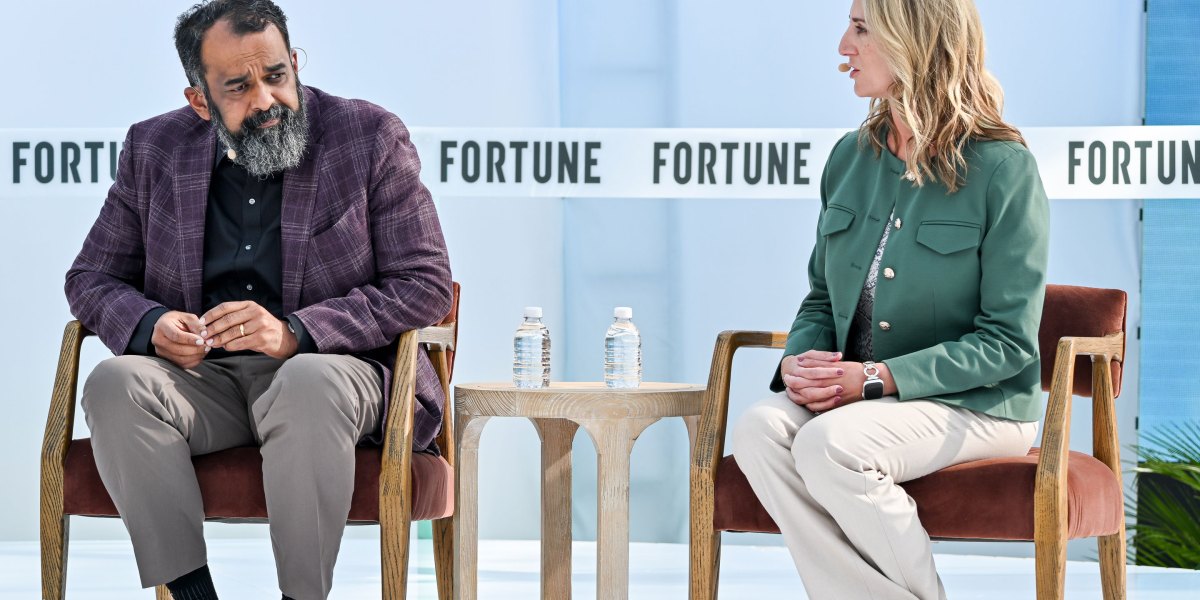
No, according to Suresh Venkatarayalu, the chief technology officer and president of the company’s software-focused division, Honeywell Connected Enterprise. “What has changed is the type of developer skill sets,” said Venkatarayalu at the Fortune Brainstorm Tech conference held last week in Park City, Utah.

With less time needed to write code, Honeywell’s software developers can perform more complex work, including spending more time in the field with customers to solve their system integration needs. 

For decades, the industrial sector has been embracing automation technologies that have made it easier to move goods across the factory floor, perform quality control inspections, and monitor machinery to predict when a fix may be in order before any breakdowns occur. Workers have also gotten more access to AI-enabled tools, helping recommend when supplies need reordering, predict demand from customers, and help handle repetitive back-office tasks. 

AI represents yet another new way to rethink manufacturing automation. Many are still early in their adoption journey, with only 29% using AI or machine learning at the factory or network level, and just one out of four having deployed generative AI at that scale, according to a survey of 600 executives from large manufacturing companies by consultancy Deloitte.

Jaime Mineart, SVP and CTO of construction and mining equipment manufacturer Caterpillar, joined Venkatarayalu during the panel discussion and shared leaders need to change how their workers engage with technology. That might include classes in prompt engineering, so they know how to get the most out of large language models, specialized training in how to work alongside robots, or lessons on how to glean insights from the data streaming from a more connected manufacturing ecosystem. 

“It’s huge change management,” Mineart said. The biggest challenges that they will need to solve will be related to both labor capability and labor availability, she added.

Venkatarayalu sees things slightly differently. In the U.S. and other developed markets, he believes that there is a labor shortage. But in higher growth regions, the problem is more focused on the skills gap.

“The only way to offset the labor shortage and a skills shortage is to augment with something, and that something is AI,” said Venkatarayalu.

A survey conducted by the National Association of Manufacturers last year found that nearly 60% of manufacturers report that their inability to attract and retain employees is their top challenge. A separate study by Deloitte and The Manufacturing Institute last year showed that 1.9 million U.S. manufacturing jobs could go unfilled over a decade if the talent woes aren’t addressed.

Meanwhile, the median tenure of a manufacturing worker has slipped from 5.9 years in 2014 to 4.9 years in 2024, according to the Bureau of Labor Statistics.

Mineart said automation and AI can help move workers away from less safe, duller, and more repetitive tasks. “Those are jobs that robots, robotics, and technology can really do very, very well, alongside that human capability and that human creativity to get more productivity and safer work sites,” she said.

Caterpillar and Honeywell share some similarities in that they are both over a century old and are on the Fortune 500 (Caterpillar at 64, Honeywell at 119). But their AI journeys are evolving in different ways. 

Honeywell, which is in the process of splitting itself into three different companies, has launched new generative AI features for customers including an AI assistant to automate tasks for operators and production workers and has inked partnerships with Google, Chevron, and Qualcomm to collaborate more on AI innovation.

Caterpillar’s revenue is getting a boost from the data center boom that’s leading to stronger sales of the company’s generators. It has also pledged $100 million over the next five years to upskill workers on evolving technologies, including AI.

“When you think about bringing manufacturing back into the United States, we have to reimagine how we are going to do that,” said Mineart.

John Kell

Send thoughts or suggestions to CIO Intelligence here.

NEWS PACKETS

Momentum continues to build for quantum. While the most promising advancements for quantum computing look to be at least a few years away, excitement for the developing field is accelerating as seen by a Wall Street Journal report last week that quantum computing startup PsiQuantum raised $1 billion from investors including BlackRock and Nvidia’s venture-capital arm to bring the company’s total valuation to $7 billion. There’s been quite a bit of funding action in the space in recent weeks, with Honeywell’s quantum computing company, Quantinuum, and Europe’s IQM Quantum Computers both disclosing funding rounds earlier this month. WSJ also separately reported on IBM’s efforts to lead in the space, which includes a partnership with chip maker AMD to develop “quantum-centric supercomputers.”

Automation is more popular than augmentation for Anthropic’s Claude. Anthropic, the AI startup whose CEO warned that the technology could wipe out 50% of entry-level white-collar jobs in five years, published a broad report this week that found that 77% of enterprises’ usage of Claude AI software was focused on automation, with just 12% for augmentation (which includes improved collaboration and learning). Peter McCrory, head of economics at Anthropic, told Bloomberg that it wasn’t clear whether the increase in automation was due to “new model capabilities that are expanding the set of things that get automated, or if it’s people being more comfortable with large language models and becoming more willing to delegate certain tasks to Claude.”

As OpenAI spends big, questions begin to swirl on the startup’s monetization strategy. Wall Street cheered the news of Oracle’s $300 billion cloud deal last week, an OpenAI halo that’s also lifting the valuations of key investor Microsoft, AI chip maker Nvidia, and Broadcom, the latter seeing a stock pop after it was reported that OpenAI placed a $10 billion order for its custom AI chips. The thesis of all this investment is that enterprises and individual customers will spend on AI at exponentially higher rates than they are today, to justify the hundreds of billions of dollars that OpenAI is putting into AI infrastructure. That’s not necessarily a guarantee, with studies and surveys beginning to call into question the success of generative AI pilots and very few paying individual customers. While nearly two billion individuals use AI, only 3% of them are paying for premium services, which includes ChatGPT, according to a study by Menlo Ventures.

ADOPTION CURVE

AI skills are becoming a job requirement A report on the Group of 7 nations found that 78% of all tech roles now include at least some AI skills and that seven of the 10 fastest-growing tech roles are related to AI. The highest in-demand roles that saw the largest year-over-over growth are AI risk and governance specialist (234%), NLP engineer (186%), AL/ML engineer (145%), AI business consultant (134%), and AI infrastructure engineer (124%), according to a study published by the AI Workforce Consortium, a group of ten large employers that includes Google, Intel, Microsoft, and SAP. 

Beyond merely hiring new talent for those roles, AI Workforce Consortium is also advocating for more upskilling, saying that tech skills like prompt engineering, conversational AI, and generative AI require “immediate” intervention to cater to the job market demand.

“I think there has been a gap, for quite some time, between higher education and corporations,” Fran Katsoudas, Cisco’s chief people, policy and purpose officer, tells Fortune. Those gaps were initially focused on soft skills, including learning how to collaborate on a project or respectfully disagree. Now, corporations will need to take that same college-to-work skills gap playbook and apply it to AI.

“Part of the challenge is when companies think about training or education, we make it very individualized,” adds Katsoudas. “Enterprise education has to be more team- and roll-based.”


Courtesy of The AI Workforce Consortium

JOBS RADAR

Hiring:

Jefferson Center for Mental Health is seeking a CIO, based in Wheat Ridge, Colorado. Posted salary range: $184.1K-$222.5K/year.

Jeffer Mangels Butler & Mitchell is seeking a CTO, based in Los Angeles. Posted salary range: $280K-$320K/year.

DriveWealth is seeking a chief information security officer, based in New York City. Posted salary range: $300K-$400K/year.

Managed Health Care Associates is seeking a SVP of technology, based in Parsippany, New Jersey. Posted salary range: $211.3K-$316.9K/year.

Hired:

State Farm Mutual Automotive Insurance appointed Joe Park as EVP and chief digital and information officer. He will officially join the auto and home insurance company in October after most recently serving as chief digital and technology officer at KFC and Taco Bell restaurant operator Yum Brands. Park will oversee tech, data, and innovation at State Farm, which includes several thousand associates.

Mural named Omar Ayub as its new CTO, joining the digital collaboration software provider to accelerate its AI vision. Ayub has held various leadership positions, including as VP of engineering, data and product for fintech unicorn Zepz, CTO for remittance company Sendwave, and an engineering lead for credit-card company Capital One.

Visiting Media announced the appointment of Eric Sniff as CTO, a newly established role to embed AI and oversee innovation for the sales software provider. Sniff held various technology leadership roles at software providers including as senior director of data engineering for Contentstack and VP of engineering for Lytics.

Qualstar announced the appointment of Jeff Sengpiehl to the newly created role of CTO, effective immediately. Sengpiehl joins the data storage and power supplies manufacturer after most recently serving as CTO and chief technologist at broadcast and media production technology provider Key Code Media. He also held leadership roles at Panavision and ABC.

CyberArk appointed Omer Grossman, who has served as CIO since late 2022, to the newly created role of chief trust officer and announced that Ariel Pisetzky will succeed Grossman as CIO. Pisetzky joins the identity security provider after most recently serving as VP of IT and cyber at digital ad provider Taboola.


Source link

Continue Reading

Business

A SpaceX IPO could be the largest public offering of all time—and Elon Musk’s biggest headache

Published

on


The SpaceX public offering could very well be the largest public offering of all time—bringing in even more money than Saudi Aramco’s cosmic $29 billion public listing in 2019. And with the rocketing costs (pun intended) that SpaceX would rack up as it paves the way for more test flights for the mega-rocket Starship it wants to send to Mars, the thousands of additional satellites it intends to send to orbit, and the artificial intelligence data centers it may decide to construct in outer space, some extra billions in cash sure wouldn’t hurt.

But the multibillion-dollar question is: Does Elon Musk really want the headaches that would come with all that money?

Since reports of the potential IPO emerged, would-be buyers have been acting like Christmas came early. Investors—from Wall Street mainstay institutions to the Elon fan-boys who trade shibu inu meme coins in their basements—will clamor to purchase shares in SpaceX on the public markets. The company, which Musk founded in 2002 with a large portion of the money he had made off PayPal, has quite literally built the foundation of America’s private space ecosystem. It is the leading space company in the world and is one of the U.S. government’s most important—and well-paid—private contractors.

Reporting has, thus far, pegged a potential market capitalization at $1.5 trillion, meaning that a public debut would immediately catapult SpaceX into the ranks of the 10 most valuable public companies in the world. Payload Space, which publishes detailed annual revenue research and estimates on SpaceX, forecasted that SpaceX will generate around $15 billion in revenue this year, and between $22 billion to $24 billion in 2026. Musk said earlier this month that SpaceX has been cash flow positive for “many” years. “The SpaceX IPO will be the most anticipated and successful IPO ever, in my opinion,” says Andrew Rocco, a stock strategist at Zacks Investment Research.

Early shareholders who have had to wait for their turn to sell shares in SpaceX’s liquidity events will finally get all the liquidity their hearts desire. And journalists like myself will finally have real visibility into the company’s business and profit breakdowns, and an explanation of what SpaceX has determined are key risks to the business. 

In short, pretty much everyone has a legitimate reason to get excited about a SpaceX IPO—except for Elon Musk.

It’s hard at first to grasp why Musk has suddenly become convinced that taking SpaceX public is worth the scrutiny, criticism, and regulatory burden he has long said he wanted to avoid. He was the leader who took Twitter private, after all, so he could instill sweeping layoffs and changes without the criticisms of the public markets. And, in earlier business history lore, he famously tweeted he was considering taking Tesla private in 2018—a tweet that prompted an SEC investigation and litigation with shareholders. Keeping his other companies private—including Neuralink, xAI, and the Boring Co.—has allowed Musk to run his businesses the way he likes without much public scrutiny.

Tesla—the only one of Musk’s six companies that is publicly traded—has, on several occasions, attracted more short sellers than any other stock in the last several years; Musk’s pay package has been ridiculed and challenged; his tweets have been investigated; and his improbable timelines for product delivery have been picked apart by analysts. Investors punished Tesla stock when Musk stepped away to work in the White House earlier this year, even as SpaceX, thanks to being private, was able to avoid much of the fallout. Indeed, quite the opposite: A share sale this summer pegged SpaceX’s value at $400 billion, while an impending tender offer will double that valuation, according to the Wall Street Journal

The fickle tendencies and demands of public investors haven’t only been inconvenient for Musk at Tesla; he’s sometimes taken them as a personal affront. In a 2017 interview, Musk described a heaping $9 billion short position into Tesla as “hurtful.” In March, during the heat of Musk’s episode running President Trump’s Department of Government Efficiency, Musk admitted on Fox News the personal toll the vandalism to Tesla vehicles and showrooms and Tesla’s plummeting stock price had taken on him.

If SpaceX goes public next year, it will be immediately thrown into the frenzy of Wall Street scrutiny over short-term financials, product delays, and costs. Few analysts will be asking Musk about his long-term plans for colonizing Mars. Surely Musk would never subject SpaceX—the beating heart of his broader cosmic ambitions—to the scrutiny that Tesla endures. That is: unless he felt it was the only option. 

Hitting the ceiling of private markets

It’s hard to imagine that Musk would ever take SpaceX public unless the math depended on it. And, to be sure, the math may not, at least in the short term. SpaceX’s CFO has reportedly told employees that whether and when an IPO would take place was “highly uncertain.”

To date, SpaceX has managed to reel in more capital than most other private companies in history. The company has raised more than $10 billion, according to PitchBook, a figure that, just a decade ago, would have sounded absurd. 

Of course, this is 2025, and—as the private markets have exploded as institutional investors like endowments, pension funds, mutual funds, and sovereign wealth funds have sought outsized returns in venture capital funds—companies like the AI juggernaut Musk cofounded, OpenAI, and TikTok-owner ByteDance have reached valuations in the hundreds of billions that are well above those of most public companies. An $800 billion tender offer would put SpaceX among the 20 most valuable public companies in the U.S., right alongside JPMorgan Chase, which has an $880 billion market cap, and Walmart, which was worth $931 billion at market close on Monday. 

But the private markets have their limits. While there may be some $2 trillion to $3 trillion in capital sitting on the sidelines, available to deploy into private companies—which is nothing to sneeze at—there is somewhere around $100 trillion to $150 trillion that has been invested in global equities, according to PitchBook emerging technology analyst Ali Javaheri. 

“SpaceX has effectively hit the ceiling of what private markets can support,” Javaheri says. “Financing a multi-decade, industrial-scale roadmap simply doesn’t map cleanly onto private fund structures.”

In pure numbers, reports peg discussions for a more than $30 billion raise for SpaceX, which would be—in a single listing—about three times the capital the company has raised since its inception in 2002. To be clear, not all that money would go to fund future SpaceX operations. In an IPO, it all comes down to which shareholders choose to float shares, and it remains to be seen how many shares—if any—SpaceX would list itself.

But it’s hard to imagine a scenario where SpaceX didn’t raise any money at all, or was simply under pressure from shareholders to give them an opportunity to cash out. The company does regular liquidity events, and there is never a shortage of demand. SpaceX’s board includes personal confidants as well as investors who have already made a fortune off of Musk’s various companies, and it would seem unlikely they’d be putting any kind of pressure on Musk to take the company public.

Given that SpaceX is already profitable, and therefore likely doesn’t need immediate cash to continue operation, SpaceX must need capital for some of its impending priorities.

If you follow Musk’s X account and public comments closely, he has suggested a series of places that money might go: the rollout of Starlink for mobile devices, data centers in space, Starlink factories on the moon, and a Starlink-esque satellite network around Mars. There’s the whole defense business, Star Shield, which we know so little about. SpaceX is also working on new Starship launch pads.

All of this will cost money—and a lot of it.

More scrutiny going public

Preparing SpaceX for an IPO would be a headache for Musk. For one, SpaceX would probably need to make some adjustments to its board. As we learned with Tesla early last year, there will be skepticism over whether its members are adequately independent—or if their ties are too close to the founder.

In the heat of the litigation over Musk’s compensation package agreement with Tesla, a judge determined that the process for approval for Musk’s compensation was “deeply flawed,” due to Musk’s close personal and financial ties with the members of the compensation committee, which included SpaceX board member Antonio Gracias.

Based on Fortune’s reporting, SpaceX’s board currently has six members. In addition to Musk and Tesla board member Gracias, who is an investor at Valor Equity Partners and a close friend of Musk; there is Luke Nosek, who was also a PayPal cofounder; Steve Jurvetson, one of the original SpaceX investors and a longtime friend of Musk; and Gwynne Shotwell, who is an insider as president and COO of SpaceX. The only truly independent board member seems to be Donald Harrison, who is president of global partnerships and corporate development at Google. That board composition could expose SpaceX to pressure from investors and potential litigation if it went public.

It’s “heavily weighted toward insiders and Musk loyalists,” PitchBook’s Javaheri says. “I would expect a meaningful expansion of truly independent board members ahead of any listing.”

There’s also ongoing litigation that would draw scrutiny should SpaceX start having to explain it in annual reports. The company is currently fighting a case with the National Labor Relations Board, over allegations from eight engineers who say they were fired for contributing to and signing an open letter that criticized Musk. In March 2025, an appeals court determined that the case could proceed, after SpaceX had attempted to block the Board from pursuing its claims.

Musk’s compensation plan at SpaceX—along with the compensation of all the other top executives, like Shotwell—will become public, too. And, depending on what those plans look like, they could end up provoking more public, and legal, attention.

To infinity and beyond

In 2018, Musk had the phrase “DON’T PANIC” written on the touchscreen of a Tesla Roadster that SpaceX launched into space on board the Falcon Heavy it was testing. It was in homage to one of his favorite books, A Hitchhiker’s Guide to the Galaxy, in which that message was written on the cover of a  guidebook meant to reassure confused space travelers who might be frightened by the chaotic universe they suddenly found themselves in.

As companies graduate from the private markets to the public, executives must start spending as much time reassuring their shareholders as they do running their businesses. There is a slowdown that happens when you have to explain and answer for the decisions you make, versus just looping in a few people on your board. For people like Musk—someone who will sometimes demand that engineers figure out how to catch a rocket with chopstick arms—there is a constant tension between the predetermined rules and bureaucracy of regulation and the desire to move faster, dream bigger.

At Tesla, Musk must balance his ultimate vision for humanoid robots and self-driving vehicles with quarterly metrics and manufacturing costs. A SpaceX IPO will almost certainly hinder the speed at which his plans for Mars become a reality. At the same time, it may be the money and financing generated via that IPO that is the only means to make it possible.

But, for Musk, it will be a sacrifice. He will have to spend an increasing amount of his time saying the same thing to his investors, over and over: DON’T PANIC.


Source link

Continue Reading

Business

Down Arrow Button Icon

Published

on


It was the week before Christmas, and Americans got one more dispiriting look at the jobs market. 

After a year of stalled hiring and “ghost jobs,” Americans are going back to school, retraining, and trying to get off the sidelines. But they’ve been flying blind after the longest federal government shutdown in history clouded the picture on job growth and unemployment. Finally, the October and November figures confirmed what most of them seem to feel already: The labor market has no room for them.

The unemployment rate rose to 4.6% in November, the highest since 2021. But this isn’t a standard recession: The BLS isn’t seeing layoffs happen as much in the private sector. Instead, it continues to see a virtual hiring freeze, two-thirds of a year after the bottom fell out of employment growth in April.

Jeffrey Roach, chief economist at LPL Financial, wrote in a note the jump in unemployment reflects a “transformation” in the labor force. Rather than unemployment being driven by layoffs, he said, “it was driven by an increase of individuals formerly not in the labor force.” In other words, people who had been without work for so long they weren’t considered to be in the labor force started looking during the holiday, and didn’t find any takers. 

Changes could be driven by ‘idiosyncratic spikes’

That shift is becoming increasingly visible in the data. During the past year, the total number of unemployed Americans has risen by more than 700,000. The fastest-growing segment isn’t people who lost jobs, but “re-entrants,” or workers returning after a period of inactivity. That number spiked roughly 20% year-over-year, outpacing every other category of unemployed, according to a note from Nicole Bachaud, ZipRecruiter’s labor economist. 

Bank of America Research, in a note by U.S. economist Shruti Mishra and her team, noted this increase was “noisy,” driven by one-time effects and “idiosyncratic spikes.” One such example she noted was the indirect impacts of DOGE. These “furloughed employees,” she said, likely drove this spike in unemployment. Leisure and hospitality jobs also fell in November, “likely due to slower air travel” as the FAA struggled with staffing. Air-traffic controllers were ordered to work without pay for over a month and the government slashed hundreds of flights, a situation the Trump administration addressed by only giving post-shutdown bonuses to the 776 workers who had perfect shutdown attendance, leaving out nearly 20,000 others. 

Bachaud wrote she saw the increase of re-entrants as a “positive” signal, though, for the labor market, since it counteracts the dual negative forces of “an aging population and lower immigration.” It suggests people who were previously sidelined—by caregiving, health issues, or discouragement—are willing or compelled to try again, “rebalancing the labor force,” Bachaud wrote. 

But in many cases, re-entry might not be a sign of optimism so much as a necessity. Pandemic savings are gone, inflation has strained household budgets, and higher borrowing costs have made living on one income more difficult to sustain. As financial cushions thin, the rebalancing Bachaud referenced is a function of the economy pushing more Americans back into the job search.

The Department of Government Efficiency (DOGE), Elon Musk’s short-lived effort to reduce the size of the federal government, also clearly drove a sharp federal payroll drop: The federal government shed 162,000 jobs in October alone as government employees’ “fork in the road” buyout offers took effect. Data suggests when Uncle Sam moves to aggressively shed headcount, it has a chilling effect on the entire private sector.

How the job search is changing 

The average job search is also lengthening, another sign the hiring door is locked. The number of people unemployed for 27 weeks or more has climbed more than 15% during the past year, now accounting for nearly one-in- four unemployed workers, Bachaud calculated. At the same time, the ranks of marginally attached and discouraged workers—those hovering at the edge of the labor force—are also growing, suggesting some re-entrants may be cycling back out after failing to land work.

Wages are also no longer providing much of a cushion. Average hourly earnings rose just 0.1% in November, slowing annual growth to 3.5%, the weakest pace since 2021. This slowing down in wage growth, Roach wrote, “may turn out to be a big story for the job market in the coming months.”

Slower wage gains have the positive of easing inflation pressures—beneficial in a time in which more Americans complain about affordability—but they also limit income growth for households already facing tighter job prospects.

Industry data reinforces the imbalance. Outside of health care, social assistance, and construction, hiring has been flat to negative in recent months. Seasonal hiring—which typically helps absorb marginal workers over the holidays—has “disappointed this year,” particularly in retail, leisure, hospitality, and transportation, Bill Adams, chief economist for Comerica Bank, wrote in a note.

Adams described the labor market as having “hit an air pocket” in the fourth quarter. Federal job losses amplified the slowdown, but private-sector hiring outside a narrow set of industries has also failed to keep pace with rising labor-force participation.

The S&P 500 greeted the news with a disappointed shrug, down 0.8% intraday, as the jobs report was balanced by an October retail sales report that surprised to the upside, showing Americans are still splashing the cash, driving the all-important consumer spending that powers two-thirds of GDP. But as a general lump of coal in the stocking, Mishra concluded after so many months of strong spending that appears bifurcated by income cohort and a “low-hire, low-fire” jobs market, “the consumer labor conundrum remains.”


Source link

Continue Reading

Business

OpenAI releases new image model as it races to outpace Google’s Nano Banana amid company Code Red

Published

on


OpenAI released a new flagship image generation model today as it moves to counter recent concerns that it is slipping behind rivals in the race to capture both consumer and business mindshare.

The new image generation model allows for more precise image editing and can generate images up to four times faster than OpenAI’s previous image creation AI, the company said in a blog post. It said the new model, as well as a new images feature in ChatGPT are designed to make image generation “delightful.”

According to an OpenAI blog post, the new ChatGPT Images is rolling out to all ChatGPT users and API users globally today. The company said it works across models, so users don’t need to select a specific model in the drop-down menu in order to use it. 

“We believe we’re still at the beginning of what image generation can enable,” the company said in the blog post. “Today’s update is a meaningful step forward with more to come, from finer-grained edits to richer, more detailed outputs across languages.” 

While it may seem like a Christmas present for loyal ChatGPT users, OpenAI staffers have been the busy elves responding to Santa—er, CEO—Sam Altman’s post-Thanksgiving “Code Red” memo, which was meant to push the company to improve ChatGPT over the next eight weeks amid intense competition from rivals, most notably Google

Google’s Gemini model had been gaining steam after its image generation model, Nano Banana, was released in August. Google said monthly active users grew from 450 million in July to 650 million in October. 

The company’s latest version, Nano Banana Pro, went viral after its November 20 release, thanks to the model’s newfound ability to handle text in images cleanly (something that had been a thorny problem for years). Users were also wowed by Nano Banana Pro’s ability to produce diagrams and infographics that made sense, and the fact that it allowed people to edit their images rather than regenerating them from scratch. 

Last week, OpenAI released the latest version of its text model, GPT-5.2; since then, industry-watchers have waited to see if the company would release a new image model before the New Year. But will it be good enough to outpace Google? 

Fidji Simo, OpenAI’s CEO of applications, wrote in a Substack post that ChatGPT’s chat interface was not originally designed to go beyond text, so the new image model is accompanied by a “dedicated entrypoint” in ChatGPT for images that works more like a “creative studio,” available in the sidebar through the mobile app and on the web.

“The new image viewing and editing screens make it easier to create images that match your vision or get inspiration from trending prompts and preset filters,” she wrote. “On top of that, our new model is faster and better at following detailed instructions so you get more accurate edits and creative transformations.” The model can keep key elements like lighting, composition, and likeness consistent between what users input and what the model outputs, “so the results stay much closer to what you imagined,” she added. 

Still, Nano Banana Pro may still have an early mindshare advantage. In a recent interview with Fortune, Allie Miller, an AI advisor and investor, discussed how she recently attended a Shark Tank-type event hosted by Mark Cuban and was struck by what happened when Cuban said the words “Nano Banana.” 

She expected that the mention of Google’s whimsically-named AI image generator might cause confusion among the thousands of people in the audience, who Miller described as mostly new to AI. Instead, the crowd nodded in recognition.

Like ChatGPT itself, she explained, “there are certain AI tools or models that you just start hearing over and over and over again that gain such a big pop culture moment.” 

Whether OpenAI’s elves can make its new ChatGPT Images as irresistible as the most sought-after toys of the season remains to be seen. But the moment—coming amid the company’s Code Red—underscores a broader reality: While model quality still matters in the AI race, it’s increasingly a battle for consumer hearts and minds.


Source link

Continue Reading

Trending

Copyright © Miami Select.