
Fashion
In Paris, Europe’s fashion industry closes ranks against ultra-fast fashion

Published
September 17, 2025
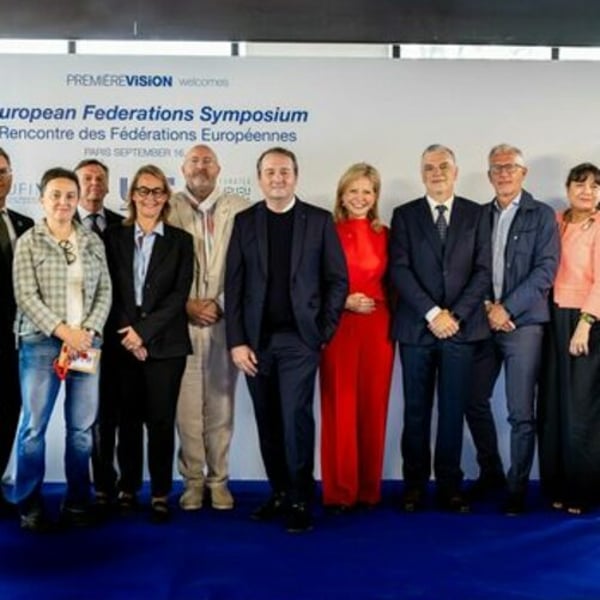
A rare group photo. Some twenty* representatives of Europe’s textile and clothing sectors met in Paris on September 16 to sign a declaration committing their various bodies to a joint fight against ultra-fast fashion, and calling on national and European authorities to take action in the face of competition from Shein and Temu.
The signing took place in Villepinte, where the Première Vision Paris trade show runs from September 16 to 18. Behind the expected conviviality among industry peers, a palpable tension surfaced, as the professionals gathered shared a sense of urgency in the face of ultra-low-cost Chinese competition evading all oversight, including customs checks.
This feeling was reinforced by what already looked like a countermove: Shein France announced an agreement with a first French brand that very morning. The announcement had initially been scheduled for Monday, September 15.
In the text signed by the federations, the European institutions are urged to swiftly abolish the duty exemption for small non-EU parcels worth under 150 euros. The federations would also like to see a levy applied to these parcels to fund inspections, alongside VAT collection. The signatories further call for accelerated investigations and penalties under the Digital Services Act and the Digital Markets Act, and for the establishment of a dialogue with the Chinese authorities, whose sustainability objectives diverge from the practices of local platforms.
The document also calls on Member States to adopt national measures to curb, as in France, the marketing activities of ultra-fast-fashion players, while actively supporting textile and clothing companies investing in sustainability, quality and innovation. Consumers are not overlooked in this effort. The joint declaration invites them to favour sustainable products, and to support companies and brands taking part in the sustainable transition of the textile and clothing industry.
“The fashion industry can’t and won’t wait,” warned Pierre-François Le Louët, president of UFIMH (Union Française des Industries Mode & Habillement), who initiated the event.
“We need this battle to be waged country by country, for our federations to take this issue to legislators and the press, and, at EU level, to press the European Commission to move faster,” he continued, noting that France has already passed a “Fast Fashion Law” that now legally defines a business model deemed harmful.
Mario Jorge Machado, president of the European textile industry confederation Euratex, pointed out that this event will help the industry make its voice heard by the European Commission.
“We have to stop being naive and pretending not to see what’s happening to our market: these players are exploiting the fact that we play by the rules,” insisted the industry representative. \
“They take advantage of our brands as well as our consumers. You cannot destroy creativity and intellectual property in this way: it’s unacceptable. Our industry is known for its innovation, quality and design. So we have a lot to defend.”

“Enough is enough,” said Olivier Ducatillion, president of UIT (Union Française des Industries Textiles).
“We are all suffering from this situation. Every time we propose solutions at the local level, we’re told it won’t work because these players will find workarounds at the European level. So we have to find new ways and set our sights wider. Today’s signature is not an end point; it’s a starting point.”
Representatives from the Italian, Portuguese and Dutch sectors took turns at the microphone, each reaffirming the need for action that is as swift as it is coordinated across the sector.
“There was no representative of the European Commission among us this morning, and that’s not down to the organisers,” noted Ralph Kamphöner, who represents the German Textil+Mode federation in Brussels.
The federations estimate that 4.5 billion parcels were imported into Europe last year via Chinese low-cost platforms, a volume that they say now accounts for 5% of clothing sales in Europe and 20% of online clothing sales.
*UFIMH (Union Française des Industries Mode & Habillement), UIT (Union Française des Industries Textiles), Euratex, ATP (Portugal), Chambre du Commerce de Services, Confindustria Moda (Italy), Finnish Textile & Fashion (Finland), TOK (Bulgaria), Modint (Netherlands), WKO (Austria), SEPEE (Greece), LATIA (Lithuania), DM&T (Denmark), Swiss Textiles (Switzerland), Consejo Intertextil Español (Spain), Fedustria (Belgium), Textil+Mode (Germany), ANIVEC-APIV (Portugal), TEKO (Sweden), Creamoda (Belgium), European Flax and Hemp Alliance, and PIOT (Poland).
This article is an automatic translation.
Click here to read the original article.
Copyright © 2025 FashionNetwork.com All rights reserved.




Alabama vs. Oklahoma Game Preview

Down Arrow Button Icon

Guess The Famous Babe In Bed!
-

 Politics8 years ago
Congress rolls out ‘Better Deal,’ new economic agenda
-
Entertainment8 years ago
New Season 8 Walking Dead trailer flashes forward in time
-
Politics8 years ago
Poll: Virginia governor’s race in dead heat
-
Entertainment8 years ago
The final 6 ‘Game of Thrones’ episodes might feel like a full season
-
Entertainment8 years ago
Meet Superman’s grandfather in new trailer for Krypton
-
Politics8 years ago
Illinois’ financial crisis could bring the state to a halt
-
Business8 years ago
6 Stunning new co-working spaces around the globe
-
Tech8 years ago
Hulu hires Google marketing veteran Kelly Campbell as CMO