Connect with us

Business

Schumer warns millions are going to ‘start getting letters in the mail telling them their health insurance costs are about to go through the roof’

Published

on


There’s bipartisan support in Congress for extending tax credits that have made health insurance more affordable for millions of people since the COVID-19 pandemic. But the credits are in danger of expiring as Republicans and Democrats clash over how to do it.

Democrats are threatening to vote to shut down the government at the end of the month if Republicans don’t extend the subsidies, which were first put in place in 2021 and extended a year later when they controlled Congress and the White House. The tax credits, which are slated to expire at the end of the year, go to low- and middle-income people who purchase health insurance through the Affordable Care Act.

Some Republicans who have opposed the health care law since it was enacted under President Barack Obama are suddenly open to keeping the tax credits. They acknowledge that many of their constituents could see steep hikes in coverage if the subsidies are allowed to lapse.

Still, the two sides are far apart. Republicans are divided, with many firmly opposed. GOP leaders in the House and Senate have been open but noncommittal on the extension, and many of those Republicans who say they support it argue that the tax credits should be reworked — potentially opening up a new health care debate that could take months to resolve.

Democrats would be unlikely to agree to any changes in the subsidies, increasing the chances of a standoff and mounting uncertainty for health insurers, hospitals, state governments and the people who receive them.

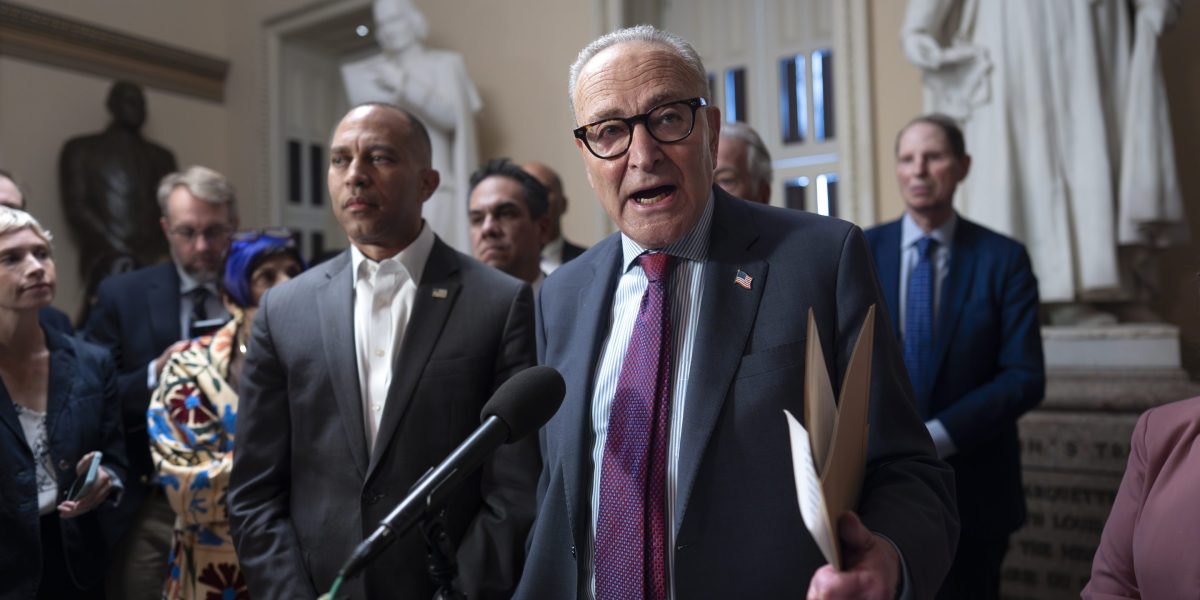
“In just a few weeks, unless Congress acts, millions of Americans will start getting letters in the mail telling them their health insurance costs are about to go through the roof — hundreds of dollars, thousands in some cases,” Senate Democratic Leader Chuck Schumer said this past week.

Millions of Americans could face higher health insurance rates

Enrollment in ACA plans has surged to a record 24 million people in large part due to the billions of dollars in subsidies that have lowered costs for many people. The expanded subsidies allowed some lower income enrollees to access health plans with no premiums and capped the amount higher earners pay for premiums to 8.5% of their income. It also expanded eligibility for middle-class earners.

With expiration now just a few months away, some of those people have already gotten notices that their premiums — the monthly fee paid for insurance coverage — are poised to spike next year. Insurers have sent out notices in nearly every state, with some proposing premium increases of as much as 50 percent.

Lawmakers are facing pressure to act from some of the country’s biggest industries, including the insurers that cover people on the marketplace and hospital executives who say they’re already going to be squeezed by the Medicaid cuts in President Donald Trump’s “big, beautiful” tax bill.

“There’s broad awareness that there’s a real spike and premiums coming right around the corner, both Republicans and Democrats,” said David Merritt, senior vice president of external affairs at Blue Cross Blue Shield. “It’s certainly lining up for Congress to have an opportunity to head off this problem.”

Companies have said they’ll need to raise premiums without the subsidies because healthier and younger people are more likely to opt out of coverage when it gets more expensive, leaving insurers to cover older and sicker patients.

In Iowa last month, the state’s insurance commissioner weighed increases ranging from 3% to 37% against a stream of angry public comments. One woman who runs a garden center in Cedar Falls, Iowa, said she was considering dropping health insurance altogether.

“I am already living as frugally as I possibly can while working as hard as I possibly can, putting in as many hours as I am allowed to at my job, never missing a day of work,” the woman, LuAnn, wrote in a public comment published to the commissioner’s website.

Tug-of-war over Obamacare spending plays out on the Hill

On Capitol Hill, the issue has become entangled in a larger fight over government funding as a shutdown looms at the end of the month. Schumer and House Democratic Leader Hakeem Jeffries have said Democrats will not vote to keep the government open unless an extension of the health care tax credits is part of the deal. Republicans have said that they want more time to look at the subsidies and potentially scale them back. They will also have to wait for a signal from Trump, who has not yet weighed in.

Jeffries said this past week that “we will not support a partisan Republican spending bill that continues to rip away health care from the American people.”

Republican leaders are eyeing a potential stopgap bill that would keep the government open for a few weeks and are unlikely, for now, to include the extension. But GOP leaders in both the House and Senate are also under pressure from some members who worry that premium increases will be a political liability before the midterm elections.

Senate Majority Leader John Thune, R-S.D., has said he wants to see a proposal from Democrats on how to extend the subsidies since they are pushing the issue. “Maybe there is something we can do in the middle as a solution,” he said in a Punchbowl News interview on Thursday, adding that his members are divided on the issue.

Still, Thune has ruled out quick action, even as he noted that premium notices will go out soon. He has said a short-term spending measure to fund the government for several weeks while Congress finishes its budget bills is not likely to include an extension of the benefits,

House Speaker Mike Johnson, R-La., has said that many of his members would oppose an extension, but has not ruled it out.

In recent days, 15 House Republicans in competitive political districts introduced legislation to extend the tax credits for one year. “While the enhanced premium tax credit created during the pandemic was meant to be temporary, we should not let it expire without a plan in place,” said Rep. Jen Kiggans, R-Va., who led the effort with Rep. Tom Suozzi, D-N.Y.

Middle-class and small business owners, like the ones who dot Kiggan’s coastal Virginia district, will be especially vulnerable to big health insurance hikes if the subsidies are not extended.

Several Senate Republicans also said they’d favor an extension. Missouri Sen. Josh Hawley said that if Congress doesn’t act, some premiums will “skyrocket, and not by a little bit. We’re looking at massive increases. People will not be able to afford it.”

Texas Sen. John Cornyn said he thinks Congress should scale back the subsidies for the highest income people who receive them. “I think we all know that access to health care is important and we take it very seriously,” he said.

Senate Finance Committee Chairman Mike Crapo, R-Idaho, who has jurisdiction over the tax credits, said he’s working with his colleagues to figure out if there is a solution. “There are a lot of ideas being thrown out there,” Crapo said. “I’m trying to find a solution, I’m not telling you what the solution is.”

Others were firmly against it. “It’s costing us billions of dollars,” said Sen. Ron Johnson, R-Wis.

Open enrollment begins Nov. 1 and people will begin to see “real sticker shock,” as ACA plan prices are posted next month, said Sen. Tammy Baldwin, D-Wis.

“Timing is important,” Baldwin said.

___

Associated Press writers Lisa Mascaro in Washington and Hannah Fingerhut in Des Moines, Iowa, contributed to this report.


Source link

Continue Reading

Business

If the Fed cuts interest rates today it may be the last round of cheaper money until June 2026

Published

on


Enjoy your Fed interest rate cut today—it may be the last one for a while. There is a 90% certainty that U.S. Federal Reserve Chairman Jerome Powell will announce a 0.25% cut to the base rate this afternoon, bringing it down to the 3.5% level, according to speculators on the CME FedWatch Fed funds futures index. But after that, the FedWatch index is indicating no certainty for any further cuts in 2026.

Today’s cut is priced in at level of certainty approaching 90%. But here are what the levels of certainty for keeping the rate at 3.5% look like for 2026, per FedWatch:

  • January: 72.2%
  • March: 55.8% 
  • April: 47.6%

Only in June does a plurality—41.9%—emerge for a further cut to 3.25%.

Analysts are all over the place in their guesses about how many further rounds of cheaper money the Fed will deliver next year, and with good reason: President Trump is set to replace Powell with a new Fed chair in May. 

“We see the Fed cutting rates twice in 2026, with moves in March and in June,” ING’s James Knightley et alargued earlier this month. Plus, “the potential for a more dovish FOMC tilts the risks toward additional rate cuts later in the year.”

“But does this matter, given that we know the Federal Reserve’s structure is changing?” Knightley wrote.

At Deutsche Bank, the forecast is “one further 25bp cut in each of 2026 and 2027.”

Pantheon Macroeconomics’ guess is for three cuts, “We expect 75bp of easing in 2026, but fiscal policy and FOMC personnel changes cloud the outlook.”

The presumed favorite candidate for the new Fed chair is Kevin Hassett, widely regarded as a “dove” who will follow Trump’s preference for lower rates regardless of rising inflation. But there are three others in the running: Fed governors Kevin Warsh, Christopher Waller and Michelle, Bowman, and BlackRock Chief Investment Officer of Global Fixed Income Rick Rieder.

It’s not certain if the new appointee will tip the Federal Open Markets Comittee into a more dovish position (favoring more cuts) or whether the Fed’s institutional commitment to apolitical economics will prevail, which would imply a slower schedule of cuts or perhaps—if inflation continues to rise—none at all. 

ING’s Knightley noted that by the end of 2026 it is possible that “five of the seven members of the Board of Governors are Trump appointees.” The Fed is about to become much more unpredictable, in other words.

Stock markets are largely in a holding pattern today as investors wait for the rate decision. It will be Powell’s commentary— and whether he says or doesn’t say certain words—that move markets this afternoon. S&P 500 futures were flat this morning prior to the open after the index closed flat yesterday.

Here’s a snapshot of the markets ahead of the opening bell in New York this morning:

  • S&P 500 futures were flat this morning. The last session closed down marginally 0.09%. 
  • STOXX Europe 600 was down 0.12% in early trading. 
  • The U.K.’s FTSE 100 was up 0.29% in early trading. 
  • Japan’s Nikkei 225 was down 0.1%. 
  • China’s CSI 300 was down 0.14%.
  • The South Korea KOSPI was down 0.21%.
  • India’s NIFTY 50 was down 0.32%. 
  • Bitcoin was at $92K.
Join us at the Fortune Workplace Innovation Summit May 19–20, 2026, in Atlanta. The next era of workplace innovation is here—and the old playbook is being rewritten. At this exclusive, high-energy event, the world’s most innovative leaders will convene to explore how AI, humanity, and strategy converge to redefine, again, the future of work. Register now.


Source link

Continue Reading

Business

Exclusive: U.S. businesses are getting throttled by the drop in tourism from Canada: ‘I can count the number of Canadian visitors on one hand’

Published

on


From Washington state to northern New England, American businesses that have long depended on Canadian visitors are seeing traffic dry up — and with it, a crucial source of revenue.

A new report shared exclusively with Fortune by the Joint Economic Committee (JEC) – Minority, a congressional standing committee dating back to 1946 responsible for documenting the economic conditions of the U.S., details how a sharp drop in Canadian tourism is hitting every U.S. state along the northern border. The findings come as President Trump has proposed annexing Canada, imposed several rounds of tariffs on Canadian goods, and repeatedly broken off trade talks with Ottawa, contributing to a chill in cross-border travel and spending.

From January to October 2025, the number of passenger vehicles crossing the U.S.-Canada border fell by nearly 20% compared with the same period in 2024, according to the JEC analysis, which draws on U.S. Customs and Border Protection travel statistics. In some border states, the decline reached 27%, a shift that local tourism agencies say is showing up in fewer tourists, more hotel vacancies, and weaker sales.

“Going back for generations, Canadians have visited New Hampshire and many other states along the U.S.-Canada border to see family or friends, stay in our hotels, share a meal at our restaurants, and shop at our stores,” said U.S. Senator Maggie Hassan (D-NH), Ranking Member of the Joint Economic Committee. “However, in the wake of President Trump’s reckless tariffs and needless provocations, fewer and fewer Canadians are making trips to the United States, putting many American businesses in jeopardy and straining the close ties that bind our two nations.”

Canadians have historically been among the most important international visitors to the U.S., both in sheer numbers and in spending. Analysts and tourism officials note that rising prices, a weaker Canadian dollar, and heightened political tensions have nudged many travelers to choose domestic trips within Canada or alternative international destinations instead. For U.S. border communities, that shift is being felt in real time.

“These are more than numbers; they represent missed revenue for local businesses, reduced hotel demand, and fewer dollars supporting jobs and investment in our community,” said Shirley Hughes, president and CEO of Visit Fargo-Moorhead in Fargo, North Dakota, and Moorhead, Minnesota.

In northern New Hampshire, the absence of Canadian license plates is especially stark. “Being only eight miles from the border, normally Canadians make up anywhere from 15-25% of visitors. Now, I can probably count the number of Canadian visitors on one hand. I’m just trying to plug along and keep my nose above the waterline,” said Elizabeth Guerin, owner of the Fiddleheads gift shop in Colebrook, New Hampshire.

The impact stretches beyond retail and lodging into wineries and attractions that rely on cross-border regulars.

“The drop in visits from Canadian tourists has had a noticeable impact on our bottom line. With Canadians making up about 10% of our business, fewer cross-border travelers mean fewer tastings, tours, and wine sales — a ripple effect that touches our entire operation, underscoring how important cross-border tourism is to our business model,” said Scott Osborn, president and co-owner of Fox Run Vineyards in Penn Yan, New York.

Some operators worry the damage will outlast any eventual thaw in U.S.–Canada trade relations, as Canadian travelers form new habits elsewhere.

“This is long-lasting damage to a relationship and emotional damage takes time to heal. While people aren’t visiting Vermont, they’ll be finding new places to visit, making new memories, building new family traditions, and we will not recapture all of that,” said Christa Bowdish, owner of the Old Stagecoach Inn in Waterbury, Vermont.

On the West Coast, festival organizers are also feeling the pinch.

“Since March of this year, we have not only seen Canadian traffic drop drastically, but we have also seen a drop in our number of attendees at our festival this year in late September. We knew that after March, we could not rely on our Canadian business because of fear at the border and lack of understanding of what is happening with tariffs and Canada drawing a strong line of promoting Canada first,” said Kevin Coleman, executive director of SeaFeast in Bellingham, Washington.

For businesses up and down the northern border, the question now is not just when Canadians will return in force, but how much of that lost business can ever be won back.

For this story, Fortune journalists used generative AI as a research tool. An editor verified the accuracy of the information before publishing. 


Source link

Continue Reading

Business

Activist investors are targeting female CEOs—and it’s costing Corporate America

Published

on


Good morning. When Victoria’s Secret reported stellar quarterly results last week, shares shot up 14% and likely gave Hillary Super some breathing room from the activist investors pushing the lingerie company to, among other things, consider whether the CEO of 16 months is up to the task of turning it around.

Of course, the potential of having to deal with an activist investor’s campaign goes with the territory of being a CEO, especially at a company that has been struggling. But Super’s saga is a reminder that women CEOs remain much likelier than their male counterparts to be targeted by activist investors.

This year, according to a report last week by the Conference Board, women have made up 8% of the CEOs in the Russell 3000 index but accounted for 15% of activist campaigns specifically targeting chief executives. Other women to have recently confronted activists: Cracker Barrel’s Julie Masino, who survived a campaign, and Vail Resorts’ Kirsten Lynch, who did not. 

What makes the Conference Board report especially frustrating is that it adds more proof points to an old, seemingly intractable trend.

In 2015, the New York Times’ DealBook pondered “Do Activist Investors Target Female CEOs?” while Fortune’s Pattie Sellers asked “Does Nelson Peltz have a problem with women?” In 2017, Harvard Law School found that women CEOs had almost a 50% higher probability than men of becoming the target of shareholder activism.

Why? One reason, the Conference Board theorized, is rooted in a stereotype that women are more cooperative. It’s also conceivable that the trend reflects the glass cliff phenomenon in which women often take the helm of companies in decline. But there is almost certainly some bias at play. The Conference Board research showed that women targeted by activists face the same odds of being canned whether they turn things around or not, while male CEOs are less likely to be ousted when results improve.

Some of the most prominent women chief executives ever have tangled with activists: PepsiCo’s ex-CEO Indra Nooyi, ex-Yahoo CEO Marissa Mayer, ex-DuPont CEO Ellen Kullman, ex-Mondelez CEO Irene Rosenfeld, ex-HP CEO Meg Whitman, and Mary Barra, still at GM. Michelle Gass, now thriving as CEO of Levi Strauss & Co, dealt with not one but three activist campaigns as she tried to fix Kohl’s.

Everyone should be held accountable when their company is failing or on a bad path. But it is worth wondering what this extra hurdle women CEOs face is costing us. Activist campaigns are bruising to the company but also to a CEO’s reputation. Does this mean boards might be more likely to avoid naming a woman to lower the odds of an activist campaign, or that fewer women will throw their hat in the ring?

Either way, it seems the phenomenon could needlessly be costing corporate America some much needed talent.—Phil Wahba

Contact CEO Daily via Diane Brady at diane.brady@fortune.com

Top news

Fed watch

All eyes will be on the Fed meeting today even though an interest rate cut is all but certain. Instead, investors will focus on Chair Jerome Powell’s tone and whether he characterizes Fed policy as “in a good place;” doing so would imply that a January cut is unlikely. 

Fed chair watch 

Meanwhile, President Donald Trump has narrowed down the candidates to replace Powell as Fed chair. The frontrunner is National Economic Council Director Kevin Hassett, but to clinch the job he’ll reportedly have to outshine three other contenders in the final round of interviews, suggesting he’s not a shoo-in for the job. 

Trump’s affordability tour

In his first in a series of speeches about “affordability,” President Trump mocked the term and insisted that Americans are doing better than ever. In reality, U.S. inflation is close to 3%, about where it was when Trump’s predecessor Joe Biden left office. 

Miami’s mayoral race

As Trump railed against affordability, Eileen Higgins, a Democrat, defeated Trump’s favored candidate in Miami’s mayoral race with a campaign focused in part on affordable housing. She’s the first Democrat to occupy Miami’s City Hall in three decades (and the first-ever woman), giving Democrats another jolt of momentum ahead of the 2026 midterms. 

Taiwan’s chip action

Taiwan is invoking a national security law to protect the trade secrets of its homegrown chipmaker TSMC and has used it to indict a TSMC supplier for allegedly letting a former employee steal details about TSMC’s top chips. 

Layoffs hit 1.1 million

Recruitment firm Challenger, Gray & Christmas has calculated the number of layoffs so far this year at 1.1 million, the sixth time since 1993 that layoffs have been that high. Technology was the hardest hit sector with 150,000 layoffs.

Americans ‘living on the financial edge’

Moody’s Analytics Chief Economist Mark Zandi told Fortunethat many Americans are “already living on the financial edge,” and that a drop in their spending could lead to a recession. If layoffs increase, then Zandi estimates that a “jobs recession” is certain. 

Sam Altman worries about ‘rate of change’

During an appearance on The Tonight Show with Jimmy Fallon, OpenAI CEO Sam Altman admitted that he’s worried about “the rate of change that’s happening in the world right now.” He added that the “rate at which jobs will change over may be pretty fast,” with hopes that “much better jobs” will follow. 

The markets

S&P 500 futures were up 0.05% this morning. The last session closed down 0.09%. STOXX Europe 600 was down 0.19% in early trading. The U.K.’s FTSE 100 was up 0.14% in early trading. Japan’s Nikkei 225 was down 0.1%. China’s CSI 300 was down 0.14%. The South Korea KOSPI was down 0.21%. India’s NIFTY 50 is down 0.32%. Bitcoin is up at $93K.

Around the watercooler

New contract shows Palantir is working on a tech platform for another federal agency that works with ICE by Jessica Mathews

Jamie Dimon taps Jeff Bezos, Michael Dell, and Ford CEO Jim Farley to advise JPMorgan’s $1.5 trillion national security initiative by Nino Paoli

Trump’s $12 billion farmer bailout is a ‘Band-Aid on a bigger wound’ the American agriculture industry is still reeling from by Sasha Rogelberg

Exelon CEO: The ‘warning lights are on’ for U.S. electric grid resilience and utility prices amid AI demand surge by Jordan Blum

CEO Daily is compiled and edited by Joey Abrams, Claire Zillman and Lee Clifford.


Source link

Continue Reading

Trending

Copyright © Miami Select.