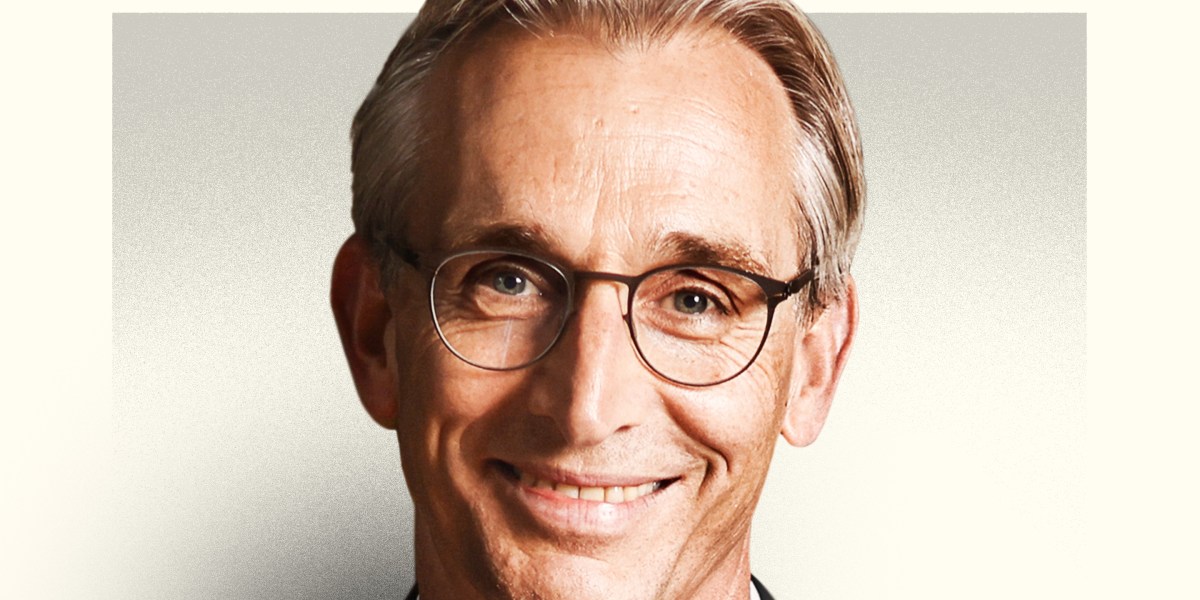
CEO Agenda provides unique insights into how leaders think and lead and what keeps them busy in a world of constant change. We look into the lives, minds and agendas of CEOs at the world’s most iconic companies.
Founded in 1891 as a light bulb manufacturer, Philips has transformed itself into a health-tech leader in the 21st century. Its early work in lighting laid the foundation for the development of X-ray tubes, which became the cornerstone of its health care business.
The 134-year-old technology company faced perhaps the most significant crisis in its history following the 2021 U.S. recall of Philips breathing devices, including CPAP and BiPAP machines, owing to potential health risks. Roy Jakobs, who joined Philips in 2010, became CEO of the Dutch company in 2022, around the time of the crisis. Since then, he has helped bring the company into stabilization. While annual revenue has remained steady—reaching $19.5 billion in 2024—the company’s share price has risen a total of 81% since Jakobs took over. Though today the company’s share price remains below its 25-year average, Jakobs is committed to driving a long-term turnaround.
Alongside the recall, one of Jakobs’s first major actions as CEO was announcing a restructuring plan that cut 10,000 jobs—around 13% of the workforce—a move aimed at helping the company absorb settlement payouts.
Rising patient expectations—along with technologies like remote robotics, digital health platforms, and AI-driven machine learning—are rapidly transforming health care. In response, Jakobs is driving continuous innovation at Philips by enhancing hospital patient monitoring through IntelliVue bedside, wearable, and transport monitors—seamlessly integrated with the Philips Patient Information Center iX for real-time data access—and advancing Azurion image-guided therapy platforms to support minimally invasive procedures.
“Explaining the why is very important,” he says. “It’s not about where you do innovation. It’s about the impact.” He emphasizes how crucial it is for companies to stay relevant in an ever-changing market, and to do so honestly and with integrity.
From boardrooms to soccer sidelines (he’s an avid sports enthusiast), Jakobs brings a grounded yet global mindset shaped by his (and Philips’s) Dutch heritage. Whether it’s planning his calendar around family events or sparking innovation across continents, Jakobs exemplifies what it means to lead with intent.
This interview has been edited for length and clarity.
Down to business
Fortune:Walk us through your career journey.
I started working at Shell, where I ran several operations. Then I was at Elsevier. When I joined, it was still a majority print-based business in the sciences, and it moved very rapidly.
That triggered why Philips invited me over in 2010, when lighting started to digitize rapidly and LED lighting was introduced. A major transformation from analog to digital light was starting, and Philips wanted to lead. I feel I can contribute to the heritage of strong global companies built in a small country, especially in key fields like energy, science, and health care.
How does the Dutch business style differ from that of other multinationals?
You need to think globally. There’s an outward perspective in how you engage with the world, respecting differences but also opportunities. That’s what the Dutch have been doing—going out, traveling the world, and grabbing opportunities.
The Dutch can also be very direct. I like clarity as a personal leadership style. There is value in speaking out, respectfully. There is also a part of Dutchness that is consensus-driven—you need to take many stakeholders into account if you want to do business. That’s a strength. We also think broadly—about patients, people, society, and sustainability. But at the same time, if you’re too consensus-driven, it can make you slower. That’s something to be mindful of.
You’ve led a major restructuring and significant repositioning of the business. What have you learned from the experience?
You need to be grounded in the reality you face, and if you restructure respectfully and with the right intent, you will gain support.
I had to significantly reduce headcount. In the same period, we drove our [employee] engagement score up by 12 points—because of how we did it. We were respectful and clear about why we did it and what we wanted to achieve, which was a simpler, leaner organization and to get Philips winning again.
It’s all about how you stay relevant and how you do it together with the audience you serve. Explaining the why is very important. It’s not about where you do innovation—it’s about the impact.
“There’s an outward perspective in how you engage with the world, respecting differences but also opportunities. That’s what the Dutch have been doing—going out, traveling the world, and grabbing opportunities.”
Roy Jakobs
Philips is known for consumer-facing innovation—how have you approached its communication strategy?
As a consumer brand, you have a wide reach with billions of consumers. In health care, patients are more focused on getting the best care than on the brand itself.
I’ve been refocusing the company on driving towards delivering better and more care—because the challenge in health care is only getting bigger due to the growing gap between demand and supply. I also engage with the government and relevant stakeholders on the payer side. We’ve been in health care for 100 years and are known as a trusted partner. While consumer branding differs from B2B, our legacy and ongoing activities continue to build our presence.
With challenges in China and global trade, where is your focus as CEO, and how do you navigate these tensions?
The system is under pressure as government funding shifts to energy and defense, so we need to become more efficient due to reduced health care support.
There are big differences globally—countries like the U.S. spend 20% of GDP and need efficiency, while others like Indonesia are still building up. China has been challenged since COVID because its economy has not been back in full force. The country is strengthening, but it is still not back to where it was. The U.S. still has strong health care demand and is looking for solutions.
Tariffs are also something we are dealing with. COVID made us aware of constraints, especially if you have a too long or too diversified supply chain. Since COVID we started to regionalize more. You need to be local.
How do you think we can address the productivity gap between Europe and the U.S.?
Philips is a big European company. We drive many activities in other parts of the world.
You need to have financial capital streams that support talented startups, especially in tech. It’s easier to access capital in the U.S. than in Europe. We need to [fix] that.
If you want to remain competitive, you need to have an energy cost that is competitive globally. Europe is expensive because of its heavy reliance on outside sources, including Russia. We need to strengthen our energy infrastructure.
We’ve been advocating for appropriate AI regulation that supports but does not overburden it.
Being productive
What’s your morning routine that sets you up for the day?
I get up early, play sports if I can. I want to be not only a CEO, but also a father and good husband, so careful planning is essential.
I plan my time, especially when traveling, so I can be present. I carve out time for my sons’ soccer matches and make sure to show up when it matters. A big part of staying connected, whether with customers, stakeholders, or family, is clear communication.
Coffee or tea?
I studied in Italy, so I start with a cappuccino and then shift to regular coffee or espresso. I also love tea.
Tell us a bit about your sports interests?
I like sports for many reasons. I get energy out of it, and I also like the social aspect of sports. I play soccer, tennis, and also run. I like to learn from sports, with the team.
I also think [sports] is very important, especially since we’re a health care company. So [we should] lead by example. There’s value in being fit for the energy that we need for the daily grind.
Do you have a set end to your workday? Are you strict about stopping work, or do you tend to continue with emails and tasks into the evening once you’re home?
I’m quite flexible. Running a global business means that sometimes I need to be early for China or Asia, or late for the U.S. Work and personal [life] are intertwined.
I appreciate spending time with my family on Friday nights, especially cooking dinner together.
Getting personal
What apps or methods do you use to be more productive?
I use my iPad as my notebook, and that works for me.
Jakobs joins colleagues for an early morning game of soccer in Shanghai.
Courtesy of Royal Philips
Who is on your personal board?
I have a broad network of people whom I can get inspiration from. Some are friends, my professional coach, my sister. Sometimes people assume that a CEO knows everything, but I’m the first to admit if I don’t. That’s why I have a team.
As a consumer, what is your favorite company and why?
Apple. I love the combination of design and the user focus.
What is your favorite cuisine to either cook or eat?
Italian. I love eating and cooking. Living in Bologna, I learned to appreciate Italian cuisine. Simple recipes yield magnificent outcomes—we should do the same in business.
CEO Agenda provides unique insights into how leaders think and lead, and what keeps them busy in a world of constant change. We look into the lives, minds and agendas of CEOs at the world’s most iconic companies.Dive into our other CEO Agenda profiles.
Good morning. When Victoria’s Secret reported stellar quarterly results last week, shares shot up 14% and likely gave Hillary Super some breathing room from the activist investors pushing the lingerie company to, among other things, consider whether the CEO of 16 months is up to the task of turning it around.
Of course, the potential of having to deal with an activist investor’s campaign goes with the territory of being a CEO, especially at a company that has been struggling. But Super’s saga is a reminder that women CEOs remain much likelier than their male counterparts to be targeted by activist investors.
This year, according to a report last week by the Conference Board, women have made up 8% of the CEOs in the Russell 3000 index but accounted for 15% of activist campaigns specifically targeting chief executives. Other women to have recently confronted activists: Cracker Barrel’s Julie Masino, who survived a campaign, and Vail Resorts’ Kirsten Lynch, who did not.
What makes the Conference Board report especially frustrating is that it adds more proof points to an old, seemingly intractable trend.
Why? One reason, the Conference Board theorized, is rooted in a stereotype that women are more cooperative. It’s also conceivable that the trend reflects the glass cliff phenomenon in which women often take the helm of companies in decline. But there is almost certainly some bias at play. The Conference Board research showed that women targeted by activists face the same odds of being canned whether they turn things around or not, while male CEOs are less likely to be ousted when results improve.
Some of the most prominent women chief executives ever have tangled with activists: PepsiCo’s ex-CEO Indra Nooyi, ex-Yahoo CEO Marissa Mayer, ex-DuPont CEO Ellen Kullman, ex-Mondelez CEO Irene Rosenfeld, ex-HP CEO Meg Whitman, and Mary Barra, still at GM. Michelle Gass, now thriving as CEO of Levi Strauss & Co, dealt with not one but three activist campaigns as she tried to fix Kohl’s.
Everyone should be held accountable when their company is failing or on a bad path. But it is worth wondering what this extra hurdle women CEOs face is costing us. Activist campaigns are bruising to the company but also to a CEO’s reputation. Does this mean boards might be more likely to avoid naming a woman to lower the odds of an activist campaign, or that fewer women will throw their hat in the ring?
Either way, it seems the phenomenon could needlessly be costing corporate America some much needed talent.—Phil Wahba
All eyes will be on the Fed meeting today even though an interest rate cut is all but certain. Instead, investors will focus on Chair Jerome Powell’s tone and whether he characterizes Fed policy as “in a good place;” doing so would imply that a January cut is unlikely.
Fed chair watch
Meanwhile, President Donald Trump has narrowed down the candidates to replace Powell as Fed chair. The frontrunner is National Economic Council Director Kevin Hassett, but to clinch the job he’ll reportedly have to outshine three other contenders in the final round of interviews, suggesting he’s not a shoo-in for the job.
Trump’s affordability tour
In his first in a series of speeches about “affordability,” President Trump mocked the term and insisted that Americans are doing better than ever. In reality, U.S. inflation is close to 3%, about where it was when Trump’s predecessor Joe Biden left office.
Miami’s mayoral race
As Trump railed against affordability, Eileen Higgins, a Democrat, defeated Trump’s favored candidate in Miami’s mayoral race with a campaign focused in part on affordable housing. She’s the first Democrat to occupy Miami’s City Hall in three decades (and the first-ever woman), giving Democrats another jolt of momentum ahead of the 2026 midterms.
Recruitment firm Challenger, Gray & Christmas has calculated the number of layoffs so far this year at 1.1 million, the sixth time since 1993 that layoffs have been that high. Technology was the hardest hit sector with 150,000 layoffs.
Americans ‘living on the financial edge’
Moody’s Analytics Chief Economist Mark Zandi told Fortunethat many Americans are “already living on the financial edge,” and that a drop in their spending could lead to a recession. If layoffs increase, then Zandi estimates that a “jobs recession” is certain.
Sam Altman worries about ‘rate of change’
During an appearance on The Tonight Show with Jimmy Fallon, OpenAI CEO Sam Altman admitted that he’s worried about “the rate of change that’s happening in the world right now.” He added that the “rate at which jobs will change over may be pretty fast,” with hopes that “much better jobs” will follow.
The markets
S&P 500 futures were up 0.05% this morning. The last session closed down 0.09%. STOXX Europe 600 was down 0.19% in early trading. The U.K.’s FTSE 100 was up 0.14% in early trading. Japan’s Nikkei 225 was down 0.1%. China’s CSI 300 was down 0.14%. The South Korea KOSPI was down 0.21%. India’s NIFTY 50 is down 0.32%. Bitcoin is up at $93K.
The views seem to range from bubble-wary to bubble-dismissive. We hashed it all out over eggs and sausages at Fortune’s IRL Term Sheet Breakfast at Brainstorm AI in San Francisco yesterday. This is Amanda Gerut, Fortune’s West Coast news editor, pinch-hitting for my colleague Allie Garfinkle.
Allie hosted five VCs with funds ranging in size from $5 million to $25 billion and views varied across the panel. This group alone is collectively going to deploy anywhere from tens to hundreds of millions over the next decade into companies with AI as a backdrop and these investments will either prove spectacularly right or wrong.
Here’s a roll call:
Jenny Xiao, partner at Leonsis Capital and former researcher at OpenAI, came in with a nuanced take. There’s something of a bubble, but it’s “relatively contained” in the infrastructure layer with overinvestment primarily in data centers, GPUs and in large language model companies. But right now, there’s actually underinvestment in the application layer because there are so many ways AI can make an impact in various enterprises, Xiao said.
Vanessa Larco, former partner at New Enterprise Associates (NEA) and co-founder of new venture firm Premise, has a contrarian view. “Everyone thinks enterprise is safer,” Larco said. “But I actually think the consumer might, this time around in the current environment, be what survives.” Larco’s reasoning is that if a consumer adopts your AI product, it’s because you’re giving them something faster, “radically cheaper, or much easier to use.” Once you’ve done that and built a brand, it’s very hard for people to quit you.
Rob Biederman, managing partner at Asymmetric Capital Partners and chairman of Catalant Technologies, had a sobering view. “In every boom, 99% or 99.9% of companies fail, and one or two of them become Amazon or Google,” said Biederman, who had to dash off to catch a flight. Only companies that can systematically create value for customers, which most of them aren’t doing right now, will survive.
Aaron Jacobson, partner at NEA, said the history of technological innovation “is always overhyped in the near term and underhyped in the long term, and that will be true of AI.” So at some point there will be a correction and there will be cycles of pain around valuation and funding, “but ultimately, in 10 years, we’re going to have a lot of really big, impactful companies.”
Daniel Dart, founder and general partner of Rock Yard Ventures, had the boldest counter to fears about a bubble. He sees a total addressable market we can’t yet imagine. People think self-driving Waymos will replace Ubers, but Dart sees elementary schools and elderly care centers with Waymos waiting out front and that proves to him we’re still in the early innings.
“You’re really going to tell me there aren’t going to be any trillion-dollar companies in 2030 or 2034? No one here is going to take that bet,” said Dart. “There is going to be so much value creation that it’s like the birth of fire.”
Joey Abrams curated the deals section of today’s newsletter.Subscribe here.
Venture Deals
– Saviynt, an El Segundo, Calif.-based identity security platform, raised $700 million in series B funding. KKR led the round and was joined by SixthStreetGrowth, TenEleven and existing investor CarrickCapitalPartners.
– fal, a San Francisco-based AI-generated media platform, raised $140 million in Series D funding. Sequoia led the round and was joined by KleinerPerkins, NVentures, and AlkeonCapital.
– Radial, a New York City-based network designed to help patients access advanced mental health treatments, raised $50 million in Series A funding. GeneralCatalyst led the round and was joined by SolariCapital, SLHealthCapital, FounderCollective, BoxGroup, ScrubCapital, and DiedevanLamoen.
– Relation, a London, U.K.-based developer of medicines for immunology, metabolic, and bone diseases, raised $26 million in funding from NVentures, DCVC, and MagneticVentures.
– Aradigm, a New York City-based benefits platform for cell and gene therapies, raised $20 million in Series A funding. FristCresseyVentures led the round and was joined by AndreessenHorowitz and MorganHealth.
– PrimeSecurity, a Tel Aviv, Israel and New York City-based AI-powered platform designed to detect and mitigate risks during software design, raised $20 million in Series A funding. ScaleVenturePartners led the round and was joined by FoundationCapital, FlybridgeVentures, and others.
– Algori, a Madrid, Spain-based AI-powered shopper insights platform for the fast-moving consumer goods industry, raised €3.6 million ($4.2 million) in funding from RedBullVentures, Co-invest Capital, AttaPoll, and others.
– EmpromptuAI, a San Francisco-based platform designed to help transition SaaS products into AI-native systems, raised $2 million in pre-seed funding. PrecursorVentures led the round and was joined by AlumniVentures, FoundersEdge, RogueWomenVC, and others.
Private Equity
– AppDirect, backed by CDPQ, acquired vComSolutions, a San Ramon, Calif.-based IT management platform, at an enterprise valuation of more than $100 million.
– JensenHughes, backed by GryphonInvestors, acquired SafetyManagementServices, a West Jordan, Utah-based fire and life safety company. Financial terms were not disclosed.
– NewStateCapitalPartners acquired a majority stake in Harrell-Fish, a Bloomington, Ind.-based mechanical installation and maintenance services provider. Financial terms were not disclosed.
– PestCoHoldings, a portfolio company of ThompsonStreetCapital, acquired SouthwestExterminating, a Houston, Texas-based pest control provider. Financial terms were not disclosed.
– ProsperityPartners, backed by UnityPartners, acquired a majority stake in Farkouh, Furman & Faccio, a New York City-based provider of tax, attest, accounting and business consulting services. Financial terms were not disclosed.
– SEVA acquired a minority stake in Pronto, a Lehi, Utah-based team communications platform designed for front–line employers and higher education institutions. Financial terms were not disclosed.
Exits
– ArclineInvestmentManagement acquired Altronic, a Girard, Ohio-based supplier of ignition, control, and instrumentation systems for critical infrastructure power systems, from HOERBIGERGroup. Financial terms were not disclosed.
– BerkshirePartners agreed to acquire UnitedFlowTechnologies, an Irving, Texas-based process and equipment solutions company for water and wastewater systems, from H.I.G.Capital. Financial terms were not disclosed.
– BessemerInvestors acquired Xanitos, a Newtown Square, Penn.-based provider of environmental services, patient transport, patient observation, and linen services, from AngelesEquityPartners. Financial terms were not disclosed.
– ShareRockPartners acquired a majority stake in AMAGTechnology, a Hawthorne, Calif.-based physical security solutions provider, from AlliedUniversal.
Coupang chief executive officer Park Dae-jun resigned over his failure to prevent South Korea’s largest-ever data breach, which set off a regulatory and political backlash against the country’s dominant online retailer.
The company said in a statement on Wednesday that Park had stepped down over his role in the breach. It appointed Harold Rogers, chief administrative officer for the retailer’s U.S.-based parent company Coupang Inc., as interim head.
Park becomes the highest-profile casualty of a crisis that’s prompted a government investigation and disrupted the lives of millions across Korea. Nearly two-thirds of people in the country were affected by the breach, which granted unauthorized access to their shipping addresses and phone numbers.
Police raided Coupang’s headquarters this week in search of evidence that could help them determine how the breach took place as well as the identity of the hacker, Yonhap News reported, citing officials.
Officials have said the breach was carried out over five months in which the company’s cybersecurity systems were bypassed. Last week President Lee Jae Myung said it was “truly astonishing” that Coupang had failed to detect unauthorized access of its systems for such a long time.
Park squared off with lawmakers this month during an hours-long grilling. Responding to questions about media reports that claimed the attack had been carried out by a former employee who had since returned to China, he said a Chinese national who left the company and had been a “developer working on the authentication system” was involved.
The company faces a potential fine of up to 1 trillion won ($681 million) over the incident, lawmakers said.
Coupang founder Bom Kim has been summoned to appear before a parliamentary hearing on Dec. 17, with lawmakers warning of consequences if the billionaire fails to show.
Park’s departure adds fresh uncertainty to Coupang’s leadership less than seven months after the company revamped its internal structure to make him sole CEO of its Korean operations. In his new role, Rogers will focus on addressing customer concerns and stabilizing the company, Coupang said.
Join us at the Fortune Workplace Innovation Summit May 19–20, 2026, in Atlanta. The next era of workplace innovation is here—and the old playbook is being rewritten. At this exclusive, high-energy event, the world’s most innovative leaders will convene to explore how AI, humanity, and strategy converge to redefine, again, the future of work. Register now.