Connect with us

Business

China’s economy continues to stumble as industry output, retail sales disappoint

Published

on


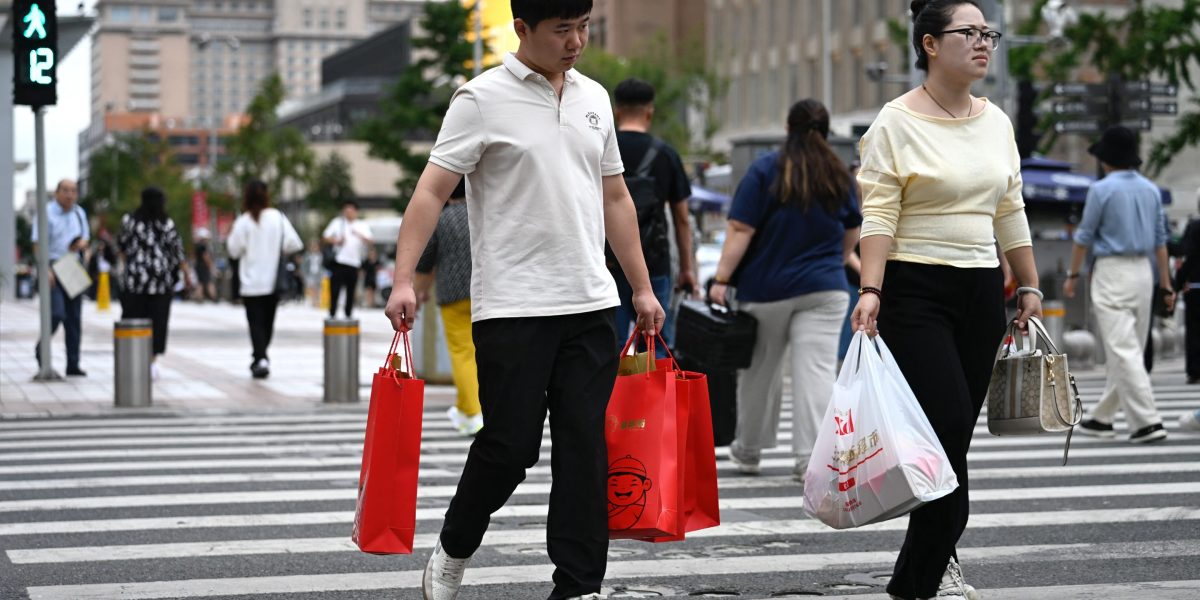
China’s economy showed further signs of weakness last month, with key data Monday revealing factory output and consumption rising at their weakest pace for around a year.

Beijing has struggled to fully reignite the world’s number two economy since the end of the COVID-19 pandemic, with the once-booming property sector mired in a debt crisis and exports facing mounting headwinds.

The trends have contributed to a slump in consumer confidence, dragging on spending and threatening leaders’ official growth target for this year of around 5%.

Industrial production edged up 5.2% year-on-year in August, according to data from the National Bureau of Statistics (NBS), the slowest pace since the same month last year.

The figure missed the 5.6% growth forecast in a Bloomberg survey of economists.

The NBS also said retail sales climbed 3.4% last month—the slowest since November and falling short of the 3.8% estimated in the Bloomberg survey.

“The activity data point to a further loss of momentum last month,” Zichun Huang, China economist at Capital Economics, wrote in a note.

“While some of this reflects temporary weather-related disruptions, underlying growth is clearly sliding, raising pressure on policymakers to step in with additional support,” she said.

New residential property prices fell year-on-year during August in 65 out of 70 cities surveyed by the NBS, data also showed.

Urban unemployment ticked up to 5.3% last month, a slight increase from 5.2% in July, according to NBS data.

“In the domestic market supply is strong, demand is weak and some enterprises are facing operational difficulties,” NBS chief economist Fu Linghui told a news conference Monday.

Fu added that “there is still much instability and uncertainty in the external environment, and (China’s) economic performance still faces numerous risks and challenges”.

One of the main challenges facing the economy is the strained relationship between Beijing and Washington as disputes over technology and geopolitics mount.

China-U.S. trade tensions have been on a rollercoaster ride in 2025, with both sides slapping escalating tariffs on each other.

Officials from the two countries on Sunday kicked off a fresh round of talks in Madrid, where they are set to thrash out disputes over hefty U.S. tariffs and other key issues.

Tit-for-tat levies reached triple digits on both sides at one point this year, snarling supply chains.

Leaders have since reached an agreement to de-escalate tensions, temporarily lowering the duties to 30% on the United States’ side and 10% on China’s part.

They agreed last month to extend their pause for another 90 days until November 10.


Source link

Continue Reading

Business

MacKenzie Scott’s $7 billion year: Philanthropist reveals inspiration for monumental giving

Published

on


It’s official—we finally have a total figure for MacKenzie Scott’s donations this year: an eye-popping $7.2 billion. That brings the billionaire philanthropist’s total gifts since 2020 to $26 billion and more than 2,700 gifts. This squarely places Scott among the most generous philanthropists, alongside fellow billionaires Bill Gates, Melinda French Gates, and Warren Buffett—all of whom announced major giving plans this year.

“This dollar total will likely be reported in the news, but any dollar amount is a vanishingly tiny fraction of the personal expressions of care being shared into communities this year,” Scott wrote in an essay published Tuesday. “To use just one year in the United States as an example, the total donated to US charities of all kinds in 2020 was $471 billion, nearly a third of it in increments of less than $5,000.”

This year, the philanthropist, novelist, and ex-wife of Amazon founder Jeff Bezos made donations to more than 180 organizations, many of which were focused on DEI, education, disaster recovery, and humanitarian causes.

Her largest disclosed donations this year, according to her organization Yield Giving, include:

  • Blackfeet Community College: $80 million
  • Projeto Saúde e Alegria: $80 million
  • Filantropía Puerto Rico: $80 million
  • Thurgood Marshall College Fund: $70 million
  • HSF: $70 million
  • UNCF (United Negro College Fund): $70 million
  • Prairie View A&M University: $63 million
  • North Carolina Agricultural and Technical State University: $63 million
  • California State University, Northridge: $63 million
  • Morgan State University; $63 million
  • Howard University: $63 million

Scott’s giving style

Many of these gifts were the largest single donations ever received by the respective organizations. And many have gone to organizations working on issues that have experienced major cuts from the Trump administration—namely a $60 million donation to the Center for Disaster Philanthropy this fall. The gift came after the Trump administration’s cuts to the Federal Emergency Management Agency (FEMA)—an organization Americans rely on for help during and after hurricanes, wildfires, tornadoes, and floods.

“All sectors of society—public, private, and social—share responsibility for helping communities thrive after a disaster,” CDP president and CEO Patricia McIlreavy told Fortune. “Philanthropy plays a critical role in providing communities with resources to rebuild stronger, but it cannot—and should not—replace government and its essential responsibilities.”

But what makes Scott’s philanthropic efforts so impactful is her giving style. Scott makes unrestricted gifts, meaning the organizations can use the donations however they choose to do so.

“She practices trust-based philanthropy,” Anne Marie Dougherty, CEO of the Bob Woodruff Foundation, told Fortune.

The veterans-focused Bob Woodruff Foundation has received two gifts from Scott: a $15 million gift in 2022, and a subsequent $20 million donation this fall. The $15 million gift was the largest in history at the time for the organization, which is almost two decades old now—founded the same year military reporter Bob Woodruff was severely injured by a roadside bomb in Iraq. It was cofounded by Woodruff and his family to provide support for injured service members, veterans, and their families.

Noni Ramos, CEO of Housing Trust Silicon Valley, also previously toldFortune that Scott’s donations are “unlike traditional funding processes,” which typically involve lengthy applications, specific restrictions, and reporting requirements. 

“Her style empowers organizations like ours to determine how best to direct funds quickly and innovatively to address pressing issues,” Ramos said. Her organization received a $30 million donation from Scott in 2024.

In fact, some say Scott’s philanthropic style is so transformative it could change giving for years to come. 

“At a moment when philanthropy is deciding its role in shaping our future, [her gifts point] to a path forward in the second half of this defining decade,” Melanie Allen, co-director of Hive Fund, said in a statement. The climate- and gender-justice-focused Hive Fund received part of a $140 million gift to climate-focused organizations, also including Equity Fund and The Solutions project. 

“As federal climate commitments are rolled back and public funding becomes increasingly uncertain, frontline climate leaders are met with growing challenges but with fewer resources to enact innovative, locally responsive solutions,” Gloria Walton, CEO of The Solutions Project, added. “I hope this is just the beginning of an urgently-needed infusion of investment.”

Why Scott donates so much money

Although Scott had a career writing novels before her marriage to Bezos, the vast majority of her wealth came as the result of her 2019 divorce from the world’s fifth-richest man. During their marriage, Scott played a key role in Amazon’s founding and early operations, including helping with business plans and contracts. She received roughly a 4% stake in Amazon upon their divorce—a cut equivalent to roughly 139 million shares at the time. 

She’s since reduced her Amazon stake by about 42% by selling or donating about 58 million shares. Still, Scott is worth about $40 billion today despite having donated more than $27 billion to charitable organizations through her foundation Yield Giving, which she founded in 2022.

Her proclivity for giving began in college when she witnessed two major acts of generosity: Her dentist offered her free dental work when he saw her securing a broken tooth with denture glue, and her college roommate who loaned her $1,000 when she saw her crying about nearly having to drop out during her sophomore year.

“It is these ripple effects that make imagining the power of any of our own acts of kindness impossible,” Scott wrote in the Dec. 9 essay. “The potential of peaceful, non-transactional contribution has long been underestimated, often on the basis that it is not financially self-sustaining, or that some of its benefits are hard to track. But what if these imagined liabilities are actually assets?”

What’s more, Scott also says giving just feels good.

“Generosity and kindness engage the same pleasure centers in the brain as sex, food, and receiving gifts, and they improve our health and long-term happiness as well,” she said.


Source link

Continue Reading

Business

International students skipped campus this fall — and local economies lost $1 billion because of it

Published

on


This school year, American colleges and universities saw a 17% decline in new international student enrollment. If you set aside the year of the pandemic, that’s the steepest decrease in over a decade. This reduction is making waves far beyond the halls of higher-ed. Based on my recent analysis, it represents a nearly $1 billion hit to the U.S. GDP – a hit that’s particularly concentrated in the Main Street sectors that form the backbone of many communities.

The employers taking the largest hit are in the restaurant industry (700 jobs), retail (350 jobs), and residential and commercial property rental (345 jobs), and auto repair (100 jobs). This is where the science of input-output analysis meets the art of economic impact analysis. We don’t know exactly which specific firms will be impacted. But from my experiences on campus across the country, these are exactly the types of main street college town businesses that exist near campus and serve students of all types. 

My analysis quantified the impact of new international students’ non-tuition spending. The results? Hosting 21,587 fewer new international students (277,118 this year as opposed to last year’s 298,705) means 7,300 fewer jobs and $500 million in lost labor income. 

Further analysis reveals which occupations are most heavily impacted. Of the 7,300 jobs that are affected, 390 are retail sales worker jobs, 370 are food and beverage server jobs, 290 are home health aide jobs, 280 are health care diagnostics jobs, and 260 are material moving worker jobs. This only takes into account non-tuition spending. The effects of lost revenue will hit higher education institutions as well. 

What are the structural reasons that the economic footprint of new international students is so wide-ranging? As a whole, international students are high-spend consumers, shelling out significant sums on housing, food, transportation, healthcare, and retail. The dollars spent by international students cycle through local economies. For example, a landlord uses the student’s rent money to buy pizza, and the pizza shop owner uses the money the landlord spent on dinner to buy a new shipment of cardboard pizza boxes – and so on.

Collectively, this year’s 277,118 new international students’ spending supports 93,000 jobs and $12.6B in GDP. The would-be international students who faced visa application issues or got caught up in President Donald Trump’s immigration crackdown will spend their money elsewhere, whether it’s in their home countries or in other study-abroad destinations. 

This demand shock hitting local economies and service jobs may seem quiet now, but as the school year goes on, and the spending shortage ripples through local economies, the implications are grim for local consumer spending, small business revenues, commercial real estate around campuses, and even tax collections. College towns and metro areas with large university footprints will see the strongest effects, especially in states with historically heavy international enrollment, like California, Texas, New York, Florida, and Illinois. 

Business leaders and government officials need to think about the myriad ripple effects of changes to international enrollment statistics in higher education. The broader linkages to both the local and national economy are underappreciated. Needless to say, fewer international students today can mean fewer skilled workers in sectors like tech, healthcare, and engineering tomorrow. What’s just as important, and maybe less apparent, is the immediate threat to jobs and GDP upstream of enrollment that a decline in new international students represents. 

New rules that make it harder for students to get visas and proposed caps on international students at some institutions present a threat to the U.S. economy at large and to small businesses in our communities – not just institutions of higher learning. We cannot ignore the  economic tradeoffs of national policy changes at the local level. Beyond the immediate economic impacts, my experience as a professor at campuses large and small have informed my view that international students enrich their communities in ways other than just the number of dollars they spend at local businesses. The perspectives they bring on both a personal and intellectual level are invaluable. They have spurred my thinking on topics from economics and development to the personal and profound. We are richer for their presence. 

International students are part of student spending in communities across the country and the number of new international students limits Americans’ ability to work and thrive, too. It is imperative that we not ignore or underestimate how this demand shock prompts a material headwind to growth in key regions.    

The opinions expressed in Fortune.com commentary pieces are solely the views of their authors and do not necessarily reflect the opinions and beliefs of Fortune.


Source link

Continue Reading

Business

Political communication scholar on how Zohran Mamdani hacked ‘slacktivism’ to appear on your phone, on your street and in your mind

Published

on


Accounts of Zohran Mamdani’s campaign for New York City mayor have highlighted both his online presence and his ground game.

Mamdani won the general election with 50.4% of the vote, a larger share than was predicted by most polls, and his get-out-the-vote campaign has received some of the credit. Mamdani claims that his campaign had over 100,000 volunteers knocking on doors across New York City.

This focus on on-the-ground mobilization stands out given the increasing attention devoted to online campaigning over the past 15 years.

Particularly during that time period, online platforms have been a major focus of political campaigns and campaign research. Targeted advertising and new media strategies are increasingly viewed as central to campaign success. So is coverage of the campaign by legacy and social media more generally.

Moreover, solid empirical evidence of the effectiveness of door-to-door canvassing is limited. Recent work finds very few effects of in-person canvassing, except in very specific circumstances. One recent paper suggests that door-to-door canvassing by the candidate can make a difference to election outcomes. But in a race in New York City, it is not likely that Mamdani himself was able to reach enough voters to make a difference.

How much did Mamdani’s ground game contribute to his victory? As a political communication scholar, I know that assessing the impact of different methods used by political campaigns is difficult – in part because political campaigns include multiple lines of communication.

‘Hybrid’ campaigns

No campaign exists in isolation — nearly every candidate’s campaign occurs alongside opposing candidates’ campaigns. The effects of one campaign are often masked by the countering effects of the other.

The size of a campaign on one platform also tends to be correlated with the size of that candidate’s campaign on other platforms. When television advertising increases alongside social media advertising and door-to-door canvassing, identifying the effects of any single platform can be difficult.

Clever research designs are in some instances able to identify effects. These generally find that the impact of not just door-knocking but also ads and online advertising can be relatively limited.

In the modern technological environment, the impact of any single aspect of a campaign may be especially difficult to assess. Campaigning increasingly occurs in what researchers have called a “hybrid media” environment. Campaigns are waged in person, on the news and across multiple social media.

Each of these platforms comes with different advantages and disadvantages. Each also prioritizes different kinds of information.

Plainly stating your policy platform may work for coverage of a campaign stop on the evening news. But if you want that policy to go viral on TikTok, then you may need to add a dance – or an influencer.

Find volunteers online, send them knocking

Candidates have increasingly recognized the need to tailor messages for different communication platforms, such as television ads, Facebook posts and TikToks, building hybrid campaigns that attempt to spread a message across multiple, different spaces.

This interactivity across platforms has been especially evident in postelection assessments of the Mamdani campaign. His social media campaign was adept at producing the kinds of content that attract attention online. That campaign also appears to have been able to convert online engagement into real-world activism, including door-to-door canvassing.

There have been growing concerns among academics and campaign organizers about “slacktivism” — activism that amounts to one or two clicks online but nothing more. One worry is that a quick online endorsement may in some instances give people a sense that they have done their share and limit more active forms of engagement. The Mamdani campaign appears to have overcome this problem, at least in part.

But 100,000 people knocking on doors probably does not happen without the success of an online campaign. Finding and mobilizing campaigners was one important focus of Mamdani’s engagement online, after all.

Do it yourself − then repeat on socials

In-person campaigning by Mamdani, on the street and in the taxi line, is almost certainly made more effective through circulation on Instagram and TikTok.

Using mass media to broadcast campaign stops is not new, of course.

The construction of campaign stops that produce good social media content is becoming more common, however. The ways in which campaigns unfold in person are increasingly intertwined with the way they unfold online.

In this way, the Mamdani campaign may have been a textbook example of a modern hybrid campaign and an illustration of the coevolution of digital and on-the-ground campaigning.

To be clear, the success of the Mamdani campaign is probably not about his online presence or his ground game, but both at the same time.

Stuart Soroka, Professor, Communications and Political Science, University of California, Los Angeles

This article is republished from The Conversation under a Creative Commons license. Read the original article.


Source link

Continue Reading

Trending

Copyright © Miami Select.