Connect with us

Business

Housing market: the ‘most critical’ variable for predicting recessions is at lowest since pandemic

Published

on


The housing market is long been seen as an early warning sign for recessions, and one data point in particular has caught the attention of Moody’s Analytics chief economist Mark Zandi.

In social media posts on Sunday, he noted that Moody’s own leading economic indicator that uses machine learning has estimated the odds of a recession in the next 12 months are now at 48%.

Even though it’s less than 50%, Zandi pointed out that the probability has never been that high previously without the economy eventually slipping into a downturn.

A crucial component in the Moody’s indicator comes from the housing market.

“The algorithm has identified building permits as the most critical economic variable for predicting recessions. And while permits had been holding up reasonably well, as builders supported sales through interest rate buydowns and other incentives, inventories of unsold homes are now high and on the rise,” Zandi warned.

“In response, builders are pulling back, and permits have started to slump. They are now as low as they’ve been since the pandemic shutdowns.”

Last month, the Census Bureau reported that residential building permits in July were at a seasonally adjusted annual rate of 1.35 million, down 2.8% from the prior month and down 5.7% from a year ago.

In July, Zandi singled out the housing market for concern, escalating it to a “red flare” as home sales, homebuilding, and house prices were getting squeezed by elevated mortgage rates.
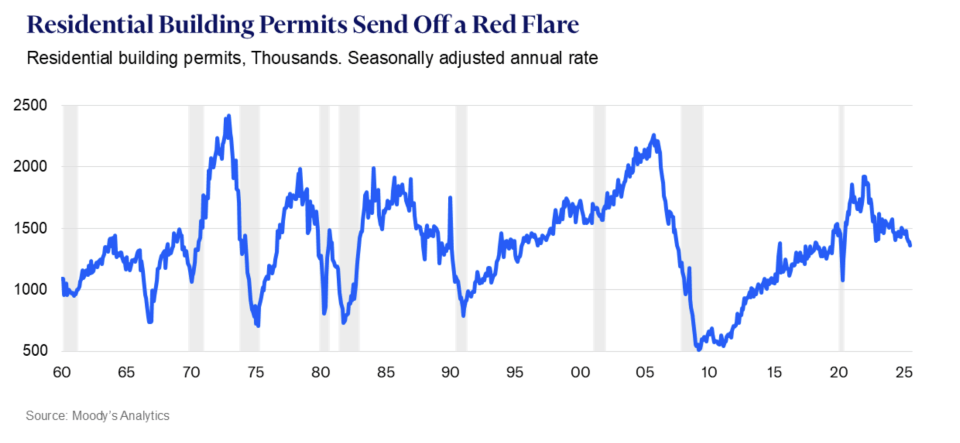
While the 30-year fixed rate has since come down from near 7% to about 6.3%, it’s not clear yet if that’s low enough to revive builders or how much it will continue to drop. On Sunday, Zandi said all eyes should be on August permit data, which will come out on Wednesday.

“They are sure to provide another reason why the Fed should and will announce a rate cut later that day,” he predicted.

In fact, Federal Reserve policymakers have already started worrying about the housing market. Minutes from the central bank’s July meeting revealed concerns about weak housing demand, rising supply, and falling home prices.

And not only did housing show up on the Fed’s radar, officials flagged it as a potential risk to jobs, along with artificial intelligence technology.

“In addition to tariff-induced risks, potential downside risks to employment mentioned by participants included a possible tightening of financial conditions due to a rise in risk premiums, a more substantial deterioration in the housing market, and the risk that the increased use of AI in the workplace may lower employment,” the minutes said.

Permits aren’t the only housing market data point to follow. The economist Ed Leamer, who passed away in February, famously published a paper in 2007 that said residential investment is the best leading indicator of an oncoming recession.

On that score, the data doesn’t look good either. In the second quarter, residential investment tumbled 4.7%, accelerating from the first quarter’s 1.3% decline.

Fortune Global Forum returns Oct. 26–27, 2025 in Riyadh. CEOs and global leaders will gather for a dynamic, invitation-only event shaping the future of business. Apply for an invitation.


Source link

Continue Reading

Business

5 VCs sounds off on the AI question du jour

Published

on


The views seem to range from bubble-wary to bubble-dismissive. We hashed it all out over eggs and sausages at Fortune’s IRL Term Sheet Breakfast at Brainstorm AI in San Francisco yesterday. This is Amanda Gerut, Fortune’s West Coast news editor, pinch-hitting for my colleague Allie Garfinkle.

Allie hosted five VCs with funds ranging in size from $5 million to $25 billion and views varied across the panel. This group alone is collectively going to deploy anywhere from tens to hundreds of millions over the next decade into companies with AI as a backdrop and these investments will either prove spectacularly right or wrong.

Here’s a roll call:

Jenny Xiao, partner at Leonsis Capital and former researcher at OpenAI, came in with a nuanced take. There’s something of a bubble, but it’s “relatively contained” in the infrastructure layer with overinvestment primarily in data centers, GPUs and in large language model companies. But right now, there’s actually underinvestment in the application layer because there are so many ways AI can make an impact in various enterprises, Xiao said. 

Vanessa Larco, former partner at New Enterprise Associates (NEA) and co-founder of new venture firm Premise, has a contrarian view. “Everyone thinks enterprise is safer,” Larco said. “But I actually think the consumer might, this time around in the current environment, be what survives.” Larco’s reasoning is that if a consumer adopts your AI product, it’s because you’re giving them something faster, “radically cheaper, or much easier to use.” Once you’ve done that and built a brand, it’s very hard for people to quit you. 

Rob Biederman, managing partner at Asymmetric Capital Partners and chairman of Catalant Technologies, had a sobering view. “In every boom, 99% or 99.9% of companies fail, and one or two of them become Amazon or Google,” said Biederman, who had to dash off to catch a flight. Only companies that can systematically create value for customers, which most of them aren’t doing right now, will survive. 

Aaron Jacobson, partner at NEA, said the history of technological innovation “is always overhyped in the near term and underhyped in the long term, and that will be true of AI.” So at some point there will be a correction and there will be cycles of pain around valuation and funding, “but ultimately, in 10 years, we’re going to have a lot of really big, impactful companies.”

Daniel Dart, founder and general partner of Rock Yard Ventures, had the boldest counter to fears about a bubble. He sees a total addressable market we can’t yet imagine. People think self-driving Waymos will replace Ubers, but Dart sees elementary schools and elderly care centers with Waymos waiting out front and that proves to him we’re still in the early innings. 

“You’re really going to tell me there aren’t going to be any trillion-dollar companies in 2030 or 2034? No one here is going to take that bet,” said Dart. “There is going to be so much value creation that it’s like the birth of fire.”

See you tomorrow,

Amanda Gerut
Email:
Amanda.gerut@fortune.com
Submit a deal for the Term Sheet newsletter here.

Joey Abrams curated the deals section of today’s newsletter.Subscribe here.

Venture Deals

Saviynt, an El Segundo, Calif.-based identity security platform, raised $700 million in series B funding. KKR led the round and was joined by SixthStreetGrowth, TenEleven and existing investor CarrickCapitalPartners.

fal, a San Francisco-based AI-generated media platform, raised $140 million in Series D funding. Sequoia led the round and was joined by KleinerPerkins, NVentures, and AlkeonCapital.

Radial, a New York City-based network designed to help patients access advanced mental health treatments, raised $50 million in Series A funding. GeneralCatalyst led the round and was joined by SolariCapital, SLHealthCapital, FounderCollective, BoxGroup, ScrubCapital, and DiedevanLamoen.

Relation, a London, U.K.-based developer of medicines for immunology, metabolic, and bone diseases, raised $26 million in funding from NVentures, DCVC, and MagneticVentures.

Aradigm, a New York City-based benefits platform for cell and gene therapies, raised $20 million in Series A funding. FristCresseyVentures led the round and was joined by AndreessenHorowitz and MorganHealth

PrimeSecurity, a Tel Aviv, Israel and New York City-based AI-powered platform designed to detect and mitigate risks during software design, raised $20 million in Series A funding. ScaleVenturePartners led the round and was joined by FoundationCapital, FlybridgeVentures, and others.

Algori, a Madrid, Spain-based AI-powered shopper insights platform for the fast-moving consumer goods industry, raised €3.6 million ($4.2 million) in funding from RedBullVentures, Co-invest Capital, AttaPoll, and others.

EmpromptuAI, a San Francisco-based platform designed to help transition SaaS products into AI-native systems, raised $2 million in pre-seed funding. PrecursorVentures led the round and was joined by AlumniVentures, FoundersEdge, RogueWomenVC, and others.

Private Equity

AppDirect, backed by CDPQ, acquired vComSolutions, a San Ramon, Calif.-based IT management platform, at an enterprise valuation of more than $100 million.

JensenHughes, backed by GryphonInvestors, acquired SafetyManagementServices, a West Jordan, Utah-based fire and life safety company. Financial terms were not disclosed.

NewStateCapitalPartners acquired a majority stake in Harrell-Fish, a Bloomington, Ind.-based mechanical installation and maintenance services provider. Financial terms were not disclosed.

PestCoHoldings, a portfolio company of ThompsonStreetCapital, acquired SouthwestExterminating, a Houston, Texas-based pest control provider. Financial terms were not disclosed.

ProsperityPartners, backed by UnityPartners, acquired a majority stake in Farkouh, Furman & Faccio, a New York City-based provider of tax, attest, accounting and business consulting services. Financial terms were not disclosed.

SEVA acquired a minority stake in Pronto, a Lehi, Utah-based team communications platform designed for front–line employers and higher education institutions. Financial terms were not disclosed.

Exits

ArclineInvestmentManagement acquired Altronic, a Girard, Ohio-based supplier of ignition, control, and instrumentation systems for critical infrastructure power systems, from HOERBIGERGroup. Financial terms were not disclosed.

BerkshirePartners agreed to acquire UnitedFlowTechnologies, an Irving, Texas-based process and equipment solutions company for water and wastewater systems, from H.I.G.Capital. Financial terms were not disclosed.

BessemerInvestors acquired Xanitos, a Newtown Square, Penn.-based provider of environmental services, patient transport, patient observation, and linen services, from AngelesEquityPartners. Financial terms were not disclosed.

ShareRockPartners acquired a majority stake in AMAGTechnology, a Hawthorne, Calif.-based physical security solutions provider, from AlliedUniversal.


Source link

Continue Reading

Business

Coupang CEO resigns over historic South Korean data breach

Published

on


Coupang chief executive officer Park Dae-jun resigned over his failure to prevent South Korea’s largest-ever data breach, which set off a regulatory and political backlash against the country’s dominant online retailer.

The company said in a statement on Wednesday that Park had stepped down over his role in the breach. It appointed Harold Rogers, chief administrative officer for the retailer’s U.S.-based parent company Coupang Inc., as interim head.

Park becomes the highest-profile casualty of a crisis that’s prompted a government investigation and disrupted the lives of millions across Korea. Nearly two-thirds of people in the country were affected by the breach, which granted unauthorized access to their shipping addresses and phone numbers.

Police raided Coupang’s headquarters this week in search of evidence that could help them determine how the breach took place as well as the identity of the hacker, Yonhap News reported, citing officials.

Officials have said the breach was carried out over five months in which the company’s cybersecurity systems were bypassed. Last week President Lee Jae Myung said it was “truly astonishing” that Coupang had failed to detect unauthorized access of its systems for such a long time.

Park squared off with lawmakers this month during an hours-long grilling. Responding to questions about media reports that claimed the attack had been carried out by a former employee who had since returned to China, he said a Chinese national who left the company and had been a “developer working on the authentication system” was involved.

The company faces a potential fine of up to 1 trillion won ($681 million) over the incident, lawmakers said.

Coupang founder Bom Kim has been summoned to appear before a parliamentary hearing on Dec. 17, with lawmakers warning of consequences if the billionaire fails to show.

Park’s departure adds fresh uncertainty to Coupang’s leadership less than seven months after the company revamped its internal structure to make him sole CEO of its Korean operations. In his new role, Rogers will focus on addressing customer concerns and stabilizing the company, Coupang said.

Join us at the Fortune Workplace Innovation Summit May 19–20, 2026, in Atlanta. The next era of workplace innovation is here—and the old playbook is being rewritten. At this exclusive, high-energy event, the world’s most innovative leaders will convene to explore how AI, humanity, and strategy converge to redefine, again, the future of work. Register now.


Source link

Continue Reading

Business

Databricks CEO Ali Ghodsi says company will be worth $1 trillion by doing these three things

Published

on


Ali Ghodsi, the CEO and cofounder of data intelligence company Databricks, is betting his privately held startup can be the latest addition to the trillion-dollar valuation club.

In August, Ghodsi told the Wall Street Journalthat he believed Databricks, which is reportedly in talks toraise funding at a $134 billion valuation, had “a shot to be a trillion-dollar company.” At Fortune’s Brainstorm AI conference in San Francisco on Tuesday, he explained how it would happen, laying out a “trifecta” of growth areas to ignite the company’s next leg of growth.

The first is entering the transactional database market, the traditional territory of large enterprise players like Oracle, which Ghodsi said has remained largely “the same for 40 years.” Earlier this year, Databricks launched a link-based offering called Lakehouse, which aims to combine the capabilities of traditional databases with modern data lake storage, in an attempt to capture some of this market.

The company is also seeing growth driven by the rise of AI-powered coding. “Over 80% of the databases that are being launched on Databricks are not being launched by humans, but by AI agents,” Ghodsi said. As developers use AI tools for “vibe coding”—rapidly building software with natural language commands—those applications automatically need databases, and Ghodsi they’re defaulting to Databricks’ platform.

“That’s just a huge growth factor for us. I think if we just did that, we could maybe get all the way to a trillion,” he said.

The second growth area is Agentbricks, Databricks’ platform for building AI agents that work with proprietary enterprise data.

“It’s a commodity now to have AI that has general knowledge,” Ghodsi said, but “it’s very elusive to get AI that really works and understands that proprietary data that’s inside enterprise.” He pointed to the Royal Bank of Canada, which built AI agents for equity research analysts, as an example. Ghodsi said these agents were able to automatically gather earnings calls and company information to assemble research reports, reducing “many days’ worth of work down to minutes.”

And finally, the third piece to Ghodsi’s puzzle involves building applications on top of this infrastructure, with developers using AI tools to quickly build applications that run on Lakehouse and which are then powered by AI agents. “To get the trifecta is also to have apps on top of this. Now you have apps that are vibe coded with the database, Lakehouse, and with agents,” Ghodsi said. “Those are three new vectors for us.”

Ghodsi did not provide a timeframe for attaining the trillion-dollar goal. Currently, only a handful of companies have achieved the milestone, all of them as publicly traded companies. In the tech industry, only big tech giants like Apple, Microsoft, Nvidia, Alphabet, Amazon, and Meta have managed to cross the trillion-dollar threshold.

To reach this level would require Databricks, which is widely expected to go public sometime in early 2026, to grow its valuation roughly sevenfold from its current reported level. Part of this journey will likely also include the expected IPO, Ghodsi said.

“There are huge advantages and pros and cons. That’s why we’re not super religious about it,” Ghodsi said when asked about a potential IPO. “We will go public at some point. But to us, it’s not a really big deal.”

Could the company IPO next year? Maybe, replied Ghodsi.


Source link

Continue Reading

Trending

Copyright © Miami Select.