Botswana and southern African peers that built much of their prosperity on diamonds are scrambling for alternatives as cheaper, lab-grown stones threaten their economies.
AFP
Diamond-dependent Botswana is leading the way and launched a sovereign wealth fund this week to lay the “foundation for a more resilient, sustainable and diversified future beyond diamonds”.
It is exploring other avenues too, like boosting luxury wildlife tourism, launching into the medicinal cannabis market and exploiting its abundant sunshine for solar power.
President Duma Boko has even mooted taking a majority stake in industry giant De Beers and selling Botswana’s diamonds independently.
“Countries such as Angola, Namibia and South Africa are all exposed but not to the same degree as Botswana,” economist Brendon Verster at the Oxford Economics Africa think tank told AFP.
The stones are the country’s main source of income and account for about 30 percent of its gross domestic product (GDP) and 80 percent of its exports, according to the International Monetary Fund.
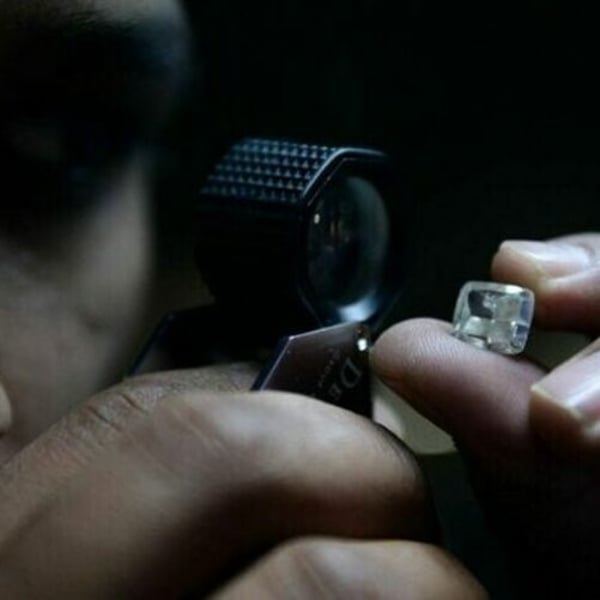
But, as consumers turn to cheaper diamonds created in China and India, the average price of a one-carat natural diamond is falling.
The price dropped from a peak of $6,819 in May 2022 to $4,997 by December 2024, according to the World Diamond Council.
Botswana, which is 70 percent desert, was lifted from poverty by the discovery of diamonds in the 1960s. It is already feeling the effects of the lab-grown competition.
– ‘Risks of economic collapse’ –
As its foreign reserves deplete, the government has turned to debt to fill the public coffers.
Government funds ran so low that the health system teetered on the verge of collapse in August, leading Boko to declare a state of emergency.
“If left unaddressed, there is a real risk of the situation becoming not just an economic challenge but a social time bomb,” he said in July.
Highlighting the fears, global ratings agency S&P on Friday dropped its long-term ratings on Botswana one notch to “BBB” and declared a negative outlook, citing the rapid expansion of the lab-diamond market.
Synthetic stones had captured “approximately 20 percent of the global market by value and up to 50 percent by volume in the US engagement ring segment in 2025,” it said in a statement.
Diversification is “essentially now or never”, Verster said.
“We don’t really see anything that would cause a monumental shift back in favour of natural diamonds to curb the rising popularity of synthetic diamonds.”
Also suffering is tiny Lesotho, where diamonds contribute up to 10 percent of its $2 billion GDP and the larger, vital textile market has been hit by US tariffs.
This month its biggest diamond mine, Letseng, said it would lay off a fifth of its workforce, citing “sustained pricing pressure” and “softer demand in key markets”.
The mine closures “could heighten risks of economic collapse”, independent economic analyst Thabo Qhesi told AFP, stressing an urgent need to explore other options, such as rare-earth resources.
In a bid to keep the sparkle alive, Angola, Botswana, Namibia, South Africa and the Democratic Republic of Congo pledged in June to allocate one percent of their annual diamond revenues to marketing natural diamonds.
The campaign would need to reframe their value as a coveted “luxury product”, former Bank of Botswana deputy governor Keith Jefferis told AFP.
“We see a significant opportunity to engage consumers in the story of responsibly sourced diamonds from Botswana,” De Beers, also taking part, told AFP.
The South Africa-British firm is meanwhile exploring the potential of synthetic diamonds in high-tech fields like quantum networks and semiconductors, as prices fall below $100 per carat.
For Botswanan ministry of minerals official Jacob Thamage, natural and lab-made diamonds “offer different value propositions to different consumers and therefore can and will coexist”.
In an upscale Johannesburg mall, behind fortified steel gates, a natural yellow diamond priced at over $50,000 stood as a symbol of exclusivity.
Just steps away, a lab-grown diamond valued at $115 was unguarded.
“We each have our target,” one jeweller said. “So long as everyone is happy.”
US and Indian trade negotiators begin two days of talks Wednesday as they try to reach a deal amid geopolitical turbulence after Washington hit New Delhi with huge tariffs over its purchases of Russian oil.
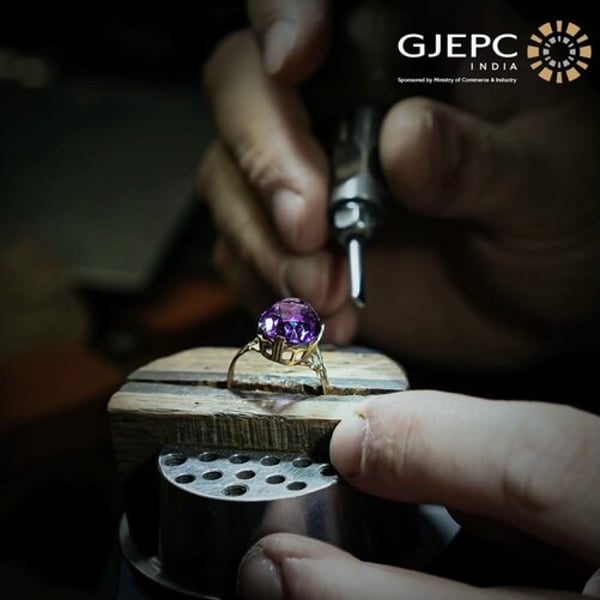
The gem and jewellery industry hopes an improved tariff rate will turn around export rates to the US – GJEPC – India- Facebook
The 50% levies on most goods was imposed in August, with US officials arguing the imports of discounted Russian crude effectively bankroll Moscow’s war in Ukraine. Deputy US Trade Representative Rick Switzer’s visit comes a week after Prime Minister Narendra Modi embraced Russian President Vladimir Putin in New Delhi.
India’s foreign ministry described Switzer’s meetings as a “familiarisation” trip. India was among the first countries to begin trade talks after President Donald Trump unveiled sweeping tariffs on most US trade partners in April. But it is one of the few major economies still without an agreement, raising risks for jobs, economic growth, and markets.
India is the world’s fastest-growing major economy and recorded a $45.8 billion goods trade deficit with the US in 2024. Large export categories such as smartphones and generic drugs are exempt from Trump’s tariffs, but many labour-intensive industries are not.
That’s a serious blow for a country already struggling to generate well-paid jobs for millions of young graduates, and the turmoil threatens Modi’s ambition to lift the country into high-income status. Exports fell nearly 12% year-on-year in October, driven by a plunge in US-bound shipments.
The Global Trade Research Initiative (GTRI) estimates that labour-heavy sectors- gems and jewellery, textiles and seafood- saw export drops of 37-60% between May and September. Foreign investors have dumped more than $16 billion in Indian equities this year, helping push the rupee to a record low past 90 per dollar.
The International Monetary Fund has also cut India’s 2026-27 growth forecast from 6.4% to 6.2%, assuming “prolonged 50% US tariffs”. Exports could shrink to about $49.6 billion this fiscal year, from $86.5 billion last year, potentially knocking up to 80 basis points off growth, according to the GTRI.
India enthusiastically bought discounted Russian crude after the 2022 invasion of Ukraine as Moscow was hammered with severe sanctions including on its sale of oil. But Trump’s decision to link trade policy to geopolitics upended US-India relations in August, with roughly half of the tariff burden stemming from Washington’s attempt to penalise those purchases.
The US president has repeatedly claimed India either plans to stop, or has already mostly stopped, buying Russian oil- a claim New Delhi has neither confirmed nor denied. But when in the Indian capital, Putin offered to “continue uninterrupted shipments of fuel.” Modi did not comment directly on oil flows.
However, top buyer Reliance Industries said in November it stopped importing Russian oil for its export-focused refinery, while smaller refiners like HPCL-Mittal Energy have said they have stopped entirely.
Analysts at trade intelligence platform Kpler expect a “notable dip” in India’s December-January imports. Whether that decline will sway Washington is unclear.
Negotiating a trade pact is complicated by the need to address Trump’s so-called reciprocal tariffs, though both tracks are linked, officials say.
“These are two separate, parallel negotiations that are going on, but one will feed into another,” Commerce Secretary Rajesh Agrawal told an industry event last week.
Relations have improved since August, with several smaller deals advancing. That includes US approval in November for two arms sales worth nearly $93 million, and New Delhi’s “significant” deal for the US to supply nearly 10 percent of its liquefied petroleum gas (LPG) imports.
Energy commitments have anchored past US trade deals, and experts say the LPG contract may help convince Washington that India is reducing its reliance on Russia.
Chanel will stage its next cruise show in Biarritz on April 28, 2026, the Paris based fashion house revealed on Wednesday.
Chanel – Courtesy
The brand will present what will be its Cruise 2026/27 collection with a runway show in Biarritz, an historic seaside resort on France’s Atlantic coast.
“Biarritz plays a fundamental role in the history of Chanel,” commented Bruno Pavlovsky, president of Chanel Fashion, in a release.
“We are delighted that Matthieu Blazy has chosen this destination, so dear to the house, to present his first vision of the Cruise collection,” he added.
The news comes just one week after Chanel’s creative director Blazy staged a highly acclaimed Métiers d’Art show in a disused New York subway station in lower Manhattan.
In 1915, buoyed by the success of her boutique in Deauville, Gabrielle Chanel set up her first couture house in the Villa de Larralde, an elegant neo feudal mansion in Biarritz. It comprised a boutique and an atelier of some 60 petites mains, or skilled artisans, where she presented her collections.
The free-spirited and sporty atmosphere of this iconic seaside resort in south-western France helped forge her vision of fashion and design, making Biarritz an essential chapter in the construction of her style, the house noted.
Outlet destinations have been among the most buoyant retail centres in recent years and on Wednesday, retail property giant Landsec provided yet more evidence of that trend.
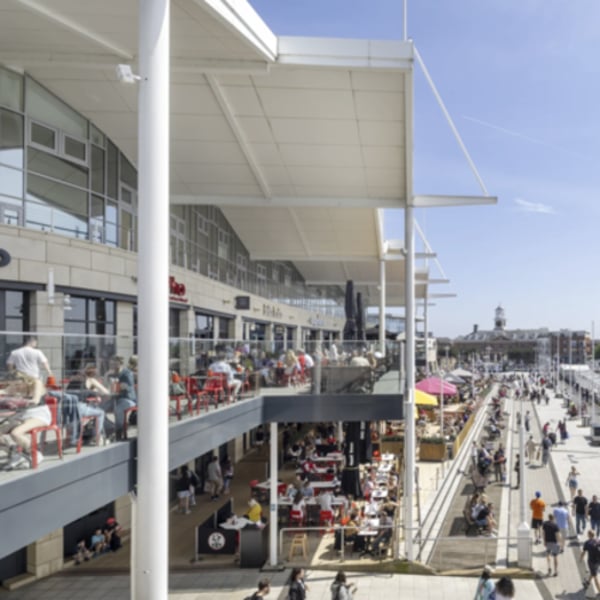
Gunwharf Quays
It said it recorded 8.1% year-on-year sales growth across its outlets during Black Friday week, continuing a year of sustained growth across its outlet portfolio, which also reported a record-breaking year in 2024.
Its outlet trio, Gunwharf Quays, Braintree Village and Clarks Village, generated a combined spend of £16.3 million across the week, with footfall up 8.6% year on year, “demonstrating the continued strength of in-person retail during key calendar moments”. But it also demonstrated just how much consumers are focused on discounts given that they visited destinations already offering discounts for the even greater markdowns available during that week.
Landsec said this “builds on a consistently strong trading performance across the outlet portfolio and follows a record-breaking year for spend across major Landsec retail destinations during the last financial year”.
Braintree Village enjoyed a record-breaking week, with Saturday seeing its highest single day of footfall since the pandemic. Clarks Village recorded its highest-ever sales day. And Gunwharf Quays saw its biggest-ever sales week, building on last year’s record. The outlet also recorded its highest-ever single-day revenue and footfall up 9.8% year on year.
The landlord added that individual store success was strong, with 25 brands achieving record sales weeks at Gunwharf Quays alone, while a further nine brands set new records on Saturday.
And what were consumers buying? Across the outlet portfolio, shoppers spent the most on health & beauty (+46% week on week), gifts, cards, toys and books (+43%), and accessories (+40%). These categories have continued to show strong momentum in 2025 across Landsec’s outlet destinations.






 Politics8 years ago