Connect with us

Business

A day in the life of the P.F. Chang’s CEO who wakes up at 4 a.m.

Published

on


“My life is my work. My work is my life.” 

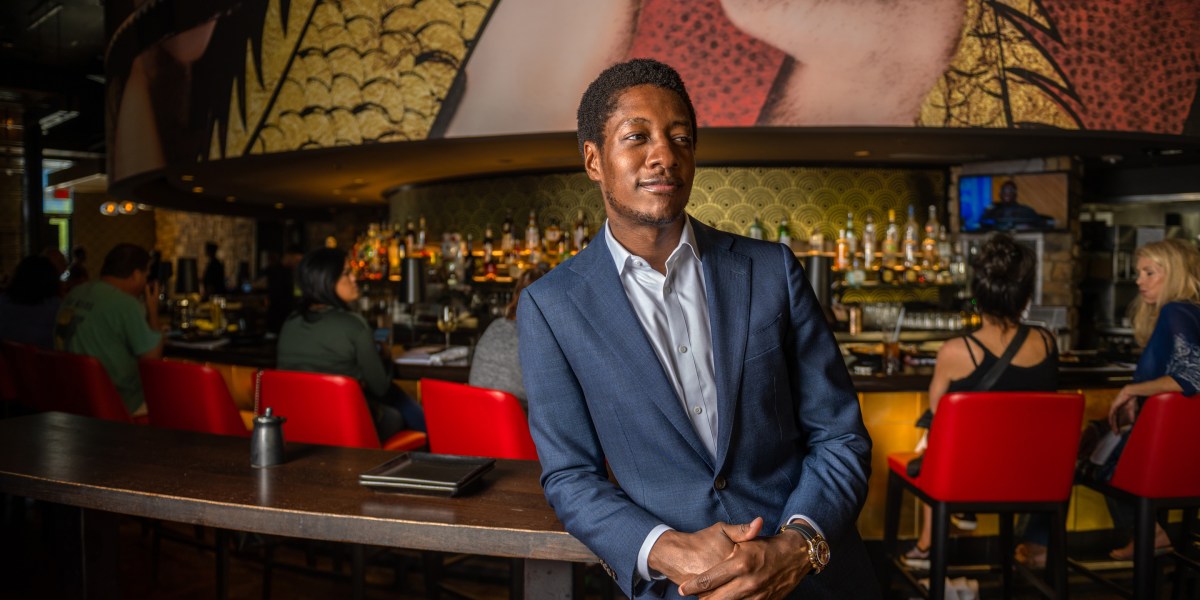
So says Damola Adamolekun, former Wall Street whiz turned CEO of casual-dining restaurant chain P.F. Chang’s. In the midst of the remote work revolution, employees worldwide have been fighting for a better work-life balance, pushing back against employer mandates to return to office and advocating for four-day workweeks. Even global superstar Rihanna recently expressed that finding “balance is almost impossible.” 

But for Adamolekun, work and life have never been separate. “I never really have been a person that separated work and life,” he tells Fortune. “It mixes.”

That might be because the 34-year-old has a lot on his plate. He’s one of the few Black CEOs leading a major U.S. company; there are only six black CEOs in the Fortune 500, and only 8% of C-suite executives are Black, according to a 2021 Washington Post analysis of the 50 most valuable companies. And Adamolekun balances running the helm with his job as a partner at Paulson & Co., the hedge fund that acquired the Asian-inspired restaurant chain in 2019.

It follows a successful career in private equity, where Adamolekun worked at top companies, including Goldman Sachs and TPG Capital. He says he dedicated his finance era to “working all the time,” even on the weekends. 

“I thought it was fun. So it wasn’t like I had to go in on a Saturday,” Adamolekun said. “It was like ‘I got stuff to do, and I want to knock it out, or I want to look at something.’” 

It’s not unlike the life of many financiers and CEOs, who are known for logging after-work hours to get the job done. He says he still works on the weekends and can sometimes be found checking emails by the pool. 

Although Adamolekun has never prioritized finding a work-life balance, he acknowledges that work impacts people differently. “It’s an individual thing,” he says, adding that you should separate the two if work is stressful. That’s why he encourages employees to build in “buffers,” taking a day off on a Tuesday or Wednesday since weekends are usually busy at the restaurant due to higher demand.

But for him, despite all the pressures of being a chief executive, “work doesn’t stress [him] out.”

Adamolekun gave Fortune a sneak peek into his daily routine, which kicks off at 4 a.m. sharp. 

From a.m. runs to p.m. cigars

4:30 a.m.: Adamolekun’s motto: “Early to bed, early up.” 

He begins his day with a seven- to eight-mile run, which he says helps him feel less stressed and more relaxed. The aerobic exercise routine stimulates his “calm, relaxed, autonomous nervous system,” Adamolekun says, unlike the sympathetic nervous system, which triggers your body’s fight-or-flight reaction.

There’s a reason you feel good when you work out, he adds: “You’ll feel better the whole day. You’ll be smarter, you’ll be sharper, you’ll be more energetic.”  

6:00 a.m.: After his run, Adamolekun showers and prepares to head to P.F. Chang’s headquarters in Scottsdale. 

Before hitting the road, he takes a few minutes in his home office to review the chain’s performance numbers from the previous day, checking to see if they aligned with the company’s expectations. 

7:00 a.m.: Adamolekun arrives at the headquarters, a 20-minute drive from his house, and casually meets with the COO and CFO before jumping into a day full of meetings. His schedule is packed with internal and external meetings. 

In between meetings, Adamolekun manages emails, prioritizing the most essential tasks to ensure employees are being met with timely approvals to move forward with their work. 

6:00 p.m.: When the day’s meetings are over, Adamolekun clears his inbox and heads home. But his workday doesn’t exactly stop there. 

As the CEO of a major restaurant chain, Adamolekun is no stranger to mixing business with dinner, often meeting with colleagues and connections after the traditional nine-to-five workday ends.   

As he puts it, “It’s a hospitality business, so a lot of dinners are involved.” 

On the occasions when Adamolekun can go straight home without any post-work affairs, he relaxes with a cigar on the patio, ending his day the same way he starts by activating his parasympathetic nervous system. 

Fortune Global Forum returns Oct. 26–27, 2025 in Riyadh. CEOs and global leaders will gather for a dynamic, invitation-only event shaping the future of business. Apply for an invitation.


Source link

Continue Reading

Business

Goldman Sachs CFO on the company’s AI reboot, talent, and growth

Published

on


Good morning. Goldman Sachs is betting big on using AI to fundamentally rethink how the company operates.

At the Goldman Sachs U.S. Financial Services Conference on Tuesday, CFO Denis Coleman discussed the company’s recently announced OneGS 3.0 initiative—a multiyear overhaul of its OneGS program aimed at integrating AI throughout the bank’s operating model to reduce complexity and boost productivity. The effort is a top priority and will involve every division and function across the company, from business lines to control functions to engineering, Coleman said. “At its core, it’s an effort to drive more scale and more growth,” he said.

Goldman Sachs (No. 32 on the Fortune 500) is emphasizing the quality, availability, accuracy, and timeliness of data that underpins all of its AI initiatives, Coleman noted. That focus includes ensuring the company invests properly in shared platforms that span the organization.

“We’re asking all of our people to rethink the human processes they go through,” Coleman said. “And then we’re making investments in AI and agentic AI to accelerate change across these processes and platforms.”

They have identified six discrete workstreams, created dedicated teams, and tasked them with reviewing key activities, analyzing pain points, and identifying opportunities for efficiency, he said. Each group will then present formal investment cases for leadership review.

“We’ll fund some of those investments and hold teams accountable for the productivity outcomes that follow,” Coleman said. “This is a fundamental rethinking of how we expect our people to operate at Goldman Sachs.”

He added, “We don’t want to simply add more manual processes to drive growth. We need to convert some of that effort into digitized and automated systems—and rethink how those engines work.” Coleman expressed optimism that the OneGS 3.0 strategy will help fuel the firm’s continued growth.

‘The bar for talent remains high’

During the discussion, Coleman also addressed the talent environment, a key concern for many CFOs. “We continue to see incredible demands for people who want to come and work at Goldman Sachs, more than a million people asking to move in laterally to the firm,” Coleman said. “We can accommodate far less than 1%, so we’re still in a position to be extremely selective on the people that we hire.” 

Goldman Sachs reduced headcount earlier in 2025 as part of its annual performance review process, which typically targets the lowest 3% to 5% of performers. The company moved that process up to the second quarter from its usual September timing. Despite those cuts, Goldman still expects a net increase in headcount by the end of 2025, supported by hiring in key growth areas.

“The bar for talent remains very high,” Coleman said. “We continue to operate as a pay-for-performance organization. Our goal is to pay competitively—especially for our very best people in each domain—and we are laser-focused on that.”

He added, “As long as markets stay buoyant and the outlook remains optimistic, maintaining that focus will be critical.”

Regarding the U.S. economic outlook, Coleman described it as “resilient and conducive to business.” He added, “We obviously have a Fed decision coming up. Our economists expect a 25-basis-point cut, likely followed by a pause at the beginning of 2026, and then possibly two more cuts.” Coleman also noted that 2025 is shaping up to be the second-biggest year in history for announced mergers and acquisitions industrywide.

SherylEstrada
sheryl.estrada@fortune.com

Leaderboard

Fortune 500 Power Moves

Kathryn A. Mikells, senior vice president and chief financial officer of Exxon Mobil (No. 8), will retire effective Feb. 1, 2026. Mikells, who has undergone several procedures to address a debilitating but non-life-threatening health issue, is stepping down to focus on her recovery, according to an SEC filing.

Mikells is among the CFOs represented on the Fortune Most Powerful Women list for 2025. She joined Exxon Mobil in 2021. Mikells is the company’s first official CFO; before her appointment, the finance duties were shared across a range of executive roles. Mikells is the first woman to join the management committee of Exxon.

On Dec. 8, ExxonMobil named Neil A. Hansen, 51, as her successor. Hansen has served as president of Exxon Mobil Global Business Solutions since May 2025 and previously held senior roles in Energy Products, Europe, Africa and Middle East Fuels, and in the company’s controllers, audit, treasury, and investor relations departments, including vice president of investor relations and corporate secretary.

Like other executive officers of the corporation, Hansen will not have an employment contract. His annual salary will be $1.02 million, and he remains eligible for performance-based bonuses and long-term equity incentives.

Every Friday morning, the weekly Fortune 500 Power Moves column tracks Fortune 500 company C-suite shifts—see the most recent edition

More notable moves

Jeff Chesnut was appointed CFO of Conestoga Energy, a provider of low-carbon intensity, effective immediately. With over 25 years of experience in strategic planning, capital markets, and finance, Chesnut will play a pivotal role in executing Conestoga’s growth strategy. Prior to joining Conestoga, Chesnut served as SVP of treasury, investor relations and corporate development at Upbound Group, Inc. (Nasdaq: UPBD). Before that, he served as EVP and CFO at publicly listed Loyalty Ventures Inc., which was a spinoff from publicly listed Alliance Data Systems, Inc. (now Bread Financial), where he spent over a decade.

James Robert “Rob” Foster was promoted to SVP of finance and CFO of ATI Inc. (NYSE: ATI), effective Jan. 1. Foster succeeds Don Newman, who will serve as strategic advisor to the CEO beginning Jan. 1. As previously announced, Newman will retire on March 1, 2026, and serve in an advisory capacity. Foster, a longtime ATI leader, most recently served as president of ATI’s specialty alloys and components business. He previously served as ATI’s VP of finance, supply chain and capital projects, overseeing the company’s global finance organization, capital deployment processes, and enterprise supply chain performance. Earlier, he led finance for both ATI’s operating segments and the forged products business.

Big Deal

The 11th annual Women in the Workplace report, released by McKinsey & Company and LeanIn.Org, examines the state of women in corporate America and Canada. This year, only half of companies are prioritizing women’s career advancement—a continuation of a multiyear decline in commitment to gender diversity. For the first time, women are less interested than men in being promoted.

One of the key findings is that sponsorship matters. “Women overall are less likely than men to have a sponsor—and entry-level women stand out for receiving far less sponsorship than any other group of women or men,” according to the report. “Even when entry-level women do have a sponsor, they’re promoted at a lower rate than men. Sponsors have a substantial impact on career outcomes: in the past two years, employees with sponsors have been promoted at nearly twice the rate of those without.”

Courtesy of LeanIn.Org and McKinsey. From the report, Women in the Workplace.

Going deeper

When Employees Feel Slighted, They Work Less” is a new report in Wharton’s business journal. New research from Wharton’s Peter Cappelli reveals how even the slightest mistreatment at work can result in lost productivity. Emphasizing respect can help companies mitigate productivity loss, according to the research. 

Overheard

“I think in the next five years, you’re going to see large sections of factory work replaced by robots—and part of the reason for that is that these physical AI robots can be reprogrammed into different tasks.”

Arm CEO Rene Haas said at Fortune Brainstorm AI in San Francisco on Monday. 


Source link

Continue Reading

Business

If the Fed cuts interest rates today it may be the last round of cheaper money until June 2026

Published

on


Enjoy your Fed interest rate cut today—it may be the last one for a while. There is a 90% certainty that U.S. Federal Reserve Chairman Jerome Powell will announce a 0.25% cut to the base rate this afternoon, bringing it down to the 3.5% level, according to speculators on the CME FedWatch Fed funds futures index. But after that, the FedWatch index is indicating no certainty for any further cuts in 2026.

Today’s cut is priced in at level of certainty approaching 90%. But here are what the levels of certainty for keeping the rate at 3.5% look like for 2026, per FedWatch:

  • January: 72.2%
  • March: 55.8% 
  • April: 47.6%

Only in June does a plurality—41.9%—emerge for a further cut to 3.25%.

Analysts are all over the place in their guesses about how many further rounds of cheaper money the Fed will deliver next year, and with good reason: President Trump is set to replace Powell with a new Fed chair in May. 

“We see the Fed cutting rates twice in 2026, with moves in March and in June,” ING’s James Knightley et alargued earlier this month. Plus, “the potential for a more dovish FOMC tilts the risks toward additional rate cuts later in the year.”

“But does this matter, given that we know the Federal Reserve’s structure is changing?” Knightley wrote.

At Deutsche Bank, the forecast is “one further 25bp cut in each of 2026 and 2027.”

Pantheon Macroeconomics’ guess is for three cuts, “We expect 75bp of easing in 2026, but fiscal policy and FOMC personnel changes cloud the outlook.”

The presumed favorite candidate for the new Fed chair is Kevin Hassett, widely regarded as a “dove” who will follow Trump’s preference for lower rates regardless of rising inflation. But there are three others in the running: Fed governors Kevin Warsh, Christopher Waller and Michelle, Bowman, and BlackRock Chief Investment Officer of Global Fixed Income Rick Rieder.

It’s not certain if the new appointee will tip the Federal Open Markets Comittee into a more dovish position (favoring more cuts) or whether the Fed’s institutional commitment to apolitical economics will prevail, which would imply a slower schedule of cuts or perhaps—if inflation continues to rise—none at all. 

ING’s Knightley noted that by the end of 2026 it is possible that “five of the seven members of the Board of Governors are Trump appointees.” The Fed is about to become much more unpredictable, in other words.

Stock markets are largely in a holding pattern today as investors wait for the rate decision. It will be Powell’s commentary— and whether he says or doesn’t say certain words—that move markets this afternoon. S&P 500 futures were flat this morning prior to the open after the index closed flat yesterday.

Here’s a snapshot of the markets ahead of the opening bell in New York this morning:

  • S&P 500 futures were flat this morning. The last session closed down marginally 0.09%. 
  • STOXX Europe 600 was down 0.12% in early trading. 
  • The U.K.’s FTSE 100 was up 0.29% in early trading. 
  • Japan’s Nikkei 225 was down 0.1%. 
  • China’s CSI 300 was down 0.14%.
  • The South Korea KOSPI was down 0.21%.
  • India’s NIFTY 50 was down 0.32%. 
  • Bitcoin was at $92K.
Join us at the Fortune Workplace Innovation Summit May 19–20, 2026, in Atlanta. The next era of workplace innovation is here—and the old playbook is being rewritten. At this exclusive, high-energy event, the world’s most innovative leaders will convene to explore how AI, humanity, and strategy converge to redefine, again, the future of work. Register now.


Source link

Continue Reading

Business

Exclusive: U.S. businesses are getting throttled by the drop in tourism from Canada: ‘I can count the number of Canadian visitors on one hand’

Published

on


From Washington state to northern New England, American businesses that have long depended on Canadian visitors are seeing traffic dry up — and with it, a crucial source of revenue.

A new report shared exclusively with Fortune by the Joint Economic Committee (JEC) – Minority, a congressional standing committee dating back to 1946 responsible for documenting the economic conditions of the U.S., details how a sharp drop in Canadian tourism is hitting every U.S. state along the northern border. The findings come as President Trump has proposed annexing Canada, imposed several rounds of tariffs on Canadian goods, and repeatedly broken off trade talks with Ottawa, contributing to a chill in cross-border travel and spending.

From January to October 2025, the number of passenger vehicles crossing the U.S.-Canada border fell by nearly 20% compared with the same period in 2024, according to the JEC analysis, which draws on U.S. Customs and Border Protection travel statistics. In some border states, the decline reached 27%, a shift that local tourism agencies say is showing up in fewer tourists, more hotel vacancies, and weaker sales.

“Going back for generations, Canadians have visited New Hampshire and many other states along the U.S.-Canada border to see family or friends, stay in our hotels, share a meal at our restaurants, and shop at our stores,” said U.S. Senator Maggie Hassan (D-NH), Ranking Member of the Joint Economic Committee. “However, in the wake of President Trump’s reckless tariffs and needless provocations, fewer and fewer Canadians are making trips to the United States, putting many American businesses in jeopardy and straining the close ties that bind our two nations.”

Canadians have historically been among the most important international visitors to the U.S., both in sheer numbers and in spending. Analysts and tourism officials note that rising prices, a weaker Canadian dollar, and heightened political tensions have nudged many travelers to choose domestic trips within Canada or alternative international destinations instead. For U.S. border communities, that shift is being felt in real time.

“These are more than numbers; they represent missed revenue for local businesses, reduced hotel demand, and fewer dollars supporting jobs and investment in our community,” said Shirley Hughes, president and CEO of Visit Fargo-Moorhead in Fargo, North Dakota, and Moorhead, Minnesota.

In northern New Hampshire, the absence of Canadian license plates is especially stark. “Being only eight miles from the border, normally Canadians make up anywhere from 15-25% of visitors. Now, I can probably count the number of Canadian visitors on one hand. I’m just trying to plug along and keep my nose above the waterline,” said Elizabeth Guerin, owner of the Fiddleheads gift shop in Colebrook, New Hampshire.

The impact stretches beyond retail and lodging into wineries and attractions that rely on cross-border regulars.

“The drop in visits from Canadian tourists has had a noticeable impact on our bottom line. With Canadians making up about 10% of our business, fewer cross-border travelers mean fewer tastings, tours, and wine sales — a ripple effect that touches our entire operation, underscoring how important cross-border tourism is to our business model,” said Scott Osborn, president and co-owner of Fox Run Vineyards in Penn Yan, New York.

Some operators worry the damage will outlast any eventual thaw in U.S.–Canada trade relations, as Canadian travelers form new habits elsewhere.

“This is long-lasting damage to a relationship and emotional damage takes time to heal. While people aren’t visiting Vermont, they’ll be finding new places to visit, making new memories, building new family traditions, and we will not recapture all of that,” said Christa Bowdish, owner of the Old Stagecoach Inn in Waterbury, Vermont.

On the West Coast, festival organizers are also feeling the pinch.

“Since March of this year, we have not only seen Canadian traffic drop drastically, but we have also seen a drop in our number of attendees at our festival this year in late September. We knew that after March, we could not rely on our Canadian business because of fear at the border and lack of understanding of what is happening with tariffs and Canada drawing a strong line of promoting Canada first,” said Kevin Coleman, executive director of SeaFeast in Bellingham, Washington.

For businesses up and down the northern border, the question now is not just when Canadians will return in force, but how much of that lost business can ever be won back.

For this story, Fortune journalists used generative AI as a research tool. An editor verified the accuracy of the information before publishing. 


Source link

Continue Reading

Trending

Copyright © Miami Select.