The sniper who assassinated Charlie Kirk is believed to have jumped off a roof and fled into a neighborhood after firing one shot and has not been identified, authorities said Thursday in disclosing they have recovered a high-powered, bolt-action rifle they believe was used in the attack and are reviewing video footage of the person they believe was responsible.
The shooter appeared to be of college age and blended in on the university campus where Kirk was killed Wednesday, said Beau Mason, the Commissioner of the Utah Department of Public Safety. It remained unclear how far the shooter has traveled, though law enforcement officials say nearby woods where the rifle was found have been secured.
Even as law enforcement officials revealed new details about an attack they called targeted, much remained unclear nearly 24 hours later, including the sniper’s identity, motive and whereabouts. Two people detained Wednesday were released after neither was determined to be connected to the shooting, but by Thursday officials expressed confidence they had tracked the shooter’s movements on campus in the run-up to it.
Kirk, a close ally of President Donald Trump, was killed in broad daylight while speaking about social issues at a Utah Valley University campus courtyard. The circumstances brought renewed attention to the escalating threat of political violence in the United States that in the last several years has cut across the ideological spectrum. The killing drew bipartisan condemnation, but a national reckoning over ways to prevent political grievances from manifesting as deadly violence seemed elusive.
The attack was captured on grisly videos circulating on social media that show Kirk speaking into a handheld microphone when suddenly a shot rings out. Kirk can be seen reaching up with his right hand as blood gushes from the left side of his neck. Stunned spectators gasp and scream before people start running away.
Trump said he would award Kirk the Presidential Medal of Freedom, the highest civilian honor in the U.S., while Vice President JD Vance and his wife, Usha, were set to visit with Kirk’s family in Salt Lake City. Vance posted a remembrance on X chronicling their friendship, dating back to initial messages in 2017, through Vance’s Senate run and ultimately praying after hearing of the shooting. Kirk played a pivotal role in setting up Trump’s second Republican administration, Vance wrote.
“So much of the success we’ve had in this administration traces directly to Charlie’s ability to organize and convene,” Vance wrote. “He didn’t just help us win in 2024, he helped us staff the entire government.”
Kirk was taking questions about gun violence
Kirk was speaking at a debate hosted by his nonprofit political youth organization, Arizona-based Turning Point USA, at the Sorensen Center courtyard on campus. Immediately before the shooting, he took questions from an audience member about gun violence.
“Do you know how many transgender Americans have been mass shooters over the last 10 years?” the person asked. Kirk responded, “Too many.”

The questioner followed up: “Do you know how many mass shooters there have been in America over the last 10 years?”
“Counting or not counting gang violence?” Kirk asked.
Then a shot rang out.
The shooter, who Gov. Spencer Cox pledged would be held accountable in a state with the death penalty, wore dark clothing and fired from a building roof some distance away.
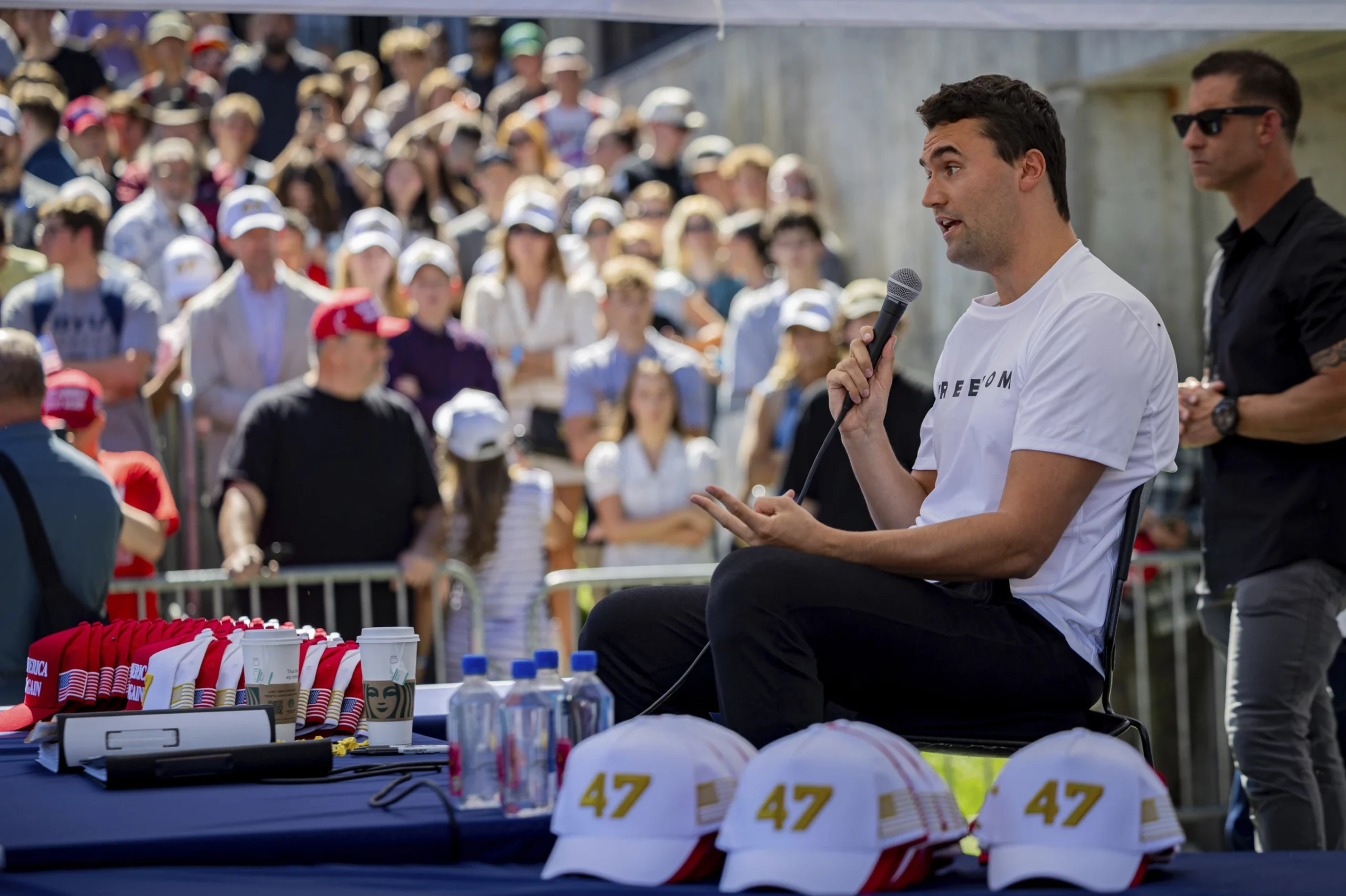
Charlie Kirk. Image via AP.
Madison Lattin was watching a few dozen feet from Kirk’s left when she heard the bullet hit him.
“Blood is falling and dripping down, and you’re just like so scared, not just for him but your own safety,” she said.
She saw people drop to the ground in an eerie silence pierced immediately by cries. She and others ran. Some fell and were trampled in the stampede.
When Lattin later learned that Kirk had died, she wept, she said, describing him as a role model who had showed her how to fight for the truth.
Trump calls Kirk a ‘martyr for truth’
About 3,000 people were in attendance, according to a statement from the Utah Department of Public Safety. The university police department had six officers working the event, along with Kirk’s own security detail, authorities said.
Trump announced Kirk’s death on social media and praised the 31-year-old co-founder and CEO of Turning Point as “Great, and even Legendary.” Later, he released a video in which he called Kirk a “martyr for truth and freedom.”
Utah Valley University said the campus was evacuated after the shooting and will be closed until Monday.
Meanwhile, armed officers walked around the neighborhood bordering the campus, knocking on doors and asking for any information residents might have on the shooting. Helicopters buzzed overhead.
Wednesday’s event, billed as the first stop on Kirk’s “The American Comeback Tour,” had generated a polarizing campus reaction. An online petition calling for university administrators to bar Kirk from appearing received nearly 1,000 signatures. The university issued a statement last week citing First Amendment rights and affirming its “commitment to free speech, intellectual inquiry, and constructive dialogue.”
Last week, Kirk posted on X images of news clips showing his visit was sparking controversy. He wrote, “What’s going on in Utah?”
Condemnation from across the political spectrum
The shooting drew swift bipartisan condemnation as Democratic officials joined Trump, who ordered flags lowered to half-staff and issued a presidential proclamation, and other Republican allies of Kirk in decrying the violence.
“The murder of Charlie Kirk breaks my heart. My deepest sympathies are with his wife, two young children, and friends,” said Gabrielle Giffords, the former Democratic congresswoman who was wounded in a 2011 shooting in her Arizona district.
In a joint statement, the Young Democrats of Connecticut and the Connecticut Young Republicans called the shooting “unacceptable.”
“There is no place in our country for such acts regardless of political disagreements,” they said.
Turning Point was founded in suburban Chicago in 2012 by Kirk, then 18, and William Montgomery, a Tea Party activist, to proselytize on college campuses for low taxes and limited government. It was not an immediate success.
But Kirk’s zeal for confronting liberals in academia eventually won over an influential set of conservative financiers.
Despite early misgivings, Turning Point enthusiastically backed Trump after he clinched the GOP nomination in 2016. Kirk served as an aide to Donald Trump Jr. during the General Election campaign.
Soon, Kirk was a regular presence on cable TV, where he leaned into the culture wars and heaped praise on the then-President. Trump and his son were equally effusive and often spoke at Turning Point conferences.
___
Republished with permission of The Associated Press.
City Hall aide Monica Matteo-Salinas just won a four-year term on the Miami Beach Commission, outpacing a better-funded but controversy-laden opponent in a runoff for the panel’s Group 1 seat.
With all precincts reporting, a full tally of early votes and a partial count of mail-in ballots, Matteo-Salinas had 71% of the vote to defeat Republican lawyer Monique Pardo Pope.
She’ll succeed fellow Democrat Kristen Rosen Gonzalez, who must leave the city’s seven-member governing body after an unsuccessful mayoral run.
Matteo-Salinas said in a statement that she is “deeply grateful” Miami Beach voters trusted her to represent their interests on the City Commission.
I ran for this seat because I love our city — because my children, and every child in our community, deserve to grow up in a Miami Beach we can be proud of, and because our residents deserve a city government that truly works for them. I am inspired every day by the people who make Miami Beach so special: families, seniors, small business owners, first responders, and neighbors from every background who care deeply about our community,” she said.
“I promise to always listen, solve problems, and deliver on the issues that matter most. This victory belongs to everyone who believes in a Miami Beach that protects its neighborhoods, invests in its future, and reflects the values of the community we love. I am ready to get to work.”
Tuesday’s runoff sharpened into a choice between two contrasting résumés, platforms and campaign narratives, along with late-cycle revelations about Pardo Pope, one of which drew national headlines.
Matteo-Salinas, 46, consolidated establishment support for her campaign, which centered on promises to work on expanding trolley service, increase the city’s affordable housing index and establish a new “water czar” position in the city, paid by resort taxes.
She’s received endorsements from several local political notables, including Miami-Dade County Mayor Daniella Levine Cava, Miami Beach Commissioners Alex Fernandez, Laura Dominguez and Tanya Bhatt, and former Miami Beach Dan Gelber.
Groups backing her bid include the Miami Beach Fraternal Order of Police, LGBTQ groups SAVE Action PAC and Equality Florida Action PAC, and the public safety-focused neighborhood group SOBESafe.
The Miami-Dade Democratic Party also celebrated Matteo-Salinas’ double-digit victory Tuesday, calling it “a monumental victory with profound implications for every community across Miami-Dade.”
(L-R) Monica Matteo-Salinas and Monique Pardo Pope. Images via the candidates.
Pardo Pope, 45, centered her messaging on public safety, investing in mental health, backing school choice initiatives, supporting homelessness services, encouraging “smart, thoughtful development” that preserves Miami Beach’s character while addressing flooding and roadway congestion, and alleviating cost-of-living issues for longtime residents and first-time homebuyers through “fair taxation.”
She touted her guardian ad litem work as evidence of her temperament and commitment to service, but that part of her record came under scrutiny in recent weeks. A review of Pardo Pope’s case records with the Miami-Dade Clerk’s Office showed her listed as a guardian ad litem in just three cases — one of which she was discharged from after trying to get the mother in the case jailed.
She was also the subject of negative attention for omitting that her father was the convicted, Nazi-adoring serial killer Manuel Pardo, to whom she wrote several loving social media posts.
Pardo Pope has said she forgave her dad to move forward with her life, asking voters to judge her on her own life and work.
She is also the target of a Florida Bar inquiry for falsely claiming that documentarian Billy Corben, who was the first to reveal her father’s identity, lost a defamation lawsuit.
Her backers included the Miami-Dade Republican Party, Miami-Dade Commissioner René García, Rep. Alex Rizo, former Miami Beach City Attorney Jose Smith, Miami Realtors PAC, Venezuelan American Republican Club and Teach Florida PAC, a Jewish education group.
Two of her former Group 1 opponents, Daniel Ciraldo and Omar Gimenez, also endorsed her.
Matteo-Salinas raised about $133,000 and spent $82,000 by Dec. 4. Pardo Pope raised about $190,000 — of which 29% was self-given — and spent close to $170,000.
Matteo-Salinas finished first in Miami Beach’s General Election last month with 23.2% of the vote. Pardo Pope advanced with 20.1% after narrowly avoiding a recount.
They outpaced four other candidates, but neither captured a large enough share of the vote — more than 50% — to win outright.
Delray Beach Commissioner Rob Long is bound for state office after winning a Special Election for House District 90.
Long captured 63% of the vote to defeat Republican lobbyist Maria Zack and independent businesswoman Karen Yeh, who took 35% and 1% of the vote, respectively.
He will now finish the term of Democratic state Rep. Joe Casello, who died in July, and again face voters next November if he seeks re-election.
“I am humbled and grateful for the support of the people of District 90, and I’m ready to get to work,” Long said in a statement.
“Joe Casello was a dedicated public servant who always put this community first. I intend to continue his legacy by fighting every day to make life more affordable, support our first responders, strengthen our public schools, keep our neighborhoods safe, and protect our environment. Voters sent a clear message tonight: they want a representative who will stand up for them and deliver results.”
HD 90 is a Democratic-leaning district in Palm Beach County that spans Boynton Beach, Delray Beach, Golf, Gulf Stream, Briny Breezes and parts of Highland Beach, Manalapan and Ocean Ridge.
Voters had starkly different options on Tuesday’s Special Election ballot.
Long, a civil engineer, ran on his record in local government and environmental work. He emphasized public safety, infrastructure, redevelopment and water quality as his primary issues, highlighting his past service on the Palm Beach Soil & Water Conservation District and role on the Palm Beach Transportation Planning Agency Board.
He also significantly outraised his opponents. Through Dec. 4, Long and his political committee reported collecting close to $152,000 and having roughly $91,000 on hand, drawing support from labor groups, environmental and LGBTQ organizations, police and firefighter unions, trial lawyers and business interests like Associated Industries of Florida and the Florida Association of Realtors.
Florida Rising, a progressive organization that endorsed Long and phonebanked and door-knocked on his behalf, celebrated his victory with a statement.
“Rob Long has won decisively — and voters made themselves heard loud and clear: they want a champion in Tallahassee who legislates for people, not for corporate interests,” said the group’s Chief Advocacy and Political Officer, Moné Holder. “In a moment when the GOP/MAGA supermajority has repeatedly shown its disregard for working families by governing for billionaires and spreading false narratives, Long’s win signals the beginning of a new and desperately needed chapter in the capital.”
The Florida Democratic Legislative Campaign Committee (DLCC) said the race’s outcome “sets the tone” for a fruitful 2026 for progressives.
“His win sends a clear message from voters that Florida’s working families are paying attention and they’re ready to vote for Democratic state leaders who are fighting to address the issues they care about,” DLCC President Heather Williams said in a statement. “The DLCC will carry this momentum into 2026 as we flip seats in red, blue, and battleground areas.”
Long’s backers included every Democratic legislator from Palm Beach County and several members of Congress. House Democratic Leader Fentrice Driskell and her successor in the post, Parkland Rep. Christine Hunschofsky, shared comments welcoming Long to their caucus.
“We’ll never forget our friend Joe Casello, and I know Rob Long will honor his legacy of service with the same passion and dedication,” Driskell said. “We are eager to welcome him to the Caucus and get to work delivering real results for Floridians.”
Hunschofsky said long ran “an excellent race, focused on issues that actually matter to families.”
“His experience in local government means he will be an important voice with common-sense solutions to Tallahassee. Floridians are overwhelmed by the affordability crisis that is making everything more expensive. The people want solutions and they want them now,” she said. “I know Rob is up for the task, but he has some big shoes to fill. Joe Casello was a good man and an excellent leader for his community.”
At one point, Long’s list of supporters also included Republican businessman Bill Reicherter, whom Zack narrowly defeated in the GOP Primary in late September.
Reicherter endorsed Long in early October after telling the South Florida Sun-Sentinel that Zack is a “single-issue conspiracy theorist.” But in a late-breaking press release Zack’s campaign published last week, Reicherter apparently reversed his position, urging voters to back her instead and criticizing Long’s record on public safety and city priorities.
Zack, a longtime lobbyist and founder of The Strollo Group, leaned into a hard-right platform centered on eliminating property taxes, “stopping the harm of illegal immigration” and expanding school choice. She also promises to support law enforcement.
Her campaign materials showcase photos with national Republican figures and endorsements from former U.S. House Speaker Newt Gingrich and anti-abortion group Florida Right to Life.
She also brought heavy baggage into Election Day. Zack’s nonprofit, Nations in Action, has promoted debunked claims that satellites over Italy helped hack U.S. voting machines in 2020 — a QAnon-linked theory known as “ItalyGate” — and claimed to have uncovered evidence to “shadow government” conspiracies to “depopulate countries through a COVID attack.”
Zack, who is credited as a “conspiracy theorist” in the 2024 film, “Stopping the Steal,” has said she “can’t tell” who really won that election, but assumes it was Donald Trump.
Her campaign finance reporting has also drawn scrutiny. Initial filings showed tens of thousands of dollars in spending that wasn’t backed by reported contributions or loans, an apparent violation of state law barring campaigns from operating in the red.
Zack later amended her reports to add nearly $32,000 in self-loans and called the discrepancy a bookkeeping mistake.
Zack raised about $82,000 directly, more than 40% of which came from her bank account, with the rest coming from out-of-state donors and high-profile supporters like former Trump spouse Marla Maples.
Yeh, meanwhile, raised $1,900, of which all but $700 went to a qualifying fee. She ran on a promise to support legislation that expands affordable housing and cracks down on property title fraud.
First-time candidate Rolando Escalona just denied perpetuating a Miami political dynasty.
With all precincts reporting, a full tally of early votes and a partial count of mail-in ballots, Escalona took 53% of the vote in a runoff race, defeating former City Commissioner Frank Carollo for a seat on the panel long held by the Carollo family.
Escalona, who moved to Miami from Cuba 11 years ago, will succeed outgoing Commissioner Joe Carollo, Frank’s brother, in representing District 3, which spans Little Havana, East Shenandoah, West Brickell and parts of Silver Bluff and the Roads.
“Tonight, the people of District 3 made history and sent a powerful message that our future belongs to those who put residents first, not political dynasties. I am humbled and deeply grateful to the voters who believed in a new generation of leadership, in accountability, in transparency — and in the promise that City Hall can once again work for the people it serves,” Escalona said in a statement.
“My journey from arriving in Miami with nothing, to earning the opportunity to represent this community I love, is only possible because of the trust and support of neighbors across Little Havana, East Shenandoah, The Roads, and beyond. Now the real work begins: restoring integrity, fixing what’s broken, ensuring safer streets, improving city services, and helping every family and small business in District 3 thrive. I am ready to serve, ready to listen, and ready to deliver results on day one.”
The contest was marked by unusual turbulence, as both candidates faced eligibility challenges that threatened to knock them off the ballot.
Escalona survived a residency challenge in October after a rival candidate accused him of faking his address. A Miami-Dade Judge rejected the claim following a detailed, three-hour trial that examined everything from his lease records to his Amazon orders.
And after the Nov. 4 General Election — when Carollo took about 38% of the vote and Escalona took 17% to outpace six other candidates — Carollo cleared his own legal hurdle when another Judge ruled he could remain in the race despite the city’s new lifetime term limits that, according to three residents who sued, should have barred him from running again.
The plaintiffs have since filed a motion to appeal the ruling, which found that removing Carollo from the ballot would be unconstitutional and disenfranchise voters who supported both him and the referendum that led to the new term limits.
Escalona, 34, insisted voters were ready to move on from the chaos and litigation surrounding Joe Carollo, whose tenure included a $63.5 million judgment against him for violating the First Amendment rights of local business owners and the cringe-inducing firing of a Miami Police Chief, among other controversies.
A former busboy who rose through the hospitality industry to manage high-profile Brickell restaurant Sexy Fish while also holding a real estate broker’s license, Escalona ran on a promise to bring transparency, better basic services, lower taxes for seniors and improved permitting systems to the city.
He vowed to improve public safety, support economic development, enhance communities, provide more affordable housing, lower taxes and advocate for better fiscal responsibility in government.
Carollo, a 55-year-old CPA by trade, argued the district needs an experienced leader. He pointed to his record balancing budgets and pledged a residents-first agenda focused on safer streets, cleaner neighborhoods and responsive government.
He was the top fundraiser in the District 3 race this cycle, amassing about $501,000 between his campaign account and political committee, Residents First, and spending about $389,500 by the last reporting dates.
Escalona, meanwhile, reported raising close to $109,000 through his campaign account and spending all but $6,000 by Dec. 4.