Connect with us

Business

Target was hoping for a back-to-school sales bump that never game. Foot traffic is still down for the 7th month in a row

Published

on


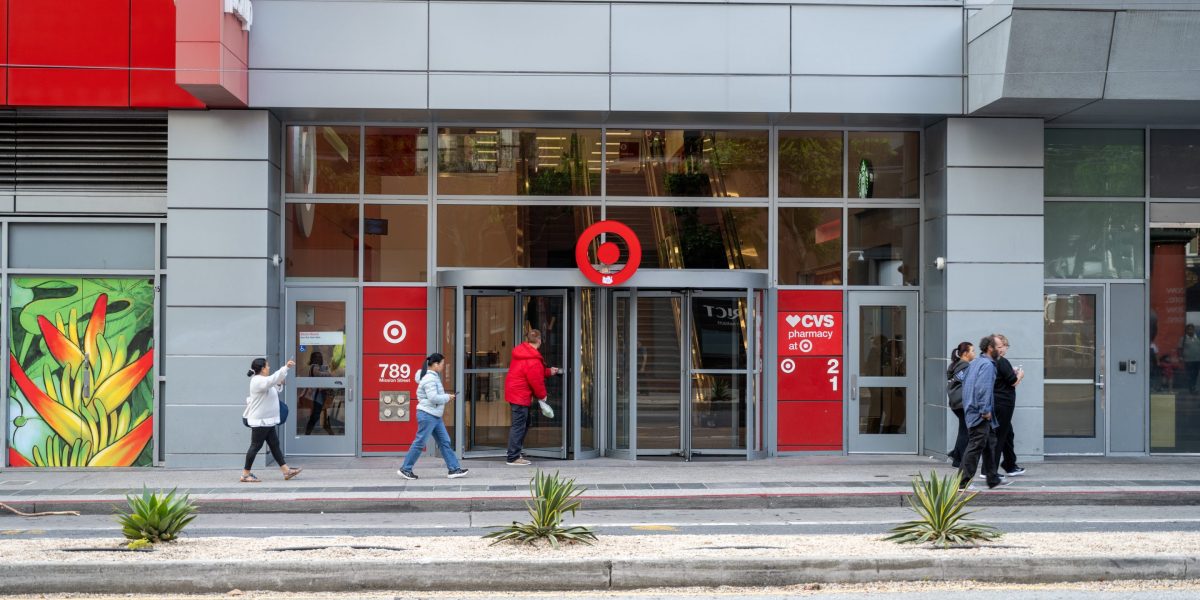
Target hoped for a back-to-school shopping bump, but foot traffic fell for the seventh straight month in August, and now a national teacher’s union has joined a boycott against the retailer.

In August, foot traffic fell 3.3% year over year for Target, with the week beginning August 25 (which included the long Labor Day weekend) dropping 4.6%, marking its worst weekly decline in seven weeks, according to data from Placer.ai.

At Target rival Costco, foot traffic was up 5.2% YoY for August, while Walmart was slightly down 0.6%.

On Labor Day, both the American Federation of Teachers (AFT) and the Chicago Teachers Union (CFT) announced they were joining the boycott against Target over it rolling back some diversity, equity, and inclusion (DEI) efforts earlier this year. The boycott, which was spearheaded by black clergy, began in March.

“We rarely engage in this type of action, but we’re doing so here because Target betrayed promises to communities of color throughout the United States,” AFT President Randi Weingarten said in a statement.

On January 23, President Trump vowed to “abolish all discriminatory diversity, equity, and inclusion nonsense,” and Target announced the next day it was ending some DEI initiatives, which Weingarten didn’t think was a coincidence.

“Target rolled back promises to help the people who have been loyal customers, because of a president who is trying to roll back history and ignore the struggle for freedom and justice,” Weingarten said. “Those customers, who have helped Target’s bottom line, now feel set aside, ignored, and dismissed.”

The Chicago Teachers Union added in a statement that it “stands in solidarity with the boycott of Target, recognizing the rollback of its DEI initiatives as part of a broader ideological attack on equity.”

The country’s second-largest teachers union behind the National Education Association, AFT represents about 1.8 million teachers and other workers; the CFT represents about 30,000.

Target did not respond to a request for comment about the foot traffic decline and teacher boycott.

Class struggle: More than 9 in 10 teachers spend their own money on classroom supplies, according to the National Education Association. For the current school year, teachers will spend an average of $895 out of pocket for school supplies, up from $600 in 2015, according to a national survey by AdoptAClassroom.org.

Back-to-school is Target’s “second-biggest season of the year,” behind the holidays, Rick Gomez, EVP and chief commercial officer at Target, said in a June earnings call. In a June report about Target possibly staging a “comeback” during the then-upcoming back-to-school season, Placer.ai said that August historically has been the retailer’s second-biggest month—after December—for store visits.

In a “Teacher Appreciation” section on its website, Target highlights incentives for teachers to buy supplies, including half-price subscriptions ($49) for annual membership to its Target Circle 360 loyalty program, exclusive discounts, and a wishlist tool to build “your dream classroom.”

The retailer also has a “Gift Ideas for Teachers” section with more than 500 items.

“Thanks, Teach!” Target’s website enthuses. “Show a little love to the ones who have taught you the most.”

This report was originally published by Retail Brew.

Fortune Global Forum returns Oct. 26–27, 2025 in Riyadh. CEOs and global leaders will gather for a dynamic, invitation-only event shaping the future of business. Apply for an invitation.


Source link

Continue Reading

Business

Paul Newman and Yvon Chouinard’s footsteps: More ways for CEOs to give it away in ‘Great Boomer Fire Sale’

Published

on


The most radical act in capitalism today isn’t launching a unicorn startup or orchestrating a multi-billion-dollar IPO – it’s giving your company away in service of good.

While some business leaders are focused on how to make their fortunes in AI or crypto, others are choosing to walk away with nothing except what matters most: a philanthropic annuity to cement their legacy. As the President and CEO of one of the most famous brands that gives 100% of its profits away, I am hearing from more and more CEOs and business owners who want to follow in Paul Newman or Yvon Chouinard’s footsteps. These leaders spent decades building profitable enterprises and are now working to transfer ownership of their companies, not to the highest bidder, but to foundations, nonprofits, purpose-driven trusts, or to their employees.

An estimated 2.9 million private U.S. businesses are owned by those over 55. Over the next 20 years, the Great Wealth Transfer and “The Great Boomer Fire Sale” is a unique opportunity to reimagine business exits as an act of generosity. 

Why give away your business? A generosity exit allows you to maximize your giving through an engine that will keep generating profits every year, creating a philanthropic annuity, while preserving the company, its employees, and the culture built over decades. Besides, conventional exit options may not be a great fit for your values if you’ve spent decades investing in your employees and your community. Selling to private equity or another business could mean layoffs and a decimated culture. Not all owners have family heirs who want or can take over. Going public is only available to the biggest businesses and subjects your life’s work to quarterly earnings pressures and the short-term thinking that comes along with it. Purpose and legacy can be more important than a big check at the end of your life, especially if you already made good money throughout your life’s work. 

As the baby boomer generation looks to the legacy they want to leave behind, Millennials and Gen Z look ahead to the legacies they want to build, with some founding successful companies where giving 100% of their profits away is baked in from the beginning. Entrepreneurs like John and Hank Green of The Good Store, and Adam McCurdie and Joshua Ross of Humanitix, are challenging the critics of the ‘business for good’ model by showing that you can grow a successful business while simultaneously giving away all profits.

The good news for those interested in giving away their business? There are now more governance models available than ever before. 

Choosing the Right Structure for Your Exit

Through the passage of the Philanthropic Enterprise Act in 2018, foundations can now own 100% for-profit companies in the US. Newman’s Own Foundation is an example of this. As a result, one hundred percent of profits and royalties from sales of Newman’s Own products go to the Foundation in service of its mission: to nourish and transform the lives of children who face adversity. 

Patagonia uses a perpetual purpose trust, a type of steward-owned ownership which is more common in Europe. Since 2022, the trust holds 100% of the company’s voting stock to ensure its environmental mission and values are preserved indefinitely, while profits are funnelled to a 501c(4), Holdfast Collective to give away to climate causes. These models create what economists call “lock-in effects” allowing owners to keep mission front and center, even when they’re gone.

Over 6,500 U.S. companies are now fully or part-owned by their workers, using Employee Stock Ownership Plans (ESOPs), including Bob’s Red Mill and King Arthur Baking Company. These models support business continuity and create thousands of employee-owners who are invested in the company’s long-term success. While in many cases, these exits are financed through loans, there’s nothing stopping an owner from giving the business to their workers.

You can also look at hybrid models. For example, Organic Grown Company uses a perpetual purpose trust to ensure profits are split between equity investors, employees, growers, and nonprofits.

And while a business owner may decide to establish their own foundation, why reinvent the wheel? There are plenty of existing foundations and non-profits who could be worthy recipients if you want to give your company away. Back in 2011, Amar Bose gave the majority of the stock of the sound system company Bose corporation to his alma mater, the Massachusetts Institute of Technology in the form of non-voting shares.

What’s Next? 

This holiday season is upon us, and whether you own a business or not, it’s a good time to reflect on what matters most: What are your values? How much money is enough for yourself and your family? What does legacy mean to you?

For CEOs and owners considering a generosity exit, the first step is to assemble the right team: attorneys experienced in foundation-ownership, purpose trusts, or ESOPs, financial advisors who understand tax implications of these unique paths, independent directors or trustees who share your vision. Organizations like 100% for Purpose, Purpose Trust Ownership Network, and Purpose Foundation can provide resources and case studies.

Start mapping out your plan, and be patient as a transition could take years, not months. Yvon Chouinard spent two years structuring Patagonia’s transition. While Paul Newman decided from the beginning to give all of the food company’s profits away back when it began in 1982, the first few years were just him writing checks at the end of the year. A foundation was initially established in 1998, and became Newman’s Own Foundation before Paul’s death, at which point the food company was gifted to the Foundation. The complexity isn’t just legal—it’s emotional, relational, and cultural, but ideally, the transition can happen while you’re still actively involved, can steward the shift, and can see the rewards of your hard labor pay dividends for good. 

In this day and age of robots and artificial intelligence, it’s good to remember Paul Newman’s wise words: “Corporations are not inhuman money machines. They must accept that they exist inside a community. They have a moral responsibility to be involved. They can’t just sit there without acknowledging that there’s stuff going on around them.”

Building a profitable company is hard but what’s truly meaningful is to let them go in service of good. In doing so, we allow our work to live on in ways that matter far beyond the balance sheet.

The opinions expressed in Fortune.com commentary pieces are solely the views of their authors and do not necessarily reflect the opinions and beliefs of Fortune.


Source link

Continue Reading

Business

Millionaire YouTuber Hank Green tells Gen Z to rethink their Tesla bets—and shares the portfolio changes he’s making to avoid AI-bubble fallout

Published

on


For years, YouTube star Hank Green has stuck to the same straightforward investing wisdom touted by legends like Warren Buffett: Put your money in an S&P 500 index fund and leave it alone.

It’s advice that has paid off handsomely for millions of investors: this year alone, the index is up roughly some 16%, and averaged more than 20% in gains over the last three years and roughly 14.6% over the past two decades. In most cases, it’s easily beaten investors who try to pick individual stocks like Tesla or Meta.

But as Wall Street frets over a possible AI-driven bubble—with voices from  “Big Short” investor Michael Burry to economist Mohamed El-Erian sounding alarms—Green isn’t waiting around to see what happens. He’s already rethinking how much of his own wealth is tied to Big Tech.

A major reason: The S&P 500 is more concentrated than ever. The top 10 companies—including Nvidia, Apple, Microsoft, Amazon, Google, and Meta—make up nearly 40% of the entire index. And nearly all of them are pouring billions into AI.

“I feel like my money is more exposed than I would like it to be,” Green said in a video that’s racked up over 1.6 million views. “I feel like by virtue of having a lot of my money in the S&P 500, I am now kind of betting on a big AI future. And that’s not a future that I definitely think is going to happen.”

So Green is hedging. He’s taking 25% of the money he previously invested in S&P 500 index funds—a meaningful chunk for a self-made millionaire—and moving it into a more diversified set of assets, including:

  • S&P 500 value index funds, which tilt toward companies with lower valuations and less AI-driven hype.
  • Mid-cap stocks, which he believes could benefit if smaller firms catch more of AI’s productivity gains.
  • International index funds, offering exposure outside the U.S. tech-heavy market.

Green’s thesis is simple: even if AI transforms the economy, the biggest winners may ultimately not be the mega-cap companies building the models.

“I think that these giant companies providing the AI models will actually be competing with each other for those customers in part by competing on price,” Green said. “And that might mean that the value delivered to small companies will be bigger than value delivered to the big AI companies. Who knows though? I just think that’s a thing that could happen.”

And if his concerns are overblown? He’s fine with that, too.

“If I’m wrong, 75% of my money is still in the safe place that everybody says your money should be, which is the S&P 500.”

YouTuber’s message to his Gen Z and Gen Alpha viewers: The stock market isn’t a ‘Ponzi scheme’

Gen Z continues to trail other generations in financial know-how—from saving and investing to understanding risk, according to TIAA. Moreover, one in four admit they are not confident in their financial knowledge and skill—a stark admission considering that 1 in 7 Gen Z credit card users have maxed out their credit cards and many young people hold thousands in student loan debt.

As a self-described “middle-aged, 45-year-old successful person,” Green said he’s trying to model what thoughtful, long-term decision-making actually looks like. And part of that effort includes dispelling one big misconception shared among some of his audience:

“I get these comments from people who are like, I can’t believe that you’re participating in this Ponzi scheme,” Green told Fortune. “I do want to alienate those people, because I don’t believe that the stock market is a Ponzi scheme. I do think that it’s overvalued right now, but I think that it’s tied to real value that’s really created in the world.”

His broader point: Investing isn’t about vibes or just dumping money into the hot stock of the week; rather, it’s something to seriously research.

“A lot of people think that investing is like getting a Robinhood account and buying Tesla,” Green added. “And I’m like, ‘Nope, you’ve got to get a Fidelity account and buy a low cost index fund everybody and or just keep it in your 401K and let the people who manage it manage it’—which is what a lot of people do, which is also fine.”

His younger viewers are paying attention. One popular comment summed it up: “As a young person entering the point in my life where I’m starting to think about investing, I really appreciate you talking through your logic and giving a ton of disclaimers rather than telling me I should buy buy buy exactly what you buy buy buy.” The comment has already racked up more than 4,700 likes.

Financial advisors agree: Portfolio diversification is king

While Green doesn’t come from a financial background, experts from the world of investing said they agree largely with his rationale: Having a diversified portfolio is the way to go—especially if you have worries about an AI bubble.

“Unlike many dot-com companies, today’s tech giants generally have substantial revenue, cash reserves, and established business models beyond just AI,” certified financial planner Bo Hanson, host of The Money Guy Show, said in a video analyzing Green’s take.

“Still, the concentration risk remains a valid concern for investors that are seeking diversification. However, this is precisely why we advise against putting all investments solely in the S&P 500, especially if you have a shorter time horizon.”

Hanson added wise investors spread their money across various asset classes, including small-caps, international, and bonds, in order to reduce portfolio volatility and provide

more consistent returns across various market environments.

It’s sentiment echoed by Doug Ornstein, director at TIAA Wealth Management, who said it’s important to realize that not every investment needs to chase growth.

“Particularly as you get older, having guaranteed income streams becomes crucial. Products like annuities can provide reliable payments regardless of market swings, creating a foundation of financial security,” Ornstein told Fortune. “Think of it as building a floor beneath your portfolio—one that market volatility can’t touch.”


Source link

Continue Reading

Business

Warren Buffett: Business titan and cover star

Published

on


Warren Buffett’s face—always smiling, whether he’s slurping  a milkshake, brandishing a lasso, or palling around with fellow multibillionaire Bill Gates—has graced the cover of Fortune more than a dozen times. And it’s no wonder: Buffett has been a towering figure in both business and 

investing for much of his—and Fortune’s—95 years on earth. (The magazine first hit newsstands in February 1930; Buffett was born that August.) As Geoff Colvin writes in this issue, Buffett’s investing genius manifested early, and he bought his first stock at age 11. By Colvin’s calculations, over the 60 years since Buffett took control of his company, Berkshire Hathaway, its returns have outpaced the S&P 500 by more than 100 to one.  

Buffett has always had a special relationship with Fortune, particularly with legendary writer and editor Carol Loomis, who profiled him many times, and to whom he broke the news of his paradigm-shifting moves in philanthropy in 2006 and 2010. The end of an era is upon us, as Buffett on Dec. 31 will step down from his role as Berkshire’s CEO. We’re grateful to have been along for the ride. 

Warren Buffett on the cover of Fortune in 2009 and 2010.

Cover photographs by David Yellen (2009), and Art Streiber (2010)

Warren Buffett on the cover of Fortune in 2003 and 2006.

Cover photographs by Michael O’Neill (2003), and Ben Baker (2006)

Warren Buffett on the cover of Fortune in 2001 and 2002.

Cover photographs by Michael O’Neill

Warren Buffett on the cover of Fortune in 1986 and 1998.

Cover photographs by Alex Kayser (1986) and Michael O’Neill (1998)


Source link

Continue Reading

Trending

Copyright © Miami Select.