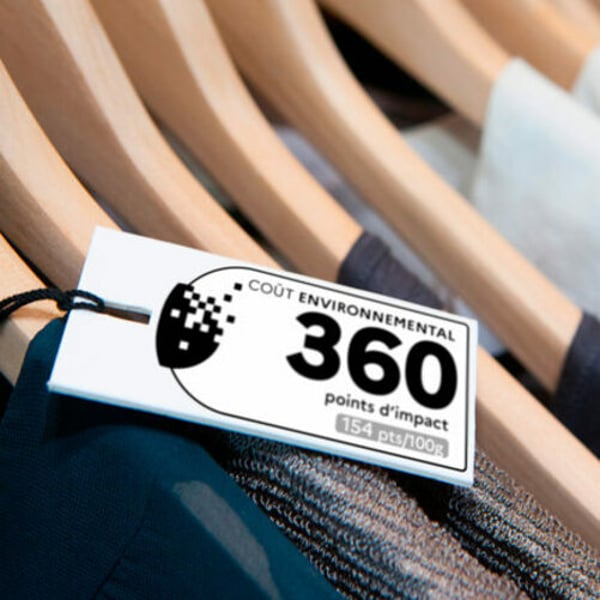
The environmental scoring system for France’s apparel distribution sector is taking shape. Validated by the European Union in May, the decree on environmental labelling was published in the Journal Officiel on September 6 and will be applied starting October 1.
FashionNetwork/Shutterstock
This step was eagerly anticipated not only by the brands themselves, but also by the many service providers specializing in environmental scoring. These providers will be able to handle the complex impact assessments of garments on behalf of brands—or even independently. If a brand fails to publish its own score, the legal framework allows third parties to do so without the brand’s consent.
This aspect has been a subject of controversy for many months. Brands argue that service providers may lack access to reliable data, making scores inaccurate or misleading. French authorities explain that this provision is intended to encourage brands to publish their own data, as brand-calculated scores will legally supersede those from third parties.
In any case, brands have a grace period: starting September 15 and for a duration of one year, only brands can declare an eco-score on the official portal. After that deadline, third parties will be allowed to publish a score on their behalf, even without their prior approval.
According to some in the industry, this mechanism could serve as an indirect way of making environmental labelling mandatory.
The industry is also questioning whether subsidies could eventually be tied to environmental labelling, making its supposedly “voluntary” nature debatable. Manufacturers, in particular, point to the “Texhabi” eco-design aid from Ademe (the French Agency for Ecological Transition), which already requires the use of Ecobalyse—the calculation platform underlying the new labeling system.
Complex calculations and contested averages
It’s important not to confuse the French eco-score with the European “PEF” score, which is now intended for professional use only. France’s eco-label is based on 17 factors: product type, weight, whether the item is remanufactured, number of SKUs and price, company size, origin and nature of materials, and manufacturing locations—covering spinning, weaving, knitting, finishing, printing, garment making, washing—as well as transport and accessories such as buttons, zippers, and underwiring.
Each of the 16 environmental impact categories is factored into the final score using a system of normalization and weighting coefficients. – Journal Officiel
Each of the 16 environmental impact categories is factored into the final score using a system of normalization and weighting coefficients.
In the absence of data, an average based on equivalent products is applied to the calculation. This remains a point of contention between public authorities and the textile and clothing industry, which believes that less sustainable actors could exploit this provision to artificially improve their scores by claiming a lack of data.
Understanding the score
In addition to the initially planned impact score, a score per 100 grams of product was added late in the process—similar to how food products display price per kilo. The higher the score, the lower the item’s environmental impact.
Pascal Dagras, who oversees the display project for the French government, indicated in spring that a public campaign explaining the eco-score will launch in early 2026 under Ademe’s leadership. In the meantime, brands are expected to educate their own customers, as the score remains obscure to many consumers.
Until this awareness grows, October 1 marks a clear regulatory milestone: all previous environmental scores displayed by brands that do not align with the new methodology will be considered non-compliant. This also raises the issue of reconciling the French system with the European PEF, given that the two scores reflect opposing views on product durability—one focused on physical wear, the other on broader lifecycle metrics. A legal convergence between both approaches is seen as inevitable.
This article is an automatic translation. Click here to read the original article.
NYC-based footwear brand Koio is relaunching The Primo, the high-top sneaker that debuted the brand in 2015, in a limited-edition collaboration with leatherworker and YouTube creator Rose Anvil for its tenth anniversary.
Koio relaunches the Primo with Rose Anvil. – Koio
The updated Primo maintains Koio’s original Italian build standards, with internal upgrades including a full leather Strobel board, leather toe cap and counter, and a gum outsole. The upper is crafted from vegetable-tanned, untreated Vachetta calf leather sourced from Italian tannery Conceria Annarita, allowing the sneaker to naturally darken and develop a unique patina with wear.
“Reintroducing the Primo for our ten-year anniversary is incredibly meaningful,” said Johannes Quodt, co-founder of Koio. “It was the shoe that launched the brand, so bringing it back with Rose Anvil’s technical rigor felt like the right way to honor its legacy. The Vachetta leather will age beautifully, making this one of the most personal and character-rich versions we’ve ever created.”
The Primo first debuted in February 2015 at Koio’s Bowery pop-up, created by the founders as their ideal high-top sneaker. The silhouette remained a core style for five years before the brand shifted focus as its range expanded. Koio continued to receive requests from collectors and longtime customers to bring back the original design, prompting the reissue as part of the brand’s tenth-anniversary celebrations.
“The Primo was already a well-built sneaker, but replacing every internal synthetic component with leather significantly elevates the craftsmanship,” said Weston Kay, Rose Anvil. “Using untreated Vachetta leather means the shoe doesn’t just look good out of the box but it continues to improve over time.”
Koio’s work with Rose Anvil follows the success of their first collaboration—the Koio x Rose Anvil Capri Triple White—which sold out in less than 24 hours.
The limited-edition Primo is priced at $325 and is now available exclusively online.
Victoria’s Secret & Co. on Friday reported better-than-expected sales in the third quarter, prompting the U.S. lingerie giant to raise its full year outlook.
Victoria’s Secret raises full-year outlook on strong Q3. – Victoria’s Secret
The Ohio-based company said sales for the three months ending November 1 totalled $1.472 billion, up 9% from the third quarter of 2024 and above its previously communicated guidance range of $1.390 billion to $1.420 billion. Meanwhile, total comparable sales for the third quarter of 2025 increased 8%.
Victoria’s Secret recouped its earnings, reporting a net loss of $37 million, or $0.46 per diluted share, compared to net loss of $56 million, or $0.71 per diluted share, for the third quarter of 2024.
“With two iconic brands, Victoria’s Secret and Pink, a curated product assortment, high-emotion marketing and a relentless customer focus, we are reinforcing our leadership in global intimates and beauty,” said Victoria’s Secret & Co. CEO, Hillary Super.
“As we continue to advance our Path to Potential strategy, we are accelerating global growth, elevating brand distinctiveness, and unlocking greater value across our ecosystem to drive long-term profitable growth.”
Looking ahead, the company is now forecasting full-year net sales in the range of $6.450 billion to $6.480 billion, compared to prior guidance of $6.330 billion to $6.410 billion for the full year 2025. Adjusted net income per diluted share is estimated to be in the range of $2.40 to $2.65, compared to prior guidance of $1.80 to $2.20.
For the fourth quarter, the company is forecasting net sales to be in the range of $2.170 billion to $2.200 billion compared to last year’s fourth quarter net sales of $2.106 billion.
Bernard Arnault has paid homage to the late Frank Gehry, the brilliant Canadian-born architect who passed away on Friday in Los Angeles.
Frank Gehry
For Arnault, Gehry designed the Fondation Louis Vuitton, widely seen as the most important work of contemporary architecture ever commissioned by a luxury brand.
Gehry died aged 96 Friday after a short respiratory illness, bringing to an end a truly remarkable career that included buildings such the highly acclaimed Walt Disney Concert Hall in Los Angeles and titanium-clad Guggenheim Museum Bilbao, his greatest masterpiece.
“I am profoundly saddened by the passing of Frank Gehry, in whom I lose a very dear friend and for whom I shall forever retain boundless admiration. I owe to him one of the longest, most intense, and most ambitious creative partnerships I have ever had the privilege to experience. His oeuvre, crowned by the Pritzker Prize, is immense. He will remain a genius of lightness, transparency, and grace,” Arnault said in a release.
In October 2014, in the presence of French president François Hollande, Gehry and Arnault opened the Fondation Louis Vuitton, a brilliant Deconstructivist building with a price tag that ran to some €800 million. Riffing on late 19th-century French architecture which revolutionized the use of glass like the Grand Palais and combining that with computer technology and 3D design, Gehry created a beautiful structure. Built on the edge of the Bois de Boulogne, its unique shape suggested a giant sailboat gathering wind in its sails.
Fondation Louis Vuitton – Courtesy
“Frank Gehry – who possessed an unparalleled gift for shaping forms, pleating glass like canvas, making it dance like a silhouette – will long endure as a living source of inspiration for Louis Vuitton as well as for all the maisons of the LVMH group. With the Fondation Louis Vuitton pour la Création, he bestowed upon Paris and upon France his greatest masterpiece, the highest expression of his creative power, commensurate with the friendship he bore our city and the affection he showed for our culture,” Arnault added.
Gehry was to go on a design several stores and handbags for Louis Vuitton and has two more buildings in the pipeline for the luxury marque. A super-store concept building on Rodeo Drive in LA, due to open in two years, and an adjacent structure beside Louis Vuitton Foundation.
“My wife, my children, and I express our deepest condolences to his wife, Berta, and to his children,” concluded Arnault.