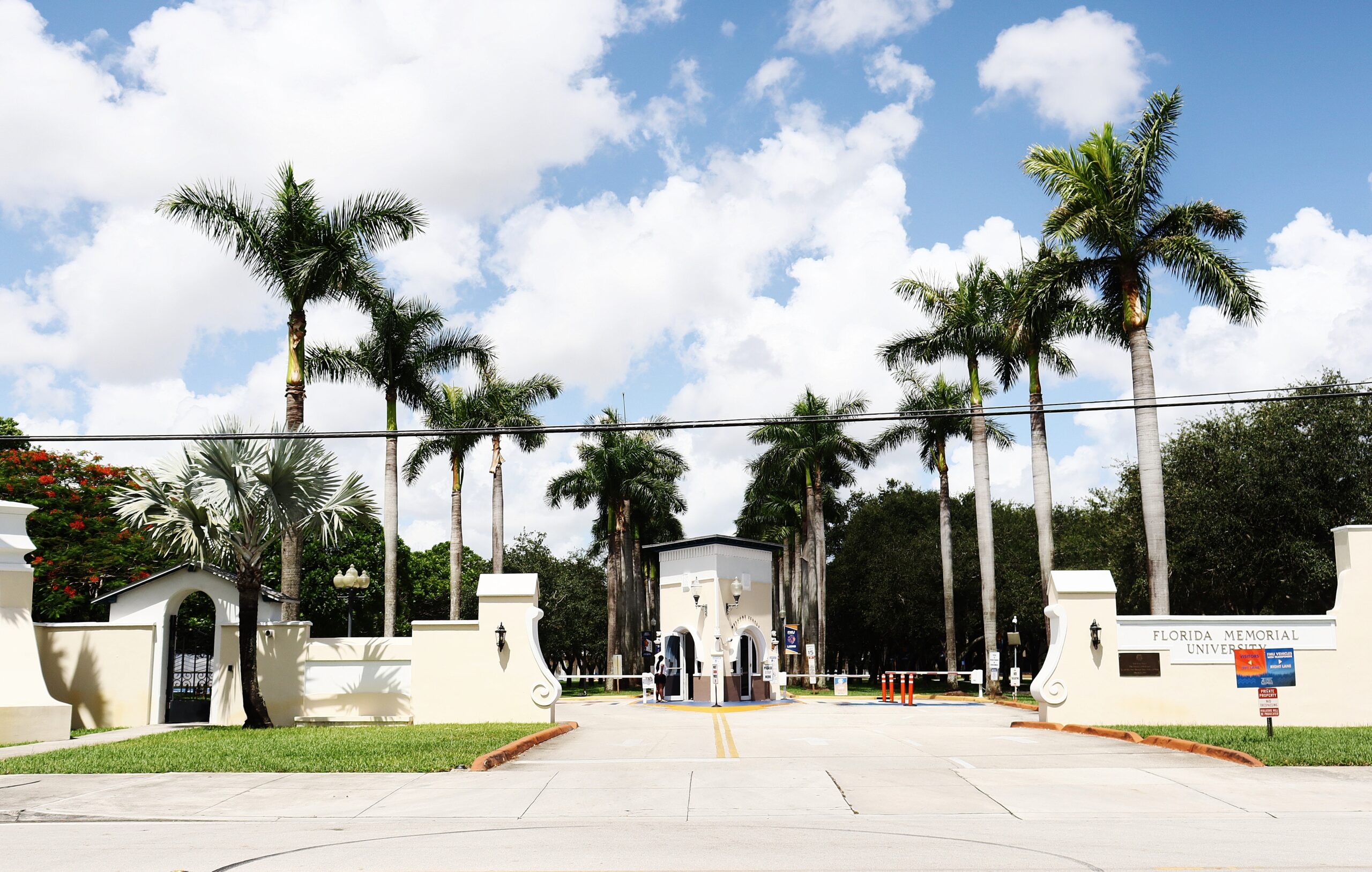
A Miami-Dade judge is refusing to intervene in a bitter governance battle at Florida Memorial University (FMU), ruling that the internal dispute over its Board of Trustees leadership and the appointment of a permanent President does not meet the legal threshold for emergency relief.
Judge Javier Enriquez of the 11th Judicial Circuit tossed out a lawsuit by the Board’s former interim Chair, Brandon Dumas, which sought a temporary restraining order and injunction to block actions taken by trustees aligned with Chair Walter Weatherington.
At issue was who lawfully chairs the FMU Board and whether the panel properly elevated interim President William McCormick as the historically Black university’s permanent leader.
Dumas and seven sitting trustees contend he was unlawfully supplanted and removed from the Board by Weatherington, who then oversaw a fraudulent appointment of McCormick.
Weatherington and the trustees who sided with him — including alum Bernard Jennings, who was named first in Dumas’ complaint — maintain he retook the chairmanship legally and justifiably.
On Friday, Enriquez denied Dumas’ request. He found Dumas failed to prove he would suffer irreparable harm, lacked a substantial likelihood of success on the merits of his case and did not show that an injunction would serve the public interest.
“While success on the merits is possible, the (Defendants’) evidence refutes the Plaintiff’s allegations competently,” Enriquez wrote. “Further, there are no facts or evidence provided in Plaintiff’s amended emergency motion or verified complaint that would show good reasons for anticipating a determination of substantial likelihood of success on the merits.”
Image via 2C2KPhotos, Creative Commons license: https://creativecommons.org/licenses/by/2.0/deed.en.
Enriquez emphasized that a temporary injunction is an “extraordinary and drastic remedy” designed to preserve the status quo, not to rewrite university governance during a power struggle.
Dumas’ case hinged largely on his claim that he was surreptitiously boxed out of key meetings and removed in what he described last month as a “coup” carried out by a “rogue faction” of the Board.
But according to Enriquez’s order denying Dumas’ motion, sworn declarations Weatherington, Jennings, and the case’s other defendants provided to the court showed Weatherington not only is the Board’s current Chair, but he also held the position during meetings Dumas claimed to have been serving in the role.
The court also noted that Dumas brought the lawsuit personally, without authorization from the Miami Gardens-based university or its Board.
In a Monday statement, the Board called Enriquez’s ruling “a clear affirmation of the truth and integrity that guide our mission,” adding that FMU will reach “new heights” under McCormick, a former Board Chair.
“With his proven record in business and an unwavering commitment to the University, it’s our time,” Weatherington said in a statement.
While the herculean tasks ahead of this administration will be challenging and continuous, we are committed to ensuring that our students achieve success in its truest form. … Together, we will forge a bright future for FMU, which will be marked by academic excellence and an unwavering dedication to our students’ success.”
Friday’s ruling leaves Weatherington’s leadership and McCormick’s presidency intact now. But it doesn’t necessarily end the matter. Under Florida appellate rules, non-final orders denying injunctions may be appealed, and Dumas can seek a review from the 3rd District Court of Appeal, though any appeal would be limited to whether Enriquez abused his discretion.
The legal fight began Aug. 22, when Dumas filed his lawsuit and authored a letter cosigned by seven trustees decrying McCormick’s appointment and Weatherington’s chairmanship.
Weatherington responded four days later, asserting in a statement first obtained by Florida Politics that the Board’s actions were legitimate, supported by a majority and aimed at ensuring continuity in FMU’s leadership. He said McCormick had proven effective as an interim President, earning the Board’s confidence, and that Dumas was properly removed for failing to adhere to governance rules.
The back-and-forth highlighted a fractured Board, where members Jennings, Kimberly Chapman, Norma Ely-Jones, Annamaria Jerome-Raja, Carl Johnson, Brittany McMillon, Vaseal Montgomery, Susan Nystrom and Audrey White sided with Weatherington and McCormick.
Dumas’ supporters included Vice Chair Mona Lisa Pinkney; Treasurer Deneshea Phelps Owens; members Bartholomew Banks, Dorothy Davis, Marcus Davis and Reggie Leon; Chair Emeritus Charles George; and Brittany McMillon, Secretary and President of the FMU National Alumni Association.
Notably, Wayback Machine snapshots that Florida Politics cited last month of the FMU Board’s composition featuring Dumas as interim Chair have since been deleted from the archive website. The Wayback Machine generally only takes such an actionif the original website’s owner requests it.
Dumas did not immediately respond to a request for comment.
Early voting is now underway in Miami for a Dec. 9 runoff that will decide whether political newcomer Rolando Escalona can block former Commissioner Frank Carollo from reclaiming the District 3 seat long held by the Carollo family.
The contest has already been marked by unusual turbulence: both candidates faced eligibility challenges that threatened — but ultimately failed — to knock them off the ballot.
Escalona survived a dramatic residency challenge in October after a rival candidate accused him of faking his address. A Miami-Dade Judge rejected the claim following a detailed, three-hour trial that examined everything from his lease records to his Amazon orders.
After the Nov. 4 General Election — when Carollo took about 38% of the vote and Escalona took 17% to outpace six other candidates — Carollo cleared his own legal hurdle when another Judge ruled he could remain in the race despite the city’s new lifetime term limits that, according to three residents who sued, should have barred him from running again.
Those rulings leave voters with a stark choice in District 3, which spans Little Havana, East Shenandoah, West Brickell and parts of Silver Bluff and the Roads.
The runoff pits a self-described political outsider against a veteran official with deep institutional experience and marks a last chance to extend the Carollo dynasty to a twentieth straight year on the dais or block that potentiality.
Escalona, 34, insists voters are ready to move on from the chaos and litigation that have surrounded outgoing Commissioner Joe Carollo, whose tenure included a $63.5 million judgment against him for violating the First Amendment rights of local business owners and the cringe-inducing firing of a Miami Police Chief, among other controversies.
A former busboy who rose through the hospitality industry to manage high-profile Brickell restaurant Sexy Fish while also holding a real estate broker’s license, Escalona is running on a promise to bring transparency, better basic services, lower taxes for seniors and improved permitting systems to the city.
He wants to improve public safety, support economic development, enhance communities, provide more affordable housing, lower taxes and advocate for better fiscal responsibility in government.
He told the Miami Herald that if elected, he’d fight to restore public trust by addressing public corruption while re-engaging residents who feel unheard by current officials.
Carollo, 55, a CPA who served two terms on the dais from 2009 to 2017, has argued that the district needs an experienced leader. He’s pointed to his record balancing budgets and pledges a residents-first agenda focused on safer streets, cleaner neighborhoods and responsive government.
Carollo was the top fundraiser in the District 3 race this cycle, amassing about $501,000 between his campaign account and political committee, Residents First, and spending about $389,500 by the last reporting dates.
Escalona, meanwhile, reported raising close to $109,000 through his campaign account and spending all but 6,000 by Dec. 4.
For the first time in a decade, hunters armed with rifles and crossbows are fanning out across Florida’s swamps and flatwoods to legally hunt the Florida black bear, over the vocal opposition of critics.
The state-sanctioned hunt began Saturday, after drawing more than 160,000 applications for a far more limited number of hunting permits, including from opponents who are trying to reduce the number of bears killed in this year’s hunt, the state’s first since 2015.
The Florida Fish and Wildlife Conservation Commission awarded 172 bear hunt permits by random lottery for this year’s season, allowing hunters to kill one bear each in areas where the population is deemed large enough. At least 43 of the permits went to opponents of the hunt who never intend to use them, according to the Florida chapter of the Sierra Club, which encouraged critics to apply in the hopes of saving bears.
The Florida black bear population is considered one of the state’s conservation success stories, having grown from just several hundred bears in the 1970s to an estimated more than 4,000 today.
The 172 people who were awarded a permit through a random lottery will be able to kill one bear each during the 2025 season, which runs from Dec. 6 to Dec. 28. The permits are specific to one of the state’s four designated bear hunting zones, each of which have a hunting quota set by state officials based on the bear population in each region.
In order to participate, hunters must hold a valid hunting license and a bear harvest permit, which costs $100 for residents and $300 for nonresidents, plus fees. Applications for the permits cost $5 each.
The regulated hunt will help incentivize maintaining healthy bear populations, and help fund the work that is needed, according to Mark Barton of the Florida chapter of Backcountry Hunters and Anglers, an advocacy group that supported the hunt.
Having an annual hunt will help guarantee funding to “keep moving conservation for bears forward,” Barton said.
According to state wildlife officials, the bear population has grown enough to support a regulated hunt and warrant population management. The state agency sees hunting as an effective tool that is used to manage wildlife populations around the world, and allows the state to monetize conservation efforts through permit and application fees.
“While we have enough suitable bear habitat to support our current bear population levels, if the four largest subpopulations continue to grow at current rates, we will not have enough habitat at some point in the future,” reads a bear hunting guide published by the state wildlife commission.
___
Republished with permission of the Associated Press.