Connect with us

Politics

Florida wildlife agency accused of scrubbing online criticism in possible free speech breach

Published

on


Florida’s wildlife watchdog agency is being accused of muzzling its critics online, with activists and residents accusing it of quietly scrubbing negative comments and blocking users from its social media accounts in a possible First Amendment violation.

Instagram and Facebook users say their comments have disappeared from Florida Fish and Wildlife Conservation Commission (FWC) posts.

Some say FWC Chair Rodney Barreto, a Miami developer and political insider who’s faced criticism for alleged ethical issues and mismanagement of past agency controversies, blocked them online before taking his Instagram account private.

They also complain that many of the comments were removed even though they complied with FWC’s official code of commenter conduct, which frequently accompanies the agency’s posts.

An Aug. 29 post by Instagram user @Florida_Legacy_ has served as a repository for recent complaints about issue. In one reply to the post, Sanford resident Connor McGuire said FWC has repeatedly blocked him.

“I guess old Rodney had a temper tantrum again,” McGuire wrote, adding that he believes he was blocked because Barreto dislikes being called out for “his conflict of interest.” Barreto, among other things, invests in real estate development, an industry that can sometimes conflict with environmental conservation.

Others shared similar experiences when complaining about the FWC’s approval last month of the first statewide black bear hunt in a decade.

Army combat veteran Solomon Wise wrote that FWC has been blocking people and deleting comments “for quite a while.” He said the agency was “especially” active in doing so in 2023 amid backlash over its officers killing dozens of captive snakes at a South Florida reptile facility.

Brent Fannin, a drone pilot and filmmaker, forwarded to Florida Politics a June 4 email he sent Barreto asking that he and “all other blocked accounts” have their access restored, citing First Amendment concerns.

He never got a reply.

“Our comments have always complied with the page’s code of conduct,” Fannin said in the email. “I can only assume our account was blocked due to the viewpoint expressed in those comments.”

FWC’s Social Media Comment Policy, last updated in 2023, states the agency “reserves the right” to remove or hide posts containing vulgar language, libel, explicit content, threats and harassment.

Other comments warranting removal, the policy says, include anything that is “clearly off topic” or “repetitive.”

FWC appears to have been liberal in applying its rules. In response to one Aug. 28 Facebook post by the agency, a counter showed 102 comments had been made by Friday afternoon. Seventy-four were visible.

Another Facebook post on Aug. 29 had 21 listed comments. Just eight could be viewed.

Of the 82 visible comments across both posts, just two included negative statements about FWC and its policies.

FWC Communications Director Shannon Knowles said her agency hasn’t blocked any accounts. She did not respond to questions about whether deleted comments are retained and, if so, where they are stored and for how long.

Barreto did not respond to a request for comment.
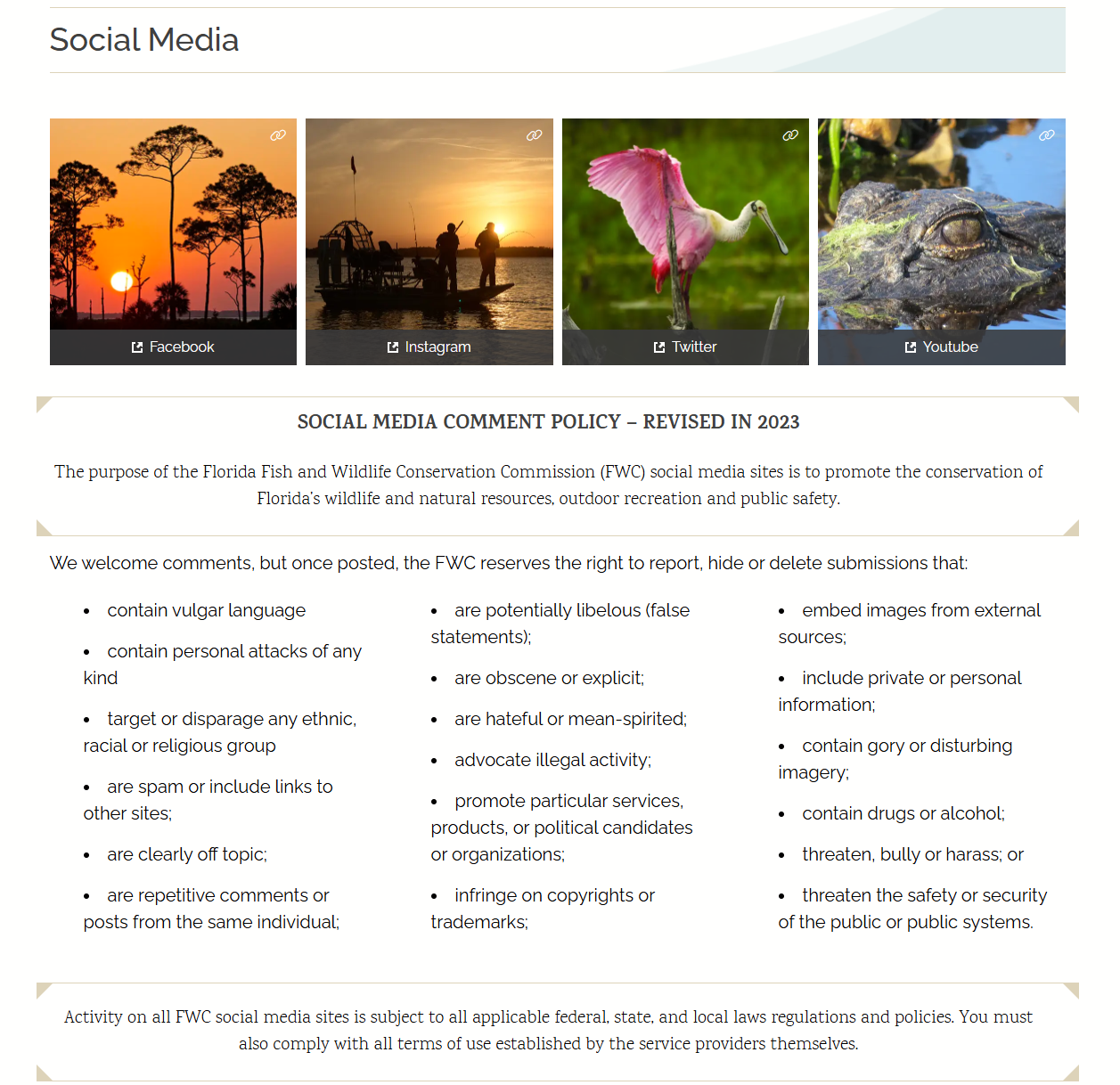
A screenshot of the Florida Fish and Wildlife Conservation Commission’s Social Media Policy page.

Government agencies that host public comments on official social media pages face First Amendment limits. Courts generally treat these forums as digital town squares, meaning that any restrictions must be applied evenly, reasonably and in a viewpoint-neutral fashion.

Several recent court cases provide guidance. In the 2024 case Linkde v. Freed, the U.S. Supreme Court held that speech by a public official on social media counts as state action if the official has authority to speak for the government and purports to exercise that authority in their posts.

Two 2019 cases, Davidson v. Randall and Robinson v. Hunt, found that the comments section of a government or public official’s social media page counts as a public forum. Blocking users (Davidson) or removing critical comments (Robinson), the courts found, is a form of unconstitutional “viewpoint discrimination.”

That isn’t to say certain speech is beyond reproach. Two landmark Supreme Court cases, Chaplinsky v. New Hampshire (1942) and Brandenburg v. Ohio (1969), provided that governments may regulate unprotected speech, like actual threats, incitement and obscenity.

But most critical online speech doesn’t meet those narrow exceptions. Posts that are “off topic” or “repetitive” clearly don’t.

Florida law and its official recordkeeping guidelines add further protection.

This year’s edition of the Attorney General’s Government-in-the-Sunshine Manual says government social media pages and materials posted there, including the government’s posts and public comments, are public records subject to Florida’s retention schedules.

Florida’s GS1-SL schedule requires such content to be preserved for at least three years.

Some officials have gotten into hot water for failing to do so, like Doug Underhill, a former Escambia Commissioner who cost his county more than $190,000 after he failed to turn over records from his Facebook page.

But there’s a relatively high bar for enforcement. In 2016, mortgage broker, activist and blogger Grant Stern sued Miami Beach and its then- Mayor, Philip Levine, for a list of blocked Facebook accounts and other records from Levine’s social media and SiriusXM show.

Stern argued the content counted as official city business and was subject to public records requests. The city refused to comply, claiming the information was personal and not subject to disclosure.

Courts sided with Levine.

Bobby Block, executive director of the First Amendment Foundation, said FWC’s alleged practices mirror a statewide and national issue, and a big part of the problem is that many of the pertinent laws were written before the digital age.

“There’s this disconnect,” he said. “People still violate those laws, and unfortunately, the only way you correct these things is to sue. Then usually, once you see there’s a credible lawsuit or the threat of one, you suddenly see these things change and everyone snaps into order.”

That’s a harder result to reach these days. Block, a longtime journalist, lamented a “new normal” today where shrinking newsroom budgets have made it easier for governments and officials to flout public records laws.

The burden of accountability is increasingly shifting from media outlets to ordinary citizens, he said. And they, too, are frequently at a significant financial disadvantage.

“The complaints we receive today at the First Amendment Foundation are not from reporters but from normal people, local activists and members of small county committees and boards who are trying to get information and find that they are blocked,” he said.

“Many of those individuals don’t have the resources to sue. And without that stick, or without increasing the penalties and updating our public records laws for the modern era, it’s become a game of Whack-a-Mole. And you’ve got to have the coins to put in the machine to play. That’s how they get away with it. Because a lot of people give up.”


Post Views: 0


Source link

Continue Reading

Politics

Carlos G. Smith files bill to allow medical pot patients to grow their own plants

Published

on


Home cultivation of marijuana plants could be legal under certain conditions.

Medical marijuana patients may not have to go to the dispensary for their medicine if new legislation in the Senate passes.

Sen. Carlos G. Smith’s SB 776 would permit patients aged 21 and older to grow up to six pot plants.

They could use the homegrown product, but just like the dispensary weed, they would not be able to re-sell.

Medical marijuana treatment centers would be the only acceptable sourcing for plants and seeds, a move that would protect the cannabis’ custody.

Those growing the plants would be obliged to keep them secured from “unauthorized persons.”

Chances this becomes law may be slight.

A House companion for the legislation has yet to be filed. And legislators have demonstrated little appetite for homegrow in the past.


Source link

Continue Reading

Politics

Rolando Escalona aims to deny Frank Carollo a return to the Miami Commission

Published

on


Early voting is now underway in Miami for a Dec. 9 runoff that will decide whether political newcomer Rolando Escalona can block former Commissioner Frank Carollo from reclaiming the District 3 seat long held by the Carollo family.

The contest has already been marked by unusual turbulence: both candidates faced eligibility challenges that threatened — but ultimately failed — to knock them off the ballot.

Escalona survived a dramatic residency challenge in October after a rival candidate accused him of faking his address. A Miami-Dade Judge rejected the claim following a detailed, three-hour trial that examined everything from his lease records to his Amazon orders.

After the Nov. 4 General Election — when Carollo took about 38% of the vote and Escalona took 17% to outpace six other candidates — Carollo cleared his own legal hurdle when another Judge ruled he could remain in the race despite the city’s new lifetime term limits that, according to three residents who sued, should have barred him from running again.

Those rulings leave voters with a stark choice in District 3, which spans Little Havana, East Shenandoah, West Brickell and parts of Silver Bluff and the Roads.

The runoff pits a self-described political outsider against a veteran official with deep institutional experience and marks a last chance to extend the Carollo dynasty to a twentieth straight year on the dais or block that potentiality.

Escalona, 34, insists voters are ready to move on from the chaos and litigation that have surrounded outgoing Commissioner Joe Carollo, whose tenure included a $63.5 million judgment against him for violating the First Amendment rights of local business owners and the cringe-inducing firing of a Miami Police Chief, among other controversies.

A former busboy who rose through the hospitality industry to manage high-profile Brickell restaurant Sexy Fish while also holding a real estate broker’s license, Escalona is running on a promise to bring transparency, better basic services, lower taxes for seniors and improved permitting systems to the city.

He wants to improve public safety, support economic development, enhance communities, provide more affordable housing, lower taxes and advocate for better fiscal responsibility in government.

He told the Miami Herald that if elected, he’d fight to restore public trust by addressing public corruption while re-engaging residents who feel unheard by current officials.

Carollo, 55, a CPA who served two terms on the dais from 2009 to 2017, has argued that the district needs an experienced leader. He’s pointed to his record balancing budgets and pledges a residents-first agenda focused on safer streets, cleaner neighborhoods and responsive government.

Carollo was the top fundraiser in the District 3 race this cycle, amassing about $501,000 between his campaign account and political committee, Residents First, and spending about $389,500 by the last reporting dates.

Escalona, meanwhile, reported raising close to $109,000 through his campaign account and spending all but 6,000 by Dec. 4.

The winner will secure a four-year term.


Source link

Continue Reading

Politics

Florida kicks off first black bear hunt in a decade, despite pushback

Published

on


For the first time in a decade, hunters armed with rifles and crossbows are fanning out across Florida’s swamps and flatwoods to legally hunt the Florida black bear, over the vocal opposition of critics.

The state-sanctioned hunt began Saturday, after drawing more than 160,000 applications for a far more limited number of hunting permits, including from opponents who are trying to reduce the number of bears killed in this year’s hunt, the state’s first since 2015.

The Florida Fish and Wildlife Conservation Commission awarded 172 bear hunt permits by random lottery for this year’s season, allowing hunters to kill one bear each in areas where the population is deemed large enough. At least 43 of the permits went to opponents of the hunt who never intend to use them, according to the Florida chapter of the Sierra Club, which encouraged critics to apply in the hopes of saving bears.

The Florida black bear population is considered one of the state’s conservation success stories, having grown from just several hundred bears in the 1970s to an estimated more than 4,000 today.

The 172 people who were awarded a permit through a random lottery will be able to kill one bear each during the 2025 season, which runs from Dec. 6 to Dec. 28. The permits are specific to one of the state’s four designated bear hunting zones, each of which have a hunting quota set by state officials based on the bear population in each region.

In order to participate, hunters must hold a valid hunting license and a bear harvest permit, which costs $100 for residents and $300 for nonresidents, plus fees. Applications for the permits cost $5 each.

The regulated hunt will help incentivize maintaining healthy bear populations, and help fund the work that is needed, according to Mark Barton of the Florida chapter of Backcountry Hunters and Anglers, an advocacy group that supported the hunt.

Having an annual hunt will help guarantee funding to “keep moving conservation for bears forward,” Barton said.

According to state wildlife officials, the bear population has grown enough to support a regulated hunt and warrant population management. The state agency sees hunting as an effective tool that is used to manage wildlife populations around the world, and allows the state to monetize conservation efforts through permit and application fees.

“While we have enough suitable bear habitat to support our current bear population levels, if the four largest subpopulations continue to grow at current rates, we will not have enough habitat at some point in the future,” reads a bear hunting guide published by the state wildlife commission.

___

Republished with permission of the Associated Press.


Source link

Continue Reading

Trending

Copyright © Miami Select.