Connect with us

Politics

Trump attending the U.S. Open as Rolex’s guest despite Swiss tariffs. Any boos may not be seen on TV
Published

on


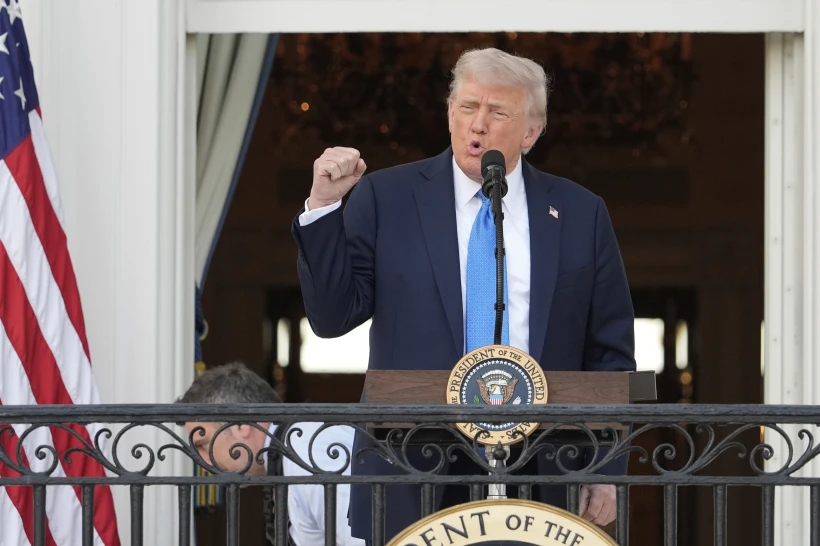
President Donald Trump is attending the U.S. Open on Sunday as a guest of Rolex despite imposing steep tariffs on the Swiss watchmaker’s home country and with organizers seeking to keep off-court disruptions — like audience members booing him — from being seen on the TV broadcast  of the tennis event.

Trump has built the bulk of his second term’s domestic travel around attending major sports events rather than hitting the road to make policy announcements or address the kind of large rallies he so relished as a candidate.

He’ll be watching the men’s final between second-seeded Carlos Alcaraz, a 22-year-old Spaniard, and No. 1 seed and defending champion Jannik Sinner, 24, of Italy, from Rolex’s suite.

The president’s acceptance of Rolex’s invitation comes mere weeks after the Trump administration imposed a whopping 39% tariff on Swiss products.

The levy is more than 2 1/2 times higher than the one the Trump administration agreed to for European Union goods exported to the U.S. and nearly four times higher than on British exports to the U.S. It has raised questions about Switzerland’s ability to compete with the 27-member bloc that it neighbors.

The White House declined to comment on Trump accepting a corporate client’s invitation at the tournament, but the president has had few qualms about blurring lines between political and foreign policy decisions and efforts to boost the profits of his family business.

Any negative reaction to Trump’s presence won’t be shown on ABC’s national telecast, per standard policy, the U.S. Tennis Association says.

“We regularly ask our broadcasters to refrain from showcasing off-court disruptions,” the organization said in a statement.

Trump was once a U.S. Open mainstay, but hasn’t attended since he was loudly booed at a quarterfinals match in September 2015, months after launching his first presidential campaign.

The Trump Organization once controlled its own U.S. Open suite, which was adjacent to the television broadcasting booth in Arthur Ashe Stadium, but suspended it in 2017, during the first year of Trump’s first term. The family business is now being run by Trump’s sons with their father back in the White House.

Trump was born in Queens, home of the U.S. Open, and for decades was a New York-area real estate mogul and, later, a reality TV star. Attending the tournament before he was a politician, he usually sat in the suite’s balcony during night matches and was frequently shown on the arena’s video screens.

In recent years, however, including between his presidential terms, Trump primarily lived at his Florida estate, Mar-a-Lago.

Alcaraz said before the final that having Trump on-hand would be a privilege and “great for tennis,” but also suggested that such sentiment went for any president watching from the stands.

“I will try not to be focused, and I will try not to think about it,” Alcaraz said of Trump’s attendance. “I don’t want myself to be nervous because of it.”

Trump golfed at the Virginia club outside Washington on Saturday, as he has many recent weekends once the summer weather turned too hot for playing near Mar-a-Lago. But the president has also frequently attended sporting events — where the roar of the crowd sometimes features people booing the president while others cheer him.

Since returning to the White House in January and prior to Sunday’s U.S Open swing, Trump went to the Super Bowl in New Orleans and the Daytona 500, as well as UFC fights in Miami and Newark, New Jersey, the NCAA wrestling championships in Philadelphia and the FIFA Club World Cup final in East Rutherford, New Jersey.

Having a sitting president attend is unusual and, before Trump, hadn’t happened since Clinton went to the 2000 tournament. Former President Barack Obama and his wife, Michelle, attended the event’s opening night in 2023.

___

Republished with permission of The Associated Press.


Post Views: 0


Source link

Continue Reading

Politics

As pennies fade away, Senate panel advances Don Gaetz proposal setting cash-rounding rules

Published

on


The rounding requirement would apply only to cash purchases.

A proposal addressing how Florida retailers will handle cash transactions now that pennies are no longer being minted has cleared its first Senate committee stop.

The Senate Commerce and Tourism Committee approved the bill (SB 1074) without debate or amendment. Sen. Don Gaetz, the bill sponsor, told lawmakers that Federal Reserve regional vaults stopped distributing pennies last month, leaving retailers unable to provide exact change in cash transactions when 1-cent coins are unavailable.

“Retailers will have no choice but to round to the nearest nickel for cash customers,” Gaetz said.

“As you know President (Donald) Trump ended the production of pennies, so now we’re moving to a pennyless economy. This bill tries to provide some guidance to help retailers know how to proceed.”

Under the bill, in-person cash transactions ending in 1 or 2 cents would be rounded down, while amounts ending in 3 or 4 cents would be rounded up to the nearest nickel. Transactions ending in 6 or 7 cents would be rounded down to a nickel, and those ending in 8 or 9 cents would be rounded up to the nearest dime.

The rounding requirement would apply only to cash purchases. Sales tax would be calculated before rounding occurs, ensuring the amount of tax owed does not increase or decrease because of the adjustment.

SB 1074 also amends Florida’s Deceptive and Unfair Trade Practices Act to specify that rounding cash transactions under these circumstances would not constitute a deceptive or unfair trade practice.

The Senate bill now advances to the Finance and Tax Committee, its second of three committee stops.

Sarasota Republican Rep. Fiona McFarland filed HB 951, the House version of the proposal, earlier this month.


Source link

Continue Reading

Politics

UWF analysis on ‘puppy mills’ leads to consumer protection investigation

Published

on


Attorney General James Uthmeier issued a report this week concluding that deceptive sales of pets have ripped off Floridians to the tune of $25.1 million annually.

The analysis focused largely on the sale of puppies in the state. The report found that at least 80% of young canines sold in Florida are sourced from breeders in other states in so-called “puppy mills.”

Since those animals usually undergo extensive transport to get to Florida, the puppies often arrive sick or mischaracterized in their breeds, which ultimately results in substantial vet bills for families.

The research was conducted by the University of West Florida’s Haas Center, an economic impact and workforce survey arm of the Panhandle campus. Uthmeier said the results led to his Office launching a consumer protection investigation into deceptive sales, sick animals and predatory financing schemes.

“Florida families deserve fair and honest business practices,” Uthmeier said. “This report exposes how deceptive retailers and shady lenders are preying on consumers who are bringing a pet into their family. Our office is opening a formal investigation into the lenders and retailers pushing these predatory loans for sick puppies.”

The 90-page report, “The Cost of Deception: How Sick Pets Drain Florida’s Economy,” also outlines the difficult conditions puppies face on their way to Florida.

As many as 120 puppies can be crammed into one van and transported thousands of miles, with few exams by veterinarians and hardly any oversight. That creates conditions for the spread of disease, which often leads to pricey veterinarian bills.

The report also found that some pet sales involve big retailers that include store-brand credit cards with interest rates as high as 35.9%, along with hidden fees and “deferred interest” in promotions.

“A $5,000 pet purchase can ultimately cost families as much as $16,000 under these terms,” a news release said.

The counties with the most complaints about puppy problems include Orange, Pinellas, Duval, Miami-Dade, Broward and Palm Beach.

The UWF analysis also provided some recommendations, including increasing consumer protections and oversight for breeders and transporters. Researchers also suggest the state modernize pet lemon laws and restrict questionable financing practices.


Source link

Continue Reading

Politics

Majority of South Florida residents support Fontainebleau redevelopment plan

Published

on


Fontainebleau Miami Beach’s proposed “family-friendly improvements” are enjoying broad support among South Florida residents, according to a new poll commissioned by the developers and conducted by MDW Communications.

The poll, obtained by Florida Politics and taken among 305 likely Miami Beach municipal voters Jan. 14-19, found nearly 60% of respondents supporting the proposal, including more than 30% who strongly support it. Fewer than 30% of respondents say they disapprove.

And most residents are aware of the plans, further signaling not just support, but informed support. Of those polled, more than 2/3 say they have heard information on the proposal, with just a third saying they’ve heard nothing about it.

Fontainebleau Development, led by Chair and CEO Jeffrey Soffer, is planning a sweeping rework of the hotel’s outdoor pool deck aimed at attracting more families, including a proposed water-park concept featuring 11 waterslides — one reportedly about 120 feet tall — along with other pool-deck upgrades.

Poll results are important, as the project requires approval from the city’s Historic Preservation Board because it sits on a historically significant site. The Preservation Board reviews alteration plans on designated historic properties.

The Fontainebleau, designed by architect Morris Lapidus and opened in 1954, is one of Miami Beach’s signature MiMo-era landmarks and is listed on the National Register of Historic Places.

The project is carefully planned to “responsibly repurpose” outdoor areas of the hotel without expanding its footprint or altering its unique architectural character.

“Under the leadership of the Mayor and the City Commission, Miami Beach continues to evolve as a destination for visitors of all ages, and this vision reflects an increased emphasis on family-oriented experiences that align with the City’s broader tourism goals,” reads a note from developers shared along with poll results.

“The proposed enhancements are private amenities for hotel guests only, and the pool deck access will remain restricted, as it is today. Given the focus on hotel guest experience, the project is not expected to generate additional traffic as guests will be remaining on property.”

The project would repurpose the resort’s existing amenity footprint while integrating features designed to complement the existing historic pool deck and honoring the entire property’s iconic architecture.

The poll comes just days after the Greater Miami and the Beaches Hotel Association urged project approval from the Preservation Board, noting that the project would help maintain Miami Beach as a competitive global hospitality destination. The group’s CEO, Curtis Crider, said projects such as this one are “essential” to the city’s economic future.

“On behalf of the hotel community, we believe this initiative strengthens the city’s competitiveness, supports sustainable economic growth, and reflects the evolution necessary to ensure Miami Beach’s continued success,” he wrote last week in a letter to the Preservation Board.


Source link

Continue Reading

Trending

Copyright © Miami Select.