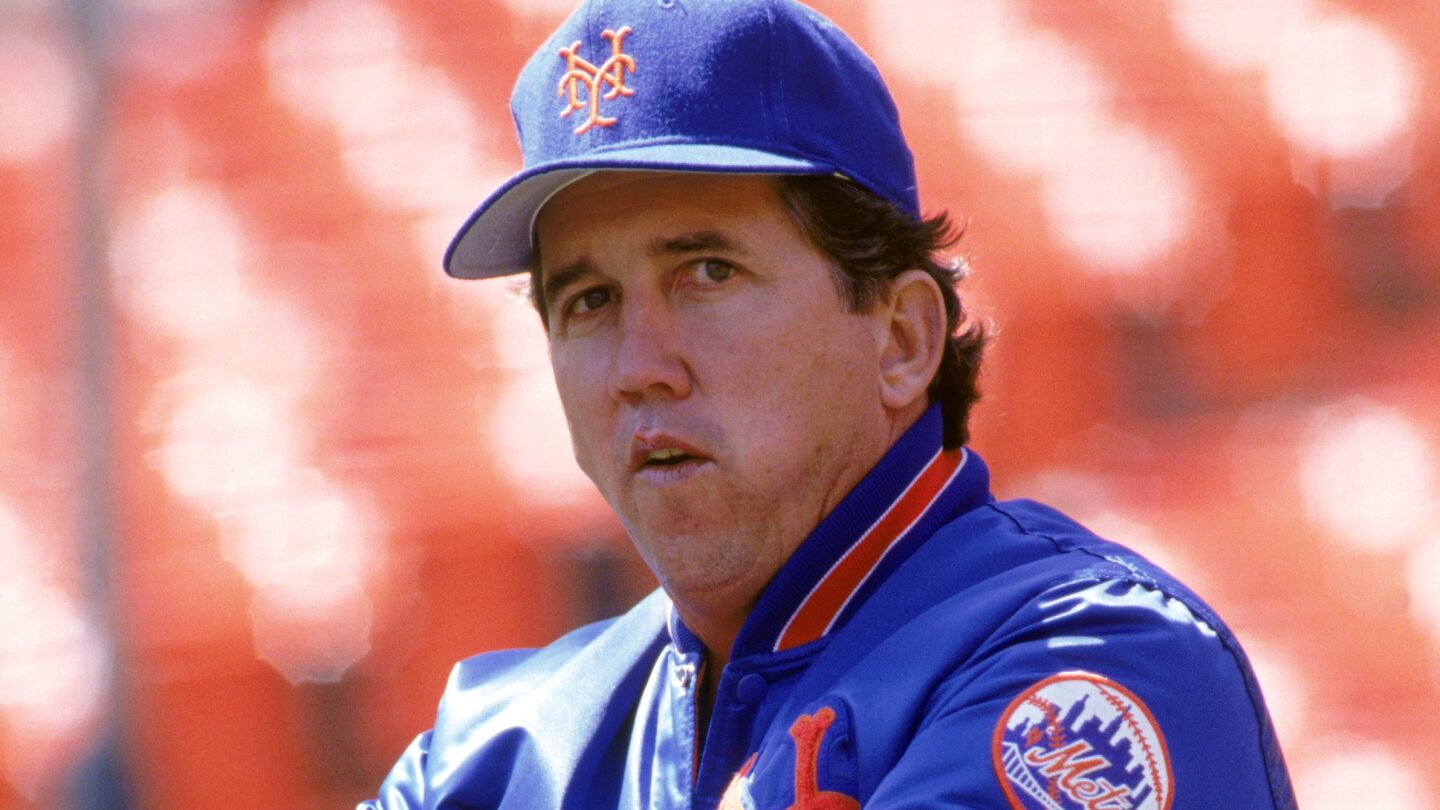
Sports Talk Florida –Orlando, FL — The baseball world mourns the loss of Davey Johnson, a revered Major League Baseball player, manager, and teacher whose impact stretched far beyond the field. Johnson passed away peacefully at the age of 82, leaving behind a legacy defined by excellence, innovation, and humanity. It was an honor to know Davey first as the Mets manager and then Baltimore with his last stop in Washington.
Born in 1943, Davey Johnson’s journey through baseball was nothing short of extraordinary. As a player, he earned four All-Star selections, three Gold Gloves, and a World Series ring with the Baltimore Orioles in 1966. Known for his sharp instincts and steady glove at second base, Johnson also made history in 1973 with the Atlanta Braves, hitting 43 home runs — a record for second basemen at the time.
But it was in the dugout where Johnson’s genius truly flourished. As manager of the New York Mets, he led the 1986 squad to one of the most iconic World Series victories in MLB history. His managerial career spanned stints with the Reds, Orioles, Dodgers, and Nationals, earning him Manager of the Year honors and a reputation as one of the most forward-thinking minds in the game.
A Pioneer of Analytics and Strategy
Long before sabermetrics became a buzzword, Johnson was integrating computer models and statistical analysis into his decision-making. He was one of the first managers to embrace data as a tool for lineup optimization and player development — a visionary approach that influenced generations of coaches and executives.
His strategic brilliance was matched by his ability to connect with players. Johnson had a rare gift: he could challenge athletes to be their best while making them feel supported and understood. From Hall of Famers to rookies, countless players credit him with shaping their careers and lives.
Orlando Roots and a Life of Integrity
Though his career took him across the country, Johnson made his home in Orlando, Florida, where he was a fixture in the community. He mentored young athletes, supported local charities, and remained a humble presence despite his fame. Friends and neighbors describe him as generous, grounded, and always willing to lend a hand or share a story.
His warmth extended to the media, fans, and colleagues. Whether in a press conference or a quiet conversation, Johnson carried himself with dignity and grace — a true gentleman of the game.
A Teacher Beyond the Diamond
Johnson’s legacy isn’t just about wins and accolades. He was a teacher in the deepest sense — someone who believed in the power of knowledge, preparation, and character. He taught players how to think, how to lead, and how to handle adversity. His lessons resonated far beyond baseball, shaping lives in boardrooms, classrooms, and homes.
Farewell to a Legend
Davey Johnson’s passing marks the end of an era, but his influence will endure. He leaves behind a blueprint for leadership, a standard for sportsmanship, and a legacy of love for the game. As tributes pour in from across the baseball world, one thing is clear: Johnson wasn’t just a great baseball man — he was a great man.
Morocco’s head coach Walid Regragui shakes hands with Morocco’s Prince Moulay Rachid as FIFA President Gianni Infantino (R) looks on duirng presentation ceremony at the end of the Africa Cup of Nations (CAN) final football match between Senegal and Morocco at the Prince Moulay Abdellah Stadium in Rabat on January 18, 2026. (Photo by FRANCK FIFE / AFP)
Yes, the 2025 Africa Cup of Nations (AFCON) had its flaws with controversial officiating but none of that changes the bigger truth that Morocco staged a tournament that celebrated African football.
The 2025 Africa Cup of Nations (AFCON) will be remembered as one of the finest editions in the tournament’s long and proud history.
The month-long football spectacle went far beyond goals and tactics as it became a celebration of African culture, unity, and sporting excellence.
From state-of-the-art infrastructure and seamless transportation to passionate crowds and unforgettable matches, AFCON 2025 reaffirmed why the competition remains one of the most compelling international tournaments in world football.
Despite late controversy surrounding the final, the overall success of the tournament should not be overshadowed. Instead, Morocco’s hosting has set a new benchmark for African football and reinforced AFCON’s growing global relevance.
AFCON 2025 transcended football
It was a cultural festival as six historical Moroccan cities hosted 24 African nations, welcoming fans from across the continent and the global African diaspora.
Cities such as Rabat, Casablanca, Marrakech, Fez, Tangier, and Agadir came alive with music, colour, and celebration.
Stadiums were packed, fan zones buzzed with activity, and local businesses flourished as visitors immersed themselves in Moroccan hospitality.
Morocco supporters watch at the Rabat Fanzone the Africa Cup of Nations (CAN) Group A football match between Morocco and Mali at Prince Moulay Abdellah Stadium in Rabat on December 26, 2025. (Photo by Abdel Majid BZIOUAT / AFP)
What stood out most was how seamlessly Morocco combined football with cultural identity, from traditional cuisine to music and street festivals, AFCON 2025 felt like a showcase of African pride, not just a sporting competition.
A new standard for African development
One of the most impressive aspects of AFCON 2025 was Morocco’s infrastructure and they demonstrated why they are viewed as one of Africa’s most capable sporting hosts.
The rail network connecting Fez, Rabat, Casablanca, and Marrakech made travel between host cities efficient and affordable.
Fans could attend matches in different cities without the logistical chaos that has plagued previous tournaments.
Even cities like Tangier and Agadir, though geographically distant, were well integrated into the tournament thanks to Morocco’s modern transport system.
At the heart of Morocco’s footballing vision lies the Mohamed VI Football Complex, a facility widely regarded as one of the best training centres in the world with 10 world-class training pitches amongst other facilities.
In addition, the complex served as a blueprint for how African football infrastructure should be developed and it is no exaggeration to conclude that Morocco delivered an organisational standard comparable to major FIFA tournaments.
Algeria’s goalkeeper #23 Luca Zidane and Nigeria’s forward #09 Victor Osimhen shake hands after the Africa Cup of Nations (CAN) quarter-final football match between Algeria and Nigeria at the Grand stadium in Marrakesh on January 10, 2026. (Photo by SEBASTIEN BOZON / AFP)
African football excellence takes centre stage
Back to the pitch, the 2025 Africa Cup of Nations delivered thrilling football action from start to finish, with Morocco waiting until the second half to score two goals against Comoros and Senegal’s hard-fought win against the hosts in the final game.
With four African coaches – Walid Regragui (Morocco), Pape Thiaw (Senegal), Eric Chelle (Nigeria), and Hossam Hassan (Egypt)- guiding their teams into the last four, the tournament showcased Africa’s tactical sophistication, depth of talent, and competitive balance.
A total of 121 goals were scored in the tournament which further asserted the rise of the continent’s explosive forwards like Brahim Diaz, Victor Osimhen, Mohamed Salah, Amad Diallo, Ademola Lookman and Sadio Mane.
Similarly, the impact of goalkeepers who showed the world that they can’t be ignored, from Edouard Mendy who made a historic penalty save in Sunday’s final to Stanley Nwabali who made two penalty saves in the third-place match against Egypt and Yassine Bounou’s brilliance as the tournament’s best shot-stopper.
AFCON 2025 shouldn’t be defined by final stain
Several irregularities marred Sunday’s final match between Senegal and Morocco at the Prince Moulaye Abdellah Stadium but it would be grossly unfair to allow these moments define the success of the 35th edition of the Africa Cup of Nations.
In comparison to the World Cup, the Euros and the UEFA Champions League, there have been controversial finals but the controversial incidents do not erase weeks of planning, world-class action and fans’ unity.
Sunday’s events – the controversial disallowed Senegal goal and the disputed penalty call – should prompt a deeper reflection and better officiating standards, and not overshadow Morocco’s organisational success.
The sparring between Major League Baseball Commissioner Rob Manfred and the Executive Director of the Major League Baseball Players Association Tony Clark continues as MLB gets ready for the 2026 season. The collective bargaining agreement between the players and the owners ends in December and the central issue seems to be this. The owners want cost certainty which could mean a salary cap and the players want no part of that. There is also the question of how much the owners are really hurting financially when the Los Angeles Dodgers owners can give Kyle Tucker a $64 million signing bonus within a four-year deal reportedly worth $240 million and the owner of the New York Mets franchise Steve Cohen can hand out a three-year deal to Bo Bichette that reportedly is worth $126 million. Of course, New York and Los Angeles are the two biggest markets in the country with a lot of wealth. It is the small market owners who are going to tell Manfred that cannot compete with the Dodgers and the Mets.
Manfred is trying to put a positive spin on the negotiations. “Until I got elected commissioner, all I did was labor relations. That’s how I made my living. I’ve never been in a negotiation where, before the first piece of paper went across the table, I, or anyone I represented, was out there saying, ‘This, we absolutely will not talk about.’ I just think it’s a hard way to begin a negotiation.” The players put out a statement that contradicts Manfred. “The league and owners say they want to avoid missing games but at the same time they appear to be dead-set on trying to force players into a system that, the last time they proposed it, led to the most missed games ever and a cancelled World Series” in 1994. The sniping continues.
Luke Littler 8 – 5 Michael van Gerwen(best of 15 legs)
Reigning double world champion and world number one Luke Littler bounced back from his Bahrain setback to win the Saudi Arabia Darts Masters on the eve of his 19th birthday, rounding off a sensational day by defeating Michael van Gerwen 8–5 in a high-quality final.
Littler had to come from behind in a hard-fought quarter-final against Gian van Veen, before exacting revenge on Gerwyn Price in the semi-final, having lost to the Welshman at last week’s event in Bahrain.
‘The Nuke’ then started off like a bullet train against van Gerwen, racing into a 4–0 lead in a matter of minutes while averaging a remarkable 114. ‘Mighty Mike’, to his credit, raised his level to haul it back to 4–3, only to miss three darts at double 10 to draw level.
From there, Littler regained his edge, and despite pressure from the Dutchman, got over the line with a superb 11-darter to seal the victory.
Explosive darts action in a restrained atmosphere in Riyadh
If the sport is judged purely on the competition itself, then the crowd were treated to a spectacular showcase of darts at its very best. van Gerwen illustrated that range perfectly, averaging just 87 in a laboured quarter-final win over Stephen Bunting before lifting his level dramatically to post 100-plus averages in both his semi-final and final.
Then there was Littler, who had to produce his best to overcome three opponents in high-quality encounters, while surprise quarter-finalist Man Lok Leung impressed by pushing Nathan Aspinall all the way. From a purely sporting perspective, it was the kind of day any darts fan would happily lap up.
But Riyadh had never hosted a PDC event before, and it showed. Without the usual fancy dress, constant noise and crowd-led momentum that darts thrives on, the atmosphere was noticeably muted from start to finish.
Culturally, that is understandable and works well enough for many sports, but darts is different. The gap in understanding was evident when the crowd greeted an early sub-50 checkout with the same muted enthusiasm as a ton-plus finish later on, flattening moments that would normally lift the room.
The players would have felt it too. Darts players feed off the crowd in different ways, and there was little coming back at them to draw energy from. Most are media-trained to not criticise openly, although Nathan Aspinall did suggest that the crowd were still finding their way with the finer details of the sport, and some may even have been ringers.
As a first staging of the event, lessons will inevitably be learned and things may improve when darts returns to the Kingdom. One thing is certain – Saudi Arabia rarely loosens its grip once it has a sport in its grasp, and it is unlikely to be content in the long term with hosting a solitary, minor tournament while the game itself is still shaking off the afterglow of the World Championship.
But if the sport is to truly thrive here long term, a balance will need to be found between local traditions and the atmosphere that has long been part of what makes darts what it is.