Connect with us

Politics

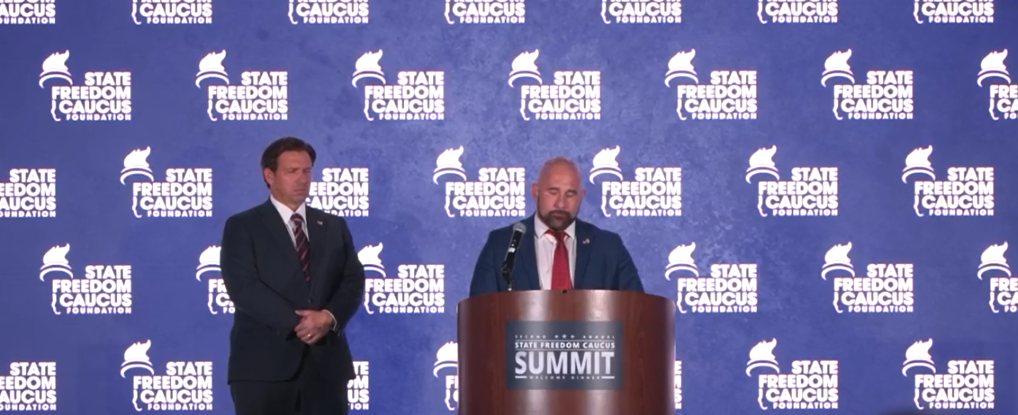
Jay Collins rehearses themes for 2026 candidacy in national speech

Published

on


Speaking at Friday’s State Freedom Caucus Summit, Lt. Gov. Jay Collins sharpened attacks on members of his own party, which will be necessary if he runs against U.S. Rep. Byron Donalds and former House Speaker Paul Renner for the 2026 GOP gubernatorial nomination.

Collins talked about his role in helping to ensure immigration legislation championed by the Legislature did not become law, arguing that he “protected” President Donald Trump, who emphatically supports Donalds.

“You would think in a state like Florida, we don’t have to fight people within our own ranks, people within our own party, that we shouldn’t have to do that. You would hope that by now, we know what right looks like, because we have a moral compass and it’s pouring the right direction. I’ll tell you what, I was pretty appalled. I was pretty frustrated to find that people in my party, people who I knew, people who ran on the same things that I ran on, failed to stand up and fight. And then they wanted to name the bill that Trump Act. Y’all, sometimes, as warriors, as people who fight to do the right thing, we have to protect those above us. And in this case, Florida protected the president, because that bill was not worthy of what Donald J. Trump has been doing for this great nation,” Collins said.

The Tackling and Reforming Unlawful Migration Policy Act rankled Gov. Ron DeSantis, in large part because it would have given Agriculture Commissioner Wilton Simpson decision making power in the fight against illegal immigration, an issue that has become DeSantis’ primary preoccupation in recent years.

The President has never explicitly said he felt “protected” by the eventual failure of the TRUMP Act, though he does seem to back House Speaker Daniel Perez for Attorney General over James Uthmeier, DeSantis’ former chief of staff and campaign manager who was appointed to replace Ashley Moody.

Collins also claimed that his run for state office was inspired by the pandemic and a military  withdrawal under President Joe Biden, the latter of which has a tenuous connection to the state Senate seat he ran for before being appointed Governor.

“I had an epiphany, as I was lamenting COVID and lamenting the failed withdrawal in that absolute mess that happened in Afghanistan, and I realized that if I was willing to die in a nation that wasn’t mine, fighting beside people I didn’t know to defend what we love here at home, why wouldn’t I do all that I can right here at home to do the same thing? So I jumped into politics, even though that’s not my dream.”


Post Views: 0


Source link

Continue Reading

Politics

AI bill of rights legislation clears its first Senate committee stop

Published

on


A Senate committee advanced a bill to create an artificial intelligence bill of rights aiming to protect consumers and minors.

With unanimous bipartisan support, the Senate Commerce and Tourism Committee backed Sen. Tom Leek’s bill (SB 482).

“Quite simply, we get a 60-day Session once a year. If we don’t act and Congress doesn’t act, those protections won’t exist for Florida’s children and vulnerable adults,” Leek, a Port Orange Republican, told lawmakers before the 10-0 vote Wednesday. “So I believe we have to act.”

Wednesday’s vote was the bill’s first committee stop to support Gov. Ron DeSantis’ agenda as the measure heads next to the Senate Appropriations Committee.

DeSantis has increasingly been calling for more regulation to protect young people from the dangers of AI technology. But President Donald Trump has also been critical of states passing AI reforms and signed an executive order in December aimed at restricting states from overregulating the technology.

Leek argued that his bill doesn’t defy Trump’s order.

“I think the protections that we’ve got here for minors and for vulnerable adults, and for all of us really, are in line with what President Trump wants,” Leek said during Wednesday’s hearing.

Leek argued Trump was striking back against “onerous restrictions,” while his bill was specifically focused on consumer protections.

“It is purposely and deliberately targeted at those protections and not … the universe of things that could be done,” Leek said.

Under Leek’s bill, chatbot platforms would be required to post pop-up warnings that a person is talking to AI. The message would appear at the start of the conversation and reappear at least every hour.

Children would not be allowed to communicate with chatbots without parental permission. Parents would have control to see their child’s communications with the chatbot and could also limit access or delete the child’s account.

The bill would also require minors to be reminded to “take a break” at least once every hour.

Chatbot platform operators that violate the proposed new rules could face civil fines up to $50,000 per violation.

The AI bill of rights legislation comes after a 14-year-old Orlando boy killed himself in 2024 after he had been chatting with an AI bot extensively. Some of the conversations turned sexual and romantic. The family later sued in a case that got national coverage by The New York Times.

“Artificial intelligence, holding a great deal of promise, also poses novel and unique threats. Generative AI in particular can be particularly insidious in some contexts when used by children or unsuspecting or vulnerable or adults,” Leek said at Wednesday’s hearing.

“Given the incredible pace of the evolution of the technology and its adoption by business and academia, it is incumbent on us to protect Floridians for some of its problematic results.”

Several advocates and Democrats praised the bill, while also arguing there was room for improvement in Leek’s legislation.

“We would like to be a part of the conversation,” said Florida AFL-CIO lobbyist Rich Templin. “This is a great consumer protection beginning, but what about workers?”

And Turner Loesel, a technology policy analyst at the James Madison Institute, warned that the bill’s language needed to be tweaked, which Leek teased is coming. Leek said he is still working with stakeholders to tighten the bill’s definitions.

“Its definition of artificial intelligence is broad enough to capture spam filters alongside companion chatbot platforms, and we look forward to the amendments on that definition,” Loesel said.

Sen. Carlos  Guillermo Smith, an Orlando Democrat, called the bill a good first step but also agreed the legislation could be beefed up.

“We need meaningful accountability in the bill. Floridians deserve more than promises. They deserve proof. That means compliance reporting and audits that show companies are actually protecting biometric data, that they’re preventing misuse, and that they’re operating transparently,” Smith said.

“I think relying solely on political actors in the Office of the Attorney General for enforcement is not enough. To stop harmful conduct, I think we need stronger civil protections, including a private cause of action for all ages to defend all of our rights that are outlined in this AI bill of rights.”


Source link

Continue Reading

Politics

As pennies fade away, Senate panel advances Don Gaetz proposal setting cash-rounding rules

Published

on


The rounding requirement would apply only to cash purchases.

A proposal addressing how Florida retailers will handle cash transactions now that pennies are no longer being minted has cleared its first Senate committee stop.

The Senate Commerce and Tourism Committee approved the bill (SB 1074) without debate or amendment. Sen. Don Gaetz, the bill sponsor, told lawmakers that Federal Reserve regional vaults stopped distributing pennies last month, leaving retailers unable to provide exact change in cash transactions when 1-cent coins are unavailable.

“Retailers will have no choice but to round to the nearest nickel for cash customers,” Gaetz said.

“As you know President (Donald) Trump ended the production of pennies, so now we’re moving to a pennyless economy. This bill tries to provide some guidance to help retailers know how to proceed.”

Under the bill, in-person cash transactions ending in 1 or 2 cents would be rounded down, while amounts ending in 3 or 4 cents would be rounded up to the nearest nickel. Transactions ending in 6 or 7 cents would be rounded down to a nickel, and those ending in 8 or 9 cents would be rounded up to the nearest dime.

The rounding requirement would apply only to cash purchases. Sales tax would be calculated before rounding occurs, ensuring the amount of tax owed does not increase or decrease because of the adjustment.

SB 1074 also amends Florida’s Deceptive and Unfair Trade Practices Act to specify that rounding cash transactions under these circumstances would not constitute a deceptive or unfair trade practice.

The Senate bill now advances to the Finance and Tax Committee, its second of three committee stops.

Sarasota Republican Rep. Fiona McFarland filed HB 951, the House version of the proposal, earlier this month.


Source link

Continue Reading

Politics

UWF analysis on ‘puppy mills’ leads to consumer protection investigation

Published

on


Attorney General James Uthmeier issued a report this week concluding that deceptive sales of pets have ripped off Floridians to the tune of $25.1 million annually.

The analysis focused largely on the sale of puppies in the state. The report found that at least 80% of young canines sold in Florida are sourced from breeders in other states in so-called “puppy mills.”

Since those animals usually undergo extensive transport to get to Florida, the puppies often arrive sick or mischaracterized in their breeds, which ultimately results in substantial vet bills for families.

The research was conducted by the University of West Florida’s Haas Center, an economic impact and workforce survey arm of the Panhandle campus. Uthmeier said the results led to his Office launching a consumer protection investigation into deceptive sales, sick animals and predatory financing schemes.

“Florida families deserve fair and honest business practices,” Uthmeier said. “This report exposes how deceptive retailers and shady lenders are preying on consumers who are bringing a pet into their family. Our office is opening a formal investigation into the lenders and retailers pushing these predatory loans for sick puppies.”

The 90-page report, “The Cost of Deception: How Sick Pets Drain Florida’s Economy,” also outlines the difficult conditions puppies face on their way to Florida.

As many as 120 puppies can be crammed into one van and transported thousands of miles, with few exams by veterinarians and hardly any oversight. That creates conditions for the spread of disease, which often leads to pricey veterinarian bills.

The report also found that some pet sales involve big retailers that include store-brand credit cards with interest rates as high as 35.9%, along with hidden fees and “deferred interest” in promotions.

“A $5,000 pet purchase can ultimately cost families as much as $16,000 under these terms,” a news release said.

The counties with the most complaints about puppy problems include Orange, Pinellas, Duval, Miami-Dade, Broward and Palm Beach.

The UWF analysis also provided some recommendations, including increasing consumer protections and oversight for breeders and transporters. Researchers also suggest the state modernize pet lemon laws and restrict questionable financing practices.


Source link

Continue Reading

Trending

Copyright © Miami Select.