Connect with us

Politics

Florida Poly professor to study brain data to reimagine engineering education
Published

on


A professor of mechanical engineering at Florida Polytechnic University in Lakeland has received a $200,000 grant from the National Science Foundation to conduct innovative research that could redefine the way educators teach engineering design.

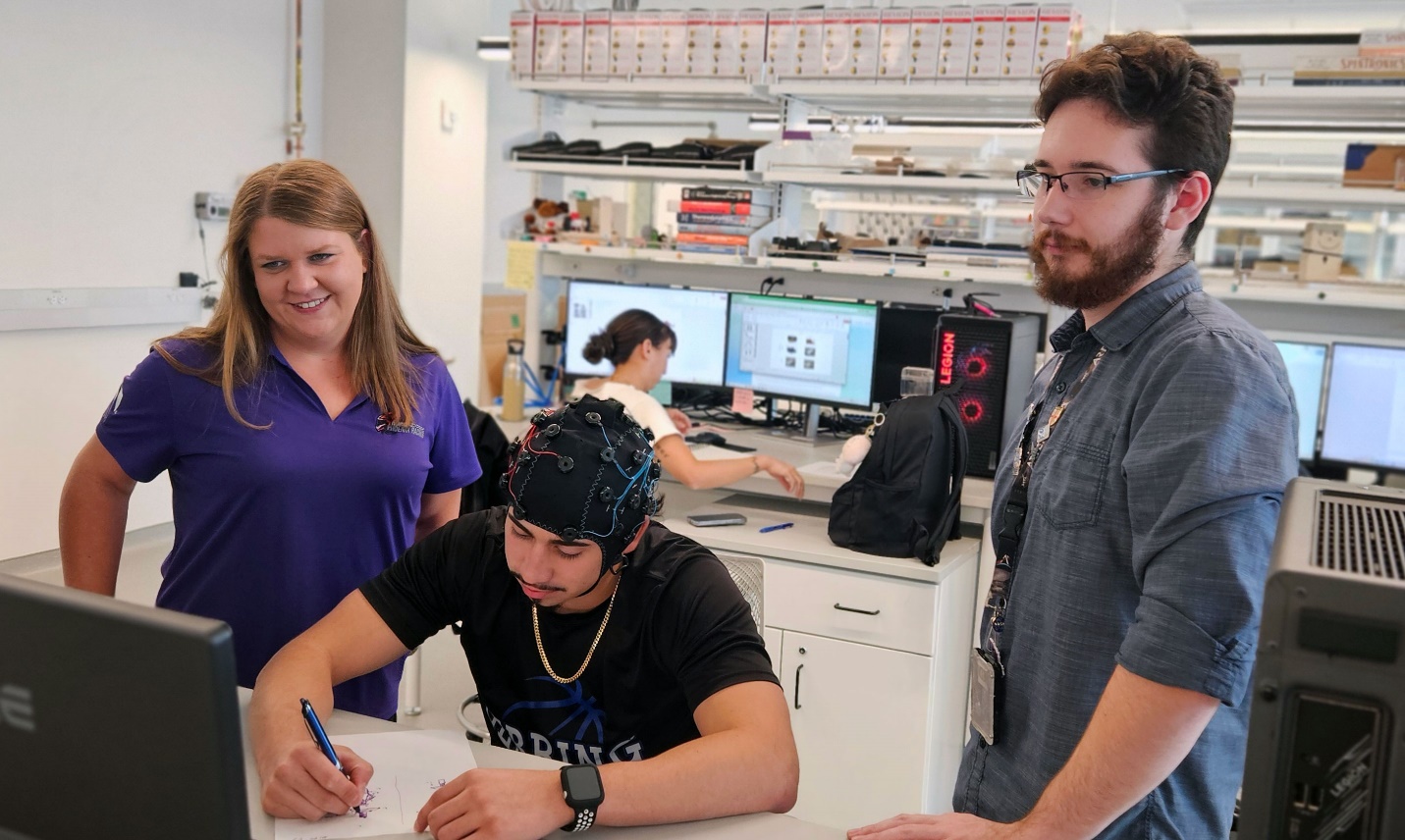
The grant, landed by Assistant Professor Elisabeth Kames, will enable her to study how students cognitively engage with engineering design challenges. The research will use neurocognitive tools, such as electroencephalography (EEG), and traditional self-assessment tools to learn more about student problem-solving and learning behavior.

The results will help professors better understand how students engage with open-ended problems and improve teaching strategies within the field.

“The goal is to inform instructional practices within Florida Poly, strengthen our design sequence, and also apply the findings nationwide to better prepare students for the complex challenges they’re going to face in industry,” Kames said. “This will add a new dimension to how we understand and teach engineering design.”

Currently, the traditional curriculum is structured so that students find a correct solution to a problem. But the engineering design curriculum is different because it does not have a predetermined correct answer. Instead, students must work through open-ended challenges to reach their own solutions.

“Examining different approaches to get students to understand what they’re doing, why they’re doing it, and be more cognizant of the steps they’re taking while they’re navigating this process, is a reason why we’re pursuing this research,” Kames said.

The study will include more than 200 engineering students who will wear specialized caps with electrodes placed at precise positions. The caps will measure electrical activity in students’ brains as they work to solve multiple engineering design problems.

“We will have data from a student’s entire session, and we can correlate specific brain patterns with student engagement during different stages of the design process, examining varying types of design problem representation,” Kames said.

Kames won’t be conducting the research alone; she’ll have help from a graduate student and two undergraduate students who will assist in analyzing brain activity data during different tasks and determining which part of the brain is active, along with the functions it controls. The student researchers will also review students’ reflective self-assessment.

“I’m very passionate about this work, so having the resources available to conduct it and disseminate my results is very exciting,” Kames said. “I’m thankful to the National Science Foundation, its Division of Civil, Mechanical and Manufacturing Innovation, and Engineering Design and Systems Engineering program for their generous support of my research.”


Post Views: 0


Source link

Continue Reading

Politics

Senate panel advances bill establishing task force to propose e-bike regulations

Published

on


A Senate bill proposing more regulations on e-bikes and scooters is gaining traction, though with some modifications.

The Senate Transportation Committee unanimously approved a measure (SB 382) sponsored by Sen. Keith Truenow, a Tavares Republican, that calls for increased regulation and data collection on e-bikes and scooters. Those devices have grown in popularity in recent years, with more accidents involving the devices occurring as well.

In the committee meeting, Truenow said he provided a strike-all amendment to revise his original draft of the bill.

“As we know it’s been a fad for a lot of reasons,” Truenow said of the growing popularity of e-bikes. “They’re causing more and more problems.”

He said his original draft called for an increase in enforcement of e-bikes and scooters. But he acknowledged that, as the original bill was scrutinized, stakeholders worried provisions in the original proposal “would be difficult to accomplish.”

A major amendment calls to establish an “electric bicycle task force.” Truenow said the issue of e-bikes in particular needs thorough study before enforcement stipulations are settled.

“The purpose of the task force is to examine and recommend improvements to state law and regulatory framework governing electric bicycles in order to encourage the safe operation of electric bicycles and to prevent traffic incidents, injuries, and fatalities involving such bicycles,” the bill states.

The Electric Bicycle Safety Task Force would collect data on e-bike and scooter accidents, provide recommendations on enforcement, and submit a report to the Florida Department of Highway Safety and Motor Vehicles. The e-bike task force would be composed of representatives of law enforcement, the e-bike industry and other “stakeholders,” and will be charged with completing its report in the Fall.

The amended bill still calls for e-bike operators to be restricted “above a certain speed limit.” Truenow said, at least initially, he would like to see speeds capped at 10 mph on sidewalks, trails and pathways.

But Sen. Shevrin Jones, a Miami Gardens Democrat, wondered how that speed limit would be enforced.

Truenow acknowledged that would have to rely on “best judgment,” and it’s doubtful that radar detector devices would be readily available in pedestrian areas.

Other members of the committee wondered if increased enforcement of e-bikes and scooters would reduce access to easy and affordable transportation for some Florida residents who rely on them.

“We’re not seeing the problems coming from those folks,” Truenow said, noting that more rowdy operators and “YouTubers” are the main target of increased enforcement, which would ultimately result in a noncriminal infraction.

Republican Rep. Yvette Benarroch is sponsoring a similar bill in the House (HB 243). That bill has three committee stops ahead.

E-bikes have been increasing in presence on roads, especially in the Sunshine State, where tourist-rich areas are seeing a striking rise, with accidents increasing as well.

Some local governments have already enacted some e-bike regulations. The Palm Coast City Council passed an ordinance in October that makes it illegal for owners of the vehicles to modify the battery-powered engines to exceed 30 mph, along with other stipulations.

The St. Johns County Commission passed a resolution in August to join forces with the Sheriff’s Office and the St. Johns County School District to promote more awareness and safety for the operators of e-bikes, e-scooters and other electronic motorized devices.


Source link

Continue Reading

Politics

Ola Hawatmeh’s CD 19 campaign notches endorsement from ‘MAGA Meg’ Weinberger

Published

on


Small-business owner Ola Hawatmeh’s bid to succeed fellow Republican Byron Donalds in Florida’s 19th Congressional District is getting a boost from one of South Florida’s most prominent Donald Trump-aligned state lawmakers.

Palm Beach Gardens state Rep. Meg Weinberger, dubbed “MAGA Meg” for the support she has given, and received from, Trump and his supporters, just threw her political influence behind Hawatmeh’s CD 19 campaign.

She believes Hawatmeh, a health and wellness entrepreneur, is most likely to win in November and keep the U.S. House in GOP hands post-Midterms.

“With Republicans needing to keep their slim majority in the U.S. House of Representatives,” Weinberger said in a statement, “we need more loyal America First Republicans like Ola to help President Donald Trump continue defending our God-given American freedoms and liberties.”

Hawatmeh, whose X page heavily features posts supporting Trump and Weinberger, also carries an endorsement from economist and Trump policy adviser Stephen Moore.

Hawatmeh said in a statement that she is “honored” to have Weinberger’s endorsement.

“Meg understands how important it is to help President Donald J. Trump retain the narrow Republican majority in the House of Representatives with true America First candidates,” she said.

Hawatmeh is running in a crowded Republican Primary to replace Donalds, the GOP front-runner in Florida’s gubernatorial race. Others competing for the party nomination include former U.S. Rep. Madison Cawthorn of North Carolina, Stephen Elliott, Johnny Fratto, Dylan Modarelli, former Illinois state Sen. Jim Oberweiss, Mike Petersen and Jim Schwartzel.

Democrat Howard Sapp, a longtime community leader in Fort Myers, has been running unopposed for his party’s nomination since February 2025.

CD 19 covers a swath of Southwest Florida spanning large parts of Charlotte, Collier, Glades, Hendry, Lee and Sarasota counties. Cities in the district include Bonita Springs, Cape Coral, Fort Myers, Fort Myers Beach, Marco Island, Naples and Sanibel.

The district leans heavily Republican, with a Cook Partisan Voting Index of R+14.


Source link

Continue Reading

Politics

Joe Gruters bill restricting public pot smoking clears first Senate stop

Published

on


A proposal that would ban smoking and vaping marijuana in public places has cleared its first Senate committee stop.

The Senate Regulated Industries Committee voted to advance a bill (SB 986) sponsored by Sarasota Republican Sen. Joe Gruters to amend the Florida Clean Indoor Air Act to prohibit smoking or vaping marijuana products in public places. The measure was presented to the committee by Doral Republican Sen. Ana Maria Rodriguez, the bill’s co-sponsor, on Gruters’ behalf.

“There is currently no prohibition on smoking marijuana in public places if adult use is approved by the voters,” Rodriguez told the committee. “By banning public smoking of marijuana, we are protecting community health and quality of life, as well as protecting certain outdoor spaces from marijuana smoke such as beaches and parks.”

Rodriguez told the committee that every state allowing recreational marijuana either bans public smoking outright or imposes tight restrictions on where it can occur. SB 986 would prohibit smoking or vaping marijuana in public places, while also folding marijuana into Florida’s existing Clean Indoor Air Act framework.

The bill defines public places as streets, sidewalks, parks, beaches and common areas of apartment buildings, restaurants, retail shops, transportation facilities and government buildings. It does not change Florida’s ban on smoking tobacco in enclosed indoor workplaces.

The Florida Restaurant & Lodging Association spoke in support of the bill’s intent but raised concerns about how the definition of “public places” could affect private property.

“We support adding vaping and marijuana to the provisions of the Florida Indoor Clean Air Act,” association Vice President of Government Relations Samantha Padgett said.

However, she said restaurants and hotels worry the bill could interfere with designated smoking areas created in compliance with existing law. Padgett said many businesses made significant investments to comply with current statutes and urged lawmakers to preserve that flexibility as the bill moves forward.

“This gives all employers the freedom to ensure a smoke-free environment in their places of employment,” she said. “We have received feedback of concern from our members regarding the definition of smoking in designated spaces on private property such as patios and designated hotel rooms or floors.”

Meanwhile, medical marijuana advocates argued the bill could have unintended consequences for patients. Jody James, speaking on behalf of the Florida Cannabis Action Network, said the proposal is overly broad and could limit lawful access for medical marijuana patients, particularly those living in apartment complexes or staying in lodging where indoor smoking is prohibited but outdoor smoking is permitted.

James also raised concerns that the bill’s definition of public places could blur the line between public and private property, potentially affecting patients smoking just outside their homes.

“We understand the problems of having people smoking everywhere, but we also hope that you’ll consider patients and property rights in this discussion,” James said. 

Committee members questioned whether the bill could inadvertently sweep in activities such as non-tobacco hookah use or vaping on private property. Rodriguez said the bill does not target marijuana use so tightly that it should affect a person smoking outdoors near their homes, or other extreme interpretations of the law.

“There is a difference between someone’s front door and a public place where the general public can gather, whether it’s a restaurant, whether it’s in a park or a beach,” Rodriguez said. Your house is your dwelling, and the front door of your house is not the same as being in a public place.”

The committee voted to report SB 986 favorably. The bill will now head to its second of three committee stops with the Senate Appropriations Committee on Agriculture, Environment, and General Government.


Source link

Continue Reading

Trending

Copyright © Miami Select.