Connect with us

Politics

Floridians are cutting back on alcohol as health-concerned drinkers seek alternatives
Published

on


Florida adults are drinking less alcohol than they did a decade ago, reflecting a broader national trend of declining alcohol use and rising concern about its health risks.

A new analysis by food and beverage compliance firm Trace One, drawing on federal data, found that the share of Sunshine State adults who reported drinking alcohol in the past month fell from a peak of 58.8% in 2015 to 52.6% in 2023.

Between 2013 and 2023, Florida’s adult drinking rate dropped by 2.7 percentage points, which was notably less than the national decrease of 4.1 points. But when measured from each state’s peak year, Florida’s 6.2-point drop outpaced the national 4.4-point decline, suggesting that Floridians are moving away from alcohol more sharply since the highest point of consumption.

The trend coincides with findings from Gallup’s annual “Consumption Habits” survey, conducted July 7-21, which found that only 54% of U.S. adults drink alcohol — the lowest level Gallup recorded in its nearly 90 years of operation.

Trace One used the Substance Abuse and Mental Health Services Administration’s annual state estimates of past-month alcohol use among adults, identified peak-use years and calculated changes to 2023. A 10-year comparison (2013-2023) was also conducted, with all changes tested for statistical significance at the 90% confidence level.

Gallup surveyed 1,015 U.S. adults living in all 50 states and Washington, D.C., by phone. The poll had a 4-point margin of error at the 95% confidence level.

Florida ranks 24th among all states in terms of reduced alcohol use from the peak year, but it is among the lowest in terms of the 10-year change.
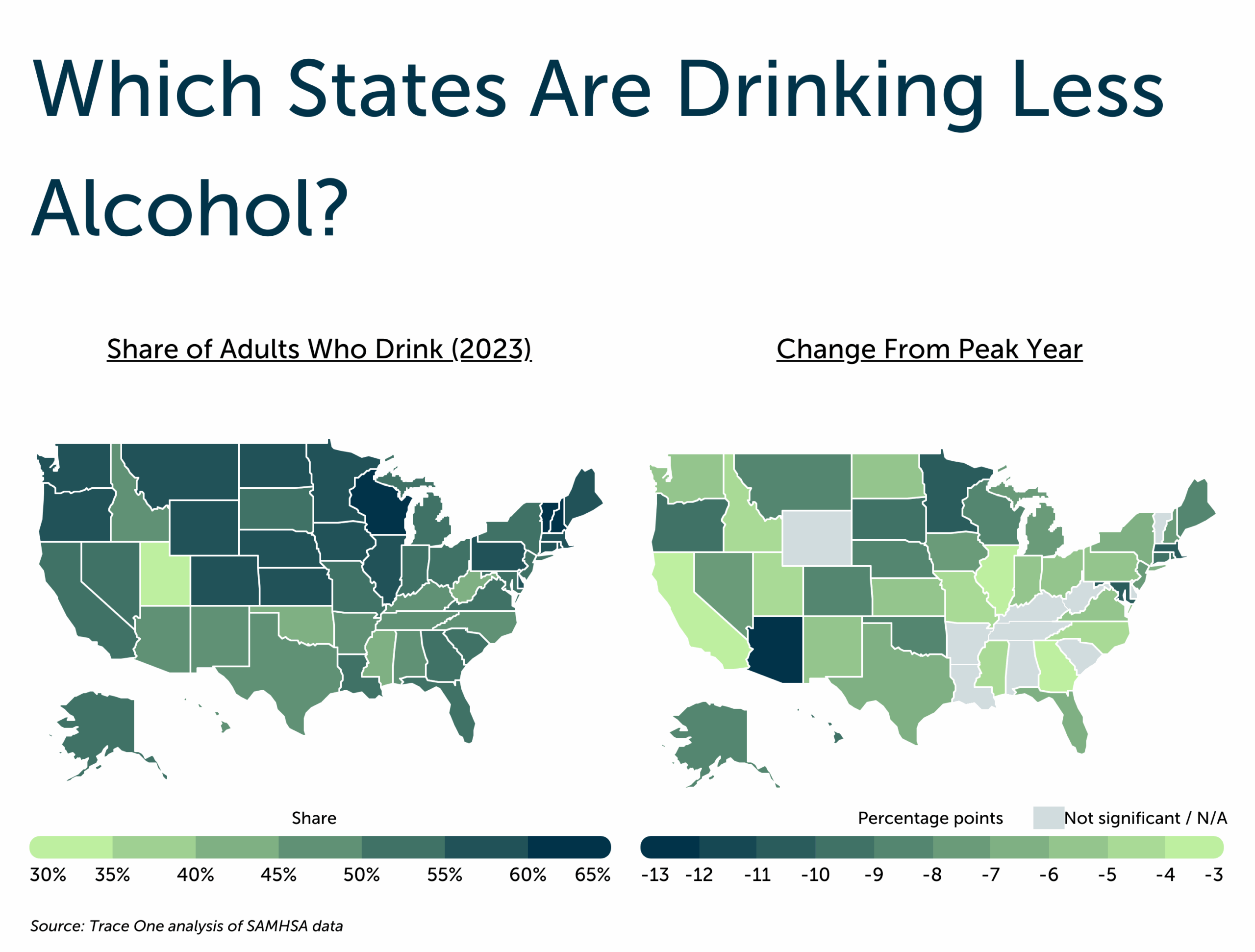
Image via Trace One.

Gallup found a majority (53%) of U.S. adults now believe even moderate drinking is bad for health, a sharp reversal from past decades when moderate alcohol was sometimes touted as beneficial.

There’s been a marked change in use along political lines. In 2023, 65% of Republicans, 64% of Democrats and 61% of independent voters told Gallup they drank alcohol. By this year, Republican alcohol use dropped to 46% — a sizable, 19-point difference, compared to the use rates of 55% for independents (-6 percentage points) and 61% for Democrats (-3 percentage points).

Those who still imbibed reported drinking less, with a record-low 24% of drinkers saying they consumed an alcoholic beverage within the past day and 40% saying it had been more than a week since their last drink, the highest percentage since 2000.

“Factoring in all drinkers, including those who did not drink in the past week, the average number of drinks consumed over the past seven days is 2.8, the lowest figure Gallup has recorded since 1996,” Gallup pollsters wrote.

“This is down from 3.8 drinks a year ago and closer to 4.0 drinks over the seven years prior to that. The highest average number since Gallup has tracked this is 5.1 drinks per week, recorded in 2003.”

Medical research has increasingly linked alcohol to serious health problems. The Centers for Disease Control and Prevention (CDC) warns that excessive alcohol use contributes to liver disease, heart problems, cancer, injuries and premature death.

Alcohol-related mortality in Florida has risen in recent years, with the CDC ranking the state third nationally last year for deaths tied to liver disease and cirrhosis.

Despite the decline in drinking overall, Americans who do drink still favor beer, followed by liquor and wine, Gallup found. Men are far more likely than women to prefer beer (52% vs. 23%), while women lean toward wine (44% vs. 14%). Liquor is about equally popular, at around 30% for both sexes.

At the same time, alcohol alternatives are booming. Trace One’s analysis of Google Trends shows searches for non-alcoholic beer, zero-proof spirits and mocktail recipes have surged over the past decade.
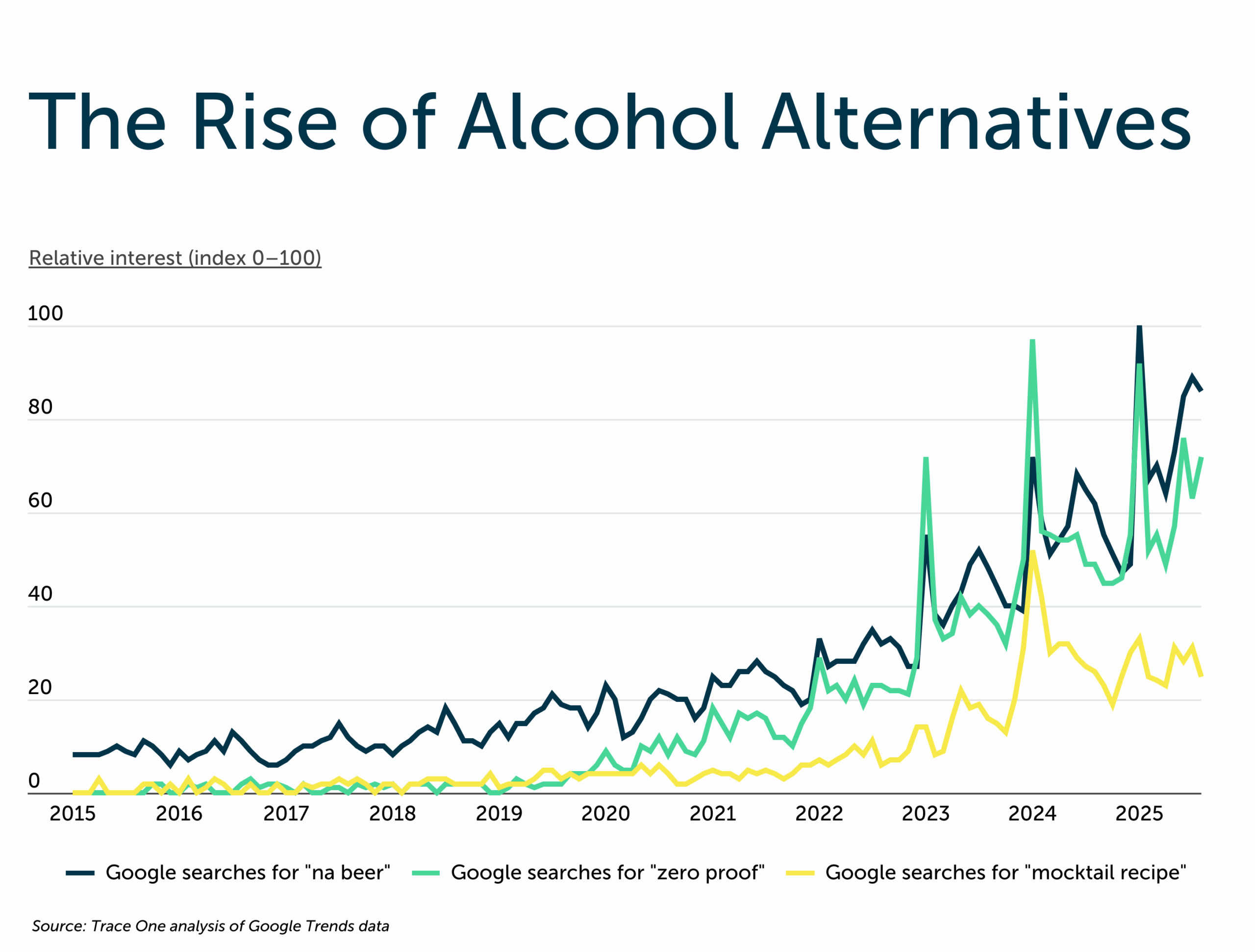
Image via Trace One.

And consumer interest is no longer niche, as evidenced by brands like Budweiser, Heineken, Guinness, Michelob and Stella, among many others, rolling out non-alcoholic versions of flagship products to sit alongside non-alcoholic brands like Athletic Brewing and O’Doul’s.

Spirits companies are also investing in zero-proof gin, whiskey and tequila alternatives, while other options — including cannabis-infused beverages — are growing in popularity.

According to the International Wine and Spirits Record, no-alcohol beverage volumes rose 29% in 2023, well ahead of the 7% growth seen in low-alcohol products. No-alcohol beer and cider servings, which make up 81% of all servings, jumped 30%, while ready-to-drink non-alcoholic subtypes surged 36%, zero-proof spirit sales rose 32% and alcohol-free wine increased 18%.

Alcohol-adjacent products known as “functional beverages,” including drinks containing a mood enhancer or supplementation like CBD/THC, nootropics or adaptogens, grew by 15% in 2023, a report from the Colorado-based Auguste Escoffier School of Culinary Arts said.

“The growing availability of these products reflects a broader shift: alcohol alternatives are no longer seen as an afterthought for the sober or ‘designated driver,’ but as a legitimate category catering to a much wider audience,” Federico Fontanella of Trace One wrote.

Notably, while most states saw large drops in alcohol use, there is a regional outlier. Trace One found that several Southeastern states, which tend to drink less overall, generally saw little to no statistically significant change from their peak years.

“Alabama, Arkansas, Kentucky, Louisiana, South Carolina, and West Virginia all report stable rates,” Fontanella wrote, “indicating that alcohol consumption in much of the region has held steady even as other parts of the country have experienced notable declines.”


Post Views: 0


Source link

Continue Reading

Politics

Stacy Hahn files to challenge GOP incumbent Donna Cameron Cepeda in Hillsborough Commission race

Published

on


Republican Hillsborough County School Board member Stacy Hahn has filed to run for the Hillsborough County Commission, challenging another Republican in a gambit for the countywide District 5 seat.

Hahn, who has served on the Hillsborough County School Board since 2018, announced her candidacy by citing her experience with the School District as evidence of her fiscal responsibility and belief in limited government.

The countywide District 5 seat is currently held by incumbent Republican Commissioner Donna Cameron Cepeda, who won election in 2022 as part of a broader GOP sweep that flipped control of the Hillsborough County Commission

The race is already drawing significant attention, with well-funded Democratic challenger Neil Manimala also vying to claim the seat. Manimala has a significant lead in funds raised, with his campaign already reporting more than $121,000 compared to $6,000 raised by Cepeda, according to Supervisor of Elections records. Hahn has not yet been required to submit a funding report.

Hahn described herself as a conservative who supports limited government and fiscal discipline, arguing that government is most effective when it empowers individuals, families and businesses rather than expanding bureaucracy.

In a statement, Hahn said her time on the School Board gave her a firsthand view of how county-level decisions affect classrooms, neighborhoods and the local economy, touching on issues such as public safety, infrastructure, housing affordability and budgeting.

“As a School Board member, I worked closely with families, educators, and community partners, and I saw firsthand how county decisions impact our classrooms, neighborhoods, and local economy — from public safety and infrastructure to housing affordability and responsible budgeting,” Hahn said.

“Hillsborough County is a unique and beautiful place with tremendous potential. To unlock that potential, we need common-sense leadership at the County Center — leaders who are focused on improving quality of life for every neighborhood, supporting local businesses, and being responsible stewards of taxpayer dollars.”

First elected to the School Board in 2018, Hahn has focused her tenure on financial transparency, literacy initiatives, workforce and career pathways, and early childhood education. She has pointed to her oversight of the School District’s roughly $4.4 billion budget and management of the county’s largest employer as preparation for the demands of county government, saying that experience helped her balance budgets, manage growth and deliver results.

Hahn has also been involved in a range of community and nonprofit efforts, including literacy- and STEM-focused programs, according to her campaign materials. She lives in Tampa with her husband, Jeff, their three children, Ethan, Jackson and Aidan, and their dog Rocky.

Hahn said she is “excited about the work ahead and the opportunity to serve.”


Source link

Continue Reading

Politics

Senate panel advances bill establishing task force to propose e-bike regulations

Published

on


A Senate bill proposing more regulations on e-bikes and scooters is gaining traction, though with some modifications.

The Senate Transportation Committee unanimously approved a measure (SB 382) sponsored by Sen. Keith Truenow, a Tavares Republican, that calls for increased regulation and data collection on e-bikes and scooters. Those devices have grown in popularity in recent years, with more accidents involving the devices occurring as well.

In the committee meeting, Truenow said he provided a strike-all amendment to revise his original draft of the bill.

“As we know it’s been a fad for a lot of reasons,” Truenow said of the growing popularity of e-bikes. “They’re causing more and more problems.”

He said his original draft called for an increase in enforcement of e-bikes and scooters. But he acknowledged that, as the original bill was scrutinized, stakeholders worried provisions in the original proposal “would be difficult to accomplish.”

A major amendment calls to establish an “electric bicycle task force.” Truenow said the issue of e-bikes in particular needs thorough study before enforcement stipulations are settled.

“The purpose of the task force is to examine and recommend improvements to state law and regulatory framework governing electric bicycles in order to encourage the safe operation of electric bicycles and to prevent traffic incidents, injuries, and fatalities involving such bicycles,” the bill states.

The Electric Bicycle Safety Task Force would collect data on e-bike and scooter accidents, provide recommendations on enforcement, and submit a report to the Florida Department of Highway Safety and Motor Vehicles. The e-bike task force would be composed of representatives of law enforcement, the e-bike industry and other “stakeholders,” and will be charged with completing its report in the Fall.

The amended bill still calls for e-bike operators to be restricted “above a certain speed limit.” Truenow said, at least initially, he would like to see speeds capped at 10 mph on sidewalks, trails and pathways.

But Sen. Shevrin Jones, a Miami Gardens Democrat, wondered how that speed limit would be enforced.

Truenow acknowledged that would have to rely on “best judgment,” and it’s doubtful that radar detector devices would be readily available in pedestrian areas.

Other members of the committee wondered if increased enforcement of e-bikes and scooters would reduce access to easy and affordable transportation for some Florida residents who rely on them.

“We’re not seeing the problems coming from those folks,” Truenow said, noting that more rowdy operators and “YouTubers” are the main target of increased enforcement, which would ultimately result in a noncriminal infraction.

Republican Rep. Yvette Benarroch is sponsoring a similar bill in the House (HB 243). That bill has three committee stops ahead.

E-bikes have been increasing in presence on roads, especially in the Sunshine State, where tourist-rich areas are seeing a striking rise, with accidents increasing as well.

Some local governments have already enacted some e-bike regulations. The Palm Coast City Council passed an ordinance in October that makes it illegal for owners of the vehicles to modify the battery-powered engines to exceed 30 mph, along with other stipulations.

The St. Johns County Commission passed a resolution in August to join forces with the Sheriff’s Office and the St. Johns County School District to promote more awareness and safety for the operators of e-bikes, e-scooters and other electronic motorized devices.


Source link

Continue Reading

Politics

Ola Hawatmeh’s CD 19 campaign notches endorsement from ‘MAGA Meg’ Weinberger

Published

on


Small-business owner Ola Hawatmeh’s bid to succeed fellow Republican Byron Donalds in Florida’s 19th Congressional District is getting a boost from one of South Florida’s most prominent Donald Trump-aligned state lawmakers.

Palm Beach Gardens state Rep. Meg Weinberger, dubbed “MAGA Meg” for the support she has given, and received from, Trump and his supporters, just threw her political influence behind Hawatmeh’s CD 19 campaign.

She believes Hawatmeh, a health and wellness entrepreneur, is most likely to win in November and keep the U.S. House in GOP hands post-Midterms.

“With Republicans needing to keep their slim majority in the U.S. House of Representatives,” Weinberger said in a statement, “we need more loyal America First Republicans like Ola to help President Donald Trump continue defending our God-given American freedoms and liberties.”

Hawatmeh, whose X page heavily features posts supporting Trump and Weinberger, also carries an endorsement from economist and Trump policy adviser Stephen Moore.

Hawatmeh said in a statement that she is “honored” to have Weinberger’s endorsement.

“Meg understands how important it is to help President Donald J. Trump retain the narrow Republican majority in the House of Representatives with true America First candidates,” she said.

Hawatmeh is running in a crowded Republican Primary to replace Donalds, the GOP front-runner in Florida’s gubernatorial race. Others competing for the party nomination include former U.S. Rep. Madison Cawthorn of North Carolina, Stephen Elliott, Johnny Fratto, Dylan Modarelli, former Illinois state Sen. Jim Oberweiss, Mike Petersen and Jim Schwartzel.

Democrat Howard Sapp, a longtime community leader in Fort Myers, has been running unopposed for his party’s nomination since February 2025.

CD 19 covers a swath of Southwest Florida spanning large parts of Charlotte, Collier, Glades, Hendry, Lee and Sarasota counties. Cities in the district include Bonita Springs, Cape Coral, Fort Myers, Fort Myers Beach, Marco Island, Naples and Sanibel.

The district leans heavily Republican, with a Cook Partisan Voting Index of R+14.


Source link

Continue Reading

Trending

Copyright © Miami Select.